Best of DC: Week of October 30th, 2019

Best of this Week: Tales from the Dark Multiverse – The Death of Superman – Jeff Loveness, Brad Walker, Drew Hennessey, Norm Rapmund, John Kalisz and Clayton Cowles

We all know the story of the Death of Superman.

It was one of the few times that Superman fought a threat that pushed him to his limits, ultimately meeting his “end” before a triumphant return after he had been presumed dead. However, what would have happened had Superman not come back as soon as he did? What if someone wanted revenge for his death and saw his passing as a failure on the part of his friends and allies? What if that person were Lois Lane, fueled by the anger of losing her loving husband, enraged enough to become the change the world needed without its greatest hero?

The book begins with Tempus Fuginaut questioning why the darkness keeps returning, why it seems to keep attempting to poison the rest of the multiverse and he is at a loss. He breaks when he mentions worlds that are already dark because of tragedy and get darker still. We then cut to Superman’s battle with Doomsday and his eventual death right up to Lois cradling his body. Where the original story sees her crying and appreciating all that the rest of the heroes were doing while the fight was going on, this book sees her turn to them in fury. She asks why none of them were there for him, why none of them helped him fight.

Brad Walker does an excellent job of conveying Lois’ emotions. Here, she is shown to be far more angry, her eyes showing a pain that honestly, I don’t think we’ve ever seen from her character. Her tears are well detailed, dripping down her cheeks with maybe some bit of mascara mixed in for effect. Her brow furrows and she lashes out at Batman in particular once he tries to comfort her.  

What’s most interesting about this take is the idea that those closest to Clark had been shunted to the side in favor of the League who Lois saw as attention seekers with no regard for his real family. In the original story, Lois and the Kents were in the forefront and were absolutely devastated at the funeral. In this story, Lois is barely able to see the proceedings as the crowd blocks her and some members of the League stop for photos (maybe, Hal Jordan stops and waves at someone). Lois is further disgusted as Lex Luthor (with luxurious long, red hair) unveils a golden statue of the Man of Steel and promises to “live up to the hope” of what Superman believed humanity was capable of. Lois feels that Clark would have found it all s disgusting.

Time goes by and the world turns back into the cesspool that it was before Superman even lit the sky up with hope. There are headlines that crime has skyrocketed and Lois can do nothing but look at it all with despair. Lois Lane had always been a giant beacon of hope, even before she met Clark, but something about his death and the way that world handled it just broke her. Her body language at her desk and later, Superman’s grave give off heavy feelings of sadness and depression. She can’t even have a good night’s rest without thinking about him and the shoddy state of the world after his passing. Superman gave so much to humanity and they’ve all just pissed it away from her point of view.

She visits Ma Kent and comforts her as the Kents couldn’t even go to their son’s funeral to say their goodbyes. As they embrace, Martha tells Lois that Jonathan fell into a coma after a heart attack and you can feel her brokenness as she laments that “her boys are gone.” It rips at the heart to see, a testament to Brad Walker’s emotional art and Loveness’ amazing script. She stays with Ma Kent for an unstated period of time before making her way to the Fortress of Solitude to deliver Superman’s cape back to his Kryptonian home. 

She puts herself in a fetal position before the statues of Jor-El and Lara Lor-Van and suddenly the form of Eradicator appears before her. John Kalisz is given a ton of space to shine as this is one of the most visually dynamic sequence of pages in the book. Eradicator shimmers with a bright and vibrant shade of red accentuated by a white form. Energy surges around him in the form of circular marks, like bubbles as one exhales while swimming underwater. Even without a mouth, his eyes emote for him. Showing his own anger and lament after failing to save Superman in time. 

Lois, with tears in her eyes, offers her body as a vessel for his power as he cannot sustain it in his current form. He is reluctant at first, thinking that her body wouldn’t be able to take it, but upon seeing her resolve and want to finish Superman’s mission, he allows her to take his power. She is then showered in his energy in a bright blast as he dissipates into her. The Fortress of Solitude is destroyed with the red of the explosion contrasted by the blues and whites of the ice. Things simmer down for a moment before another single beam of light shoots out from the ice, revealing Lois in her Super-form. 

Her costume is amazing. Mirroring the bloody logo that made the Death of Superman story feel so visceral, she already feels like a different “hero” altogether, choosing to forego bright colors in favor of a black bodysuit and Superman’s torn cape. She vows to make the world better, to make it a world that deserved Superman. The way that she goes about it very similar to Injustice Superman’s approach, but instead of raising an army, she is the army. She takes down predatory banks, ends wars, feeds the hungry, kills the corrupt and does so without a hint of remorse. She begins to wonder why Clark never used his power in that way. The questions swirl around her mind as she wonders if Clark was truly naive or if he was just afraid of truly Saving humanity for whatever reason.

Many have asked similar questions over the years with the only real answer being that Superman wants humanity to advance on their own with him being a guiding hand, but not a firm one. Lois, only fueled by revenge, doesn’t have the same restraint. Eventually she finds Lex Luthor, knowing that he’s been the cause of all of the world’s troubles since Superman’s death. He doesn’t bat an eye as he admits to his heinous crimes; funding wars and conflicts, struck down climate regulations, created child soldier and even murdering his secretary just because he could. He expects Lois to bring him to justice, claiming that he owns far more judges than she could stop.

In a terrifying moment, she bursts through the glass window separating them and grabs him by the throat. Luthor is unable to speak, unable to stop her at all and the motif of tears continues as she tells him that Superman was Clark Kent. Luthor’s face, abject terror mixed with the loss of breath is both horrifying to see and absolutely gratifying considering his actions. She flies him past Earth’s atmosphere as quickly as she can, burning him to ash and bone in her hands before continuing her mission.

These are my favorite pages in the book. Loveness wrote it in such a way that all of the emotion is able to be carried by with little dialogue and the few words that are spoken were powerful. Walker made sure to draw these pages with an amazing amount of depth to them. Lois’ boiling anger is painted on her face through her tears, her body language indicates that she feels her actions are righteous and the ease that she’s able to keep hold of Luthor as she destroys him shows a level of control over her new powers and it is amazing. Kalisz makes no bones about showing how Lois’ inner darkness has taken over, showing her shrouded in fire and feeling nothing about what she has done.

The training wheels are taken off by this point as Lois has seemingly gone on a tear through the rogues gallery of almost everyone; burning Intergang, Cadmus, Ra’s al Ghul, Ares, Black Adam, Deathstroke and finally the Joker which draws the ire of Batman. He confronts her about what she’s done, leading to them having a fight. Batman does his best, but she tells him how much Clark actually held back against him, even going so far as to say that Clark pitied him and wished that he would stop being Batman. Bruce looks at her with a seething rage, saying that “he doesn’t stop” to which Lois says that she knows. While we don’t see the aftermath of their conflict up close, we do see her heat vision make a hug blast before she flies away.

This stuck out to me because, unlike Injustice that went out of its way to show all of the brutality that Superman inflicted upon the heroes of the world, we can interpret similar actions from how she was able to easily kill Batman alone. We don’t need to see what happened to know that it was heinous and that she likely had cut a swath through the other “glory hounds” as well. As she looks out to the vast emptiness of space, she sees her own truth. Humanity can’t be saved because they don’t want to be. Batman was the pinnacle of that and now that he’s gone, she’s finally realized it. Batman was one of the greatest humans to exist, but he was too wrapped up in his own emotion and damn anyone that tried to stop him.

What would a Death of Superman retelling be without the “pretenders?” Granted, I think this bit of the story took some liberties, but it was still horrific to see. She goes after Cyborg Superman and immediately sees through his ruse. They have a tussle and as it appears that she’s about to lose, Steel and Superboy show up only to be crushed and heat visioned to death. I suppose Superboy’s clone DNA doesn’t make him as invincible as Superman, but I don’t think Cyborg Superman has the power to control metal at will to crush Steel either. Lois proceeds to fight Cyborg Superman for God knows how long, not caring about property damage or the amount of people killed.

She looks around, seeing all of the damage and suddenly, in a black suit, Clark returns. He apologizes for how long it took and sees that she’s been fighting Cyborg Superman, then he takes a look at the crowd of people and sees that they’re afraid of her and he questioned why. Unfortunately, this leaves him distracted enough for Cyborg Superman to blast the pair with a ray of Kryptonite Energy, killing him and leaving his face frozen with terror at Lois. She kills Cyborg Superman and cradles his body again, this time knowing that she’s the one that kills him.

I loved this book because it was absolutely masterful. Lois Lane is such a great character that rarely gets stories of her own these days, aside from her current ongoing series by Greg Rucka and Mike Perkins. She is always portrayed as a strong character and seeing her succumb to a weakness like rage is refreshing in a dark way. One criticism I could draw is that this story focused very little on her journalism, but in contrast, how often do we get a super powered Lois Lane? 

Brad Walker, Drew Hennessey, Norm Rapmund and John Kalisz absolutely killed it in the art department. It was brutal without blood and the motif of tears and fire was a nice addition. Waller has such a distinctive and sharp style that is accentuated by Hennessey and Rapmund’s inks and elevated by Kalisz’ colors. This book was high quality and beautiful. 

High recommend!

Best of DC: Week of October 23rd, 2019

Best of this Week: Batman: Curse of the White Knight #4 – Sean Murphy, Matt Hollingsworth and AndWorld Design

A Darkness has fallen over Gotham. 

Jim Gordon has always been one of the most trustworthy police officers in the cesspool known as Gotham City. Under his tenure as Commissioner, he cleaned up Gotham PD as much as he possibly could, brought up great officers like Harvey Bullock and Renee Montoya and even formed a long lasting partnership with Gotham’s protector, Batman. His role gained him allies and enemies alike and he put his life on the line every day he out a badge on.

Unfortunately for him, his number came in the last issue when Azrael impaled him with his sword, leaving him for dead in an alley for Batman and the Gotham PD to see. This issue follows what happens immediately after.

Gordon is rushed to the hospital and the doctors do their very best to keep him alive. The shots are tense and heartbreaking as we get no dialogue except for the words of the flashback that occurs simultaneously. Barbara is frantic, pushing through Renee and Harvey Bullock. We don’t hear what she’s saying, but her pain is palpable. She doesn’t have the cool calmness she maintained as Batgirl, she’s just a girl terrified of losing her father.

As the doctors use their defibrillators, Gordon flat lines and Barbara doesn’t even acknowledge Batman as she runs into the night, tears in her eyes. Interspersed between the operation are panels showing a flashback between Barbara and Jim. It acts a bit of foreshadowing as Jim tells Barbara to fight back and hit harder after she tells him that a boy bullied her at school. These two scenes play out in perfect opposition to each other.

Murphy is really good at Panel to Panel storytelling and conveys the happiness and absolute destruction with little dialogue, body language and facial expressions. He wants you to feel the despair that Barbara feels. Pulling in close to Gordon’s short breaths as she bangs on the window in the background as he kisses her little forehead in the next panel, it’s almost too much.

Hollingsworth colors the operation scenes with cool colors, making everything seem sterile aside from the blood on Gordon’s chest. It’s bleak and lacks the warmness of the muted pink/purple hue of the flashback. Murphy also does his best to depict how much Jim meant to Barbara by showing her childhood innocence and happiness opposite the fear that she faces as an adult. Barbara is absolutely devastated by what happens to her father and later on, it will drive to her make a reckless decision that will change her life forever.

Tensions are high when the Gotham Terrorism Oppression (GTO) unit meets in the aftermath of Gordon’s death. Barbara blames Batman and calls him a coward for operating in the shadows while her father stood at the forefront. Dick Grayson wants to console her, but Renee tells him to stay focused and when he tries to question her authority, she snaps that Jim put her in charge before his death.

Bruce leaves in the middle of the GTO’s planning, frustrating Renee as she gets a taste of what Gordon dealt with for years. He goes to visit Leslie Thompkins who’s taking care of Harleen Quinzel after she’s given birth to twins. They converse and Leslie reveals to Bruce that she and Alfred had known about the journal of Edmond Wayne.

What’s interesting about this section is the manner in which they retrieved it. Shortly after Bruce had put on the cowl, Alfred and Leslie found a letter addressed to Bruce and Batman, telling them to go to the oldest part of Gotham. The scene is drawn and colored in a style reminiscent of what I think of when I hear Victorian Era England. There’s a lot of smoke, greys, muted colors and vibrant yellows from lamps and fire. The building they enter is very old timey and they meet someone surprising upon their arrival.

While his name is never stated, I believe the Librarian of the New Order of St. Dumas to be Jason Blood. He maintains Blood’s red hair with a white streak and his brazenness when speaking to Alfred and Leslie and his lack of care when Alfred  levels a rapier to his throat is characteristic of a man that has lived for centuries and the knowledge he has attained up that point. He tells Alfred to give the journal to Bruce when he thinks the boy is read and then he just suddenly disappears. Alfred and Leslie have been guarding the secret ever since.

While all of this is going on, Barbara tries to find anything she can about the man who killed her father. Dick tries to talk to her, flipping their roles from the first White Knight series. Dick was angry the entirety of that series, blaming Bruce for the destruction of Gotham City, but now Barbara sees what he was talking about back then. Murphy makes the decision to not have Barbara don her mask, but still wear the ears, signaling that she can no longer hide behind her mask while Dick still wears his.

Page from Batman: White Knight #6

She’s rapidly removing herself from the world of capes and cowls, saying it’s not working, while Dick reminds her that she chose this life, same as him. She gets a hit on the vehicle Azrael used and sets off after him. She removes the bat ears, heads to the armory, grabs a gun and almost takes a tumbler before Harvey Bullock meets her there. Their relationship doesn’t need too many words as both of them want revenge, not justice. 

It’s wonderful to see because there’s no pretense between them. Harvey wasn’t exactly the best policeman before he was under Gordon, but he eventually learned to respect his higher up. He became a better officer and person because of Jim, he’d obviously be in the same mindset as Barbara, knowing that there’s only one way for this to end. As they race off in the Tumbler, the background is colored in a beautiful shade of light brown, insisting that the fight is on and blood is boiling.

Dick informs Batman that Barbara and a tumbler are missing, so Batman tracks it and catches up to her and Harvey just as they’ve ambushed Azrael and his crew. Barbara levels a gun to Azrael’s head and cries tears of anger as she goes to pull the trigger. Batman wraps a grapple around the muzzle of the gun and rips it away before Azrael’s brain is scattered all over the street. The distraction of Batman’s arrival allows the rest of Azrael’s crew to get their bearings as they begin to shoot at the Bat and Harvey. Azrael lunges at Barbara. 

With fire spreading all around them, the next few pages are coated with an intense orange and the action is impactful. Harvey screams at Batman to shoot Azrael as he overpowers Barbara. Bruce stands there, not knowing what to do and drops the gun, going for his grapple again. His inaction, however, allows Azrael to knee Barbara in the spine, breaking it with an unsettling “CRACK” sound effect.

Batman retaliates in anger, pleading with Azrael to leave the rest of them out of the fight. Azrael responds by saying that God must have spared Bruce for this moment, for this fight and begins to turn the tables on Batman. He manages to cut the cowl off of Batman before one of his crew pulls him away from the fight, saying that they need to leave as one of their men is lost and they escape. In the aftermath, Batman walks out of the fire with Barbara, his facial expression giving it away that he knows he has utterly failed.

One of the best characteristics of this version of Batman is his inability to recognize or change his ways following his failures. He failed to see how his increasingly dangerous battles with the Joker were destroying Gotham City, he failed to see that his protegés were slowly losing their trust and faith in him and only got worse over time. He tries his best to change throughout this series, but he’s always stopped by his own mind. 

It was heavily implied that his aversion to firearms is what caused this timeline’s original Robin, Jason Todd, to be killed and now it’s cost Barbara her mobility. Batman doesn’t often face adversity this much, so it’s great to see him continually broken down by the circumstances that absolutely could have been prevented. On the flip side, maybe this is exactly what he needed to actually solve the problem of Azrael. Not by killing him, but by using his motivation and willingness to change as a driving force to defeating the Knight and the remainder of his order.

He can’t flinch in the face of danger, not anymore.

Best of DC: Week of October 16th, 2019

Best of this Week: Metal Men #1 – Dan DiDio, Shane Davis, Michelle Delecki, Jason Wright and Travis Lanham

Will Magnus is a monster.

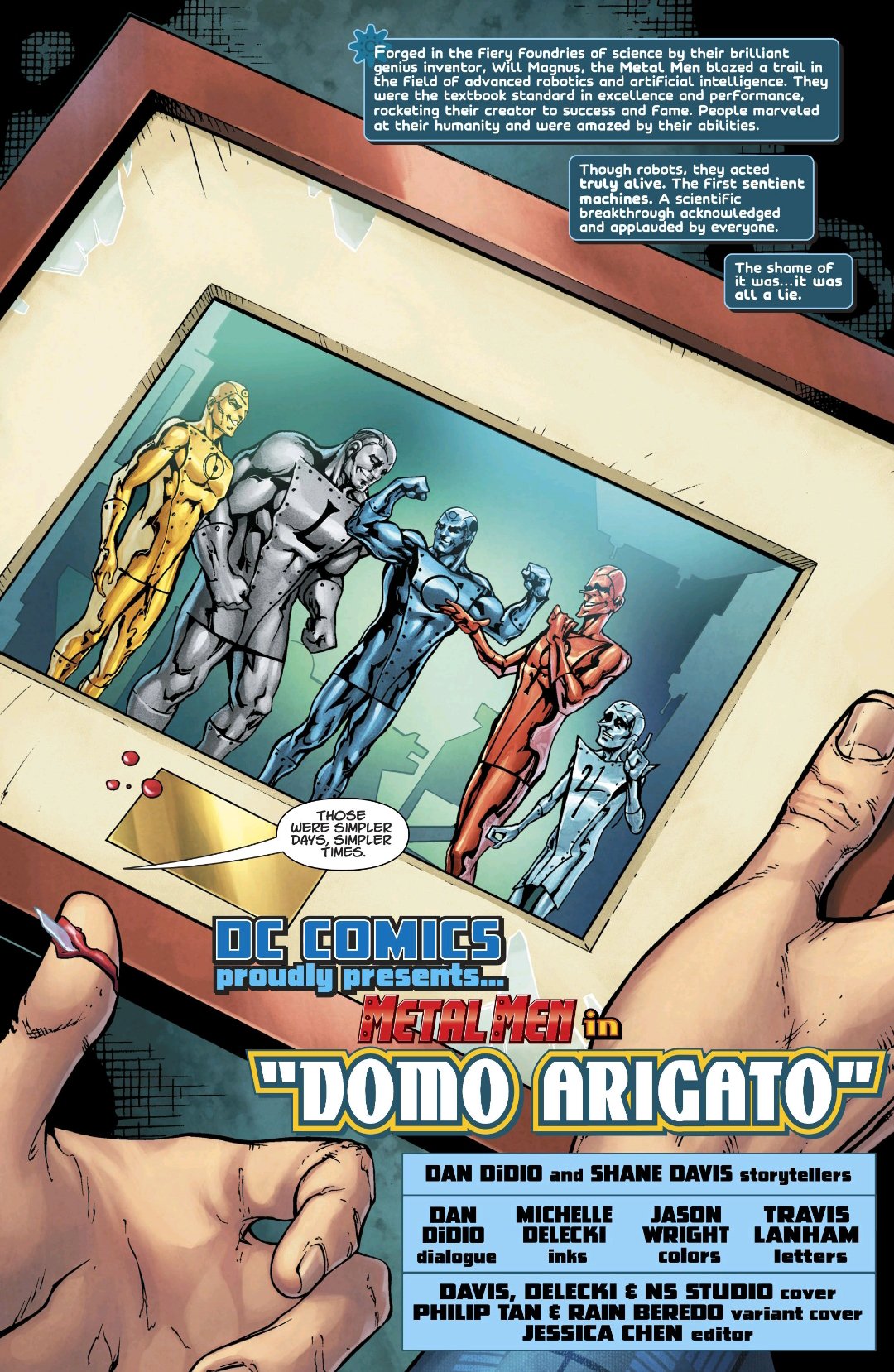
Now, that might come off as a little harsh for one of the most brilliant minds in the history of DC Comics, but this new series, or at least this first issue, builds off of past characterizations and reestablishes the Metal Men back into the DC Universe in a far more sinister light. Magnus used to be a bright spot, a brilliant mind that challenged the idea that machines couldn’t gain sentience. However, here, he falls more in line with his contemporaries in T.O. Morrow and Professor Ivo.

Will Magnus has always had something in the way of a susceptibility to mind control or falling prey to his own mental neuroses. At least with the Metal Men by his side, he’s either been able to mask this or overcome it by doing some good with his creations. When the Metal Men were supposedly the spirits of his dead colleagues, Magnus did what he could to fix them and make them heroes only for it to later be revealed that it was never the case and that his own mental illness convinced him to use that story to make the Metal Men seem unique.

When the New 52 reboot happened, Magnus was first seen as a depressed scientist who had seen his Metal Men project used in black ops missions and later as assassins before they destroyed themselves, later appearing in Cyborg’s DCYou series in a much happier state. Magnus is a brilliant mind, but time after time something will drop him from his course and cause him to retreat into himself over and over.

This series takes all of these past origins and brings back the Pre-New 52 Magnus, but paints him as a callous scientist that seems to have internalized all of his failures and lies and only talks about them to a Nameless bot that he’s created. The Nameless bot never talks, but looks at him disapprovingly. As it never moves, it’s hard to get a read as to whether or not Nameless is like the Metal Men or simply just something for Magnus to talk to without feeling judged.

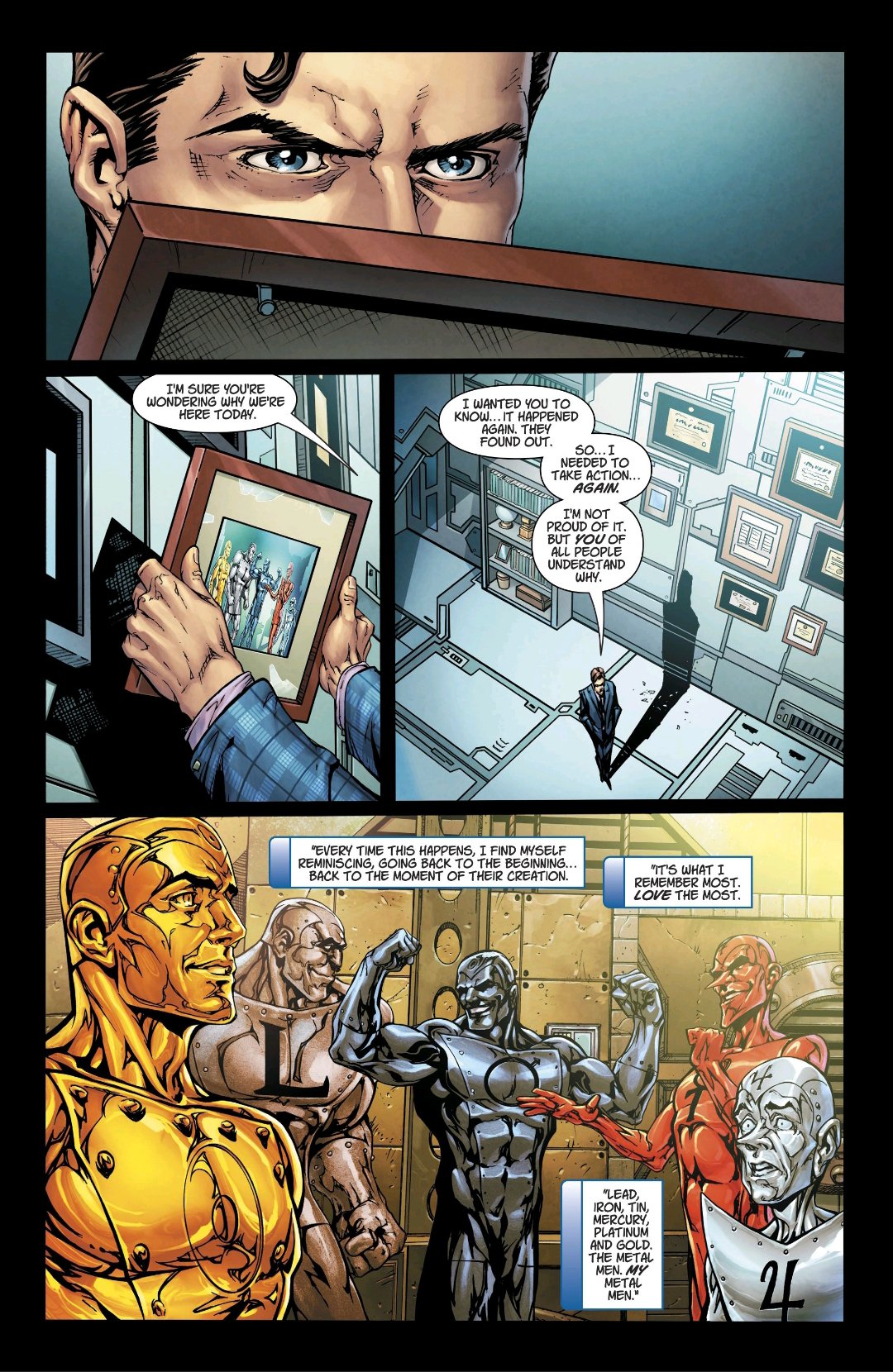
The book mostly unfolds through this conversation with Nameless, with small cuts to Challengers Mountain for the exciting subplot. Magnus talks about how he was given various awards and accolades for The Metal Men, their sentience and just how lifelike they were. Though as we come to find out, as Magnus chucks one of his trophies into the glass case holding one of his Responsometers, it was all a lie and he wishes he never built the device. He admits that he just wanted to same notice that Ivo and Morrow received for what he calls “toy robots.”

Shane Davis draws this scene with a cold fury to it. The sterile nature of his trophy room is offset by the palpable rage of his words and his face in the last panel. Davis Used a lot of pulled in shots to focus on the trophy, the Responsometer and even Magnus’ finger pointing at his many certificates and plaques. It comes as an extreme shock the moment the trophy is crashing through the case that the Responsometer is in. It was so sudden and so violent that we can feel how angry he is, especially with how much the glass flies.

Professor Ivo, best known for creating Amazo, has often been seen as one of the Justice Leagues most brilliant and terrifying foes because of Amazo’s ability to copy those of any hero he encounters. T.O. Morrow is another brilliant scientist that created the Red Tornado, one of the Justice League’s most trusted allies. Both of these robots are treated with so much more regard and respect than the Metal Men ever have and Will Magnus knows this most of all, but can’t get over that they are noticed, but he is not. So he toils away with his Metal Men, constantly trying to find the edge and bring them real sentience, but he just can’t.

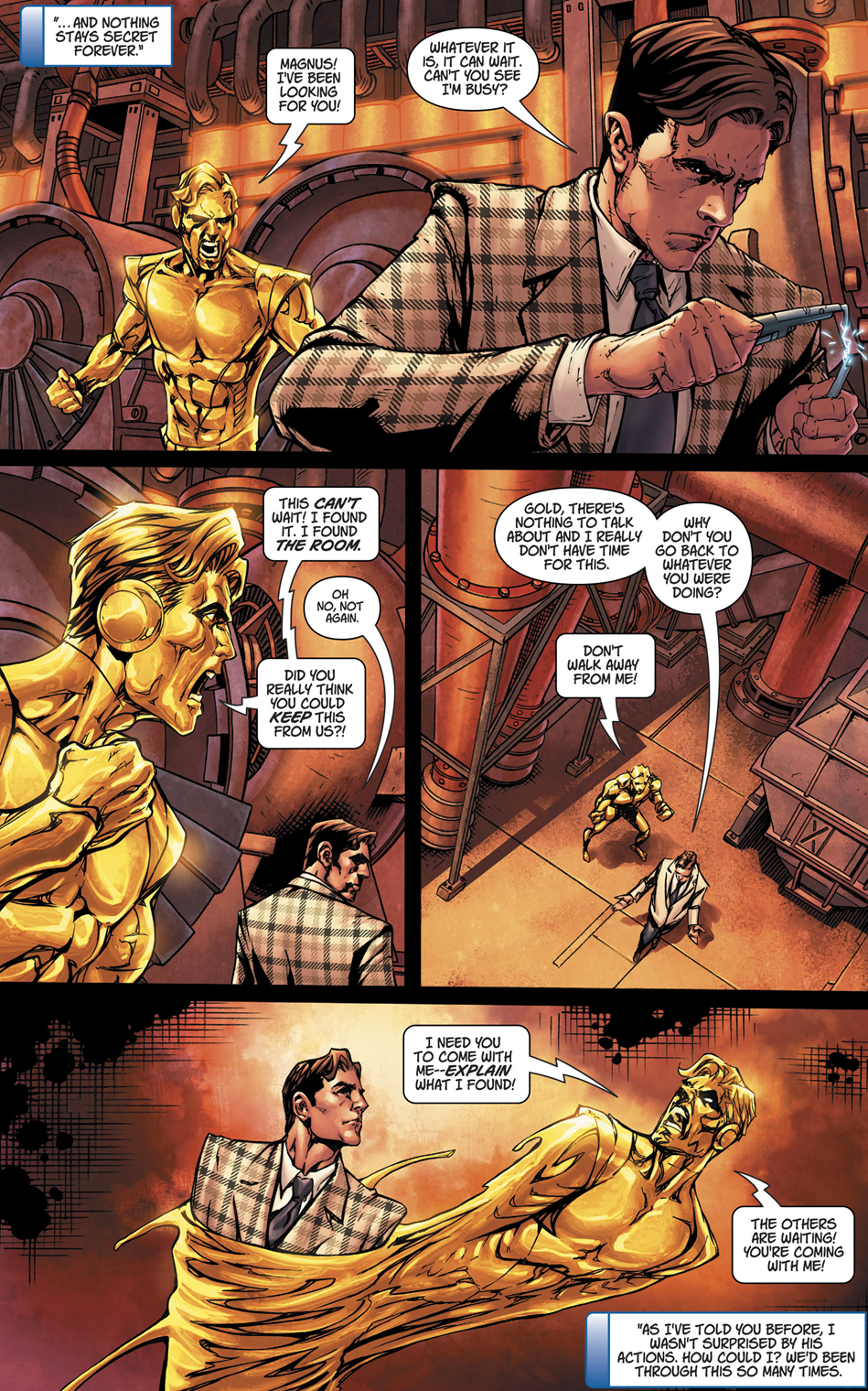
We flash back to the inciting incident of this talk when Gold finds a room containing the broken, dismantled and cast aside parts of Metal Men from the various eras of their existence. Where Gold, Tin and Mercury are enraged that Magnus thinks of these other versions as junk waiting to be recycled, Lead, Iron and Platinum are hurt and disappointed at finding all of this. They all confront him, asking why was all of this hidden away and Magnus answers by saying that he wishes he could have been honest with himself, but then he’d have to admit to being a fraud and he just can’t do that.

Gold looks a lot like Magnus, so when he screams at his creator it’s almost as if a mirror is being held up to him. Shane Davis uses this symbolism well in conjunction with the room of parts and old models showing Magnus’s failures. Platinum has always had something of an affection for Magnus so her disappointment hurts even more. Tin is always such a timid thing, so seeing him angry is a change for him and shows just how deep the betrayal goes. 

He tells them that the Responsometers just allow them to act and react and that it doesn’t give them personalities or sentience of their own. They’re all either shocked or angry, accusing him of being a liar, but he explains that their personalities are based on his own traits. His dimwittedness, his anger – hell, even their metal bodies aren’t even real with the Responsometers converting a base metal to the supposed atomic structure. Magnus couldn’t afford to make them out of real gold or platinum. Before their rage can get even worse, Magnus snaps his fingers and they immediately turn off.

What’s most disgusting about this isn’t the fact that he’s built failsafes into his “crowning achievements,” but that he mentions that they discovered the room “again.” This has happened more than once and he doesn’t know how many times they’ve done this. It shows a level of darkness and sociopathy that really chills the blood. He knows what his problems are, but instead of facing the embarrassment of admitting it to himself and his larger scientific community, he chooses to hide it and reprogram the Metal Men when they become aware, but not self-aware. 

When he’s made aware of living Nth Metal in Challenger’s Mountain asking for him by name, he gives a smile and says he has a team to rebuild…

I’m ultra excited for the future of this series because I’ve liked the Metal Men and their scant appearances in the DC Universe in recent years. Giving them this new and darker edge underneath the feeling of nostalgia. Given the cover of this issue, it’s likely that they’ll be going back to their 1960s-1970s looks, eschewing their more recent designs. Hopefully this has some interactions with the current Year of the Villain stuff as Will Magnus has the mind and motivation to receive something from Lex Luthor.

Best of DC: Week of October 9th, 2019

Best of this Week: The Joker: Year of the Villain One Shot – John Carpenter (yes, that John Carpenter), Anthony Burch, Philip Tan, Marc Deering, Danny Miki, Jonathan Glapion, Jay David Ramos and Gabriela Downie

John Carpenter understands horror. 

Helming the incredible Halloween franchise, the remakes of The Thing and a slew of iconic (and absolutely godawful) movies, Carpenter helped lend his skill to yet another psychopath in the form of the Joker in his comic debut and it is unsettling. While the rest of the Year of the Villain One-Shots have followed a particular villain and what Lex Luthor had to offer them, this book takes an entirely different route and chooses to focus on one of the Joker’s henchman while he and his boss tear through Gotham after another recent breakout from Arkham Asylum. 

Referring to himself only as Six of Hearts, this mostly somber tale sees the man examine his own mental illness through the lens of freedom while saddling alongside the Joker as they attempt to “stomp out crime” in Gotham City. Initially, he sees his illness as something that he needs to hide or repress since he is unable to get a grasp on whether whether his world is real or if everything is in his head.

He admires the Joker for his supposed freedom, the wackiness he displays by being open and free with his crazy and how unapologetic he is. Philip Tan shows this by drawing Six or “Of” as Joker refers to him, with this glazed over look of wonder as Joker blows up the other 51 henchman because they didn’t break him out. Watching Six’s face appear as if it’s being pulled into the explosion gives the idea that all of the anarchy is drawing him in. He doesn’t fear Joker, he’s willing to follow him through anything.

Joker doesn’t take notice of the kid until he randomly speaks up as the Clown Prince is dumping Scarecrow’s fear gas into the Gotham River. He asks Six of Hearts to drive him somewhere and puts a gun to the henchman’s head once boredom creeps in, ordering him to say something fun. We’re then treated to Six of Heart’s backstory of abuse for his mental illness. Gabriela Downie does an excellent job of using letters in the place of traditional borders for this scene, each border reading “Ha,” for Joker’s maddening laugh.

The scene is horrible and we see Sox’s father beating him, asking if it would kill him to be normal for two seconds before cutting to Six of Hearts holding a bloody skillet over the battered head of his father as his mother cries after trying to calm him from the beating. It’s a devastating scene that shows how the misunderstanding of mental illness can lead to needless violence.

Joker appears sated and removes the gun from Six of Hearts face and smiles, calling his tale fun. The two then stop at a gas station and encounter Condiment King. The…F-List villain attempts to rob Six, using a flurry of sauce based pins before Joker emerges from one of the aisles to put the fear of God into the villain. Putting his arm around Condiment King’s shoulder, grabbing the mustard gun and putting it directly against his head as he blubbers and cries, he fires and nearly drowns Condiment King in mustard.

Joker’s face is absolutely terrifying, shrouded in shadow with only his real eyes and red mouth, he appears far more demonic and scary than normal. His teeth are a gross yellow, making him appear gross as well. Tan does a great job of selling the fear and danger of the Joker with Condiment King’s face being absolutely great with tears and snot coming from every orifice.

With justice dispensed, Joker finds his “true” calling and makes Six don a Robin costume with himself in a Batman costume as the two then go out and fight crime. In the same way that Batman Odyssey was insane, this part of the book pulls no punches either, with mad grins from the Joker, ill fitting costumes on both men and absurd over the top violence. A man and his dog are just walking on the street when Robin Six accuses him of some sort of crime before letting him go after seeing his innocence. Just as he’s about to walk away, Joker shoots him, saying he’s got a gun, then shoots the dog saying the same thing before planting the gun on the dog. 

I audibly laughed at how ridiculous it was. It was so sudden and so random that I couldn’t contain it and the rest of the book continued that way. This is when the cracks began to show and Six slowly realized that Joker might not be all that he seemed. After an incident with Enchantress and Joker almost shooting a server in the face while commenting about Sox’s mother from earlier, Six gets terrified and tries to run from Joker. He returns home only to find Joker in his Bat costume holding a knife to his mother’s throat.

This scene felt terrifying. Coated in a slight red tint, we see the true madness from the Joker as he’s been listening to every word Six had said, knowing that he knew what he was doing all along. Six of Hearts realizes that Joker’s been done the entire time and that he’s not like his former idol at all and he attacks him in a rage. He somehow gets the upper hand before Joker puts the Batmask on Six and croaks “harder” as Six of Hearts chokes him to death. This catches the boy off guard and Joker sees the opportunity to beat him half to death with a crowbar before sauntering off.

The faces and the colors make for an absolutely great experience as we’re able to watch Six of Hearts explode with rage, Deering, Miki and Glapion’s various inks showcasing the darkness of the scene. Joker’s evil is palpable with all of this darkness. Jay David Ramos’ dark, but intense colors set an amazing tone for the somehow warm feeling that we’re supposed to get from this scene. Six of Heart earns something of a clarity, realizing that while the Joker doesn’t care about him, his mother still does and he loves her. As long as he was able to protect her and do something good with his life, then everything was worth it.

She embraces him and their broken relationship begins to mend itself unexpectedly. For an unbelievably dark and morbid story, this was amazingly sweet at the end.

I don’t know how much Anthony Burch had to carry the script for this issue, but I can definitely see Carpenter’s influence heavy in the book. Joker is amazingly terrifying and well directed and Six of Hearts is an excellent stand in for the general reader. This story was fantastic and in an event where Doom is the ultimate goal, it’s nice to get a little bit of hope.

Philip Tan’s art and the rest of the creative team from the various inkers to Jay David Ramos on colors were fantastic. Joker looks like an absolute maniac and the colors are so full and beautiful.  The inks are appreciably dark to match an equally dark character and the story therein.

I really, really want John Carpenter to do another book in much the same vein. Maybe Joe Hill and the rest of the Hill House imprint can have a place for him?

Best of DC: Week of October 2nd, 2019

Best of this Week: DCeased #5 – Tom Taylor, Trevor Hairsine, Stefano Gaudiano, Rain Beredo, Saida Temofonte

You can almost hear the sound of hope fading away.

After the explosion caused by Captain Atom decimates the cities of Baltimore, Washington and Metropolis, Superman and Wonder Woman are left in shock and horror. They stand in the ruins of Washington, gathering their thoughts on what they’ve just witnessed when they suddenly remember everyone in Metropolis. Clark rushes off to his city, expecting the worst possible outcome, only to find the top half of the Daily Planet safe: protected and saved by a distraught Lex Luthor.

Trevor Hairsine’s art paired with Rain Beredo’s colors create this brutal air of bleakness initially.. The initial few pages are drawn in wide shots, making Superman and Wonder Woman look small amidst the sheer destruction. The pages are colored in a cold grey with a gust of smoke wafting in the distance. The first color we see outside of their costumes is the green from Lex’s protective dome. Green sort of becomes a hopeful motif through the book as it’s presented a few times as the color of saviors.

In the darkest hour, even devils turn to the light.

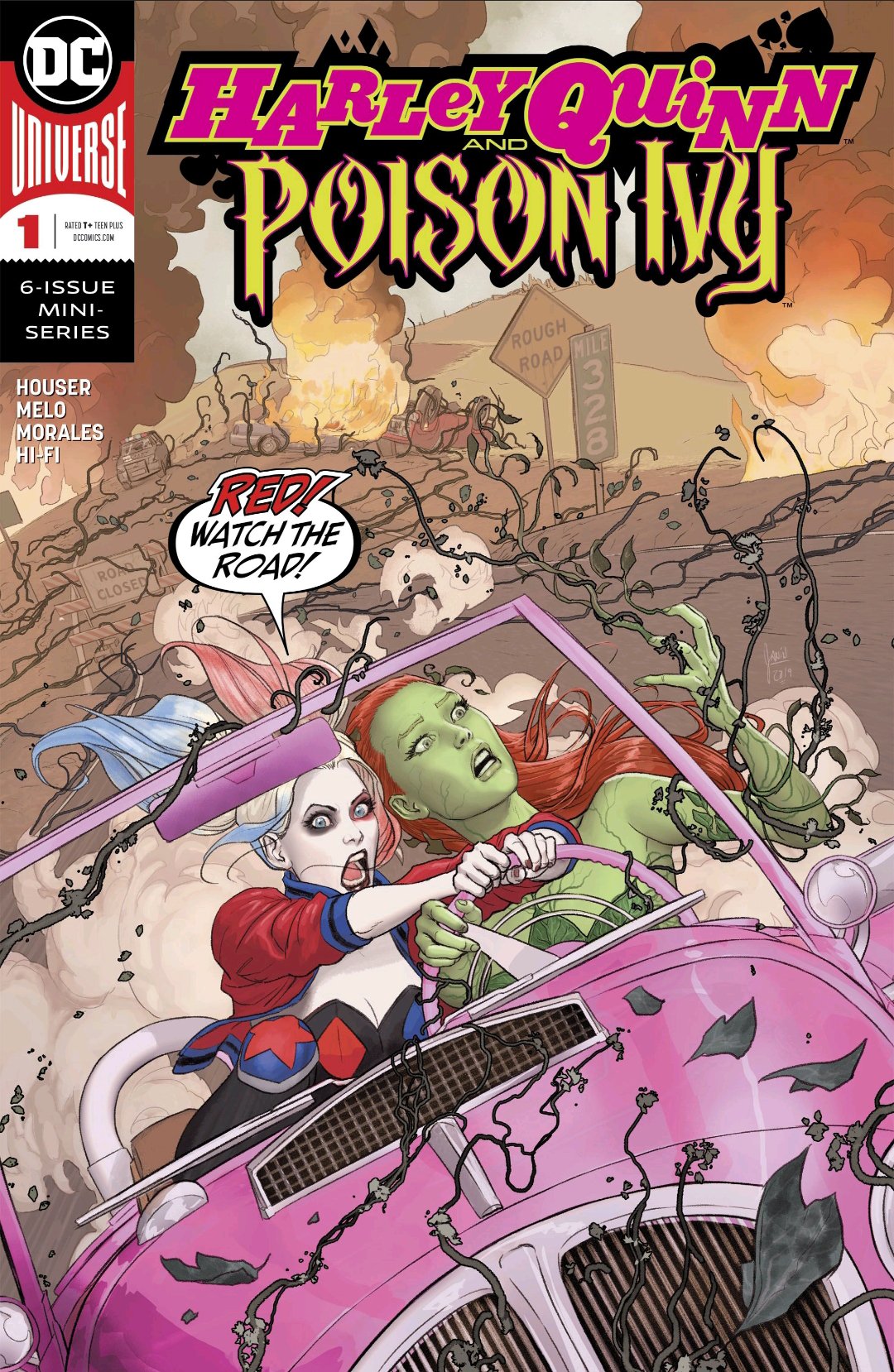
All things seem amazingly hopeful from that point on. Superman finds his family safe and sound. Damian, Dinah and Ollie enlist the help of Harley Quinn and Poison Ivy in establishing a safe zone for other living people among the newly growing forests of Gotham. The Hall of Justice acts as a refuge for other heroes and regular citizens, they even start making plans for arks to escape the Earth. They destroy everything that’s able to mass broadcast and even make new land on Themyscira.

Throughout all of this, however, you still never get the feeling that everything is all right. While the League are doing harrowing feats to save the planet, backgrounds are still colored in a washed out manner while the colorful heroes are juxtaposed against them. Even the greener backgrounds in the Harley/Ivy scenes have this dark twinge to them despite the green of Ivy’s new forest refuge being so prominent. Beredo likely does this on purpose to slowly sew the idea that not even the goodness of green is guaranteed, this being backed up by an infected Killer Croc showing up during.

Things seem hopeful until they all hear a buzzing in their minds, distracting them just long enough for something invisible to cut Lex in half and scratch The Flash, Barry Allen. Martian Manhunter somehow managed to get infected at some point and through the combined efforts of the heroes, mostly Firestorm, he is killed, but not before Barry is infected and runs away. Superman stops Wallace West from going after him and chooses to stop Barry himself. He knows he’ll never be able to catch Barry, so after confirming with Cyborg that Barry’s dead, Superman runs into him head on, obliterating his body.

Martian Manhunter’s sudden appearance is the exact moment when the motif is betrayed. J’onn is one of the most powerful heroes in all of the DC Universe and he’s almost always seen as a figure of goodness and help. To see him as a monster and the brutal way in which he kills Lex is a shock. The only warning we get is everyone feeling the buzzing before Lex’s torso is removed from his legs. Hope is shattered in an instant. 

Barry’s scream of agony, J’onn’s dead eyes of rage and the look of horror on Ollie’s face sells the sheer terror of all that’s happening. They allowed themselves to relax a little and it’s cost them everything. 

*SUPER SPOILERIFICS AHEAD*

Unfortunately for Clark, he finds two of Barry’s infected fingers impaled into his abs.

It’s unexpected, distressing and unreasonably cruel as we watch Superman say his final goodbyes before the infection takes him too. He tries to fly away from Earth, but succumbs to the infection when he nears the moon.

*SPOILER SWIM IS OVER*

DCeased does everything that it can to build up the idea that maybe there’s a way out of this situation. The heroes do everything that they possibly can to ensure that the Anti-Life Virus doesn’t spread any further than it already has. It’s decimated the Earth through its initial spread, Captain Atom and there’s no telling how much damage the Flash was able to cause by himself. I had high hopes that maybe Superman, Wonder Woman and Mera could be a beacon of light in this time of utter darkness. Hell, even seeing Harley and Ivy do their part filled me with joy.

But I loved it even more when that sense of hope was ripped right away from us. 

I hope there are even more stories like DCeased in the pipeline because even a few one-shots from the perspectives of outer space heroes like Adam Strange or the rest of the Green Lantern Corps at large would be amazing. I know I’ve trashed Marvel Zombies for doing much the same thing in the past, but It’s been a long time since then and we need new zombie media to sate our own rabid appetites.

Best of DC: Week of October 2nd, 2019

Runner Up: Batman #80 – Tom King, John Romita Jr., Klaus Janson, Tomeu Morey, Clayton Cowles

Batman is Broken no more.

For 79 issues, Bane has been orchestrating a convoluted plot in an effort to prove himself Batman’s most superior foe, the man who broke the Bat twice. He’s pulled Bruce’s father, Thomas Wayne, from another universe, caused Catwoman to leave Batman at the altar and has completely taken over Gotham City after Thomas defeated Bruce at Ra’s al Ghul most powerful Lazarus Pit.

Everything has been in an effort to leave Bruce broken, without help, unable to stop Bane. It would have worked too, if not for Catwoman. The last two issues have been mostly filler issues for Batman and Catwoman to rebuild their relationship by fighting crime together again. They’ve recontextualized their relationship with Bruce realizing that he can be happy and still be Batman and Catwoman realizes that she’s not taking anything away from Bruce by being with him.

They make each other better with Bruce taming her more criminal aspects and Selina taking away some of the more brutal rage that got him in trouble for beating the crap out of Mister Freeze several issues ago. 

Tom King does very well with writing relationships like this even if sometimes it seems heavy handed on the part of it being a woman’s duty to fix her man. Catwoman and Batman ounce off of each other in the most adorable and loving ways, but when it’s time for business, no one can hold a candle to them. Batman #80 succeeds on the merits of their skills and the skills of the entire creative tem of this book.

Right off the bat, the book begins with a noir Batman feel as Bruce, in his beach disguise (or rather his Matches Malone guise) walks through the streets of Gotham on a rainy night before being stopped by Officers Pyg and Dent. The two criminals attempt to accost him, not knowing he’s Batman and they get the crap kicked out of them. Batman doesn’t even break a sweat before he’s punched them both in the throat and gives Harvey another to the face for good measure. Harvey shoots him in the chest twice, but Bruce slowly opens his shirt to reveal a Bat emblem before tossing the bullets away like a boss. 

John Romita Jr. knows his way around a fight scene and conveys Batman’s strength and the terror of his presence in general by how Harvey reacts upon realizing it’s him. Tomeu Morey sets the scene with his amazing coloring by tinting these pages in yellow, DC’s general color for fear before it transitions into darker colors when Batman reveals himself. Klaus Janson’s inks set the tone for how unknown this mysterious stranger is before the ultimate reveal and in only a few pages, this book has me sold.

Opposite Batman who likes to be seen and feared, Catwoman strikes from the shadows. Mad Hatter is just patrolling Gotham when he spies a cat, musing about laws over strays and pulling the longest pistol ever recorded in comics out of his hat. I’m not kidding, this gun was comically large. While Batman’s scene was tinted in yellow, these pages are split between the cool blue of a street light and the seductive purple of the night sky in another, non-rainy, part of Gotham. It plays well into Selina’s finesse as she quickly and quietly takes down Mad Hatter, saving the cat.

Batman pretty much makes the rounds, letting his villains know that he’s returned to Gotham, Kite-Man gets an amazing scene as Batman drops him from a building while saying “Hell yeah” in response to Kite-Man asking if it’s actually him and later has a standoff with Officer Hush. The stand off has no reason to happen other than it’s  badass visual as these perfect opposites just trade philosophic barbs as Batman disables Hush with a batarang. In all of it’s rainy, sepia toned glory, it’s a nice double page spread, made even better by Janson’s inks giving everything the perfect black shadows.

Throughout the issue is a thread for Thomas Wayne as well. Because he’s a father that lost his child, he treats Gotham Girl as if she’s his own, giving her a new costume and consoling her however he can. He’s gotten very close to her and as such when she’s in distress over not having any more of the serum that can keep her alive as she uses her powers, Thomas is there for her. He tells her that she doesn’t need powers and that she’s skilled enough without them. He tells her to just rest as Albert Wesker walks in to tell him that Bruce has arrived. 

Bane gave a standing order that if any of the Batfamily were to reenter Gotham City, then someone close to them would die. Damian did it and got Alfred killed which left the child as the only prisoner. Batman had to know this as well as he monologues after defeating Hush that his father has to make a decision: will he kill his own Grandson? 

Batman is getting very intense as Tom King is reaching the end of his run with this book. With only five issues left, I’m actually shaking in my boots with excitement. 

In reflection, I’m also mostly glad with the entirety of this almost three year story and the leaps and bounds it’s made to cement Bane in a firm place at the top of Batman’s Rogues Gallery. Bane had always been one of Batman’s most deadly enemies, but this manipulation, the guile and deception, the audacity that he had to hatch such an amazing(ly insane and convoluted) plan just to ruin the life of his most hated enemy is insane.

Joker may always be Batman’s most popular villain… but Bane will always be his greatest.

Best of DC: Week of September 25th, 2019

Best of this Week: Harleen #1 – Stjepan Šejić and Gabriela Downie

Hindsight is 20/20.

Looking back through the history of Harley Quinn, you’d be a fool to think that she hasn’t taken a strong look back at her life before she became the psychotic Clown Princess of Crime at The Joker’s side. We’ve seen the story told many a time in movies, comics and cartoons, but there’s just something so inviting about the way Šejić presented this absolutely tragic origin story, at least for the first issue. As Harleen describes it, “it felt like one of those cheesy romance novels.”

Harleen separates itself from the other Harley Quinn origin stories by taking that cheesy romance and turning it into a long form car wreck centered entirely around Dr. Quinzel’s point of view and her early interactions with The Joker and the other criminals of Arkham Asylum. If I had to level a complaint at the book, it would have to be that, at least initially, everything is quite flowery and light. To counteract that point, it makes sense for the story to be told in this manner to show the often manipulative nature of abusive relationships like Harley Quinn’s and how ultimately, they don’t end well.

The book opens with Harleen in a dream sequence taking place in a distorted Gotham City. The style here is very reminiscent of Šejić’s work on Death Vigil with dark cityscapes, many shining lights and gothic imagery throughout. Dr. Quinzel walks down a winding road, expecting the same nightmare that she’s had many times before, but there’s something different about this particular dream. Instead of being eaten by an unknown monster, she’s met with the arrival of a bat monster and a pale man with green hair that’s being attacked by him and she chooses to intervene, smiling back at the pale man as he smiles at her. With the narration of this book, it’s easy to assume that this dream sequence takes place a little while after her relationship with the Joker is fully formed as she even acknowledges that smiling back was the biggest mistake of her life.

We get a beautiful page of Joker and Harley dancing and looking happy with each other as Harley’s future transformation occurs in the panels behind them. As beautiful as these shots are, the way that Šejić draws these panels, looking like glass shattering in the background is very telling of what we’re to expect in these future issues. Things transition to a little bit before Harleen meets Joker for the first time as she interviews a veteran who tells her about his “one bad day.” He describes how he and one of his Battle Buddies had each other’s backs until the other guy got his throat slit by a woman in a local bar during their deployment. The veteran describes how he just snapped in that moment and we have something that will be called back to in later pages.

A few years later, Doctor Quinzel presents her interview and findings to a Scientific Symposium in Gotham and it appears to be going badly. She shows her research notes and tells the crowd that the veteran then shot up a hospital full of injured kids and that her research, if implemented, would help decrease the recidivism rate of crime in Gotham by identifying what exactly made them go bad in the first place. She starts to flub her words and get nervous as some in the crowd check their watches, look disinterested or just leave altogether.

Harleen and her friend Shondra go to get drinks and talk about how the good doctor thought she nuked her presentation, they leave separately and it’s almost as if fate was just waiting to kick down the door when an explosion rings out and Harleen faces down the barrel of The Joker’s gun.

This moment is when I fell in love with this book. In a beautiful double page spread, Harleen looks on in abject horror as The Joker aims his gun directly in her face with a wide, toothy grin. The most disturbing part of this is how he’s framed as still being a sexy bad boy. He’s tall, slim with medium length hair and gives off a sickening charm. He’s very distinctly a Sějić Joker and his art style lends well to that. 

In an instant, however, he sets the entire tone for how their relationship will be in the future – threatening her life, but pulling back after seeing her face full of cold fear. In the background we see her life flash before her eyes. From her childhood of uncertain career choices, to her adulthood of being attracted to people that she’s not supposed to be, like one of her professors and eventually her current job as a criminal psychologist.

Through this we see exactly what kind of roller coaster her life had been and how, from an early age she just wanted to help people. It’s the very definition of “the road to hell is paved with good intentions” which is one of the central themes of this story.

Joker let’s her go after savoring her fear before he is stopped by the Batman. This action sequence is fairly standard Batman faire, but from Harleen’s point of view it becomes something more. She is absolutely terrified, not just because she almost died, but because she’s found herself interested and immersed in the Joker and Batman’s struggle. Everything in her mind is telling her to run away, but as Batman catches an escaping Joker and pummels the tar out of him, she follows and can’t look away.

She hears the others in the crowd and feels that there’s something wrong. The panels are arranged into a deranged smile of blood as Batman holds Joker by his collar and the sounds of his punches are replaced with the rabid howls of bloodthirst. She feels a bit of sympathy and the agony of post trauma nightmares over the next few days. After coming in to work soon after, one of her bitchy coworkers asks who she slept with to “get it,” and she soon finds out that her research has been funded by the Wayne Foundation as she is met by Lucius Fox. 

During their conversation we see more of her own pre-crisis personality come forth. Finding her nervous, insecure and initially unsure as to why she was called into her bosses office in the first place gives us perfect insight as to how the Joker will be able to manipulate her in the manner that he does. She not dumb or naive by any means, but she appears to lack a serious emotional strength. Sejic is good at writing characters like these as seen in his work on Sunstone and Switch and it gives her a good flaw in her personality.

Fox tells her that she’ll soon be transferred to Arkham Asylum to talk to the worst that Gotham has to offer and this last third of the book is rife with on the nose symbolism. As soon as she arrives at Arkham, the shadow behind her morphs from Harleen Quinzel into the form of Harley Quinn and the shadow of Arkham’s ominous gate sign becomes the perspective of someone on the inside looking out.

Within her first few days, she meets people that will be very close to her in the future such as Pamela Isley and Killer Croc to real headcases like Victor Zsasz and The Riddler. She’s also met with the disrespect of having her name mispronounced numerous times by the Arkham staff, outright dismissal of her theories by Dr. Hugo Strange and pushback from Gotham District Attorney, Harvey Dent.

Harvey in particular is most interesting because of his firmness in his ideals. He doesn’t believe there’s any rehabilitation for the residents of Arkham and that they should be sent to Blackgate Penitentiary instead. Harleen is steadfast in her beliefs that there’s more to each of these patients than simple violence and crime. Harvey notes that Arkham has a breakout rate so high that it might as well install a revolving door.

Throughout their argument, half of Harvey’s face is covered in shadow, specifically the half that would later become the deranged side of Dent’s future alter ego, Two Face. This is intriguing because in many ways this meeting feels like a shakedown, a foreshadowing of the man that he would soon become. In one instance he remarks of the beauty of Gotham City and in the next he just flat out tells her what he wants, almost threateningly while rolling his coin over his fingers. His moralizing is betrayed by his furrowed brow and eyes of fury over the sheer thought of Gotham having criminals like Zsasz freed because lawyers blame his mental illness for his horrid actions. 

Harleen, infuriated that Dent would ask her to end her research and refuse the Wayne grant so smugly, found herself driven to conduct the one interview that she had been avoiding after going through the likes of Mad Hatter, Killer Croc and The Riddler. The night before her meeting with Harvey, Harleen had gone through all of the Joker’s interview tapes. One thing that stood out to her was Joker’s propensity to retell his “troubled” past in a variety of different ways, Šejić’s own take on the Multiple Choice origin story of the Clown. She felt mildly annoyed by how underwhelming they all were until she found a tape of Joker being arrested and him speaking the way that he did the night that they first met, saying that Gotham is full of civilized monsters and all they needed was a push to send them over the edge.

Just like the veteran in the beginning.

Harley needed a full nights rest to get the courage to interview The Joker and tried a multitude of methods from horse tranquilizers, to a chiropractor, to just simple drinking, but it was Dent that gave her what she needed to go. When Joker and Harleen meet face to face again, he doesn’t recognize her until a sudden SLAM on the glass brings back her look of shock and terror, allowing the Joker to remember her. 

With their pleasantries exchanged, he asks her to refer to him as Jay and we jump into the inferno.

Stjepan Šejić is an amazing artist and writer with a knack for writing fun and silly characters. He can also delve into dak territories and themes when he needs to and while this issue is more comedic and funny, it does hide some very dark bits of story underneath. The best way to describe it would have to be…a calm before the storm. Everything in Harleen’s life is at a perfect place. She’s got the dream job that she’s wanted for her research, she’s found very interesting subjects and one in particular that might be the break that she’s been looking for. But we all know what’s on the horizon for her.

The problem I can see people having with this is the common, “this story is going to glorify the abusive relationship between Joker and Harley!” I don’t see it turning out that way. I think it’s very clear to Dr. Quinzel and the reader that The Joker is wearing a mask. His charm is an ugly façade worn to hide the monster underneath, but she just can’t turn away, especially since he’s been the subject of her dark dreams for a while.

I think that the next issue will show just how the cupcake stage of their relationship with the dark underpinnings slowly transforms her from a reasonable psychologist into a sympathetic beauty that’s found her beast. Šejić only showed us a small part of his writing and art powers and since the second issues of these Black Label books tend to be the best issues, I have no doubt that the next Harleen will be amazing. High recommend

Best of DC: Week of September 18th, 2019

Best of this Week: Year of the Villain: Lex Luthor #1 – Jason Latour, Bryan Hitch, Andrew Currie, Tomeu Morey and Tom Napolitano

Doom is Here.

Lex Luthor has gone through an amazing transformation over the last few years. He was just a rich douchebag when the New 52 started and this eventually led to him becoming a hero in his own right, even taking up the mantle of Superman after Clark died during DCYou’s Superman: Truth arc. When the status quo needed resetting after the League destroys the Source Wall and Luthor was called to join a large group of heroes and villains to stop a new threat to the universe. He saw the error of his heroic ways and embraced Doom after seeing just how powerful entropy could be.

Everything he’s been planning has been leading up to Year of the Villain and things are in full swing with the bad guys finally having the edge, but there’s just something that Luthor can’t satisfy yet: His own urge to be the ONE Luthor. His ultimate belief that he himself is the pinnacle of the multiversal Luthors and this book sets out to prove him right in a variety of ways.

Starting out on Earth-38, a universe reminiscent of the 1960s Superboy comics, Lex recruits the aid of Alexander Luthor, a younger version of himself that still rocks the ginger bowl cut and genius of his future self. Lex likely sees the malleability of this Young Luthor and sees just how similar their upbringings were ad hopes that this child can see the pending darkness and failures that other Luthors have succumbed to. Lionel Luthor is drunk and hears it all, insisting that Lex take him instead, but the Apex Predator incinerates him as Alexander looks on with nonchalance. 

Bryan Hitch might be in his finest form in years right now. Somehow, he manages to make a middle school science fair eerie and uncomfortable and make a bowl cut mildly threatening. Tomeu Morey’s coloring of these first pages paints a picture of the perfect suburban setting with darkness just sitting underneath and curiosity from the Young Luthor, the same glint in his eyes.

The next two Earths play in parallel to each other as opposite futures. Earth-45 is a desiccated world where brands brought the world to its knees along with a Doomsday Luthor that squandered the world and destroyed it. Earth-32 seems to be a world of peace where a Martian Kal-El and Lex Luthor coexist as best friends in the Superman and Batman roles.

Luthor has a special hate for this Lex as he’s chosen to live in the shadow of the alien and sicks the Doomthor on Kal-El, thinking that Bat Lex will abandon his fight with Apex Lex to save him, but a Luthor is still a Luthor and he calls Apex Lex’s bluff, but he’s seen all that he has to. He knows that Bat Lex is absolutely Doomed because of his heroic nature and chooses to let him suffer on an Earth that will absolutely be killed by Doomthor.

Luthors hate for both of these other versions is palpable though. Lex has made body modifications for power before, but never once has he allowed himself to become a mindless brute because of it. He doesn’t want to see society utterly destroyed like Earth-45 Luthor did. Even his transformation into the peak form of what a Human-Martian hybrid should be is more enlightening than dangerous.

He very likely also sees Earth-32 Luthor as one of the bigger multiversal insults. Lex Luthor stands in no one’s shadow and seeing him become a creature of the night, the Batman to a Martian Superman, is low. It also echoes back to the years when all he got was guff from the Superhero community and the American populace at large by portraying himself as a hero. It’s the opposite of his current goal of absolute Doom in that this peddling the false hope of Justice.

Doomthor is revealed in his full form during the Earth-32 scenes and he looks amazing. Bryan Hitch draws him like a bald Doomsday, but has the LexCorp logo adorning his chest. He’s an absolute unit of grey and white, muscles pulsating, arm cocked back ready to take Kal-El’s head off and face so full of rage. Of all of the alternate Doomsdays we’ve seen, I think this might be my favorite.

Lex travels to Earth-1 to a future that I certainly hope we see published one day because I absolutely love the Earth-1 stories. This segment begins with who I believe to be Perry White telling an unknown individual of the day when Lex absolutely broke the Superman of that world using the Black Mercy parasite. While the Lex of Earth-1 died after being caught in a fight between Superman and Zod, I suppose as with most other things, DC is choosing to retcon and ignore a past story in favor of this excellent story instead. Lex finds Earth-1 Lex in a hospital bed, likely in a coma and angril screams at him for being made so small, asking how his obsession with Superman is worthy of the name Luthor… but then Apex Lex takes a moment and thinks. 

He sees the ultimate Doom that this will lead to. This world, without its great symbol of Hope and Justice, will crumble as it is already a darker reflection of the Prime universe. Bryan Hitch draws Apex Lex’s face with a heated rage contrasted by Morey’s use of muted colors in the room, the sterilized feeling of it all. He grasps the Comatose Lex’s head, preparing snap his neck, but then he relents with stunned silence. Hitch captures this moment with solemn beauty and revelation for what Lex will really have to do to achieve Doom. The Comatose Lex just lies there, smiling. He’s absolutely pleased with himself and finds himself living up to the Luthor name.

After Luthor travels to Earth-50 and likely kills the Luthor of that world, in front of a statue of him replacing the Lincoln Memorial, he has a conversation with Alexander. Alexander asks “why don’t we just kill all of the Luthors when they’re babies” to which Apex Lex answers, “There is no ‘we’ only Luthor.” To me this sounds like Lex could do exactly that, but at the same time, he has to teach Alexander how exactly to be Luthor by seeing all of the mistakes that others have made in the name. By showing him alternate realities, pasts and futures, Alexander can see every possible path there is for him to take and sidestep their particular hurdles to realize his destiny.

The two Luthors meet three more over the course of their adventures, one who became a cobbler and another from the age of Merlin who became a Wizard, two drastically different paths, but neither good enough of the name of Luthor. The final is the one that intrigues me the most, however.

The final Lex appears to be the absolute opposite to Apex Lex. The Luthor who gave up his ambition, his visions of grandeur and embraced the down to Earth nature of his humanity (and a good ginger beard). Through drinking tea mixed with pieces of the Blak Mercy himself, he has lived multiple lives and experienced multiple realities and has seen the many paths just as Apex Lex and Alexander are doing now. The difference is that Bearded Lex sees through Apex Lex, he knows that his hubris and need to be the one and only Lex Luthor is why he’s willing to give up his humanity despite knowing that he will never be. He is but one of many. 

This is illustrated excellently through Hitch and Morey portraying Lex in many of the positions of other heroes like Shazam, The Flash, Orion and even as Brainiac himself among others. Morey makes these colors slightly more sepia toned to illustrate that they are potential pasts and futures to give a lived in feel. There’s also no way for Lex to ever be the one true Lex at all and every attempt is just another way to fool himself.

Hearing enough, Alexander killed Bearded Lex, gaining the respect of Apex Lex and finally becoming Luthor…only afterwards, it is revealed that at some point, Alexander was given the Black Mercy plant and acts as back up human DNA for Lex, likely for when his own status quo needs to be reset if his path towards Doom is also the wrong path. Despite the lessons that he was trying to teach, Lex still has an ace up his sleeve, he still has some of his humanity and he knows that no matter what happens, he will remain the one true Lex Luthor.

Of all of the Year of the Villain spotlights, this one is my absolute Favorite. It might just be things that put Luthor in the forefront in general, but there’s just something so great about his new form of evil. He wants to see the utter ruination of good and he’s actually making headway and earning from his past and future mistakes before he can even make these decisions. It peels back the layers of all the men that Lex Luthor could have been and shows us just why Apex Lex is the best version of all of them, because his plans have succeeded without him being subservient, comatose or a mindless beast.

Lex Luthor is here for Doom and I am on board for it.

Best of DC: Week of September 11th, 2019

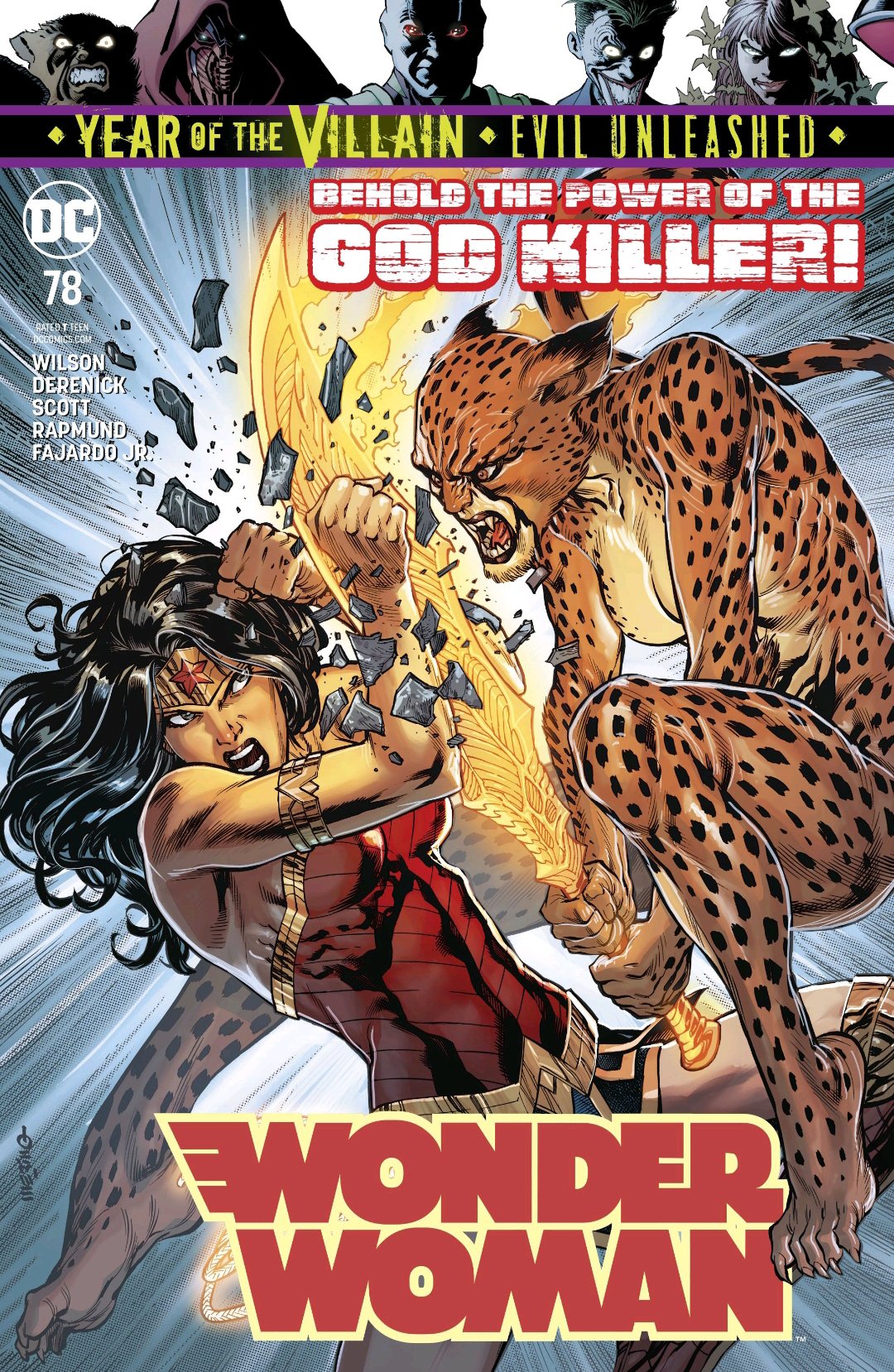
Runner Up: Wonder Woman #78 – G. Willow Wilson, Tom Derenick, Trevor Scott, Norm Rapmund, Romulo Fajardo Jr. and Pat Brosseau

Love is dead. Cheetah has killed her.

The fallout from Cheetah’s actions continue as Wonder Woman has lost her will to fight and is easily overpowered by her most deadly foe. Things begin in the most bleak way possible as illustrated by Tom Derenick. We cut back and forth from the immediate past to the current present as Cheetah wrests or destroys Wonder Woman’s armaments. 

Her sword is cut in half and her shield is demolished after swipes from Cheetah’s new Godkiller sword. Her tiara is broken and sent flying after a solid punch. The Lasso of Truth is snatched away as Cheetah mocks her, asking who is truly worthy. Even the Gauntlets of Submission are absolutely destroyed after being hit with the sword. 

Cheetah smiles with absolute glee as Diana is driven before her, helpless and unable to defeat her with her new and powerful weapon. She manages to escape into a nearby river and calls Atlantiades to help her. The demigoddess hears her call and with the help of Steve Trevor, they find Wonder Woman, broken and defeated without love.

Superman is commonly thought of as being the main hope in DC and there is a lot of merit to that, but at the same time, Wonder Woman is just as much of an inspiration to some if not more. She has almost never given up hope, even after killing Maxwell Lord in the past or losing her ability to see, hell even after fighting the Amazons after they invaded Man’s World she wasn’t at all fazed. Losing to Cheetah and feeling the crushing weight of the world on her shoulders now that she doesn’t have the hope of love to keep her head up high. It’s even worse when Steve Trevor is also suffering from this lack of love. Even while giving Diana a soothing bath for her injuries and trying to console her, his eyes are empty of the love they had and she can tell. 

Not only is love gone, but so is compassion as we see in a short scene shortly after the bath. A mail carrier on a bike accident hits a car and no one does anything to help him. It’s telling that people just either drive around him or stand idly by seeing no reason to try to walk through traffic. We see even later on that people are far more willing to commit crime, especially after Lex has been offering people gifts and changing how they think, bringing out the darkness inside.

Eventually Wonder Woman is left with no other choice than to ask Veronica Cale for help. Veronica Cale, who has nothing but enmity for Wonder Woman, decides to help her as she doesn’t even remember the feeling of dread that she had when her daughter was trapped in Themyscira and see this as an opportunity to show the Gods that mortals can see what they cannot.

In a way, Cale and Cheetah are similar in that regard. They have nothing but hate for the Gods and Wonder Woman and will do everything they can to tear them down, Cale with wit and guile and Cheetah with pure rage. 

G. Willow Wilson is absolute bringing out the bloodlust from Cheetah that we haven’t seen in some time and is making her a pretty credible threat. If her trajectory continues the way that it has, then there’s no doubt in my mind that this entire run of Wonder Woman will end in one of their deaths and that is exciting.

Best of DC: Week of September 11th, 2019

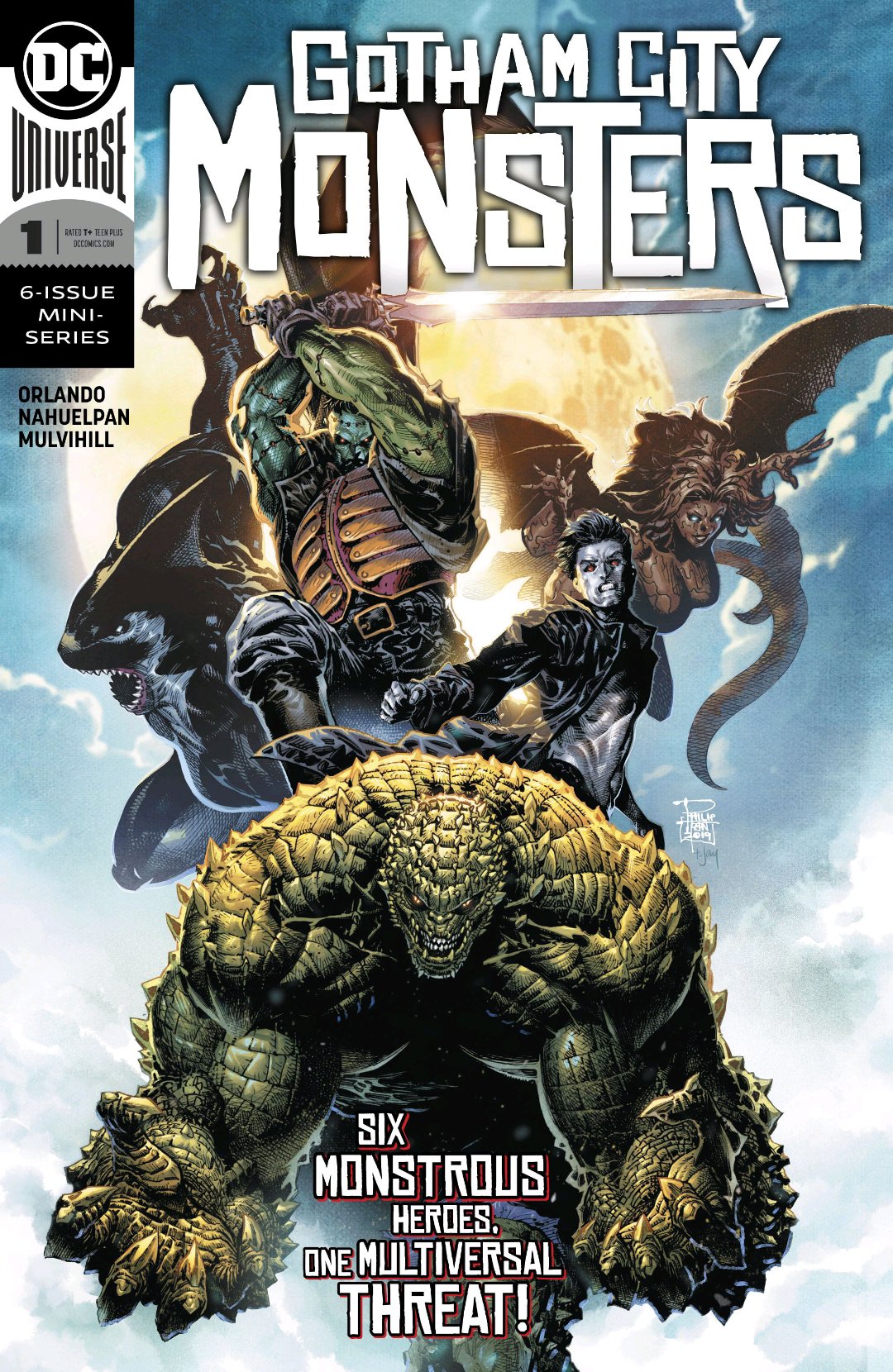
Best of this Week: Gotham City Monsters #1 – Steve Orlando, Amancay Nahuelpan, Trish Mulvihill and Tom Napolitano

Who wanted this?

Serious, this is a strange team of characters to put together for a story, but it’s so jarring in a way that it makes me really interested to see what their team dynamic is like. This book carries so much of a Universal Monster movie vibe while mixed in with the superheroics of comic books in a manner that it’s already caught my eye.

The book begins with several haunting establishing shots of Monstertown, one of the few neighborhoods in Gotham that is doing well under the control of Bane. These shots set the tone for what the story will be; a grimy, dark outing where the only light to be found is in the darkness. Naheulpan does such an amazing job capturing the essence of Gotham, while at the same time making things feel so…40s and 80s right before we’re introduced to our first hero, Andrew Bennett aka. I, Vampire.

Bennett, having been hunting down vampires that choose to spill the blood of innocents, dispatches a large group of evil vampires and learns of a new vampire king that’s soon to be restored to life. Bennett tears out the lead vampires heart and tries to drink his blood to kill him, but finds that his blood is poisonous to him. He then vows to kill their new leader no matter what. Within only a few pages Bennett is established as a noble vampire unlike some of his kin and those who were previously unaware of him are given all that they need to know about the man. His scene also feels very reminiscent of The Crow or Queen of the Damned in terms of style and color palette.

Soon after, we cut to a newly freed Waylon Jones who’s very excited to leave his past life as a criminal behind to carve out a new life in Monstertown, but sadly he knows that people will still only ever see him as Killer Croc. I can see that his arc will be all about redemption as he tries to make things in his life right after all of the turmoil he’s been forced to go through. Part of me wonders if he’ll ever learn about Roy Harper and his death at Sanctuary, given that he acted as Roy’s sponsor when the archer was getting off of heroin. He’s not seen again after his two pages which does suck quite a bit as I thought he would have a larger role starting out.

Things start to heat up as we run into the actual lead character of the story, Frankenstein, former Agent of SHADE. It has been quite some time since Frankenstein has been seen in any book, I think the last one he was in was a Valentine’s Day special from 2018. Before he is even shown, we see patrons of a local bar running in fear of the chaos that the undead one has wreaked in search of one of the last open cases SHADE had before Leviathan destroyed them. Frankenstein is not here to play games, holding the throat of a man infected with a disease that turns him into a bull-man.

Naheulpan draws this scene with the dourness that Frankenstein is often known for as Orlando scripts him to say that “in a far world you would live, but now more than ever… the world is not fair.” Napolitano’s letting also helps to make this scene even more saddening with Frankenstein’s shaky word balloons even if Frank himself is anything but. He lights the man on fire after smacking him upside the head with a bottle of ”Damn Fine Whiskey”, totally not Jack Daniels’, and watches as the creature tries to crawl away in fear and pain, terror in his burning eyes.

After this short excursion, we are introduced to our last few cast members in The Orca and Lady Clay, the latter of whom I had no clue existed. While I have limited experience with Orca as a character, mostly from Nightwing: Rebirth and the Injustice 2 tie-in comic, I know her story (and have an attraction, don’t judge me) and it’ll be interesting to see if Steve Orlando plays into the romance angle from the latter comic to give Croc the strong beau that he’s been missing since Enchantress was taken from him. Lady Clay, however, is new and exciting to me because she doesn’t know who she is anymore and finds solace in taking on the appearances of others like a Faceless Person. I’m very interested in whether or not she’ll betray the team for a sense of understanding from the main villain.

Throughout the book there had been murmurings of an opera going on in the city. This plays as the hook that will cause all of the plot to go full steam ahead in the next issue. While the crowd thinks they’re watching an amazing show, they are soon sacrificed to bring back Melmoth, an immortal whose blood was used to help in Frankenstein’s creation. Melmoth’s entire motivation is to continue being what he considers the “Last King.” He wants to subjugate all beneath his feet and will kill as many as he needs to do so, yet his followers see him as some sort of savior.

Gotham City Monsters succeeds as a story in the vein of the cheesy horror movies I liked to watch at a younger age. The stories and motivations given for each individual hero are simple, much like to protagonists of those old movies and gives this comic a nice monster movie team up feel. Naheulpan’s art is grim and made even better by Mulvihill’s gritty coloring and great use of dark inks for the moments that need shadows. For a first issue, this one was a blast and I absolutely cannot wait for the next one!