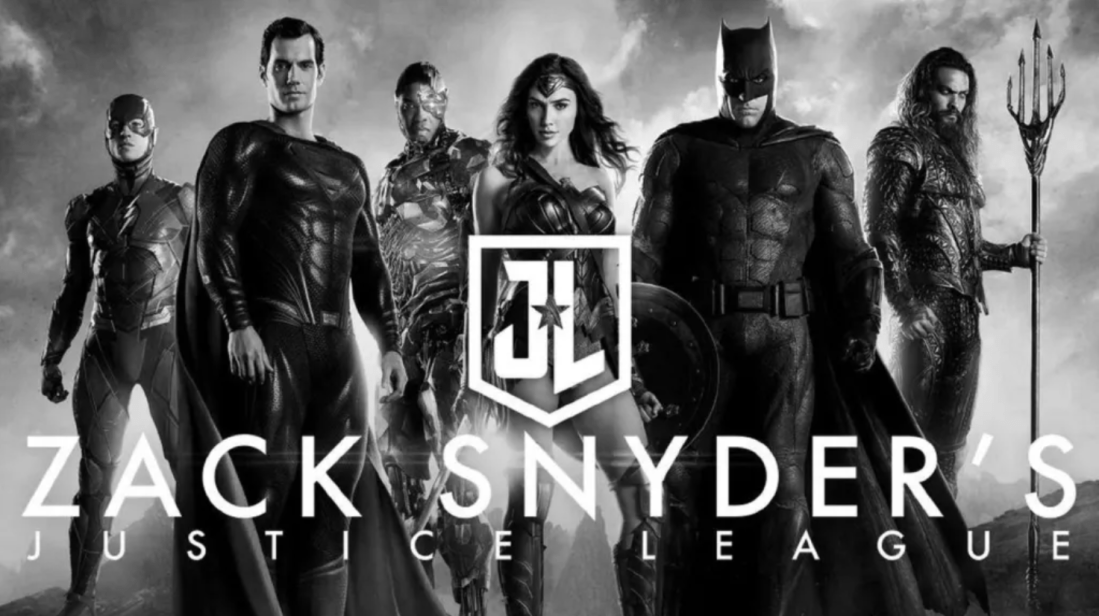
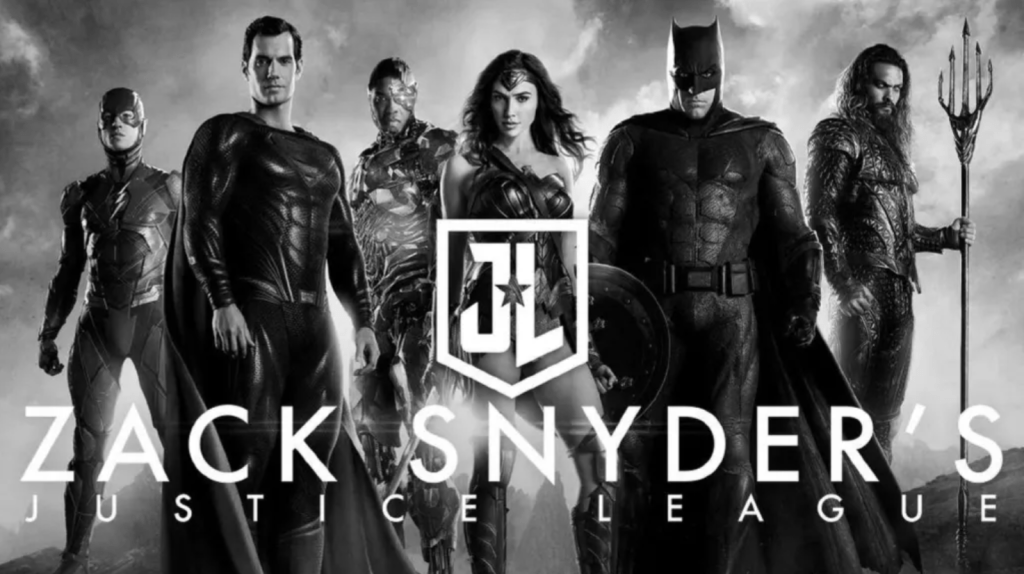
Ty Talks Comics Reviews: The Snyder Cut

What a strange position to be in.

Initially, when the groundswell of support for the Snyder Cut began, I found myself in full support of a filmmaker that I had been crapping on for his bad movies since the end of Batman V. Superman. I felt sympathy for the reasons that Zack had to leave the original Justice League project and even lightened up my criticism of the aforementioned BvS. Justice League under Joss Whedon turned out to be a mediocre mess of tonal dissonance and try-hard humor from a guy that, in retrospect, should never have been put in the driver seat after his actors’ criticism of him after Age of Ultron. I didn’t expect the Snyder Cut to actually exist, but the sliver of hope was there.

Then one after the other, the actors in the movie began to voice their support and tell of its “existence” and slowly, the sliver of hope became more real. The pressure was on Warner Brothers and then after years of speculation and cries from the fans, we got an announcement. It was vindication. Blog after blog, website after website said that it wasn’t real and that it would never happen. We would finally get Snyder’s original vision – and then he started tweeting and I remembered why I hated the man in the first place: He’s a giant, goddamn, edgelord.

Granted yes, Chris Terrio and David “She Hulk was a Giant Green Porn Star” Goyer, wrote the screenplay for BvS, Snyder still defended the murderous nature of Batman, the Martha moment and in general his love for the flawed Batman of The Dark Knight Returns and there’s a lot of bias coming from me going into this movie, but I tried my best to be as fair as I could and well, here we are.

The Good.
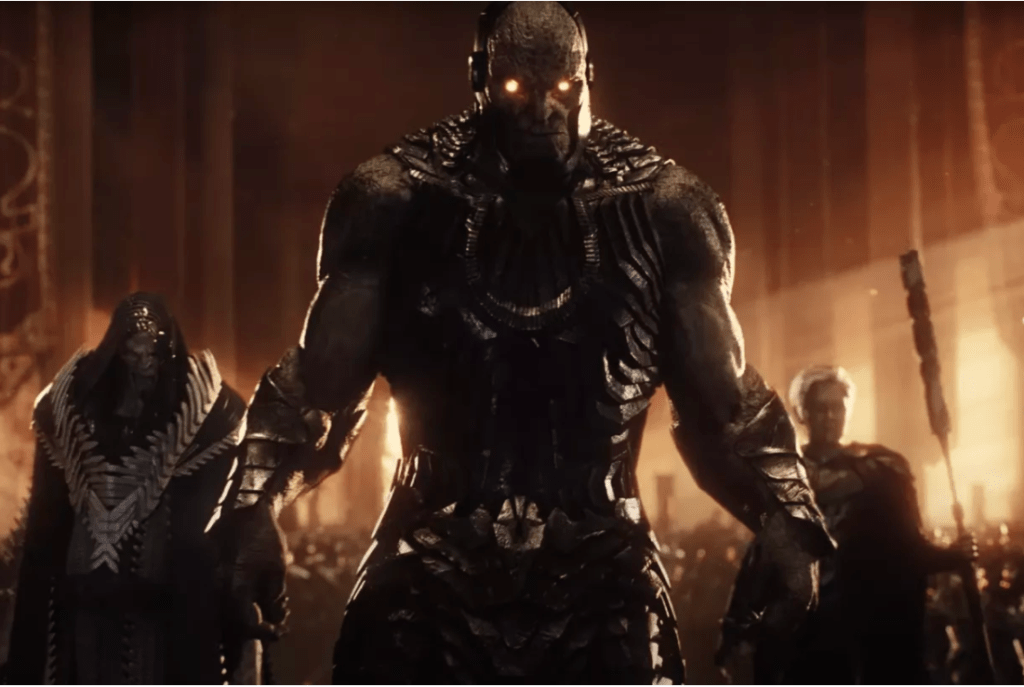
One of the biggest criticisms that came out of the original movie was how underdeveloped and forgettable Cyborg was. He had no arc to speak of clearly the director had no amount of care for the character at all. Thankfully the Snyder Cut vastly improved on Victor, not only as a character, but as an integral part of the team that had a lot to contribute. Watching him struggle with the pain of being mostly a robot and his own issues with his father before coming to terms with his new life and relationships was refreshing to see. Granted, Doom Patrol handled the arc a lot better, Zack Snyder did his best to show what his overall vision for Victor would have been and given how great of a character Cyborg is, it was much appreciated.

I love that Snyder actually made use of the awesome football scene that was a big part of the original movie’s marketing, but never made it into the final theatrical cut as it serves as some of the better character work as we’re able to see what a star football player Victor was. In many ways it reminded me of the animated Justice League War movie where his story played out in much a similar and more explosive way, with both of them acting as the eventual conduits to the defeat of the main villains through their understandings of the Mother Boxes.

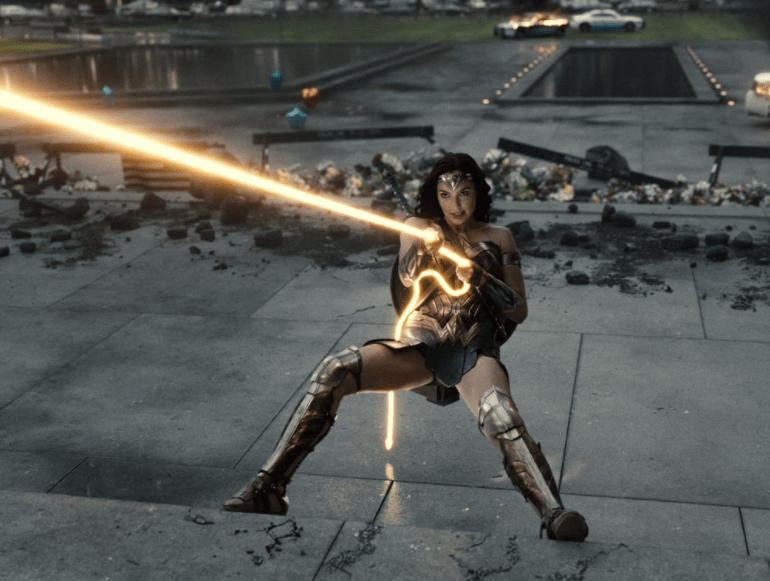
Wonder Woman and the Amazons were filmed with an uncomfortable gaze of disrespect and oversexualization in the theatrical cut. Wonder Woman’s opening rescue scene deemphasized her heroics and the invasion of Themyscira portrayed the Amazons as being weak and ineffective when Steppenwolf set foot on the island and just wrecked them without regard. The Snyder Cut allowed all of these women to breathe, be leaders and warriors in every scene that they showed up in and I was much more hyped to see them on screen. If there was one thing that Snyder knew how to do, it was portray historical warriors as buff, badasses that didn’t flinch in the face of danger. The music during the scene was good, the camera shots were always well placed to get the most out of the Amazons and surprisingly the color wasn’t awful! They took the fight to Steppenwolf and Diana even made the final blow in the movie’s climax. 
There’s not much I need to say about Superman’s resurrection scene that I haven’t said in the past review of this project. It remains one of the most epic and powerful scenes of Superman in a movie as he just systematically takes out each member of the League. It’s still fun and brutal and sort of sets the stage for how his mind would be susceptible to the Anti-Life Equation that would bring him to Darkseid’s flock if Snyder and Geoff Johns’ terrible sequel ideas ever came to fruition. I also liked the addition of the black suit, though of course he didn’t have a mullet, so this was really nothing more than fanservice.

Finally, the reshot War for Earth was definitely one of the coolest and best scenes of the movie overall as, instead of Steppenwolf getting his ass kicked by the warriors of Atlantis, Themyscira and Humanity, it showed a younger Darkseid (or Uxas as he might have been known then) leading the invasion. This scene worked out well because it showed just how united the armies of Earth were, alongside a surprise Green Lantern while at the same time showing just how viscous and effective Darkseid himself was as a younger conqueror. The battle also looked really good from a filmmaking perspective as well since the CG blended well enough with the color so nothing looked too fake while also looking grand and bombastic. This scene was especially great as Darkseid was allowed to be defeated, giving viewers the idea that he wasn’t completely invulnerable and could be defeated by a powerful enough force.

The Bad.

Oh. There was so much. 

One of the biggest criticisms I have with Zack Snyder is that he takes his artistic expression to the nth degree and comes off as an edgelord looking to make all of his works dark and serious. His form of film directing values more style over substance, best exemplified with his version of Watchmen, which mostly stripped away Alan Moore’s criticism of fascism in superhero comics and Cold War era politics. His version placed value on how cool Rorschach was as hero that had a “code” once and then realized the world was too grim for it, as well as how COOL Moore and Dave Gibbon’s heroes were instead of the dark impact their existence had on the world. Granted, I do love his version of Watchmen because I’m capable of having nuanced opinions, but that doesn’t mean it shouldn’t be criticized. 

Zack Snyder’s Justice League is dripping with his style and while that style made this movie a lot more cohesive than the theatrical cut, it is still plagued with the same problems that the rest of his movies suffer from, which is artistic over indulgence, awful color grading, and terrible dialogue in some parts (oh we will get to the Knightmare, don’t worry).

First off, I think Sucker Punch is one of the worst movies I have ever seen. It was the film that awakened me to what Zack Snyder wants all of his projects to be like if he were given full creative control of things and it wound up being a confusing mess of interconnected music video moments and Justice League has most of that, but with a tighter focus. There is one scene in particular where a bunch of Icelandic women sing a song of lamentation as Aquaman is leaving their town after providing them with fish for the winter; for someone who proclaims their movie is supposed to be realistic, I don’t think that’s something ANYONE would do out of nowhere and not induce a cringe reaction.

Aside from that, a lot of the scenes that establish characters personalities in the beginning are, as previously stated, just music videos with water splashing, rain falling or something else happening in the background, all in slow motion while melancholic tunes play in the background. While I did manage to enjoy them for what they were, there were around four of these moments and soon wore out their welcome. Very easily these could have been shown as them committing heroic acts, but in Barry’s case (which is coming next), heroism is treated more as a joke than anything else.

Barry’s hot dog scene, second only to the Knightmare, infuriated me to no end. I love Ezra Miller with a passion. He’s a fantastic actor and, for the most part, steals the show in every movie he’s in! However, his Barry Allen is the most annoying, creepy and grating version of the character I have ever seen. He makes me question my tolerance of people with ADHD because he just never stops and his interpersonal skills are almost non-existent as while he’s in the middle of saving who I presume to be Iris West in slow motion, he just stares right into her eyes, almost brushes her skin, steals a hot dog and then proceeds to save her and get back to his job interview. It’s unsettling and that’s on top of his already bad humor during the rest of the movie.

As far as the color grading goes…yeah, it’s a much darker movie than it was before. There are so many scenes that either have their colors washed out or are simply far more shadowed than they need to be, giving the movie a much more bleak tone. One of the clearest examples was Wonder Woman’s first heroic rescue scene in which there was a light layer of blue over everything. I much preferred the colorful nature of the theatrical version given that Diana is one of the more hopeful heroes of the DCU. The color change seemed needless and seemed to want to fit more in line with the look that Snyder favors in his movies. I understand cohesive presentation, but one should also tailor scenes to each individual character and their respective personalities. 

That’s not the only instance of this, however, as Snyder somehow manages to get the editor to grade Batman’s trip to Iceland in search of Aquaman to be darker and that takes place in the snow, one of the most reflective and white surfaces possible. The contrast does work well in the end, but it almost has a stubbornness to it, like everything HAS to be darker to be cool. One of the things that I was looking forward to from the original trailers was the bluish tint of night during the final stand against Steppenwolf, but somehow even that gets made EVEN darker and my buddy Matt Dennis of the Fan of Everything Podcast (of course I had to plug him) explained that it might also be because of a Dolby Picture filter that they apply to their movies to give them more of a cinematic quality, but how hard is it to consider the audience that may not have larger TVs or the time to watch the film at night?

And finally, the dialogue of this movie is…something to behold. 

I honestly don’t believe the movie got its R-Rating from the violence within the movie itself because it is heavily tame in comparison to move other comic book properties like even the recent Invincible, but rather the R-Rating comes from its three (?) uses of “Fuck.” One when one of the Wonder Women terrorists just uses it to portray an air of “maturity,” another where Victor says “Fuck the world” as he laments his robotic transformation and finally when Batman says “I will fucking kill you,” to the Joker in the Knightmare scene. I love a good fuck every now and again, but either when they have meaning or are as gratuitous as a Share Size of “M and Ms” for one person. Breaking Bad had ONE fuck per season and they made use of it for full effect, The Boys has several fucks in each episode almost as a transition word at this point. The Snyder Cut has three and each of them just made me cringe and recoil with laughter.

From Flash asking Cyborg if Diana would go for a younger guy and Cyborg replying that because she’s 5000 years old, everyone’s a younger guy to Steppenwolf proclaiming that “the Great Darkness begins” there are a number of cheesy and bad lines, but most of them can reasonably be contained to the Knightmare itself. 

Not only do I hate Jared Leto, the fact that he’s a cult leader and possibly one of the worst Joker performers I have ever seen only makes me hate the final scene of the movie so much more. From his offering Batman a reach around to not so clever lines alluding to the fact that he murdered Dick Grayson in this universe, Jared Leto hams up his lines so much that it almost feels like he’s part pig. He wants to seem intimidating and crazy, but all that I can see is a cringe mall goth from the height of Marilyn Manson’s popularity. What makes matters even worse is that he even alludes to some of the plot that would have been part of Justice League 2 with Bruce and Lois being a couple after Clark died (remember those pregnancy tests in her drawer next to her Press Pass?)

This whole scene is clouded in a shit brown and Jared Leto is still the biggest piece of shit in it. If you look closely enough, you might be able to see two other turds in the form of Zack Snyder and Geoff Johns as their crap ideas just waft away in the billowing wind.

And there you have it. It has taken me a full week to collect my thoughts and put it to paper for this mediocre mess of a movie. Not everything was bad and it did have some quite enjoyable moments in it. Zack Snyder, Chris Terrio and David “I hate Green Characters, so why did I include Martian Manhunter in the Script” Goyer did manage to pull everything together back from the horrid state that Joss Whedon left it in. They are all talented in their fields and I applaud the crew of the movie for getting those additional shots, the long hours of editing and everything else, but fucking hell this movie was overhyped and underdelivered on both its cringe and possible goodness. Here’s to hoping Snyder and co. move on to better films after this and Johns continues to do well with Star Girl and comic projects…but after Doomsday Clock, who really knows?

Green Lantern 80th Anniversary Review – 100 Page Super Spectacular

I love the Green Lantern Corps.

From Alan Scott all the way to Jo Mullein with Tai Pham and Keli Quintela being small exceptions because I haven’t read Green Lantern: Legacy and stopped reading Young Justice, respectively. All of these characters have such a long and storied history with so many great stories under their belts with an excellent team of writers and artists throughout their various years making up the entirety of this special.

Dark Things Cannot Stand the Light – James Tynion IV, Gary Frank, Steve Oliff, and Tom Napolitano

Alan Scott was one of DC’s first and most popular heroes, a founding member of the Justice Society of America and the first Green Lantern after appearing in All-American Comics #16 in 1940. He was the one that started it all and even though Hal Jordan was the character to transform the corps into what it is today, he wouldn’t be here without Alan Scott doing it first.

Alan Scott as we know him hasn’t really been used much since The New 52 and recently made his re-emergence as the reason why we were given such a darker, grittier universe with Dr. Manhattan moving the Lantern out of his way during the train crash that gave him his ring and abilities. DC did give fans an updated version of our classic heroes with the Earth-2 ongoing series, but something still felt off – a hope and heroism that came with the characters, a reason to do good and thankfully, DC took some of the surface level character progression of that series and injected it into the Alan Scott we know and love with the sense of Justice behind it.

Thanks to Gary Frank’s excellent art with a tight focus on expressive faces and Steve Oliff’s fantastic coloring throughout, James Tynion IV retells the origin story of Alan Scott and recontextualizes his relationship with colleague Jimmy Henton as Scott visits Henton’s mother, Doris, and recounts the circumstances that led to his death. We get a feel for the anger that Scott felt at the tragedy and an idea of the kind of justice he would mete out for the wicked and corrupt.

Doris underscores this idea of Justice with a message about Jimmy always believing that a light was burning inside of him that wanted to get free, but if it did, then it would burn everyone else around him.

Throughout the story, there are numerous allusions to both Alan and Jimmy being lovers, likely meaning that the 2012 retcon of Alan Scott being gay is being recognized as also being part of the character’s long history and as a hero living in the 1940s, his existence as the Green Lantern now holds even more significance as he acts as a torch for, not only himself, but other men in the closet during a very repressive time in history

Where he initially tries to get away from himself, talking with Doris, she tells him that he must be that light and show others that even in the dark world, there is a way to shine.

Last Will – Geoff Johns, Ivan Reis, Oclair Albert, Alex Sinclair and Rob Leigh

When Geoff Johns sought to revitalize the Green Lantern Corps, Ivan Reis was one of the best artists that he was paired with and together, alongside inker Oclair Albert, they managed to bring Hal Jordan to prominence after he was killed following turning into Parallax. Eventually they went on to make the AMAZING Blackest Night storyline and they return here to tell a heartfelt story about Hal as his ring is near empty and he finds himself on an unknown planet with only enough charge to send three messages.

While I have never been a big fan of Hal Jordan, Geoff Johns understands the character and writes him to be very likable, charismatic, even a bit comedic at times so he does a great job of examining a few of the relationships that Jordan values the most.

He sends a message to the Corps on the off chance that it will the last one he gets to send,he sends another to Batman, shedding light on why he’d always butt heads with the Dark Knight and finally one last message to Carol Ferris, the woman of his dreams. The last one being the most telling as most heroes end up with their love interest, but Hal has never quite been able to make their relationship stable for long, but still wishes her the best.

Reis, Albert and Sinclair make the most of the few pages that they’re given, using all of their space for either big, almost splash pages, such as when we see Hal crashed, obviously suffering from the effects and damage caused by whatever caused him to land so badly. At the same time, we also get fantastic sequential panels like when Hal picks himself back up and looks out into the desolate planet in wonder and fear.

These styles blend together when Hal talks to a projection of Batman and later Carol, showing Hal’s full body as he airs out his insecurities and regrets to perfectly colored green constructs with close shots and dynamic angles throughout.

Of course, after these various messages, Hal finds himself a few miles outside of Las Vegas and knows he’s never going to hear the end of it.

The Meaning of Fear – Cullen Bunn, Doug Mahnke, David Baron and Carlos M. Mangual

Sinestro will always be an underrated Green Lantern in my opinion.

He’s uncompromising in his values, sees the potential for strength in everyone he comes across and he has a damn good moustache; On top of all of that, he is a raging madman with aspirations of ruling the universe through fear. He is evil, almost to the highest order, and is still the greatest Green Lantern to ever live next to Hal Jordan. 

Cullen Bunn authored his first ever solo series and gave Sinestro one of the best voices he’s ever had since the Sinestro Corps War while also making sure that he still maintained a sense of villainy despite being a leading man. His run was probably what made me love the character even more than I had in the past and what makes me want to see more of him after Grant Morrison finishes his run with Green Lantern.

This story continues that characterization with the former Lantern confronting a current Member of the Corps after some unseen battle with some mechanical monsters called Purge Engineers. Sinestro recalls his history as an explorer before being chosen to wear a Green Lantern Ring, but then muses about how the War on his home planet of Korugar gave him the willpower and fear to do the things that needed to be done – IE subjugating his warring people under his sole rule, thus causing the Green Lantern Corp to rip the ring from him and forcing him to forge a tool of fear himself: The Yellow Lantern Ring.

Doug Mahnke, David Baron and Carlos Mangual absolutely smash it in the art and lettering department with a lot of upward shots to make it seem as though Sinestro is looking down at the reader for not also embracing their own fear while also making sure that word balloons and captions don’t wildly litter the pages, making everything nice and focused. Mahnke pays special attention to Sinestro’s facial expressions, painting him with that signature sense of snide arrogance with regality. 

Baron makes the most of the colors he uses and makes sure that the reader understands the high regard Sinestro used to hold the Green Light in, but posits that it was the Yellow that set him free. The best example of this is when the Yellow Lantern projects a giant fight between him and Hal Jordan to the wounded Green Lantern and the yellow is the most intense and overbearing it could possibly be, emphasized by Mahnke’s detailed and awesomely scratchy line art – Sinestro’s own Inferno of Fear.

Time Alone – Dennis “Denny” O’Neil, Mike Grell, Lovern Kindzierski, and Clem Robins

Rest in Peace to recently passed Dennis O’Neil who had probably the biggest hand in elevating Hal Jordan and Oliver Queen from being low selling heroes to becoming a fantastic duo that were making headlines with powerful political stories that made use of Hal’s moderate leanings as they bounced off of the HEAVILY liberal Oliver Queen as they solved various crimes together. Unfortunately, Time Alone was the last story that O’Neil was able to pen before his untimely death, but it definitely is an amazing one.

Superheroism has to be one of the most trying things in the DC Universe as these heroes have to deal with the worst that humanity and beyond has to offer every day and with the sense of duty that comes with that, there’s little time for breaks. However, that can also lead to stress and anger and Oliver exemplifies that as he beats the ever-loving mess out of Clock King after he takes a child hostage for a dumb plot, but is stopped by Hal before he can make an even worse mistake himself.

While Ollie chastises Hal for being gone for an extended period of time, Hal tells him what he was doing all that time; He went to another planet for two months and two days to read “Walden” by Henry David Thoreau and reevaluated his own life, started thinking and calming himself after noticing that he was becoming more brutal when dispensing “justice” and gives the book to Ollie as an explanation. O’Neil posits that much like Thoreau, everyone has the ability to set aside some time for themselves and find ways to better themselves – to change in a positive way.

Mike Grell was one of the primary artists for part of the Green Lantern/Green Arrow storyline and his art has only gotten better over time as he manages to capture the rage that Ollie feels as he sees a child in danger, giving all of his movements and expressions an intensity from a man that hasn’t stopped in months, made even worse when he punches Hal to the ground for trying to stop him, all of this is accentuated by his signature hatch shading style. Grell also sells their friendship as they take a car ride together and interact like the good friends that they are.

Of course, this all culminates in a few serene panels of Hal reading Walden in contentment, away from the trappings of regular superhero society and this is also where Lovern Kindzierski’s colors stand out the most. Where previous scenes had beautiful orange skies, these scenes popped with lush blues, purples, greens and well contrasted dark inks. Readers are easily able to get a sense of Hal’s newfound calm and maybe could contemplate their own inner peace.

Dennis O’Neil will be missed as an amazing creator and as a final send off to some of his best characters, this was fantastic.

Legacy – Ron Marz, Darryl Banks, HI-FI, and Josh Reed

Kyle Rayner is my FAVORITE Green Lantern.

It all started with one fantastic episode of Superman: The Animated Series when an aloof artist gets hit in the head with a mysterious ring and spends most of the episode trying to escape the responsibility while also fending off a yellow ring wearing villain in Sinestro. This was my first experience with the Green Lanterns at all and it left an impression, especially with the many references that the episode had to other Lanterns in Guy Gardner and Hal Jordan.

Ron Marz and Darryl Banks created Kyle in the early 90s as a modern replacement to a stale and villainous Hal Jordan, who had become Parallax, and established Kyle as the sole Green Lantern following Hal’s destruction of the Corps. Kyle always stood out to me because he wasn’t even the best choice with Ganthet’s famous line always echoing in my ear, “You’ll do.” Kyle then went on to become one of the greatest Lanterns of all time and that’s why he’ll always be my favorite – his perseverance, creativity and ability to learn from his mistakes set him apart from Hal, John and Guy.

The main crux of this story was how Kyle managed to keep things together while still being the only Green Lantern in the universe as he looks to retrieve some of the items from Guy’s old hero bar, Warriors. The owner of the warehouse praises Kyle for everything he did and Kyle simply says that he “did the best he could,” as one of the souvenirs that Guy seems to have kept was an inactive robot mech and it springs to life, causing Kyle to jump into action to stop it. 

Darryl Banks is possibly in the best form of his career with this story as his lines are smooth and thick, giving everything amazing outlines that pop off of the page. He also draws awesomely dynamic shots showcasing Kyle’s nerdiness as he creates a fire breathing Kaiju to fight the robot and projections of the friends that helped him along the way. HI-FI was the perfect colorist for this as they make every green as vibrant as possible, every red and gold from the robot as threatening and give everything the heroic lighting it deserves.

While probably not my favorite story in this Special, it certainly is the one closest to my heart.

Heart of the Corps – Peter J. Tomasi, Fernando Pasarin, Wade von Grawbadger, Gabe Eltaeb and Rob Leigh

Kilowog is without a doubt one of the most enduring members of the Green Lantern Corps and definitely one of the highest respected. Serving as the Drill Sergeant for the new Lantern Recruits, Kilowog was a genetic scientist from a planet known as Bolovax Vik before it was destroyed during the first Crisis. Since then, he has served the Corps fervently, albeit with a massive weight on his shoulders by being the last surviving member of his people. Kilowog also often bumped heads with fellow Lantern Guy Gardner and together, these two are probably the toughest Green Lanterns there are.

This story reunites the Green Lantern: Emerald Warriors and Green Lantern Corps team of Peter J.Tomasi and Fernando Pasarin for a short tale of the rest of the Corps doing something nice for the man that means so much to them. On the anniversary of his planet’s destruction/Kilowog’s birthday, Salaak, the mission coordinator of the Corps, sends Guy and Kilowog on a mission to save a few ambushed Lanterns. Much to Kilowog’s surprise, it turns out to be a birthday celebration for him as they all know what he’s lost.

Pasarin, Grawbadger and Eltaeb do their best to convey Kilowog’s frustration and later happiness as his muted pink face smiles as they all recite their oath next to a GIANT cake shaped like the Green Power Battery.

Reverse the Polarity – Charlotte Fullerton, ChrisCross, Jordi Tarragona, Luis Guerrero and Steve Wands

John Stewart was the fourth Green Lantern, created by Denny O’Neil and Neil Adams in 1972, becoming DC Comics first black superhero. Over the years John has gone from a brash, interim Green Lantern to one of the most disciplined and respected members of the Corps. Having briefly served as a Marine and later an architect, John’s mind and constructs are considered the strongest of them all because of the effort he puts into building everything piece by piece.

 In 2001 when Justice League began airing on Kids WB, John gained a wider audience as he was chosen to be the Lantern of the team, serving as representation and inspiration for an entire generation of fans while also entertaining audiences with his flirtatious relationship with Hawkgirl. This story reflects just that and mainly focuses on how the two characters lean on each other when times get rough and if I didn’t know any better, I’d say that this was Fullerton’s way of writing a love letter to her late husband in Dwayne McDuffie.

ChrisCross, Tarragona and Guerrero evoke much of the feel of that old cartoon while maintaining the current designs with Guererro’s bright and evocative colors such as Polaris’ purple and white energy, Hawkgirl’s dark greens alongside the lime greens of John’s light. ChrisCross gives the action a high intensity feel, well accentuated by Tarragona’s clean inks and thick blacks for shadows.

Because John is so used to hold the world on his shoulders, he bears a weight that he doesn’t allow others to bear with him, so when Doctor Polaris suddenly shows up on the Watchtower, it’s up to him and Hawkgirl to shut him down before he’s able to gain control of the macguffin of the story, but it’s only when he lets her in that he’s able to reign control of the object from the magnetic villain.

Four – Robert Venditti, Rafa Sandoval, Jordi Tarragona, Ivan Plascencia and Dave Sharp

Guy Gardner is the one you love to hate.

Guy is an asshole. Straight up, he’s a trash talker, an egomaniac, the least creative of the bunch, the least tactical and the least to show real leadership, but what he lacks in all of those qualities – he makes up for in bravery and toughness. Guy is notoriously the Lantern that people love the least, but he holds that special third place in my heart because of how much of a goon he is and how good he can be in the right hand. In Robert Venditti’s run of Green Lantern, Guy was amazing alongside Hal, John and Kyle and they were the Four Corpsmen.

The Four Horsemen were a wrestling stable that came together to dominate the business because they were the best of the best and Venditti drew upon that with these members of the Green Lantern Honor Guard with Guy serving as the Heart of the team. Four Legs on a Table, Four Walls in a House and Four Seats in a Mustang GT – their motto, The Four Corpsmen.

This story had my favorite storytelling conceit, old veterans sitting around the table, reminiscing about the old days and telling stories to each other. The main focus of their stories on their seventeenth anniversary (?) of being retired centered around Guy Garnder, who appeared to have been late for their annual meeting, of course at a certain point readers start to get an uncomfortable feeling that he’s not coming. That’s confirmed in the final page of the story as they all do to Horsemen Salue at the Warrior’s grave.

Rafa Sandoval might be one of my favorite artists at DC comics right now because his style is very suited to the high intensity action that Venditti’s GL run required, but he also shows an ability to calm things down and shows Kyle, John and Hal in a serene and friendly environment as they yuck it up over the good times. When Guy is shown, he’s given a wide grin, almost as if he’s saying “Please, sir, may I have another?” as he just takes hit after hit like the badass he was. Tarragona’s inks smoothing out the lines and giving emphasis to Plascencia’s airbrushed colors; every green, yellow and brown just made everything feel so warm.

The ending of this story was a real gut punch, but I know without a doubt that Guy Gardner didn’t go down without a fight and took every hit that he could so that someone else didn’t have to.

Voices – Mariko Tamaki, Mirka Andolfo, Arif Prianto and Gabriela Downie

Jessica Cruz is one of the best new Lanterns that DC has created, not only because of her personality, but because of her major character flaw – Jessica suffers from anxiety and PTSD after watching her friends get killed during a camping trip and that has informed her character for the better half of her existence. 

What Mariko Tamaki does with this story is anchor Jessica’s fear to one particular item, a knife that she was using at the time of the murders, asking herself if it was bad luck, if the knife had some sort of connection to what happened and then her mind goes on a frenzy, distracting her in a fight against some alien, allowing her to get thrown into space and being alone with her thoughts with only her partner, Simon Baz to hold her down when he rescues her. And later in a fight where she has to save him, she channels the fear and the form of the knife to save him from an attacking King Shark, overcoming her fear for the moment.

Mirka Andolfo is another one of my favorite new artists because of her style. It maintains a sharpness with thick lines and flowing hair, but at the same time has a softness that emphasizes Jessica’s despair and anxiety.

She does a good job of giving readers scenes where the camera is pulled out while still focusing on Jess, making it seem like she’s lost in her own mind or very close shots where we’re in there with her as her mind is in a frenzy. All of her panels are made even better by Arif Prianto’s colors being able to wring out just as much if not more emotion, from cold blues to dark browns.

Jessica is currently the main star of Justice League Odyssey and while that series has been fantastic so far, I can’t wait for her to rejoin with the main team or star in another Green Lantern series, either as the main lead or another team book with Simon Baz or new Lantern Jo Mullein.

Homegrown Hero – Sina Grace, Ramon Villalobos, Rico Renzi, and AndWorld Design

On the opposite end of the (Light) Spectrum, I thought that Simon Baz was the WORST Lantern that DC had introduced in his early years. 

Simon Baz is a Muslim, Lebanese-American whose first story was that he was fired from his job, stole a car and then caused an explosion on accident after discovering that the car had a bomb in it, which had him branded as a terrorist and apprehended by the police before Hal Jordan’s malfunctioning ring chose Baz as it’s new bearer. Now, I HATE the word “problematic” and the people who use it with snark, but…in this case…this was one of the first things that soured me on him and then came his reputation as “The Gun Lantern.” He was never involved in any stories worth a damn up until being teamed with Jessica.

Watching him grow from a high strung rookie to a competent Lantern that gave up his gun and relied on himself, his partner and his ring was amazing to watch…and it was even better to watch all of that characterization fall away in the last arc of that series as things transitioned into Heroes in Crisis…but then nothing happened and Baz has only been a background character since, at best.

Suffice to say, I have mixed emotions. Same with the team of this story in Sina Grace and Ramon Villalobos – the former of whom routinely kills it on Power Rangers, but also wrote the godawful Iceman and the latter of whom drew the awesome Nighthawk series in 2016, but also drew for Border Town. 

Overall, however, this story was nice. In the current political climate, where there’s been a travel ban placed on a lot of Muslim leaning countries and tensions higher because of red hat wearing assholes, people need a hero like Baz to look up to. When a gunman tries to set his sights on a Muslim art exhibit, Simon springs into action to not only save his people, but to show them that they have a hero that looks like them.

The Verdict

After all of those wonderful stories, I can absolutely say that I am an even bigger Green Lantern fan than I was before. Recalling all of their rich histories, their greatest wins and most bitter defeats, these characters have only shown that there is always something more to them, that there are still infinite character driven tales that can be weaved for each of them.

I would love to see an Alan Scott solo or mini-series where he has to reconcile his heroism with his closeted queerness; While I’m no longer reading Morrison’s Hal Jordan book, I can see merits to the character; Sinestro deserves another ongoing series, or to be put in the prominent spotlight as the Green Lantern’s main villain again, maybe with a three way battle now that his daughter, Soranik Natu, is also against her former allies in the Green Lanterns; I desperately want another Kyle Rayner focused series and maybe one for Guy Gardner too; John Stewart is doing great things with the Justice League right now and so is Jessica, but where is Baz?
Just give us more Lanterns, DC.

Best of DC: Week of March 25th, 2020

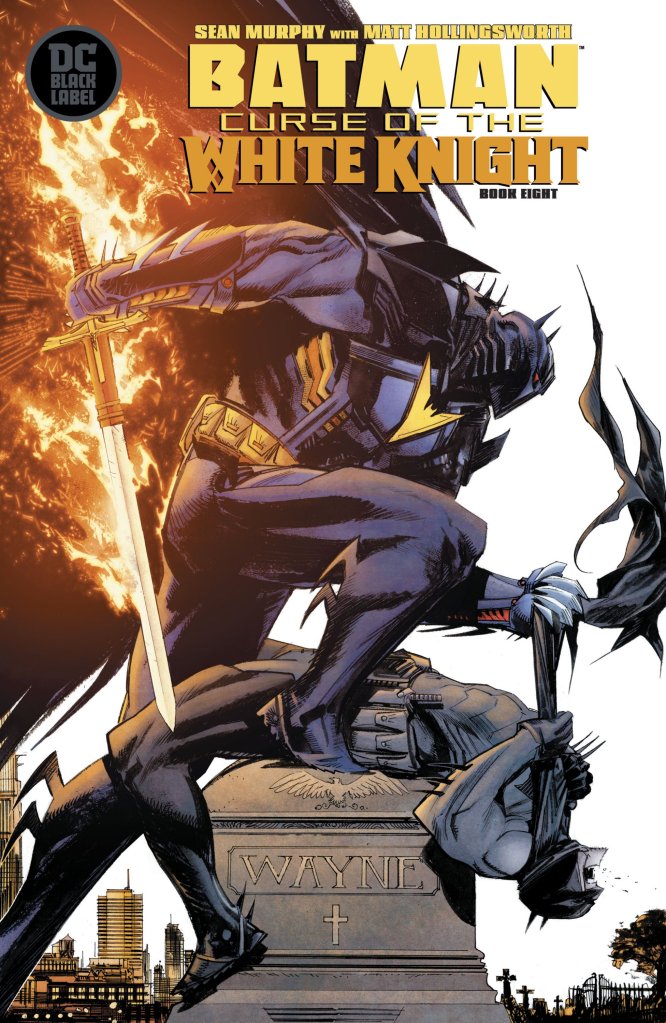
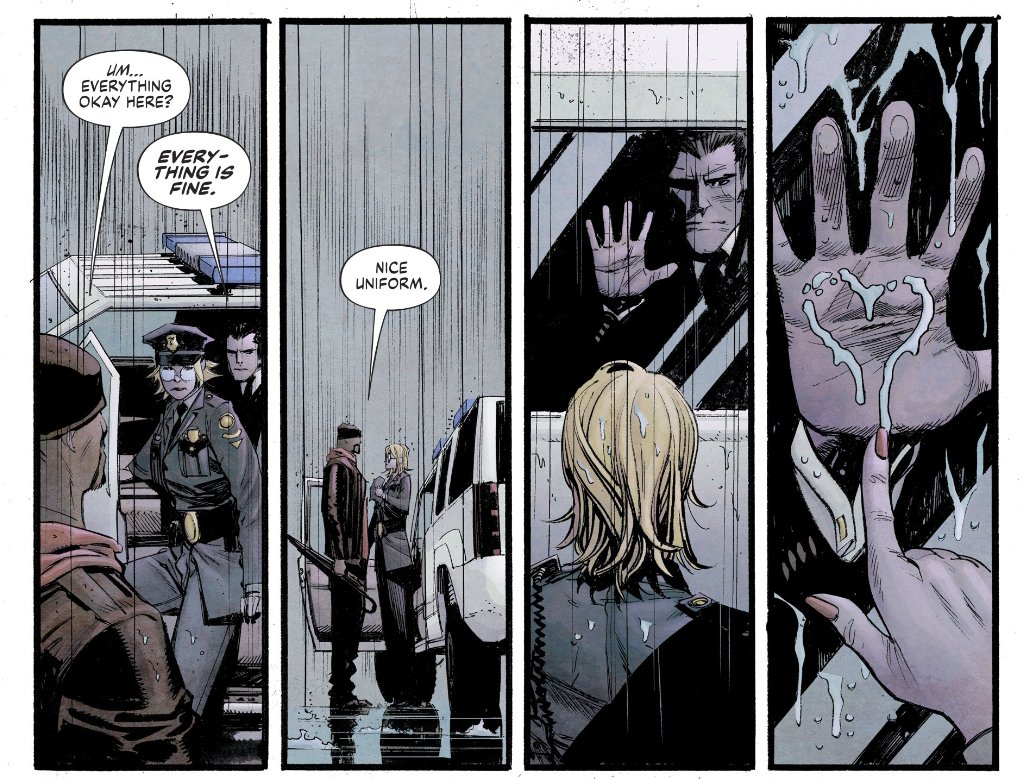
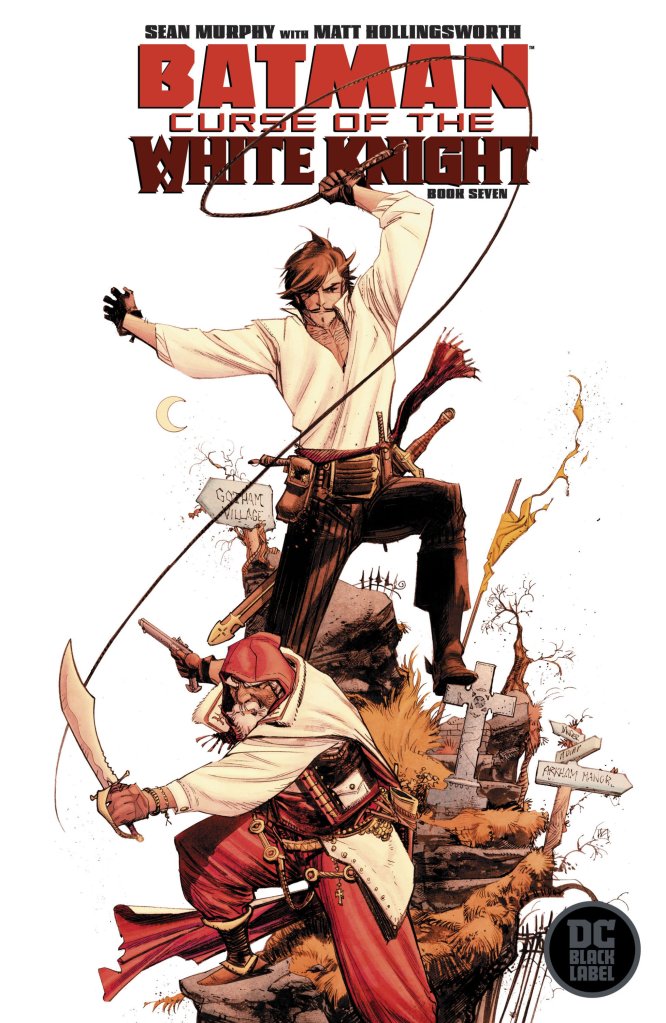
Best of this Week: Batman: Curse of the White Knight Book Eight – Sean Murphy, Matt Hollingsworth and AndWorld Design

And here we are at the end of the road.

The original Batman: White Knight gave us a tale of a hero who refused to see the error of his ways – a man that would lie to his friends and destroy his treasured city as long as villains received the justice that they deserved, but he never saw that he was becoming one of them. Enter Jack Napier, the former Joker, cured of the madness that led him down the path of costumed villainy for a time. He became a symbol for the change that Batman refused by offering to rebuild the broken down parts of Gotham and stopping Batman once and for all.

Unfortunately for Napier, he couldn’t keep the Joker at bay long enough to see his dream Gotham come to fruition, but he did manage to inspire, not only the people of Gotham and its police force, but Batman himself. Of course, not everything could remain peaceful. Soon after all of that happened, Azrael and the Order of St. Dumas cropped up to cause trouble and save Gotham from its false protector: Batman. Azrael serves as the logical conclusion to what Batman’s war on crime could have been.

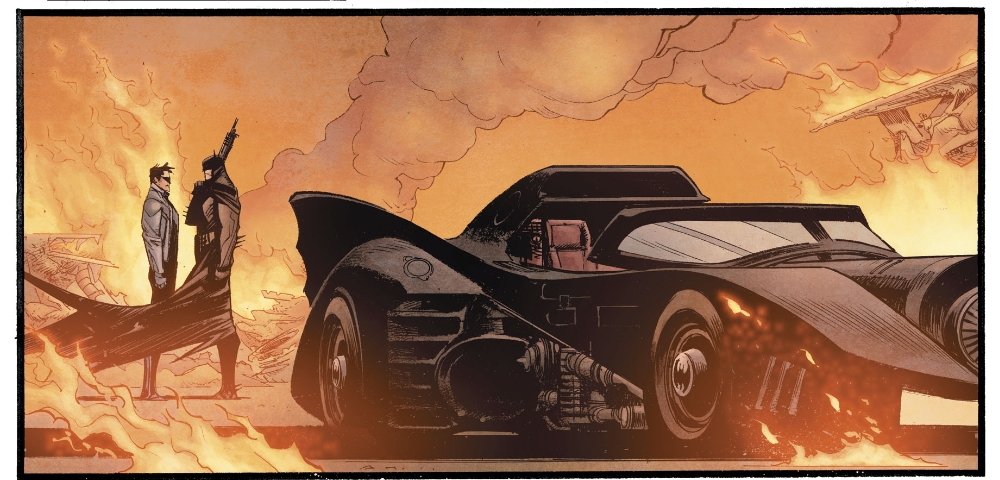
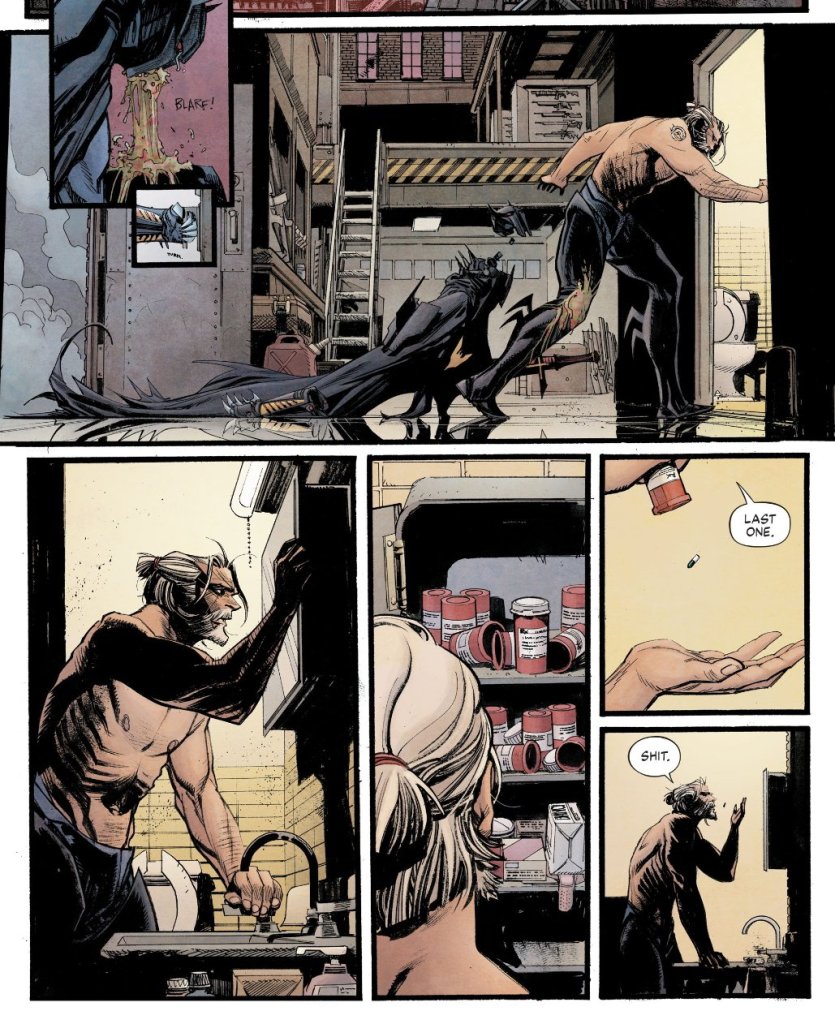
After several issues of cat and mouse, Batman is finally on the trail of Azrael with the Gotham Terrorism Oppression Unit (GTO) at his side. Initially, Sean Murphy makes the chase look like a team effort with Dick Grayson leading the charge, but Matt Hollingsworth gives slight hints at Batman’s state of mind with an orange glow around the Batmobile before getting close enough to remote shut off the rest of their cars. AndWorld Design excellently captures the slowing down of the cars with their lettering going from high energy “VvvvvvvVvvvvvs” to slow, sputtering “Pkk, Pkk” sounds as the wheels begin to stop.

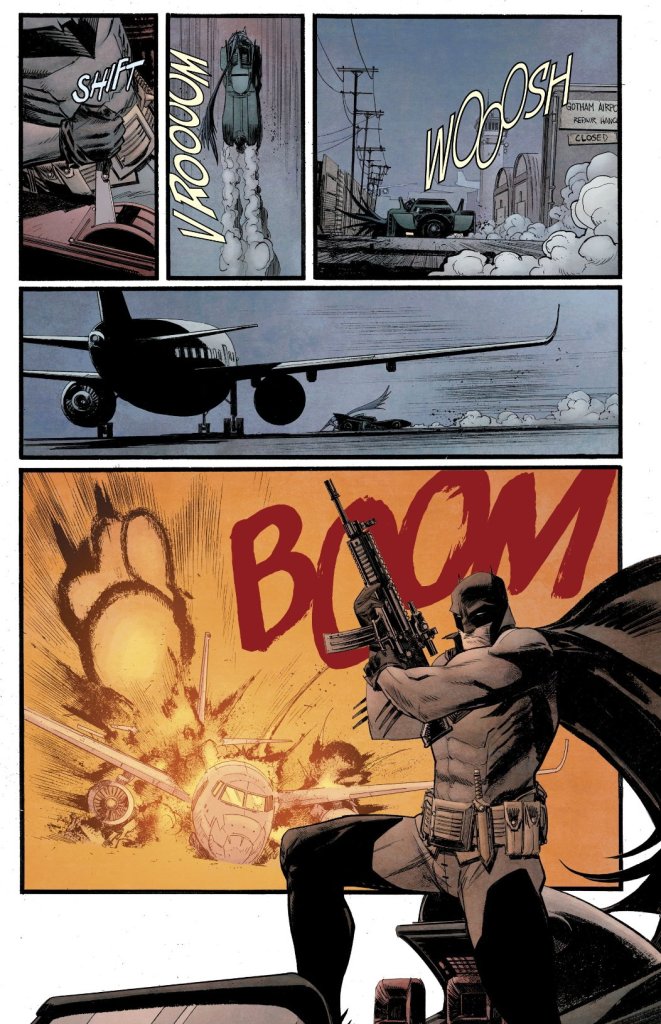
Dick, being the one closest to Bruce, had a conversation with him in the last issue and anticipated that he might have done something like this and tells the rest of them that it was because he didn’t want them to stop him from killing Azrael. Batman then zooms off to chase Azrael on his own, catching the villains foot with the cars grappling hook and hilariously swinging him around while drifting the car before reeling him in and reversing the car into a plane – all the way at the Gotham Airport. 

Sean Murphy is known to be a big car guy and he showcases the 1989 Batmobile with beautiful side shots, powerful flames blasting out of the exhaust right into Azrael’s face and even a single panel of Batman using a six gear shift to reverse. All of this badass car action results in a massive and fiery explosion. The big panel is beautifully shot with the plane being small in the background, the huge, orange pyro coming out of it, a big “BOOM” lettering in red to accentuate the power and Batman wielding some kind of assault rifle.

Of course, this is a betrayal of everything Batman is about and Azrael even acknowledges Bruce’s “No Killing” rule as the bullets bounce off of his armor before easily gaining the upper hand on this desperate Batman. Azrael then holds him by the collar of his cape and thoroughly dresses down Batman’s mindset for this entire fight, comparing the struggles of Bruce’s war on crime and futile search for peace as being the same as his own. 

Murphy and Hollingsworth draw the scene with a palpable sense of intensity as the fire rages around them while they stand on the debris of the plane and the Batmobile. The shot is pulled out, allowing for AndWorld to utilize the empty space for Azrael’s monologue while the hot oranges paint everything around them. As Batman fears his own end, Murphy draws him with terror in his eyes and a defiant gritting of his teeth as he tells Azrael to “go to hell,” for saying that they are one in the same and threatening to flood the city before Dick’s car barrels into the villain and causes another explosion. 

Initially, I questioned why Murphy decided to invert the timelines of Jason and Dick as Robins, but this book understandably gives good reason. One of the things that Dick had been dealing with over the course of both of these stories is his conflict with Batman over what the proper course of action should be when it comes to Gotham. He’s been Bruce’s biggest critic when he was destroying Gotham and didn’t want to be another casualty like Jason was, so he joined the GTO to stop Batman.

Murphy draws on this when Dick confronts Batman on his recklessness and Batman recognizes that everything he’s done, including adopting Dick and dragging him into this never ending battle all played a part in ruining his life as well as the lives of everyone close to him. Jason’s dark cloud has always hovered over Dick, but with tears in his eyes, he tells Bruce that he still believes in him and that he needs to end this fight as Batman, not as Azrael. Hollingsworth lowers the intensity of the orange backgrounds to make the scene more somber before Batman rushes off to do things the right way.

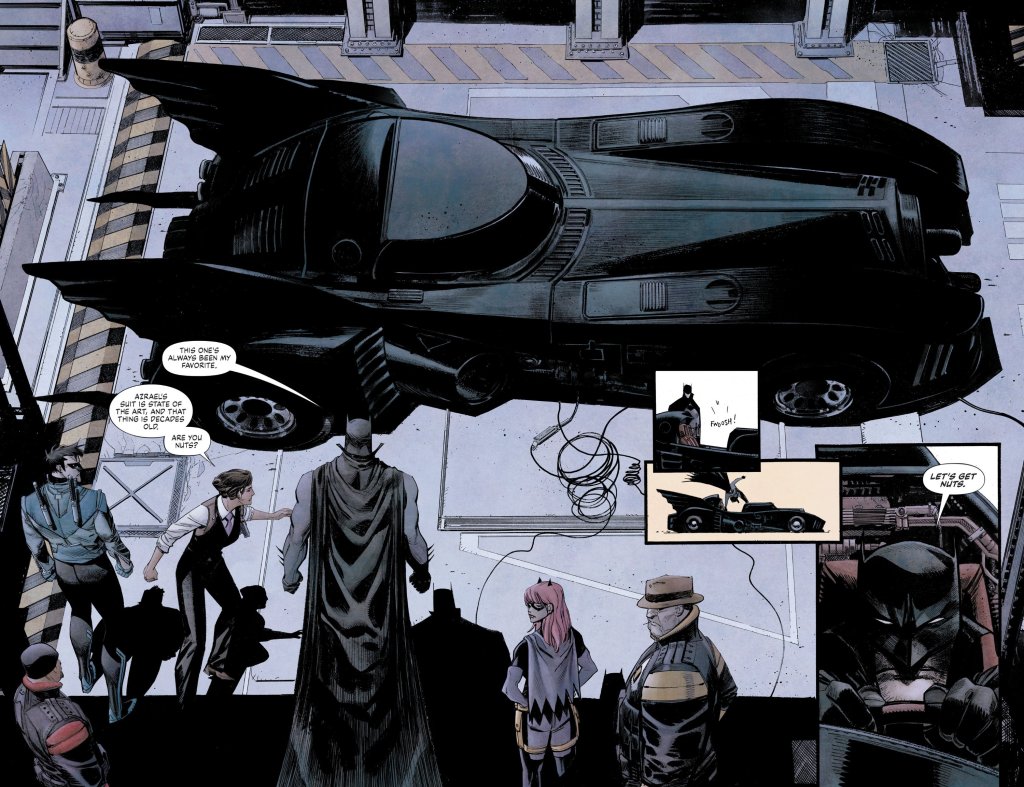
With the Rapiers of Edmond Wayne by his side, Murphy and Hollingsworth give readers an excellent double page spread of the Batmobile VROOOMing down the streets while various panels of Bruce’s interactions with Alfred, Victor Fries and Jim Gordon remind use that there’s a good man under that cape and cowl, a man that yearns for justice and peace in Gotham City.

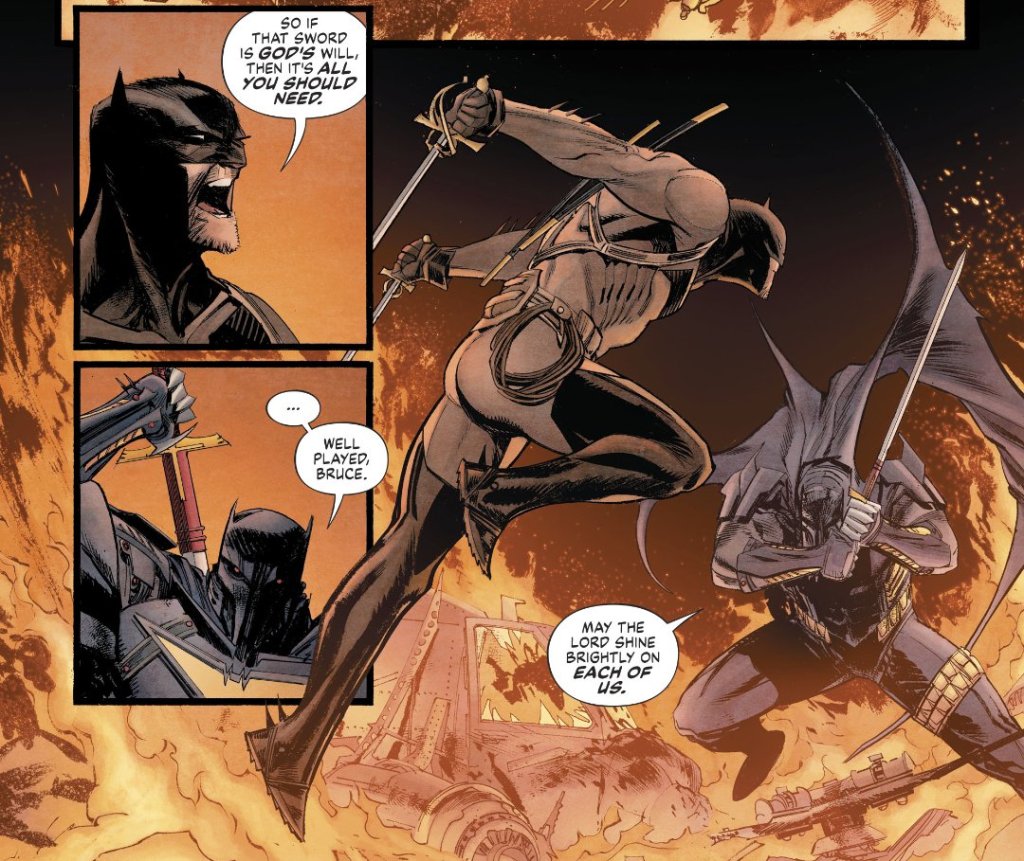
Knowing that Azrael plans to flood the city, Batman tells the GTO to shore up defenses and get everyone off the streets as he goes to finish the fight at the Gotham Reservoir and pops out of the Batmobile in an AMAZINGLY heroic pose with double rapiers sans cape, beckoning Azrael to take him in a sword fight. Murphy leans into Batman’s Zorro roots as he chooses to fight with honor, calling out Azrael’s faith, knowing that his sword’s Arabic name is God’s Will and that it is all that a God fearing man like Azrael should need and they duel valiantly.

Murphy, Hollingsworth and AndWorld Design give readers an amazing scene of Batman disarming Azrael rather than trying to kill him, removing one of his gauntlets with a deft flick, giving it a “HRRN” sound, removing his cape to get a rapier between his armor with a “WOOSH,” indicating the speed and flow of his movements. Bruce even goes so far as to let Azrael knock the rapiers from his hands so that he could knock the helmet off of his head by trapping it between the “CLINKing” panels of the Batmobile as they close before taking the villains sword.

Azrael, knowing that he’s going to lose and trying to throw Bruce off of his game for a moral victory, starts insulting Thomas and Martha’s deaths, calling them leeches of Gotham’s wealth. This causes Bruce, in a rage, to “HACK” across Azrael’s neck, slitting his throat. Murphy makes it look so sudden, Hollingsworth ratchets up the intensity of the flames in the background and emphasizes Azrael’s blood as it pours out onto the ground, proclaiming that Bruce “eliminated the last Wayne.”

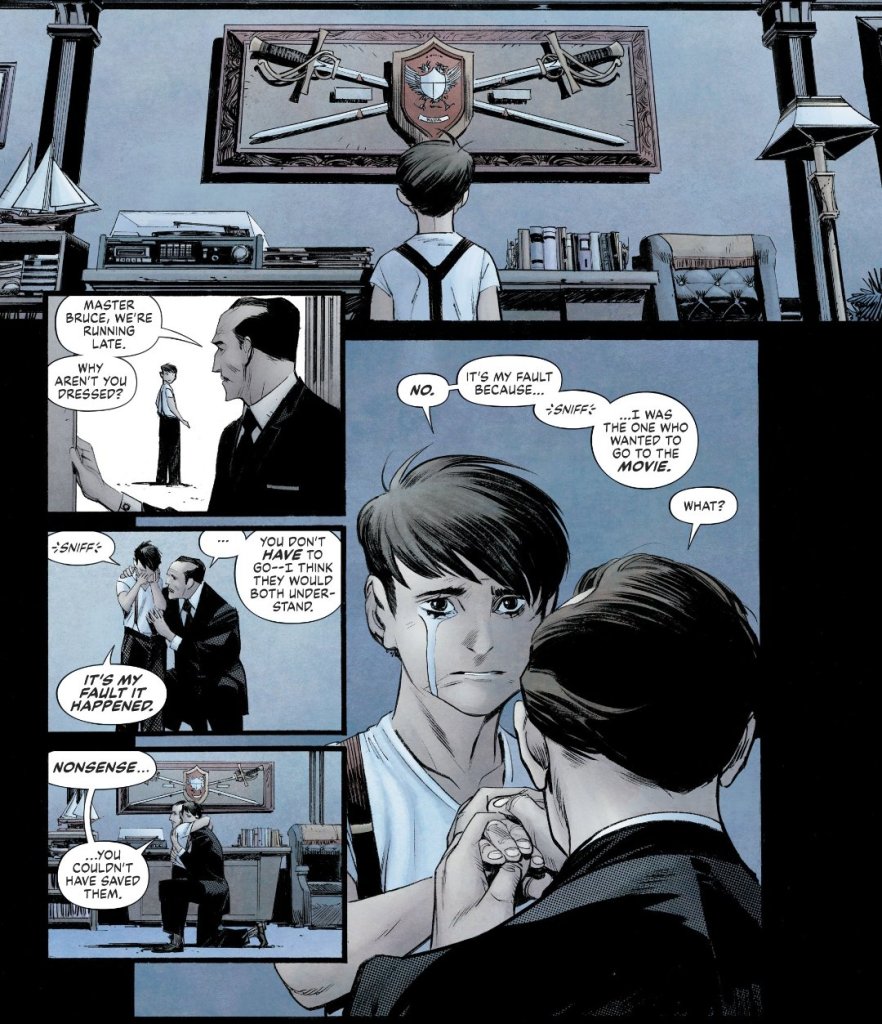
Murphy and hollingsworth treat readers to a beautiful panel of Bruce looking at his beloved city, shadowed in the night sky with orange glows coming from the streets while Azrael bleed out on the boat, Batman quickly decides to suture his throat and use his blood to keep it flowing into Azrael while proclaiming that being the protector of Gotham has always been about more than being a Wayne or a Bakkar. It’s bigger than blood and that’s why Jason Blood gave Edmond’s Journal to Bruce, because Batman was always Gotham’s true hope.

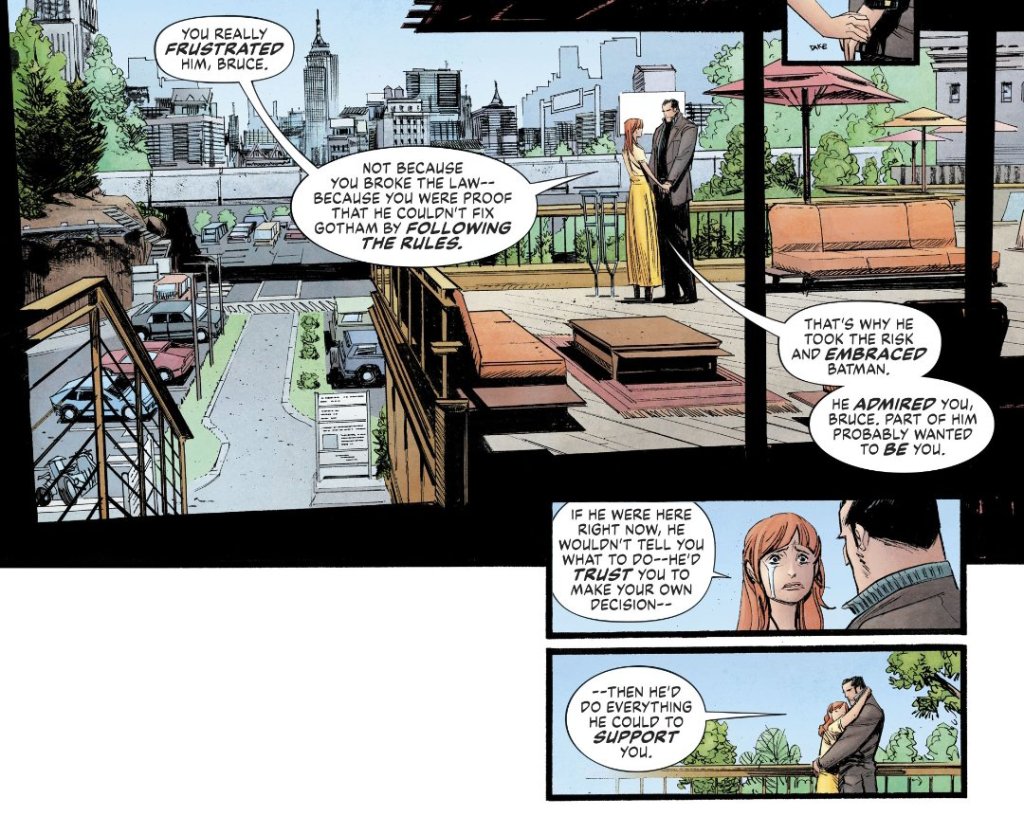
The series then starts winding down with Bruce saying his goodbyes to Dick and Barbara and the rest of the GTO with varying levels of banter. Even Harleen has a moment where we think she’s going to drive Bruce away as he allows himself to be arrested for his vigilantism, but he convinces her that she’s done all that she needs to and that she saved his soul when he was at one of his lowest moments just like he did for her after leaving The Joker. It’s sad and sobering, especially as these scenes are given a blue hue and these characters have a mutual love and respect for each other.

Murphy also drops in some political commentary at the end where the City of Gotham argues over Bruce giving away all of his fortune to the City and whether or not it goes far enough or veers too far into socialism. While this particular White Knight story has been focused on the heroism side of Batman, I might have liked more of this commentary throughout the book, much like it was focused on in the original series. Though, who’s to say that that’s not where Murphy is going as this book ends on something of a cliffhanger with a SURPRISING reveal.

For the end of such a phenomenal book, I can gladly say that this was absolutely worth it. From the compelling story, to the amazing art, coloring and lettering, almost everything about this was perfect in every way. I really enjoyed seeing Batman’s journey from angry vigilante to true savior of Gotham and the dichotomy between him and Azrael as an angry war veteran. Knowing that Sean Gordon Murphy has been given free reign to start his own White Knight Imprint, I’m ultra excited for what the future holds!

Best of Marvel: Week of March 25th, 2020

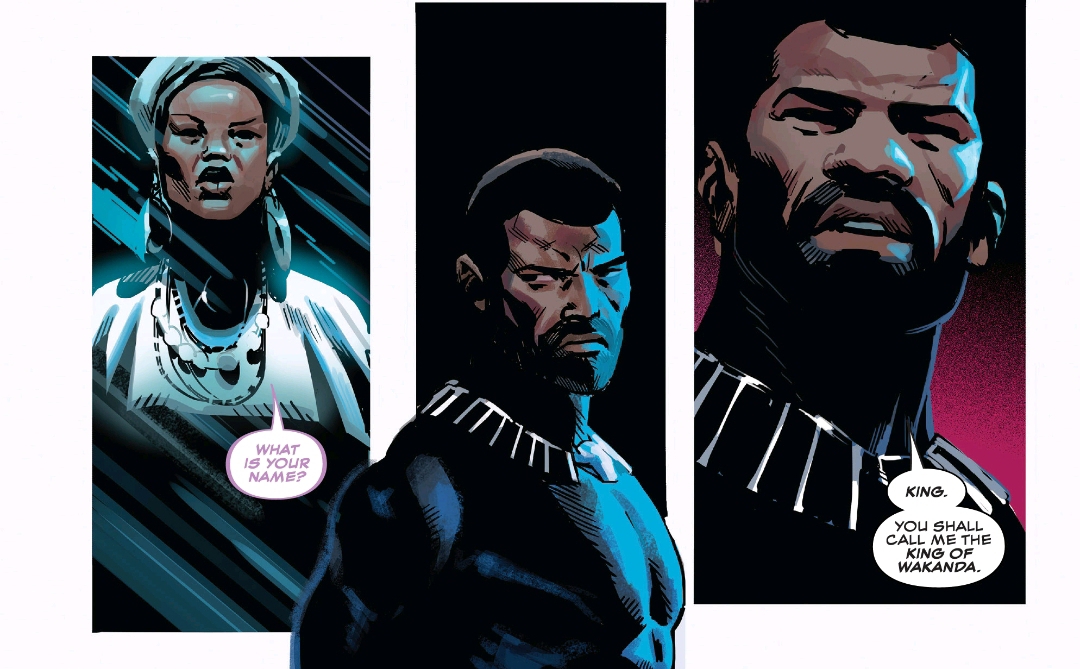
Best of this Week: Black Panther #22 (Legacy #194) – Ta-Nehisi Coates, Daniel Acuna, Ryan Bodenheim, Chris O’Halloran and Joe Sabino

Can T’Challa ever be redeemed?

Most people might not know, but I have something of a distaste for the King of Wakanda for various reasons over his long, illustrious, heroic career and, over time, it has all spun into a neverending flood of anti-T’Challa bias as time has gone on. From his time as part of the Illuminati to his failed relationship with Storm, I have hated this character and the fact that his misdeeds have gone mostly unpunished…until now.

The Black Panther has never been an apologetic hero and he shouldn’t have to be because he is a king and needs to be strong for his people. Though with his nation on Earth and in Outer Space under siege by the resurrected Erik Killmonger with a symbiote of the former Emperor N’Jadaka, T’Challa has trials to face before he’s able to command his people and see his defeat. His biggest question is, what is his name and will he be able to overcome his own transgressions and become the leader his people truly need?

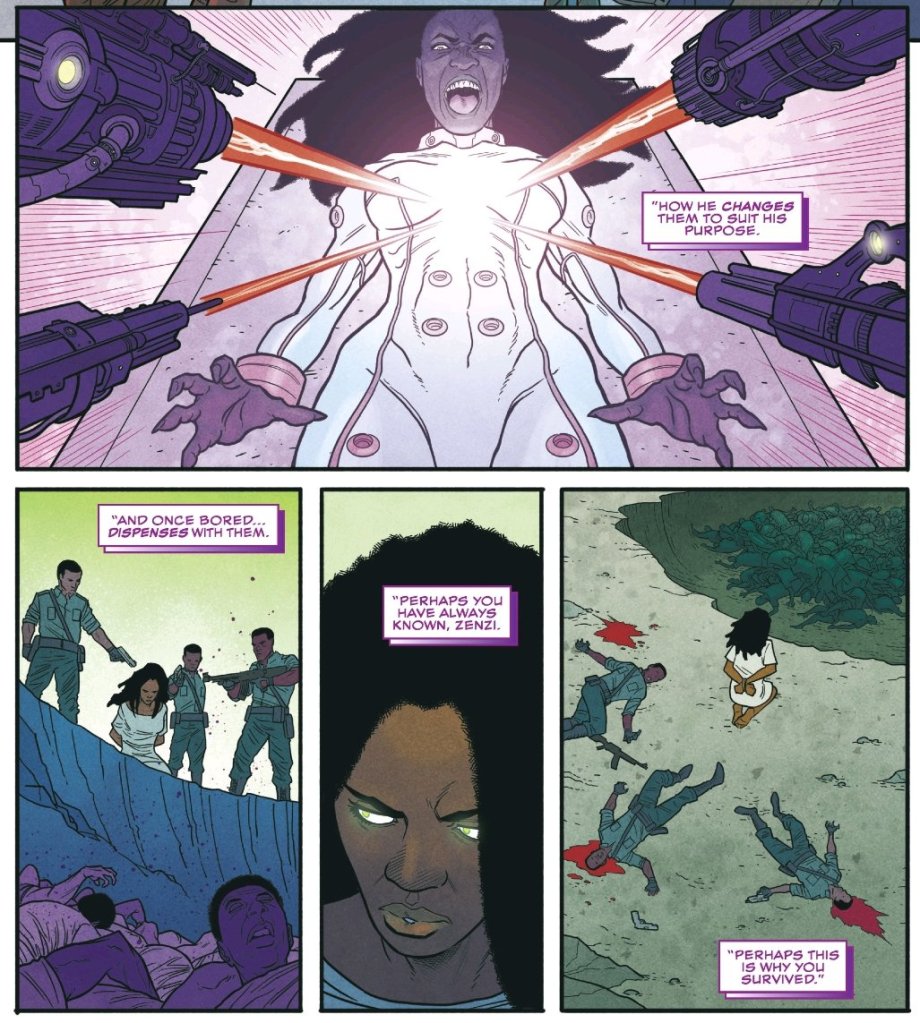
The main theme of Ta-Nehisi Coates’ Black Panther story is redemption. This issue begins with Zenzi, one of the first new villains introduced by Coates in his initial Black Panther series back in 2016, and gives us a little bit of her backstory with some history involving the original Killmonger. Through Ryan Bodenheim’s pencils, we see the simmering anger and power that she’s been capable of since her introduction and why she’s so eager to see the end of men like T’Challa who use their people and then discard them like Killmonger did for her, giving her superpowers and then trying to have her executed.

Bodenheim and Chris O’Halloran on colors gives this scene and her subsequent conversation with Bast in the body of a child a sense of weight as we now are able to understand why she’s on a mission to rid Wakanda of false rulers, Gods and Kings as Killmonger killed her entire village for his own ends and she likely feared T’Challa was doing the same to Wakanda. O’Halloran uses soft and hazy colors for the flashback, employing slight green and purple hues and switches it up to vibrant greens for Bast’s astral projection and Zenzi’s clothes as the Goddess convinces her to support Wakanda against Emperor N’Jadaka.

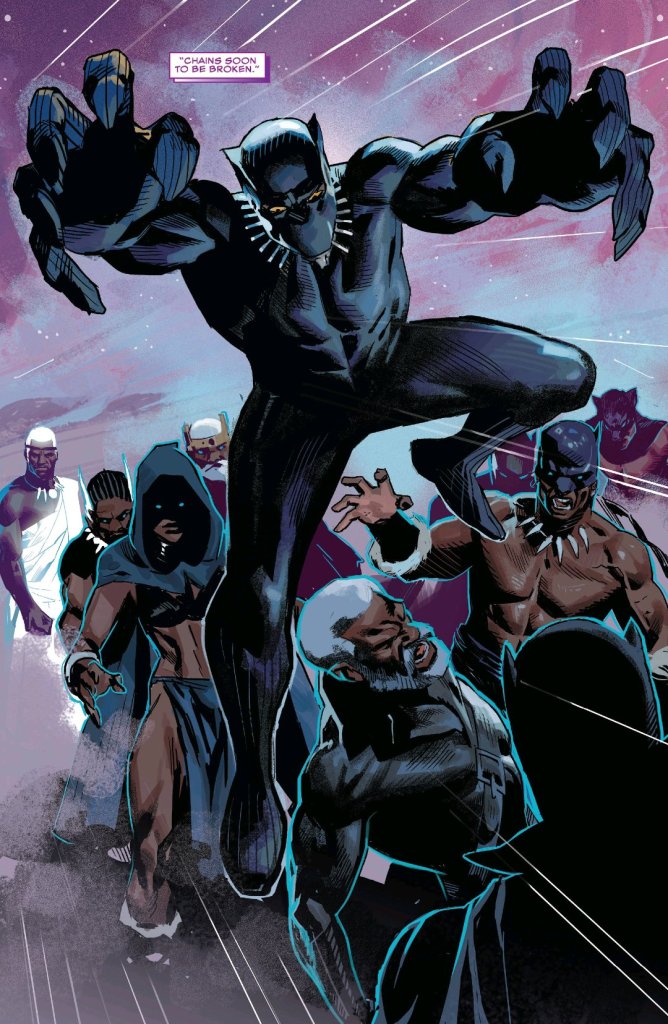
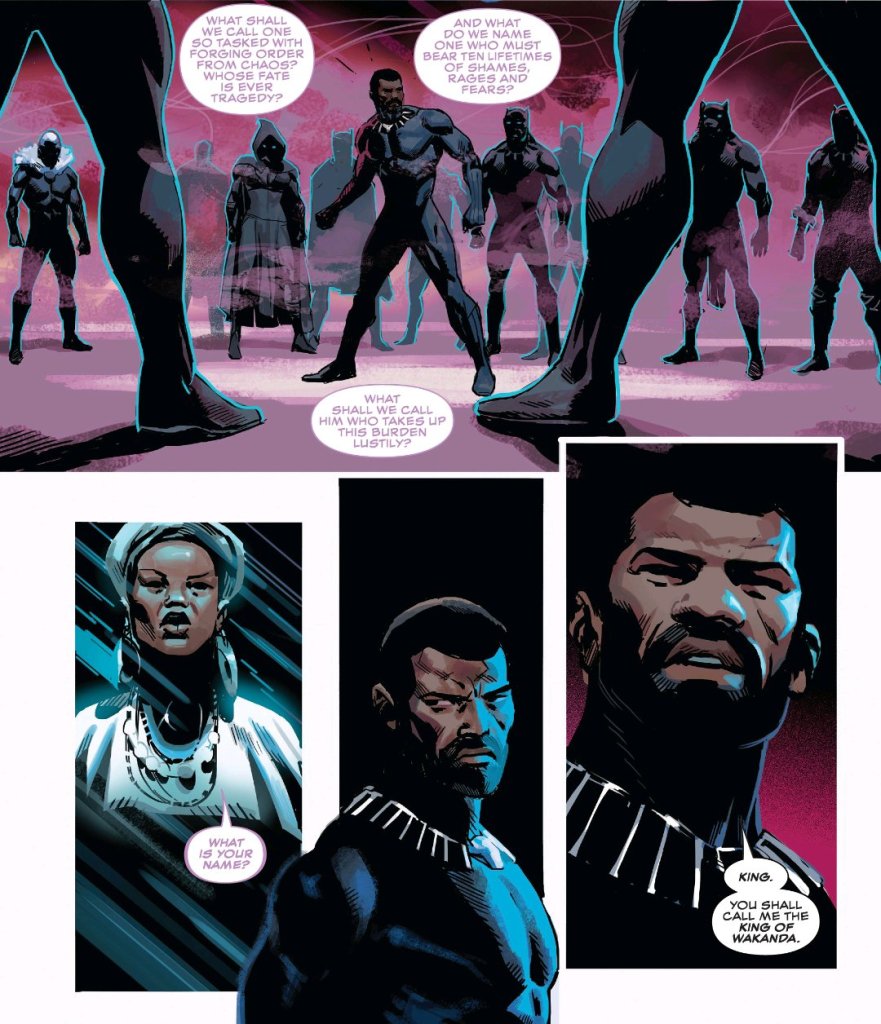
At the same time, T’Challa finds himself within the Djalia, the Plane of Wakandan Memory, facing off against his many ancestors to gain their help and fealty so that he may finally put this battle to rest. The main problem he faces, however, are both their numbers himself as a King. Daniel Acuna takes over the art for this portion of the issue and absolutely stuns throughout with impressively smooth linework and coloring which gives distinct borders to characters and their clothing and backgrounds while being absolutely beautiful at the same time. 

Joe Sabino’s lettering also shines here as he makes the distinction between T’Challa and the many other Black Panthers by giving him black letters and word bubbles while the rest have purple letters because of their nature as ethereal beings. Not only that, but his sound effects accentuate the panels perfectly as the “TWOK” from a headbutt is given a yellow hue while being transparent to show impact and a “THUD” from  T’Challa being swept at the feet is colored in a bright blue that accentuates the yellow background.

One of his female ancestors mocks his so-called “preparation” as he summons a white, luminescent spear to fight them all before she summons the Ebony Blade of the Black Knight (see Black Panther 22 – 23, 2005) and slashes him across the back, revealing his own recent past to him. This is meant to serve as a way to show how T’Challa is not as infallible as he makes himself out to be, considering how many times he’s been on the wrong side of history in regards to the world, his people, his lovers and his friends.

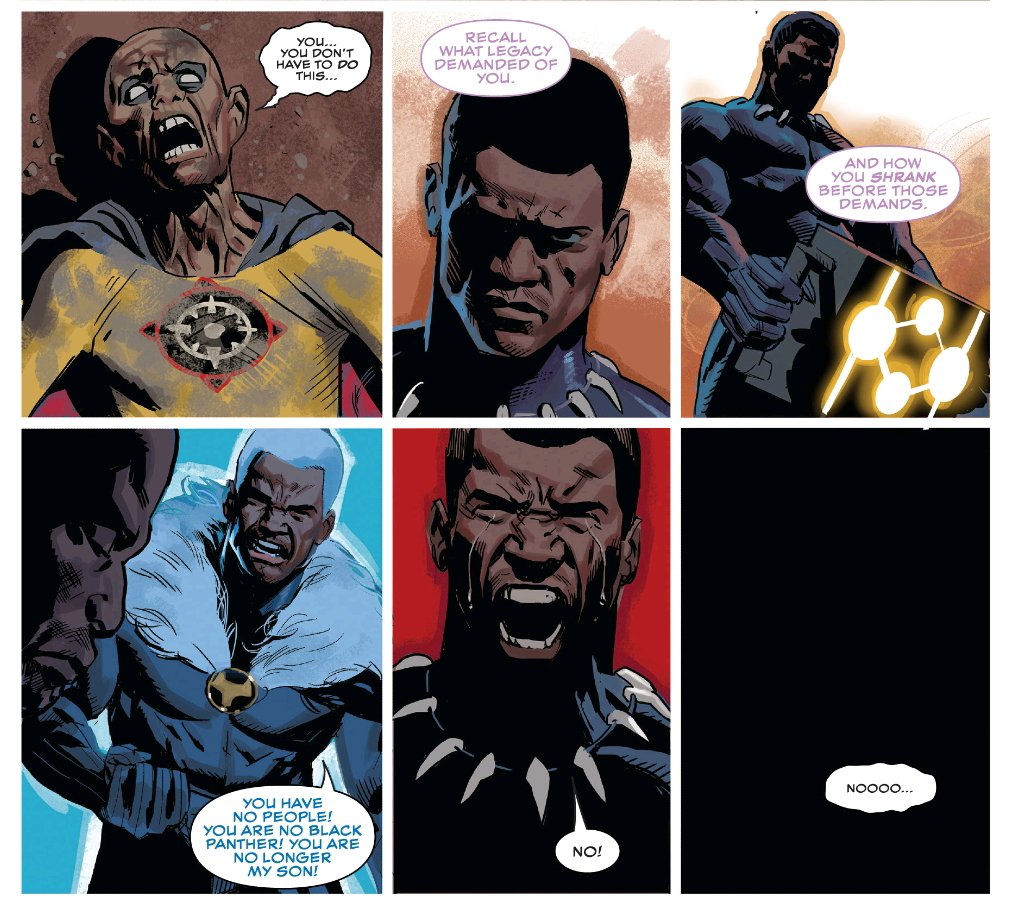
Coates has obviously done his research into Black Panther’s best and worst moments as the first flashback we get is from Jonathan Hickman’s New Avengers (#21, 2013) after the Illuminati defeated the heroes of another Earth to save their own, the caveat being that they would have to destroy the other Earth. This was one of the lowest moments for the hero as he couldn’t do what needed to be done and King Namor had to, knowing that sacrifices had to be made in order to save the Earth. He shrank away from his duties of protecting the Earth – of protecting Wakanda after The Black Order had attacked it merely ten issues prior.

Daniel Acuna portrays T’Challas fear and reticence to commit such an atrocious act by having his face mostly shadowed and showing him cry as King T’Chaka lambasts him from the spirit world for his cowardice. Coates and Acuna then cut back to the hooded Panther and she asks what his ancestors should call the boy who scorned his legacy and T’Challa, still reeling from pain, says his own name before being slashed again.

Acuna begins the next flashback with a beautiful wide show of T’Challa looking upon a vibrant purple and almost 3D looking silhouette of the secret meeting location of the Illuminati before they wiped the memory of Steve Rogers. This was because they decided to destroy planets when the honorable soldier would not and T’Challa is framed in the background of these shots, just watching it happen. Coates makes it a point to stress that “No friendship [was] too precious to be spurned.” Then he is attacked by the Spirit of his grandfather, Azzuri.

Thematically, this makes sense as Azzuri and Steve Rogers first met when the Red Skull and Hydra Nazis tried to invade Wakanda for Vibranium and the two heroes had to fight them off, becoming friends and allies over the course of their battles together (see Marvel Knights’ Flag of our Fathers, 2010). Acuna gives the T’Challa/Azzuri fight a sense of speed by using a lot of blur lines as well as struggle squiggles as T’Challa is placed in a chokehold. As he breaks free, Azzuri disappears into a cloud of hazy, purple smoke.

We are then given a flashbak of what I consider to be his greatest failure, his broken vow and fight against Storm during the events of Avengers vs. X-Men where he stood against Mutantkind after the first mutant child was born post Scarlet Witch’s Decimation of them. The child, Hope Summers, was prophesied to be either the savior of mutants or the destroyer of everything and Black Panther cast his marriage aside during the conflict (AvX #5, 2012), though it was continued in Coates’ series years later.

Of course, while ancestors are supposed to tear you down, it was his mother that proceeded to build him back up. The final flashback given is T’Challa’s birth mother, Nyami, showing T’Challa how King T’Chaka also grieved after his wife’s death, but because he was not just one man, but a nation, he had to move past it and that’s what this whole story has been about. T’Challa’s actions have all been about him and his decisions and not about Wakanda as a whole. He forgets that he is the crown and therefore the Nation itself.

Coates has become a master of longform storytelling as he’s managed to craft a saga of almost fifty issues of T’Challa taking responsibility for his crown and Coates has framed that excellently by the name he keeps giving when his ancestors ask him who he is: T’Challa. The wrong answer. Acuna show’s the various ancestors surrounding the man, waiting for him to give the correct answer as his mother encourages him and he stands for a moment before speaking. What should he be called?

King. King of Wakanda.

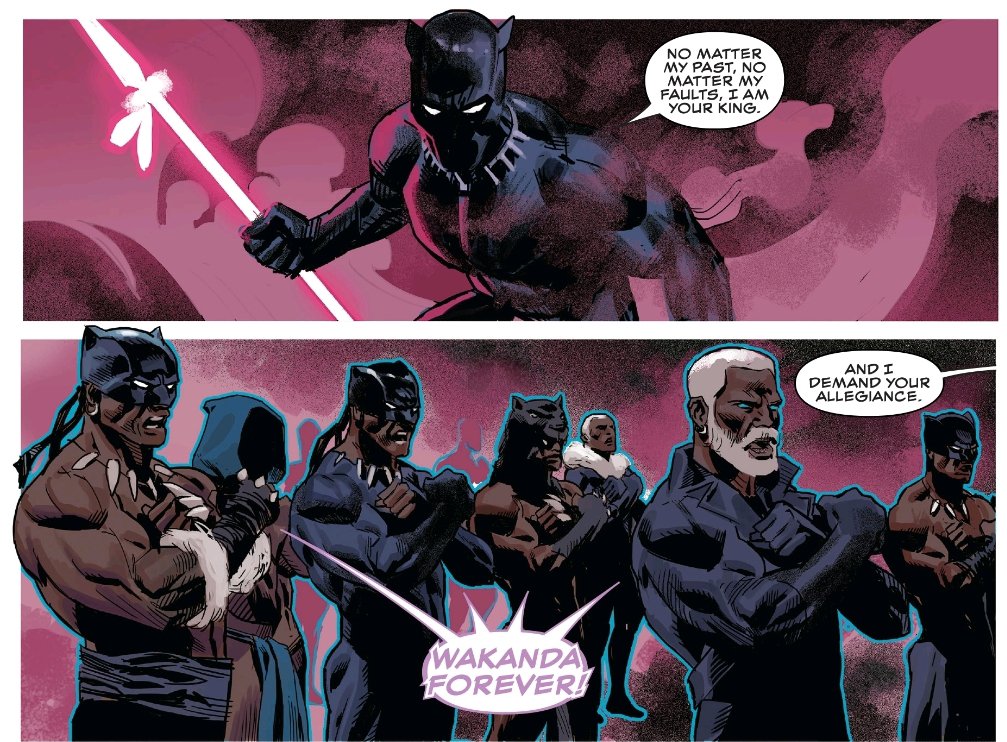
In that very instant, Acuna draws all of the ancestors giving King T’Challa the, now iconic, Wakanda salute as he demands their allegiance. He feels so strong, so complete as a character now that he accepts and acknowledges his many faults as part of who he is. He doesn’t need to apologize for them because they are a part of who he is as a man, but when he is a King, he must be better. He must protect his people and that is why he will be able to stop N’Jadaka in the coming battle, just like he stopped Killmonger all those years ago as well.

This issue of Black Panther was phenomenal and really shows how much Ta-Nehisi Coates has grown from his initial few books which were mostly full of world building. He’s shown that he can create an amazing and expansive story that utilizes not only T’Challa’s extensive history, but also that of the Marvel Universe at large to make this story seem grand and far reaching as something on this scale should. 

Ryan Bodenheim does have amazing skills as a penciller, but I found myself far more engaged with Daniel Acuna’s style throughout this issue as he manages to make the fight seem so ethereal while also focusing on some of my favorite moments of Marvel History – not to mention his colors are always so vibrant and loud, popping off the pages with the intensity that readers have come to expect from him.

I hope that the rest of this series continues this upward slope because this was fantastic and it gets a high recommend from me!

Best of DC: Week of March 18th, 2020

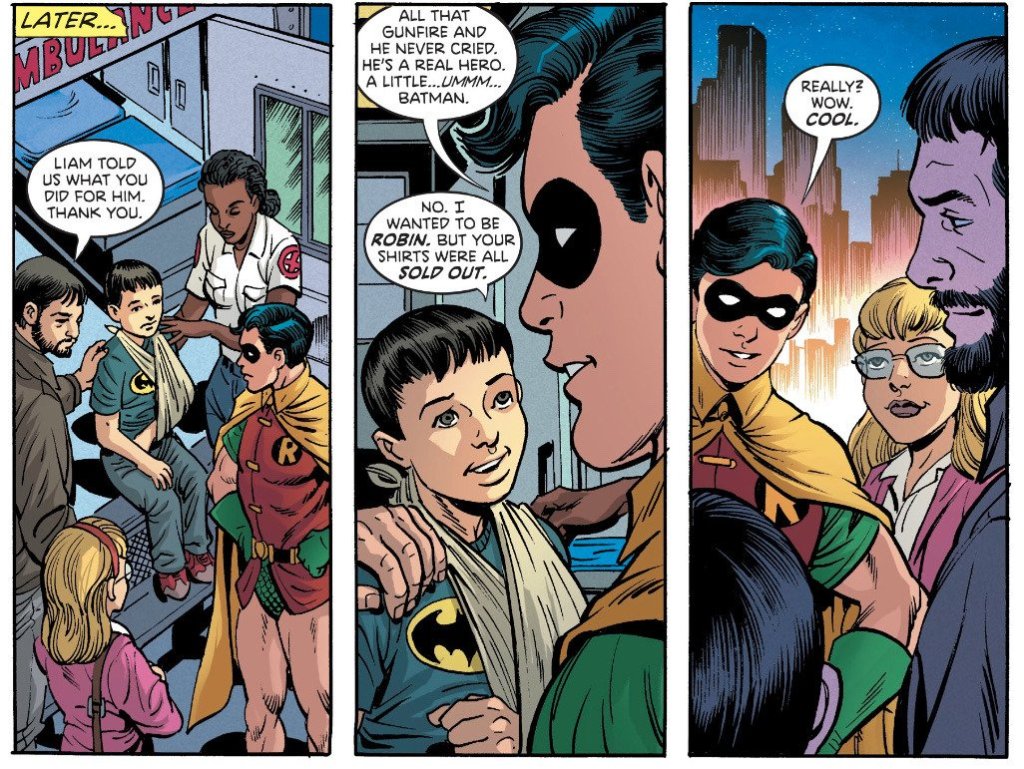
Best of this Week: Robin 80th Anniversary

All of the Robins are awesome.

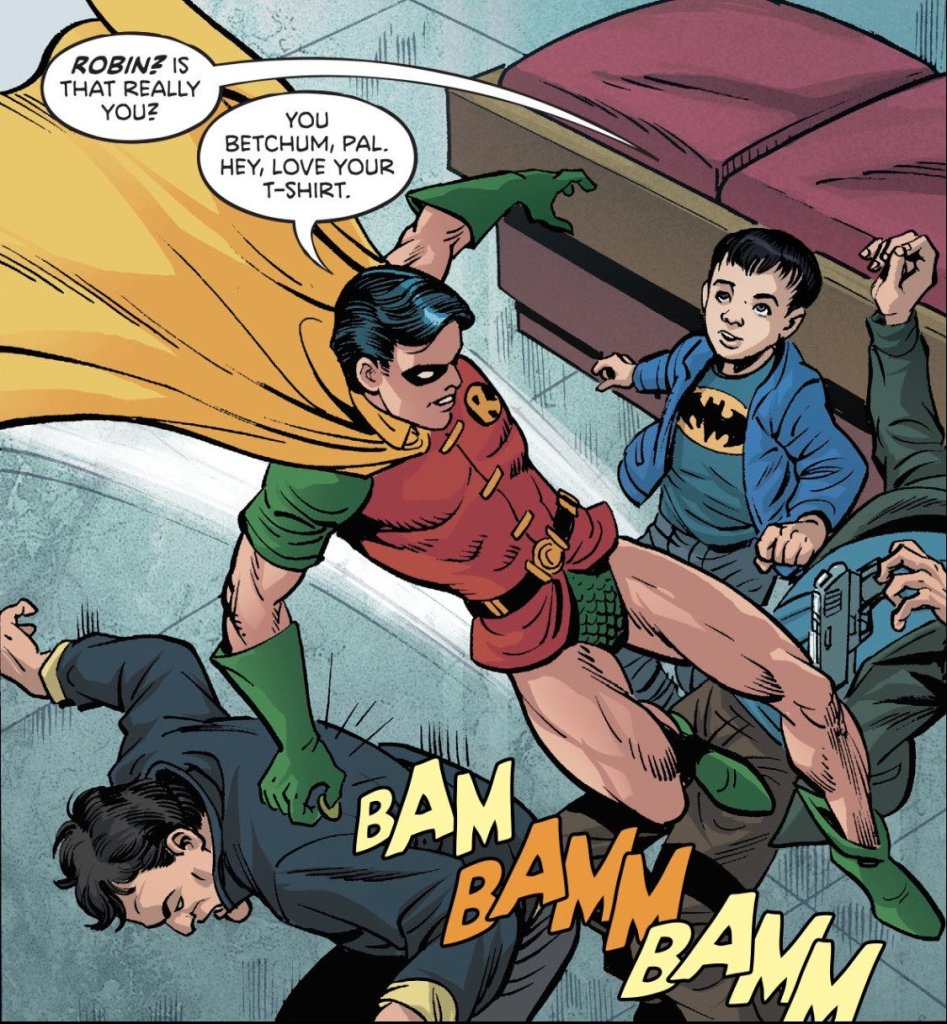
Every Bat-fan has their favorite as they usually define the era when they began their love of Batman and comics in general. Older fans love Dick Grayson for being the first and greatest Robin that helped make Batman brighter. Edgy 80s kids and teens both love and hate Jason Todd for being the bad boy that died. Younger fans love Tim Drake for being the one to carry the name in the later seasons of the animated series and being one of the best and smartest Robins. Girls get representation from the spunky Carrie Kelly and the awesome Stephanie Brown. No one like Damian. (I’m kidding, he’s super fun.)

There’s a Robin for everyone and this 100 Page Spectacular celebrates the long history of Batman’s greatest sidekicks (though misses a chance to give Carrie Kelly her own short story) and does an amazing job in displaying each characters personalities by some of the best people to have written them over the years. Because there are so many, I’m only going to talk about the ones I really enjoyed!

The first FOUR stories follow Dick Grayson and some of his best eras.

“A Little Nudge” is written by Marv Wolfman with pencils by Tom Grummett, two parts of the legendary team behind the best years of the New Titans (1989). This story follows Dick Grayson as Batman begins to nudge him in the direction of becoming his own man by being increasingly irritable to his protege. At this point in time, Dick was dealing with the stresses of outgrowing his childhood identity and Batman’s continuing overbearing nature. Where Bruce was all about being cold and methodical, Dick thought with his gut.

Grummett, Scott Hanna on inks and Adriano Lucas on colors illustrate Dick’s frustration through his increasingly sour facial expressions and sudden heroic actions. The costumes are as colorful as those old days with Dick wearing the bright yellow cape, bright red tunic and the elf shoes. In the middle of the dynamic duo’s fight with Natural History Museum thieves, Dick stops fighting when a child gets shot, against Bruce’s orders, and stays with him until the bad guys either get away or get taken down by Batman. 

Later on, Dick tells Batman that he’s outgrown the Boy Wonder name and sets off to become his own man as Nightwing. Wolfman gives readers an excellent inner monologue from Bruce where he owns up to the fact that he was nudging Dick in that direction because he had just turned eighteen and Bruce believed in him. Batman always supports his kids, especially his first and it turns the story of separation into something heartwarming.

“Aftershocks” is a fun story by Chuck Dixon and Scott McDaniel who worked on my favorite Nightwing series in the 1996 – 2005 era of the character. This wasn’t anything major, just Nightwing doing everything he could to save people after an earthquake causes massive damage to a suspended bridge in Bludhaven. This era of Nightwing was characterized by him mostly striking out on his own and becoming a Bludhaven police officer, being inspired by Jim Gordon. 

Dick really came into his own and developed a rogues gallery to himself during this time, not to mention the sweet costume with the blue “wings” running down his arms into his fingers and those big, bulky gauntlets and boots. This era was the epitome of the 90s with big set piece moments, big muscles and Nightwing just being a nice and generally charming guy. After diving off of the bridge to attach a winch to a falling car, the woman inside asks to name her baby after him and he smiles and says, “Robin works, right?”

“The Lesson Plan” is a story from my favorite modern age creators in Tim Seeley, Tom King and Mikel Janin. The Grayson series took place shortly after Dick’s identity was exposed to the world during “Forever Evil” (2013) by the Crime Syndicate. At this time he was acting as a spy for an agency called Spyral while spying on them for Batman. I never think of Tom King as a comedy guy, but this story was almost gut bustingly hilarious. It was just a world trotting adventure where he teaches one of the students of St. Hadrian’s how to be a spy.

Truly this series was Dick at his most handsome, witty and skilled. He jumps out of a helicopter and grabs onto the cords of a cable car before rescuing a woman held hostage by terrorists on walruses. Dick, the student and the hostage ten fight off more terrorists in Tanzania, riding a bus headed for Los Angeles of all places before Dick finds himself in something Dejah Thoris would wear and having a night with the hostage who reveals herself to be a gorilla from Gorilla City. It’s absolutely absurd, but it is immensely fun and welcome since that whole series is well regarded by fans.  

“More Time” by Judd Winick, Dustin Nguyen and John Kalisz is a far more somber tale about Jason Todd potentially a short time after the events of Under the Red Hood. Jason Todd was the second Robin and met his unfortunate end in the 1988 story, A Death in the Family by Jim Starlin and Jim Aparo. Jason eventually returned in the Batman: Under the Hood story where Winick and Doug Mahnke re-envisioned the former Robin as a violent vigilante Jason does have something of a strained relationship with Batman, but it wasn’t always that way as this story illustrates. 

One thing that Dustin Nguyen has always been great at, it’s making kids super adorable and he does so in this story as it flips back and forth between the past and the present as Jason gives Bruce a birthday present in the form of his father’s watch, which Jason sought to fix. Nguyen and Kalisz characterize the past with Jason appearing as a happy, young kid under the dim lights of the Batcave and a twinkle in his eyes. He’s happy to have a home and a father to care for him so he wanted to do something nice for him.

Present Day Jason is characterized by dark backgrounds with bright oranges, smoke and heavy blacks for the shadows. Jason is far more tired, grizzled and angry, but he still finds the time to place the same gift box from all those years ago on the Batmobile for Bruce to find. At this point in time, they may have been at each other throats, but the love between them was still there, buried deep – culminating in two side by side panels of past and present Jason saying, “Happy Birthday, Bruce.”

“Boy Wonders” is a story about Tim Drake by James Tynion IV, Javier Fernandez and David Baron and sees Tim taking advice from all of his brothers. Next to Chuck Dixon and Geoff Johns, James Tynion IV has had one of the longest lasting impacts on the Tim Drake character throughout his run on Detective Comics by emphasizing the power of his mind in comparison to the other Robins and why he could ultimately be the successor to Batman above each of them or eke out a new life for himself.

While taking down the cast of The Warriors on a speeding train with Nightwing, Tim contemplates what his future will be. He looks to Dick as the one who did everything that he’s doing now and Dick tells him that as the smartest Robin, the best thing he could do is use that mind to bring up the next generation of heroes. Jason, the reason he’s even wearing the costume of Robin in the first place, tells him to take everything he’s learned from Batman  to become BETTER than him. Arguably, it’s Damian that gives him the best advice by telling him that he’s the most capable of all of the Robins and that he should choose a path himself instead of relying on the advice of others.

Of course, this story takes place before the events of Detective Comics Rebirth where Tim does chart his own path in making Gotham safer with his Gotham Knights Protocol, but things don’t exactly turn out well for him. For all of the talk about how Tim is the smartest, he unfortunately could never get out of his own way long enough for things to go right…especially now that he’s going by “Drake” in that awful brown costume.

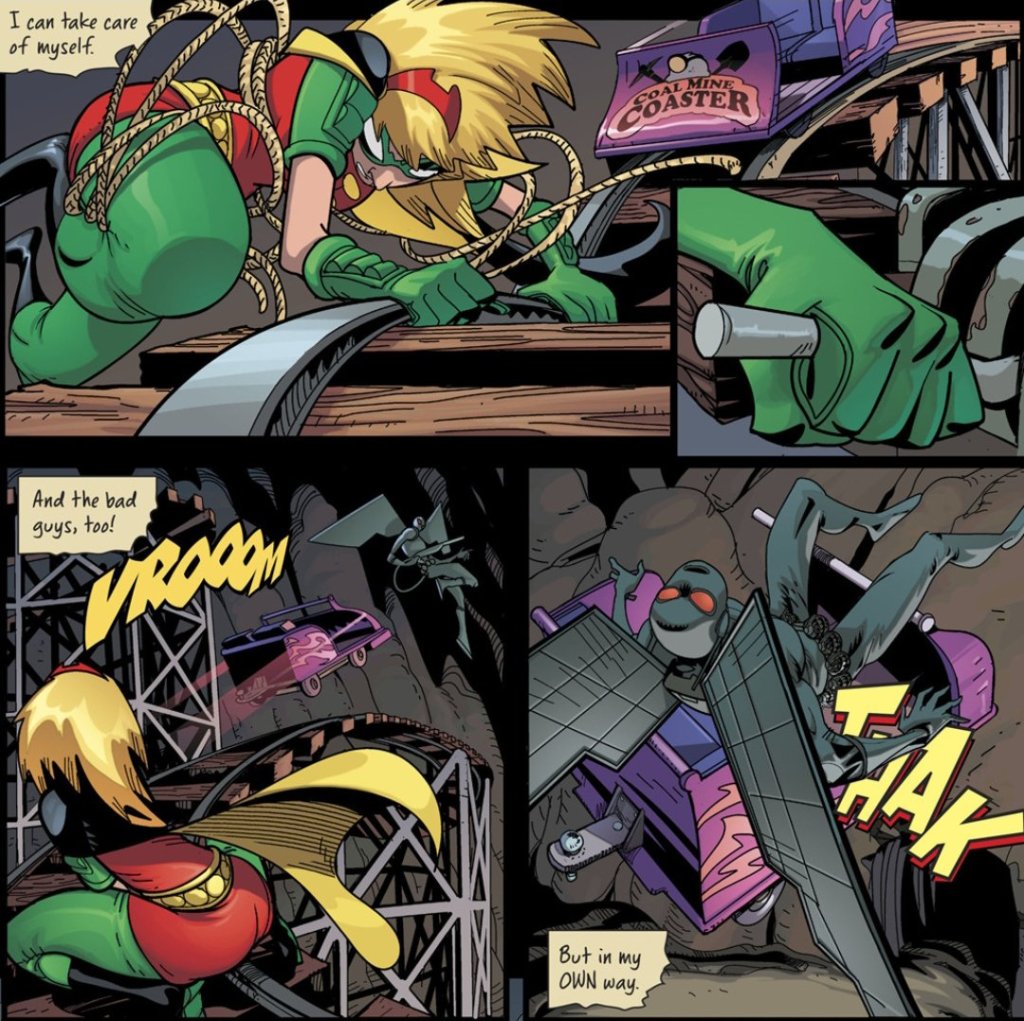
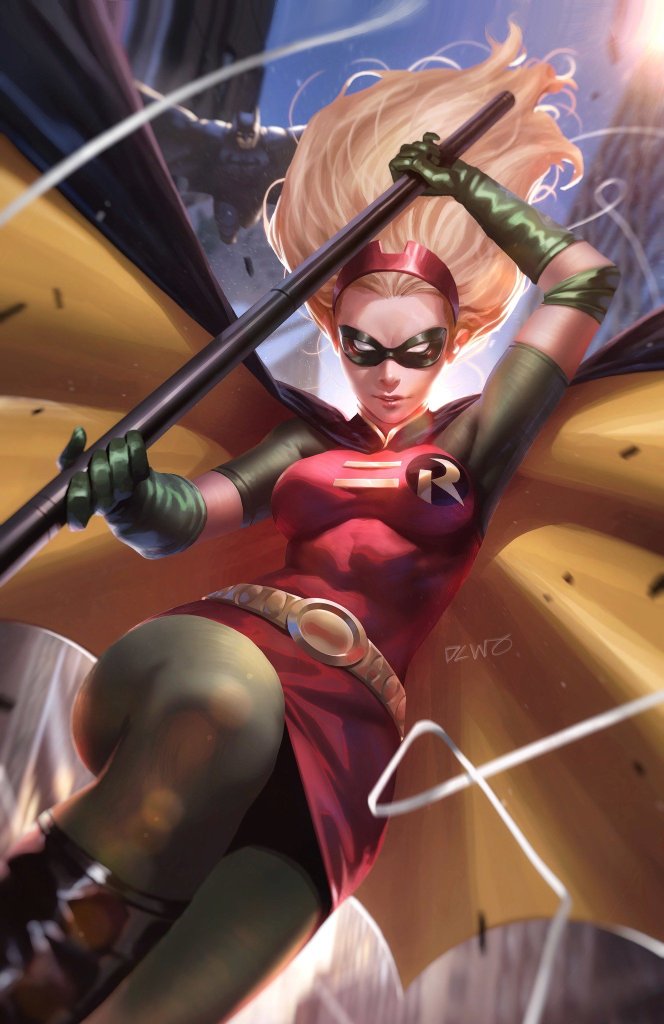
“Fitting In” is a Stephanie Brown story by Amy Wolfram, Damion Scott and Brad Anderson which sees Stephanie trying to live up to the standards of each of the boys that came before her. Stephanie was absolutely the shortest term Robin that Batman took on, as he only allowed her to take up the mantle in an attempt to get Tim back after his real father told him to hang up the cape after discovering his sons identity.

Even still, Stephanie did everything she could to earn Bruce’s respect and Wolfram plays on this and that past story by making it more about Tim than Steph. She has to train in the same costume that Tim did, but she proves more…voluptuous than Tim. Her costume bursts at the seams and Alfred designs the costume that she’s known for. She and Batman then get a call about fire at an amusement park and ride off to take down Firefly.

Unfortunately for her, she gets captured, but being the innovative girl that she is, she manages to free herself and take down Firefly at the same time. Damion Scott’s art is very well suited to the cartoonish action and paints her as a capable sidekick despite initially being a damsel in distress. I honestly wish her run as Robin would have been longer because she honestly fits well in the role as the bubbly Robin in contrast to the hell that Tim was going through at the time.

A point can be made that this story also had some needless sexualization, but given Bruce’s lack of respect for Stephanie and him just wanting a replacement Tim at the time, this was well written from that perspective. He never cared for Stephanie and her time as Robin was mostly her trying to live up to Tim’s standard which eventually left her to try too hard and “die” because of it. I’ll always take more Stephanie Brown as I can cause even now there’s not enough of her and I’m damn sure not reading Young Justice by Brian Michael Bendis.

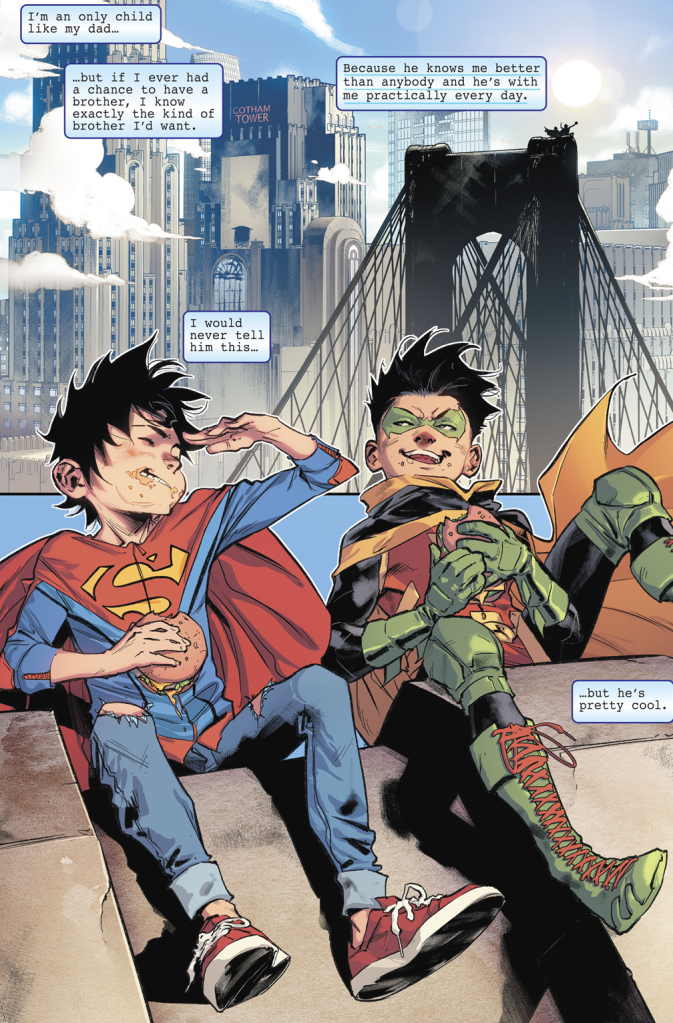
“My Best Friend” is the one that makes me the most sad as it revolves around Jon Kent writing an essay on Damian as well…his best friend. I feel like the Super Sons series was also done a dity hand by BMB as he took Jon and aged him up for his Superman story when we could have gotten more fun stories between Damian and Jon. As far as homages to one of the better Rebirth series this one was just fun.

There’s not much to say other than Jon reminisces over a few of their adventures and tells readers about the side of Damian that we don’t often see because the Bat-boy is always a little bit too intense. Jon reminds us that they’ve fought for most of the time they’ve known each other, but when it comes to being heroes, Damian always had his back. It’s heartwarming. Of course there’s the continuity issue of them going to the same school in this story cause Jon was only ten at the time and Damian was thirteen, but honestly I only care about the friendship.

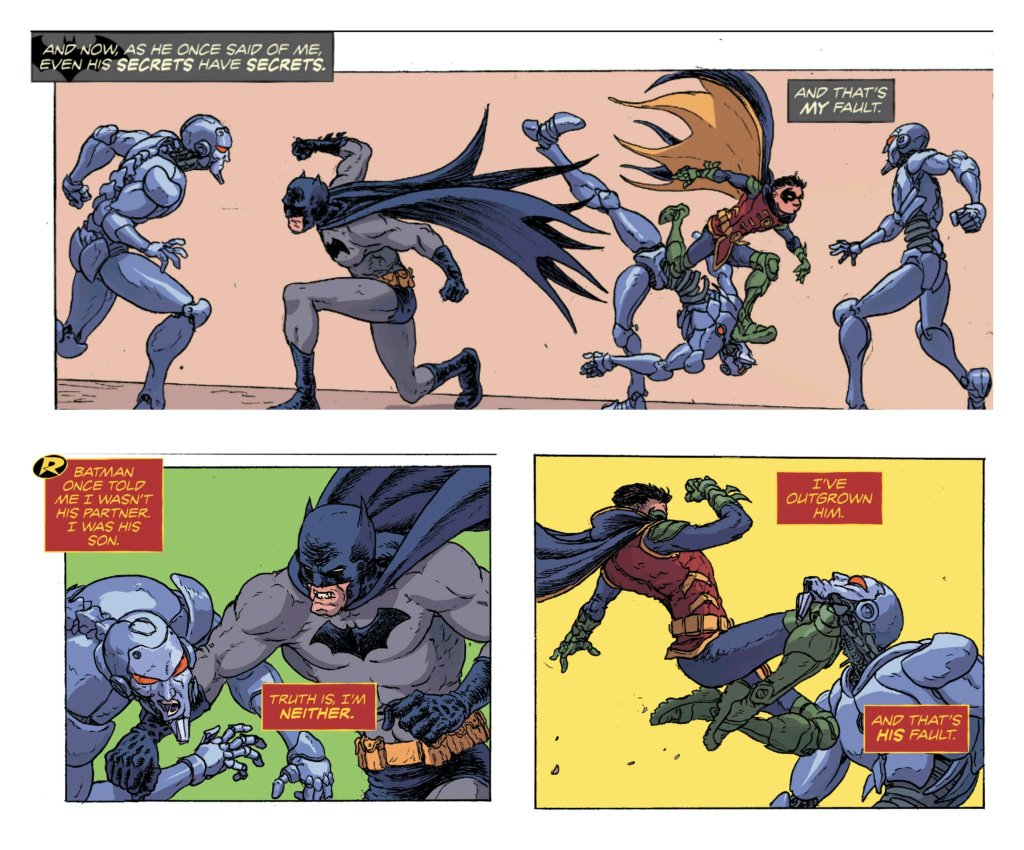
“Bat and Mouse” is a story by Robbie Thompson and Ramon Villalobos which sees Bruce and Damian having separate brooding inner monologues about how neither understands the other anymore and about how they want to open up to each other, but the distance between them has grown too wide. Admittedly, this is a much darker story in the respect that Batman and Robin haven’t really been the same since Damian started his new Titans team and started down a darker path that his father has yet to find out about.

Thompson captures this feeling that Damian is arrogant but scared. He feels like he’s outgrown what Batman has become because he’s willing to get rid of threats almost permanently through erasing their memories and villainous tendencies (see Teen Titans, 2018). At the same time, he’s afraid that maybe what he’s doing isn’t the right path and he so desperately wants to reach out to his father, but feels like he can’t.

Batman is the same way in that he loves his son more than anything and wants to regain the relationship that they had in the past, but doesn’t know how to say the words either. He knows that Damian is hiding something big, but he doesn’t want to accuse the boy and deepen the already cavernous rift. Even as they take down the robotic villain Quietus, they show signs of breaking through their equally cold exteriors, but fail to do so and I get the feeling this will all come to a head soon.

The Robins will always be some of my favorite characters in all of comics. Each of them have distinct personalities and quirks that set them apart from a lot of comic characters, especially when it comes to the trauma that they’ve faced alongside Batman. This special won’t be for everyone, just like each era of Robin isn’t for everyone, but overall, I really enjoyed it and the creators selected to honor these fantastic characters.

Best of Marvel: Week of March 18th, 2020

Best of this Week: Outlawed #1 – Eve L. Ewing, Kim Jacinto, Espen Grundetjern and Clayton Cowles

It all starts with one incident.

The original Civil War kicked off when the New Warriors team, trying to get footage for their terrible reality TV show, started a battle with some supervillains in hiding, one of which was Nitro. Nitro self destructed and wound up killing over 750 people in Stamford, Connecticut. This resulted in heroes choosing sides in the debate of whether or not to register their identities and receive training under SHIELD, effectively being handed a leash, or choosing to fight against the tyranny of having their lives exposed and powers exploited.

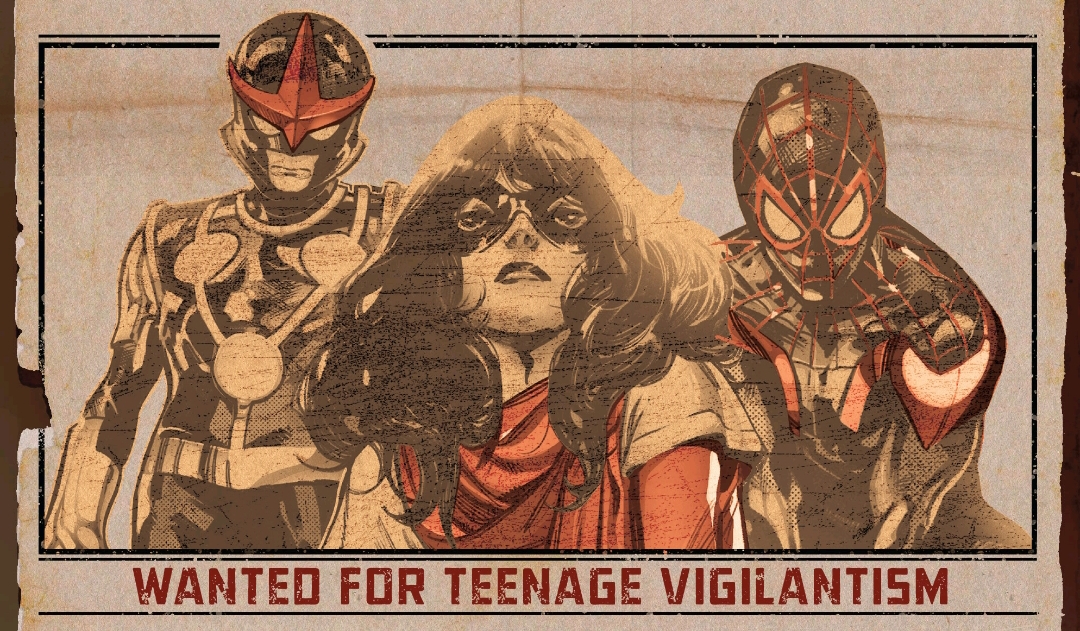
It’s been a little over 13 years since that story and a new crop of heroes has emerged in its wake. Outlawed #1 takes the basic concept of Civil War and lowers sheer tragedy while maintaining the stakes of hero groups like The Champions who are caught in the immediate crossfire of its inciting incident, most specifically, their leader: Kamala Khan.

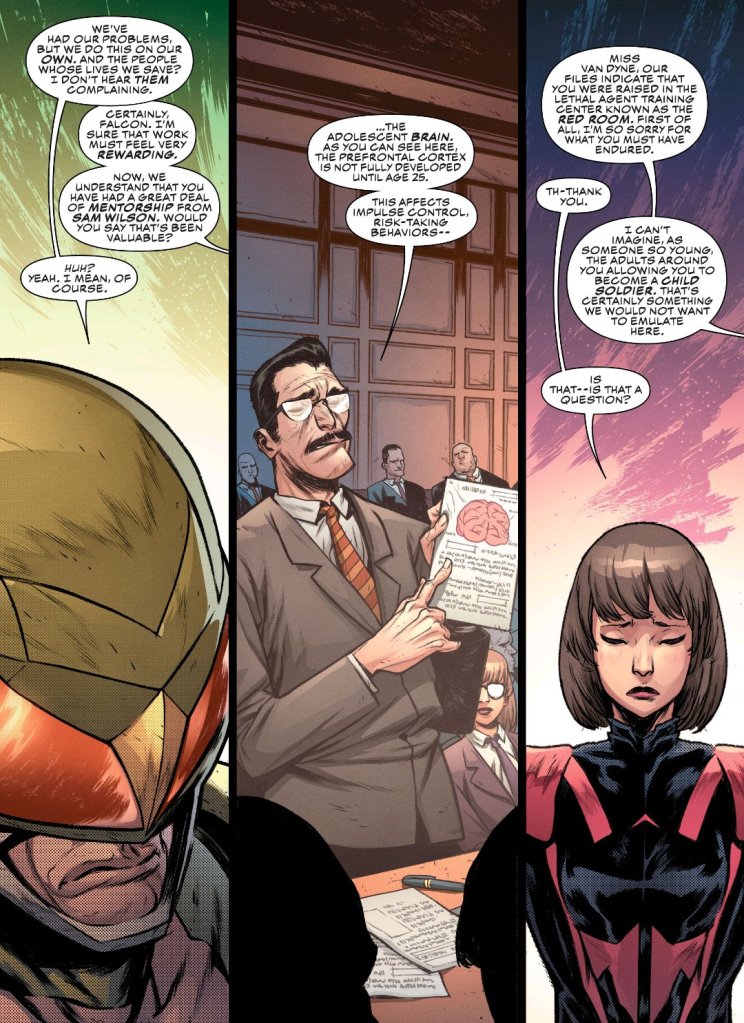
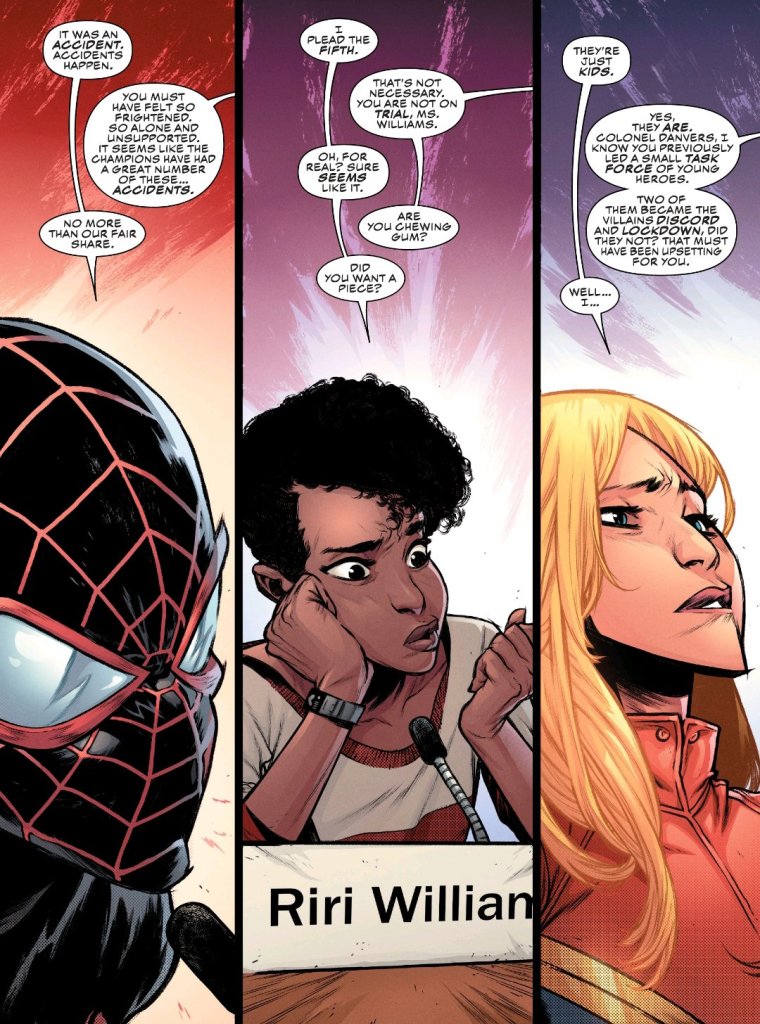
Eve L. Ewing starts the book in medias res with a Legislative hearing on a bill that would ban underage superheroism. Not only are the teens present, but we also get appearances from Avengers like Captain America, Captain Marvel and Vision, all of whom have big stakes in the fight. Captain America understands why they’re having the hearing, but counters that he was doing what the Champions were when he was their age, fighting for Freedom and he’s not wrong, but times have changed and there weren’t as many active superheroes as there are now.

Captain Marvel is a damning case as she’s managed to avoid any repercussions for her actions during Civil War II for the last few years, but one of the senators brings up the fact that two heroes under her charge became supervillains, those being Kamala’s former friends; Discord and Lockdown. She stammers as she can’t counter that and Vision is initially silent, indicating that something happened to Viv Vision in whatever incident occurred. 

When Spider-Man, Riri Williams, Nadia Pym and Sam Alexander (Nova) are questioned, they are treated as though they are kids who needed adult support and supervision, almost like fragile things and not like heroes who have helped save the universe. Kim Jacinto and Espen Grundetjern characterize each hero through facial expressions and backgrounds that color their moods. Miles looks furious under his mask with a red background, Riri is nonplussed as she always is under a cool purple glow and Nadia is forlorn with hazy pink color.

Sam then goes on a tirade about how these same people don’t care about the problems that the Champions were created to solve like poverty, drug abuse and hunger and only make a stand when the kids try to protect their own and he makes a good point. When they were founded, the adult heroes were just fighting one another again and again, month after month and not caring about the citizens… but his concerns are simply pushed to the side by a well dressed man with a Supercuts hairstyle and fake concern.

We then cut to the “Coles Academic High School” where Kamala, Miles and others are attending some sort of teen summit to watch over the plot device, Ailana Kabua, as she’s been receiving death threats for her speeches on environmentalism. She’s a very obvious nod to Malala Yousafzai, a young Pakistani advocate for female education, and Greta Thunberg, the young Swedish environmental activist that’s also begun to speak to the world. Both of these young women have courted controversy for speaking about what they believe in and have garnered undue hatred for it.  

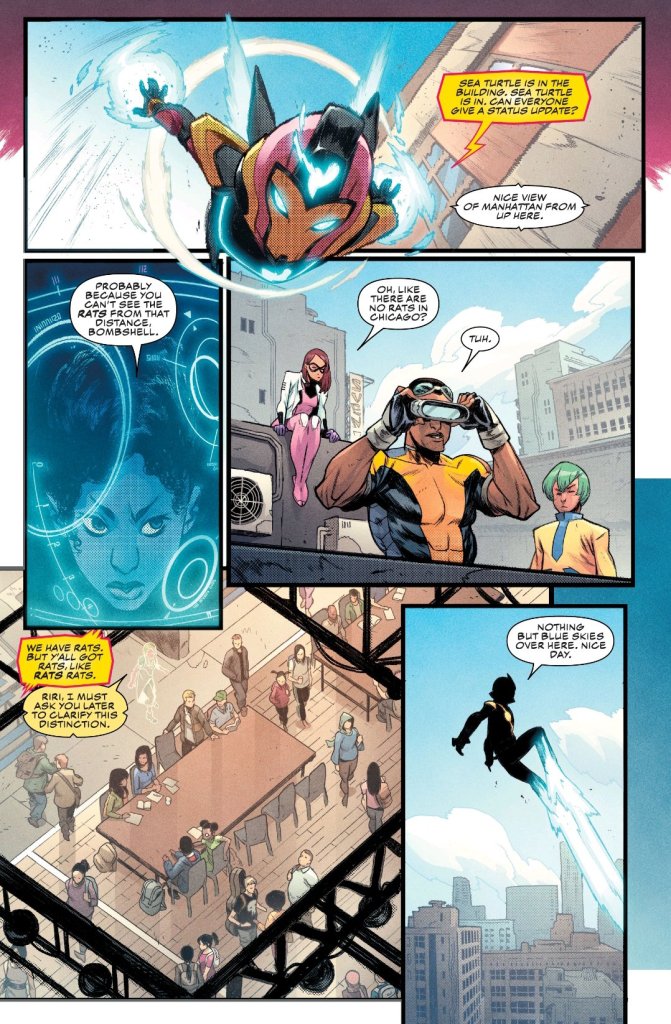
The other Champions, consisting of Power Man (Victor Alvarez), Nadia Pym (The Wasp), Riri, Viv, Nova, Bombshell and Pinpoint, wait in the wings for anyone trying to assassinate or attack her. All things considered, this is a pretty stacked team. Ewing also does an amazing job of writing each character with their individual voices, much like she’s been able to make Riri Williams feel natural in her own solo series. They banter with each other like the teenagers/young adults that they are while Jacinto gives their stakeout a light hearted feel.

Things initially seem to be going well up until a DRAGON shows up out of nowhere to attack the summit. Jacinto, Grundetjern and Cowles give us an excellent splash page of the Dragon looking down at the Champions while breathing a small bit of fire. Jacinto frames the dragon as being far larger than the Champions, towering over the buildings around them with its wings taking up the sides of the page. Grundetjern colors the dragon with varying oranges, sometimes glowing and sometimes shadowed on its skin and Cowles accentuates it with a scratchy “GRAAAAAHHH” sound effect for its yell.

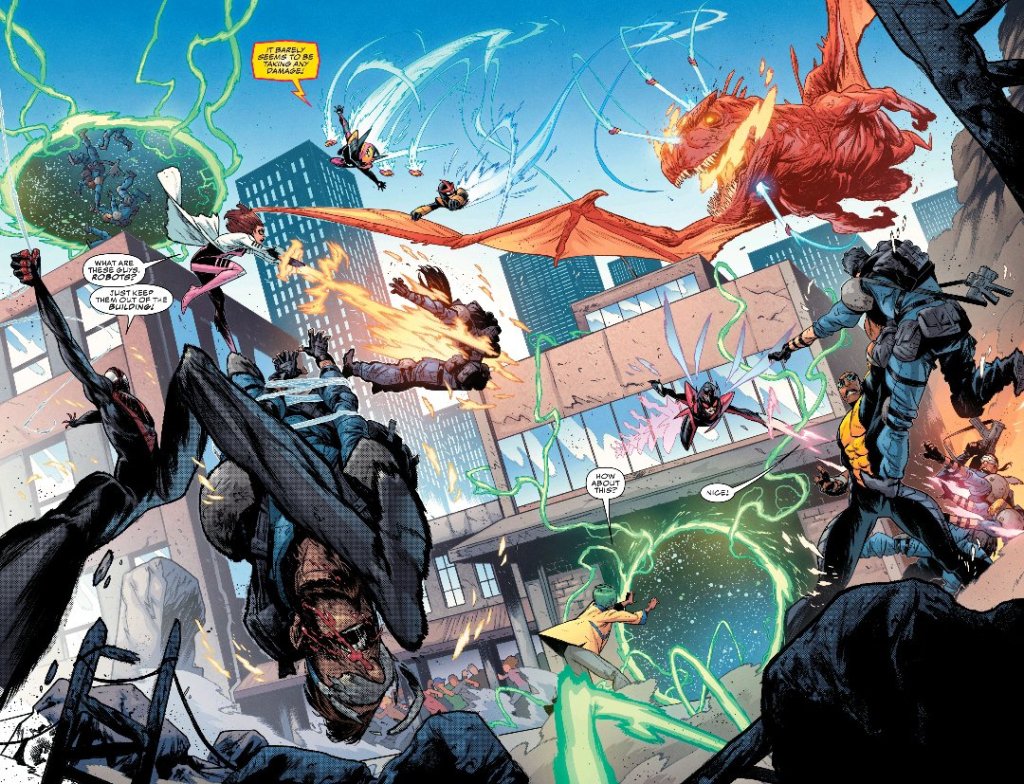
While some of them are dealing with that, Bombshell encounters the Roxxon Strike Team while Kamala and Ailana make their daring escape through the tunnels of the school. Jacinto and Grundetjern give us a double page spread of the absolute chaos with several Champions fighting off the dragon or the mercenaries. Admittedly, this scene is utterly chaotic but it does have something of a line to follow from the dragon flying through the air and its wing leading to Bombshell blasting a guy and Nadia with Power Man taking down another merc.

Grundetjern throws just about every color that they can in this scene, giving us vibrant greens for Pinpoint’s portals, nice and bright oranges for the dragon’s fire and Bombshell’s blasts as well as a more grayish black for Mile’s costume as he pretty much stomps a guy into mush

As much as the Champions maintain a sense of cordiality with each other, they’re still teenagers that struggle with working together from time to time and Ewing stresses that when Power Man forms a plan to use one of Pinpoint’s portals to punch the dragon with all of his built up Chi. Riri then comes up with her own plan to fly Power Man up to the dragon and then release him. They ask Ms. Marvel which option is better, but as she’s maintaining her cover with Ailana, she tells them to make the call.

In the middle of this indecisiveness, Viv swoops in and decides to air her frustration at not being able to defeat the dragon and decides that she’s going to phase through it. Jacinto draws a look of palpable anger on Viv’s face as she rushes past Riri with Grundetjern’s bright wave of green energy trails behind her as well as Cowles “SWOOOOSH” sound effect to capture the velocity of her flight.At the same time, Power Man, unaware of Viv’s rush of anger, goes through with his plan and punches through a portal.

This is where it all goes wrong.

Jacinto, Grundetjern and Cowles give readers a perfect sequence of panels with Power Man punching, Viv “ZOOMing” up to the dragon as Riri tells her to hold on and then the moment before it all goes bad. Pinpoint’s portal opens just behind Viv and she is overcharged with Power Man’s Chi in a blast of orange, green and yellow as her face is stretched in agony and her limbs contort before she overwhelms the dragon in two separate splash pages.

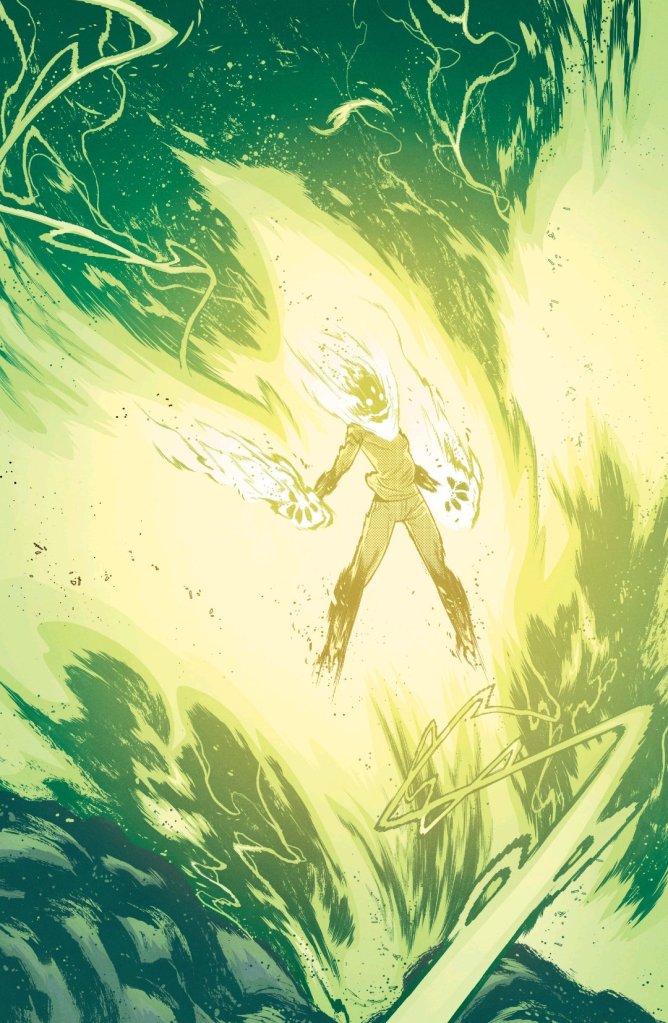
Both of these pages are intense as the first one sees Viv yelling pain before “taking control” and engulfing the dragon with a “FWOOOOSSHH” mirroring its firebreath. This page is filled with what appears to be green flame and a silhouette of Viv in the middle of it. The next splash page shows Viv alone in the pyro, looking like a horrific combination of the Phoenix Force and Dormammu. She has lost all control of herself and this is where Ewing, Jacinto and Grundetjern raise the stakes of the battle.

Viv’s newfound power spirals out of control and begins to collapse the school and the surrounding buildings and we cut to Kamala doing everything she can to protect Ailana from the collapsing ceiling around them before going back to the Champions scrambling to stop Viv. Ewing continues to show how well she can write Riri as she cries while making a plan with Nadia that possibly kills Viv and stops the dragon altogether.

The city is in shambles and this is one of the Champions lowest moments ever.

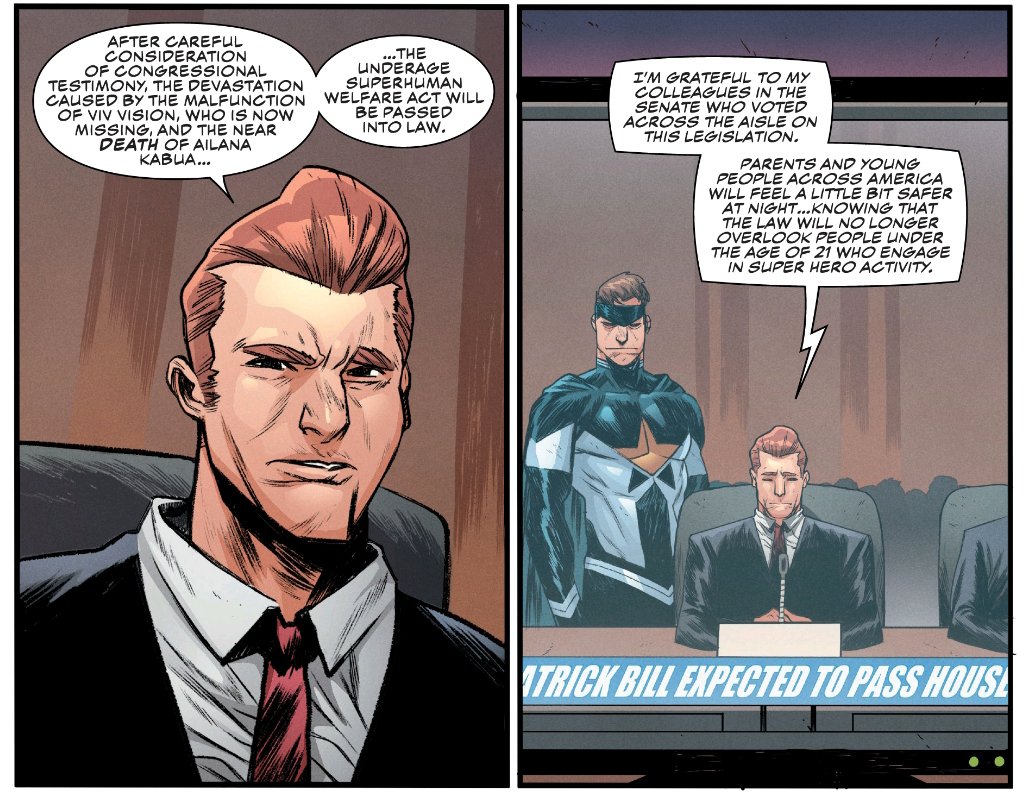
Cutting back to the present day, we see that the “Superhuman Welfare Act” passes and a new governmental watchdog group called CRADLE is sent to round up all of the teen superheroes and metahumans around America. The bill also seems to garner support from former teen heroes and New Warriors members Justice and Speedball. Justice had joined the pro-registration side during Civil War because he blamed himself for not being a guiding hand for the New Warriors that died at Stamford and Speedball had already suffered the consequences of surviving that same incident.

However, the one who may suffer the most is the girl who the act is nicknamed after, Kamala Khan as we see her in a hospital bed suffering from injuries while trying to save Ailana.

This first issue was explosive and gripping throughout. Initially I was worried that it wouldn’t be able to live up to its concept or just be a less cool Civil War, but the one thing that this book maintained because of Ewing, Jacinto, Grundetjern and Cowles was heart.

The Champions are heroes, but they’re also all teenagers that don’t have the experience that the adult heroes do and in typical American fashion, no one learns from the mistakes of the past. Victor already butted heads with Riri for his recklessness in the past, but now he’s given consequences for his actions. America remembers Stamford, but doesn’t seem to remember how the Civil War nearly tore the country apart and installed a tyrant in a high government position in the aftermath.

If anything, the Champions aren’t going to leave this incident the same people that they were before.

Best of DC: Week of March 11th, 2020

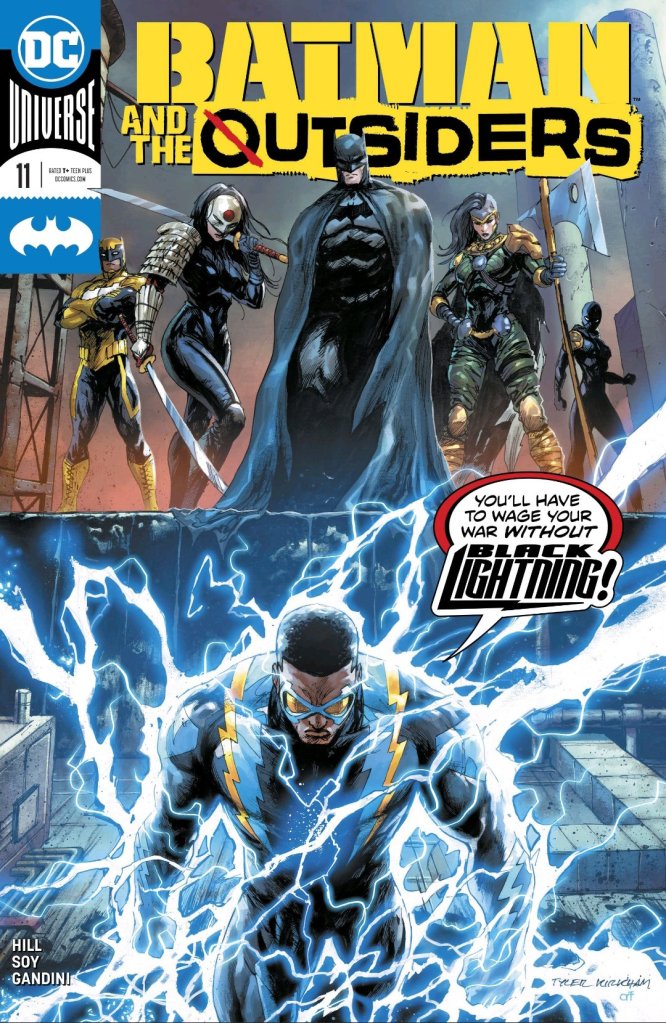
Best of the Week: Batman and the Outsiders #11 – Bryan E. Hill, Dexter Soy, Veronica Gandini and Clayton Cowles

It’s the Outsiders vs The Assassins in a knock-down, drag out fight for their lives!

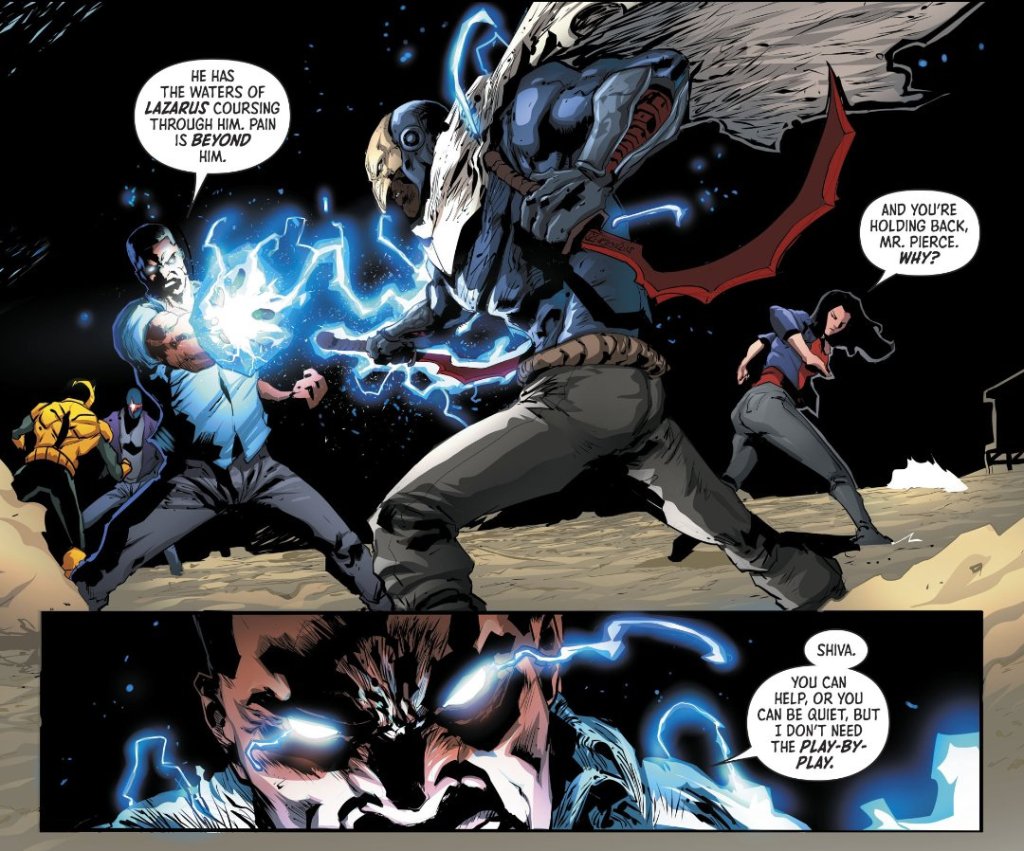
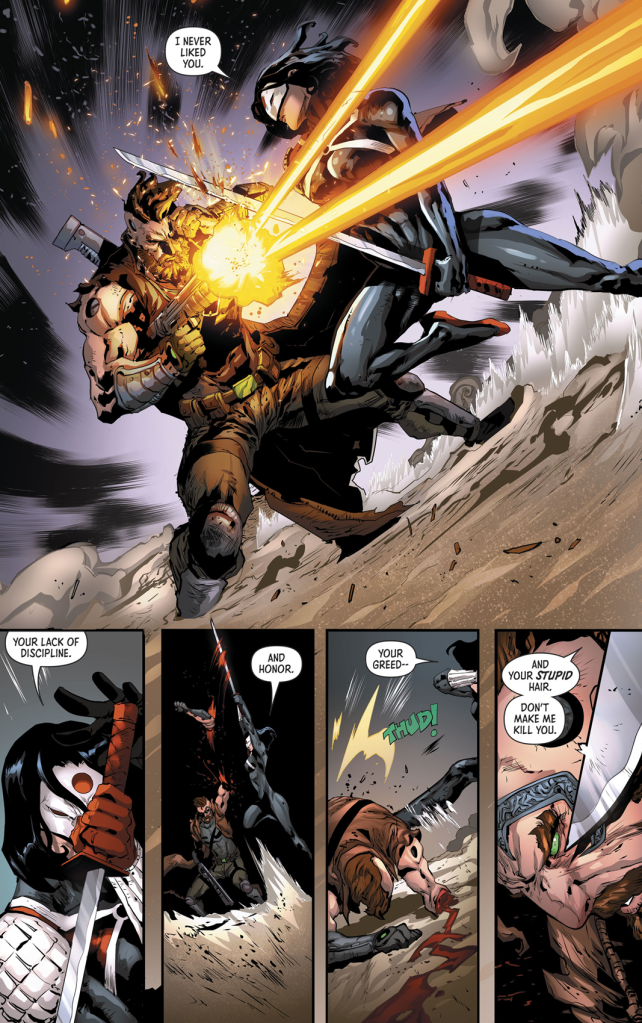
After Lady Shiva meets up with Jefferson Pierce, aka. Black Lightning, in order to convince him to join her scheme to kill Ra’s al Ghul, she and the electricity powered hero are ambushed by Ra’s al Ghul’s trusted warriors in Ishmael, the turncoat Kaliber and Karma, a villain from Hill’s run on Detective Comics. Luckily for Jefferson and Shiva, Katana arrives in the nick of time with Duke Thomas, The Signal, and Cassandra Cain, Orphan (even though her mother, Shiva, is next to her).

Dexter Soy and Veronica Gandini begin the book with an epic single splash title page, showcasing the two sides as the Outsiders pick their respective opponents. It’s an absolutely beautiful scene with the moon shining in the sky with a bright white while clouds crest over it. The moon reflects on the surface of the water that both sides are standing in, giving the epic stand off a more dynamic feel as the water crashes around them. There’s an unintentionally funny bit where Shiva is standing tall with the Outsiders, but in the background without anyone to look at because the three combatants are closer to the foreground.

Wonky page aside, Hill does a good job of catching readers up with a few of our characters’ reasons for wanting to fight each other while Soy gives us several nice, up close shots of each character in eight panels. Lightning seeks revenge against Ishmael for killing one of the teacher at his school, Duke and Cass want a rematch against Karma for targeting them and injuring Duke back in Detective Comics and Katana faces off against Kaliber for betraying the Outsiders.

Each of their respective fights take place over the course of single pages for most of the issue and while there’s not much in the way of a deep story, the fights do help to expand on who some characters are, give others some catharsis and allows for one to just showcase how cool they are.

Lightning and Shiva’s fight with Ishmael is absolutely one of ideology. Blak Lightning has always been a hero, someone who was willing to save lives and give his own if he thought the cause was worth it. Lady Shiva is one of the deadliest assassins in the DC Universe and only seeks to weed the world of the weak. She sought Jefferson out because she knows that among Batman’s team, Lightning is absolutely one of the most powerful and susceptible to her way of thinking, if the right pressure were to be applied. At the same time, she sees how Ra’s al Ghul’s plot to destroy the planet would be counter to her goals.

Soy portrays Lightning with probably the most intense anger that we’ve seen from him in this story so far. His brow is furrowed and Soy inks a close up shot of Jefferson’s face to accentuate the bright blue and white that Gandini uses for his eyes. His lightning is intense, even as Shiva tells him that she knows he’s holding back, he doesn’t care as he’s acting as the distraction. We then get another page of Shiva enacting his plan. 

Soy showcases Shiva’s speed and agility through various panels as she attacks Ishmael. Soy uses speed lines and blurring to convey how quick she can move as Ishmael’s defense is whittled away before she gives him one good kick across the face. Clayton Cowles utilizes excellent lettering with an intense “KRAK” as the foot connects and a powerful “ZZZATTT” as Lightning hits him with a blast of energy. Cowles also has fantastic bubble placement as Shiva counts down on every panel before unleashing Jefferson.

As that fight ends, we get a calm scene between the two as Ishmael lies unconscious in the water, his face just so that he doesn’t drown. Shiva tells Jefferson just how easy it would be to let him drown, but Jefferson points out that that would be murder. Because… of course it would be. Jefferson is a hero and is unwilling to take a life, not because he’s on a team with Batman, but because it’s his decision.

Karma was a Markovian soldier who had something of a past with Batman. This saw him don a mask that allowed him to read the thoughts and actions of his enemies as he targets those who he felt made Batman weak – Duke and Cass. He put them through hell over the course of many issues and this is what initially caused Batman to seek out Jefferson to help train them. This series would have spun out of that arc, but for whatever reason, delays kept it off until very recently.

The fight starts off pretty poorly as Karma reads Cassandra’s thoughts, making fun of her Orphan codename, much like I did earlier, and kicks her away. Karma is a quite capable fighter, but he hasn’t faced Duke in quite some time and doesn’t know about the hero’s new found power. Duke had initially had some PTSD when thinking about Karma, likely because of a bomb that the villain had strapped to a Batfan and exploded when Duke arrived to save him.

Duke’s powers over the light had been corrupted by Ishmael earlier in the series and this left him with a new ability to enshroud himself and others in a black shadow. He and Cass use this to their advantage to distract Karma, allowing Soy and Gandini pay off all of their months of pain and anger. Cassandra swings across Karmas face with both of her feet, knocking him back as the glowing red star of his mask leaves a small trail. The fight is honestly pretty one sided from there as Cass just beats the man.

The final fight between Katana and Kaliber is pretty much just an excuse for Soy, Gandini and Cowles to draw cool stuff. Kaliber fires a shot from one of his energy guns with a bombastic, transparent BOOM to accentuate its power and bright orange and yellow colors. Katana gets into an excellent pose and uses her Soul Sword to deflect and spread the blast with a “SHNNNNG” lettering that curves around part of the shot and her sword. Katana has no time to play any games with him, at all.

She also makes short work of him while revealing that she had never liked him. Cowles utilizes similar minimal panels to convey Hill’s script as she tears down his lack of discipline and honor before making fun of his hair while still being threatening. Soy makes Katana look like an absolute badass as she takes Kaliber’s gun arm in one fell swoop before kicking him in the gut. Kaliber may be something of a good eye and a trigger, but Katana, like Shiva, is one of the most dangerous women in the DC Universe with a sword and not someone that should be faced in a one-on-one close quarters fight.

With all of their enemies defeated, Katana holds her sword to Kaliber’s throat as he tries to convince the Outsiders that Ra’s only wants to “save the world.” In some respects, that could be true. He sees humanity as a disease and would rather the planet Earth and his chosen few thrive without the chaff. He’s built a cult of personality around himself and that’s how he’s maintained a following for centuries. Not that it was difficult to convert someone like Kaliber, a stock mercenary. But the merc soon reveals that this fight was meant to serve as a distraction as explosions ring out across a Cambodian town.

It’s another beautiful scene with the calm blues of the moons afterglow and the night sky itself is contrasted by the bright and fiery oranges of the explosions. My only criticism is that while the scene does feel weighty, there’s still a lot of empty space where more explosions and destruction could be. They sort of feel minor by comparison to the rest of the shot and maybe pulling in closer would help, but either way, it’s a nice scene.

Ra’s goons escape and Katana rallies the Outsiders to go and help the people. Despite not approving of Cassandra choosing to join Batman’s crusade, Shiva affirms her pride and love of her daughter and joins her in heroism, even if it’s only for a short time. Meanwhile, in the background of this story, Sofia, the metahuman who Ra’s initially tried to recruit away from Batman affirms that she wants to do good in the world and Batman leads her to choose her own identity.

Bryan Hill’s excellent Outsiders series continues to be one of the more underrated DC titles out right now as this issue was absolutely action packed thanks to Dexter Soy, Veronica Gandini and Clayton Cowles. It definitely built on these excellent characters that deserve more acclaim and a book separated from having Batman in the title because he is still barely present.

That’s also another point I will keep harping on, Batman is still a non-entity in this book and I think that’s something that this story does well. It allows for Black Lightning and Katana to grow as characters to take on the teacher role like Batman did in the original Outsiders comic. Duke and Cassandra have so much to learn, but so few Batman writers want to put a focus on them while Bryan Hill is giving them center stage alongside two big heroes. They absolutely deserve it and I want to see them in so many more things going forward.

I want this series to go well past fifty issues because it has, consistently, been one of the best paced, best drawn and best told series that DC has had going for it in a long while. This gets another high recommend from me.

Best of Marvel: Week of March 11th, 2020

Best of this Week: The Immortal Hulk #32 (Legacy #749) – Al Ewing, Joe Bennett, Ruy José, Belardino Brabo, Paul Mounts, Javier Rodríguez, Álvaro López and Cory Petit

Xenmu hopes you enjoy the show.

Xenmu the Living Titan or Xenmu the Hulk is a super deep cut of a character that predated The Incredible Hulk by two years and has been plaguing Hulk and his allies for the last few issues of this series. Xenmu’s origins trace back to Marvel’s old days of Sci-Fi horror in the “Journey into Mystery” anthology series back in 1960. On top of having immense strength, not unlike Hulk himself, the Living Titan is capable of using psionic abilities and mass hypnosis – something that has already come to bite Hulk in the backside.

This book begins with an incredibly creepy scene, drawn and colored by Javier Rodríguez with inks by Álvaro López, in which a mass of CRT TVs are stacked on top of each other and all show Xenmu recreating iconic Marvel moments. He emulates Spider-Man crawling down a wall, Reed Richards using the Ultimate Nullifier to scare away Galactus and even Wonder Man when he stood behind David Letterman (Avengers #239, 1984) before ending with his creepy eyes.

Al Ewing and Rodríguez do an amazing job of conveying what it is that Xenmu wants – the hearts and minds of the citizens of the Earth, to counteract the love that they’ve been giving The Hulk and other heroes of the Marvel Universe. Rodríguez draws and colors the background in a dark and dusty way with lots of dangling wires and dilapidated surfaces as well as lots of browns and hazy blues.

In the following scenes, regular series artist, Joe Bennett takes over and he and Ewing do their best Bendis impression as we get about six panels of citizens each talking about their love for Xenmu and how he’s the greatest hero in the world! One of these panels even includes a not so subtle cameo of Simpsons characters Bart Simpson, Milhouse Van Houten, Nelson Muntz and Lisa Simpson in the background. We obviously know none of this to be true and see that Xenmu’s false memories have wormed their way into their minds.

Soon after, we cut to the office of Roxxon CEO, Dario Agger, as he and Xenmu look upon the fruits of their work and continue to plan for a world without the Hulk interfering with them. Agger is always looking for a way to make a good dollar, even if that means selling out the human race to Dark Elves (War of the Realms, 2019) or by siding with an intergalactic being of mass mind control. Bennett continues to make Agger’s Minotaur form a thing of horror with his hunch back and drooling maw.

Things continue to get even more horrifying as Xenmu complains that he is getting hungry and Agger callously sacrifices Travers, one of the last men on his security team, to the monster. Bennett, Ruy José, Belardino Brabo and Paul Mounts work in tandem to create one of the most unsettling double page spreads of biomechanical body horror as Xenmu bends into a crab form like he’s Kayako from The Grudge, unleashes fleshy tendrils, dripping with blood and coiled in gold and drags Travers into the opening in his stomach. Travers screams in horror as Agger simply drinks his whiskey.

José and Brabo’s inks make the lines look incredibly smooth and do well to accentuate Bennett’s hatched shading as well as the small detail of Xenmu’s eyes peering at the floor as he reflects on the shining floor. Mounts also colors the scene with such casual, late afternoon lighting, contrasting the abject terror that is taking place within the scene. In a series with heart pounding-ly scary pages, this is HIGH up there with the most disturbing.

Soon after, we get another single page from Rodríguez with the same television set up, but this time, the news portrays the scientist, Dr. Robert Banner and his alter ego, The Devil, as a dangerous villain. These reports allude to Banner’s origin story, the events of the World War Hulk (2007) and even acknowledge the fact that General Thunderbolt Ross couldn’t be reached for comment (He was killed during the first arc of Ta-Nehisi Coates’ Captain America.)

This page distinguishes itself from the other as the backgrounds are given an eerie green color, one of the CRTs has been cracked and seems to be leaking some sort of purple liquid. The images on screen are given a green and purple static effect and the rat that was on the lower right corner of the page runs away at the sight of Banner and the Devil versus when it was mesmerized by the images of Xenmu the Incredible Hulk.

Bennett returns and utilizes the six panel structure with people lambasting Banner as a cult leader, murderer and terrorist. Bruce’s best friend, Amadeus Cho aka Brawn, doesn’t even remember his old friend. Jackie McGee, still recovering from her injuries following an attack by Roxxon, has trouble remembering if Banner and The Hulk were the same person, especially after travelling with Banner for a number of weeks/months. We then get a final panel of “Robert” Banner repeatedly saying that “nothing is wrong.”

Bennett, José, Brabo and Mounts do an amazing job of pulling us into the fracturing mindset of “Robert” Bruce Banner as we transition to Shadow Base and see Savage Hulk in the mirror, trying to break out, as Banner repeats the statement. Bennett sells us on Bruce slowly breaking with various pulled in shots of his sweaty, unshaven and crazed faces. Mounts even makes use of small hints of green around Banner’s eyes alluding to any one of the Hulks trying to escape.

Bruce is acting noticeably different and the resurrected Rick Jones seems to acknowledge this just a small bit. He doesn’t seem to be affected, but that might have to do with the metaphysical nature of his resurrected powers and how he’s always on, unlike Bruce who is still just a human holding back his various forms. Bruce also keeps referring to himself as “Robert” his real first name and also what Xenmu News keeps calling him, this suggests that Bruce as a human is also susceptible to the same mind control as other people.

Dr. McGowan and Doc Samson discuss as much when McGowan presents Samson with some video footage of her talking to Rick and Betty Ross as Harpy. Much like most others, she remembers Xenmu, but also knows that she said Daredevil in the footage and Samson confirms it. He also seems to have no actual recollection of Xenmu much like Rick and McGowan suggests that his existence is acting as some sort of Mandela Effect (google it, cause it’s weird) with multiple people remembering something that no one actually experienced.

McGowan explains that her experience as a transwoman helps her to separate what parts of her really are her and what is not and that method of self examination helps her in realizing that Xenmu’s memories aren’t real and that he’s been re-writing the minds of everyone else who looks at him through the screen, including Bruce Banner, which shocks Samson and Bennett gives us his shocked face.

We actually get one more shot of the television sets, but this final one is shockingly different. Almost all of the TV sets are smashed and bleeding, except for one showing Xenmu’s hypnotic stare. Each of the sets are a dark purple color and the background is given a bright and vibrant hot pink coloring. The purple and pink color scheme extends to the disgusting tentacles emerging from the shadows, almost leeching into the minds of all of its viewers. Even the rat in the corner isn’t safe as one of the tentacles wraps itself around the creature while Xenmu proclaims, “I’m in your head.” It’s all genuinely terrifying.

Before the book ends, Banner punches the mirror to hold back the Savage Hulk, and we get a surprising return of a previously mentioned Hulk and I’m ultra excited for the next issue.

This issue of Immortal Hulk was absolutely fantastic. Al Ewing continues with his epic run with the character by introducing a dastardly and unreasonably scary villain in the returning Xenmu to act as a foil to the plotting and genius Devil Hulk. Javier Rodríguez and Álvaro López absolutely blew my mind with their pages with the TVs by conveying the scale of the psychic threat and Joe Bennett, Ruy José, Belardino Brabo and Paul Mounts continue to stun with scenes of body horror and general grossness.

This book gets the highest of recommends from me.

Best of DC: Week of February 26th, 2020

Best of this Week: Batman: Curse of the White Knight Book Seven – Sean Murphy, Matt Hollingsworth and AndWorld Design

Batman is Dead.

The last issue of Curse of the White Knight gave us the last in the story of Edmond Wayne and revealed that the man that Bruce thought was his ancestor, turned out to have been the family to Jean-Paul Valley instead. Bakkar of the Order of St. Dumas killed Edmond after betraying and stealing Gotham from under him, thus assuming the name of Wayne and forming the city to his vision. With this newfound information, Batman has found himself a man with a lineage of thievery, especially after finding out that Gotham’s Elite have been funding their crime through Wayne Enterprises.

This issue begins with a somber flashback to a moment before the funeral of the Waynes. Bruce cries and blames himself for their deaths because he wanted to see The Mask of Zorro. He had always wanted to use the rapiers that his father kept on display and figured if he learned to use them from the movie, then he would be able to impress his father enough. Alfred, always so caring, tells him that if he’s able to go to the funeral, then he can hold a rapier. He then vows to teach young Bruce how to use it for the next danger he may face.

Matt Hollingsworth colors this flashback in a cool blue hue, emphasizing both the sadness and the hopefulness of the moment. Murphy portrays Alfred as being caring and shows that even with the tears, Bruce shows his ability to rise up and become the hero that people need. Though the rapier is far too large for his kid body, Bruce holds it firm in hopes of protecting Gotham in the future.

As we cut back to the modern day, Bruce faith in himself and his dreams of becoming Gotham’s knight are shaken. He was never a Wayne by blood and he sees himself as part of Gotham’s cuse. Many would be right to see him as such given Gotham’s crime initially started off as petty stuff and eventually escalated into battles with The Joker, Two-Face and others with Gotham being caught in the crossfire every time. He didn’t even know that his company was being used by criminals because of his singular focus on fighting crime.

Murphy draws Batman as being tired and ashamed of himself for only just now understanding Jack Napier’s vision and why Batman is just as bad for Gotham as The Joker was. His expressions are melancholic, Murphy makes excellent use of shadow to try to hide some of his shame and body language to make him look like an old man that’s been sitting on a lawn chair for eighty hard years. Harleen Quinzel acts as his voice of reason during his pity party and actually shows concern for him.

Hareen has been a central character in this world since the very first issue of the original White Knight and that doesn’t change here though her own personal arc is over. The last issue saw her do her best to bring Jack Napier out of Joker’s mind for one last time for information and to save her children. In the end, she had to shoot Joker in the head to let Jack rest and rid herself of the monster that had been plaguing her for years. She still finds herself at Batman’s side as one of his most trusted friends.

Bruce still has one thing that he can do to make sure that Jean-Paul doesn’t get away with his crimes and Harley convinces him that Gotham will forgive his transgressions like they did for the former Joker in Napier. At the same time, Azrael is still out there and Murphy and Hollingsworth give readers an AMAZING shot of the villain in his updated Knightfall costume. He grabs onto the nds of his cape s he soars backwards into his hideout. The lights of the city contrast with his blacks, yellows and blues to just give us a pretty damn good shot of how powerful he feels in the suit.

This is contrasted by the next few set of panels where he’s puking out of his mask after escaping from the GTO (Gotham Task Oppression Unit). This version of Azrael has been diagnosed with terminal cancer and as such needs medicine to live and suppress the symptoms. With little dialogue and some telling panels, we see that Azrael has empty bottle after empty bottle of pills in his cabinet. He’s starting to look a bit more gaunt than the first time we saw him. He’s withering away slowly and only has one more pill to spar for his coming battle with Batman.

I love the details that Murphy and Hollingworth add here. There’s blood in his vomit and it maintains after he pukes on his leg. His ribs are starting to show and we’ve seen just how jacked he was in the issues prior. His hair doesn’t appear as long as it did, even pulled into a bun/ponytail and there’s just something so final about the “shit” he gives after finding out that he only has one more pill left. In that singular moment, his mistakes come back to haunt him after killing his, admittedly, treacherous employer.

Soon after, Bruce makes amends to Barbara Gordon after inadvertently causing the accident that almost saw her completely lose use of her legs and effectively getting her dad killed. Barbara has always been resilient and we all feared that that issue #5 would be yet another Killing Joke, but here she is, using crutches to try walking again. The scene takes place during the bright Gotham day and this signals a brighter future for their relationship.

Bruce had always gone to Jim Gordon for advice on what route he should take, but without him, Bruce is missing one of his moral compasses. Barbara is the next best person because she has always been smarter than her father and Bruce has a ton of guilt to get off of his chest and Barbara handles everything like the mature adult that she is. She doesn’t blame Bruce for what happened, even though she said horrid things in anger, but can anyone blame her? She cries at the mention of her father and embraces Bruce, encouraging whatever his decision may be.

Of course, with this being the penultimate issue in this particular storyline, it only makes sense that we see a grand revelation come out of it. Murphy and Hollingsworth set the stage with Hollingsworth coloring the afternoon skies of Gotham with an orange-red kind of hue. We see various shots of different places in Gotham from public libraries to the streets themselves as Batman appears on the giant monitor of Gotham Square. Everything feels hot and sort of uncomfortable.

Bruce gives his appreciation and thanks to the people of Gotham for allowing him to serve as their protector and we continue to get these various shots of people. There’s auto mechanics watching the broadcast in their shop, people in a bar and kids watching on a cell phone with their dog. Murphy uses this to illustrate that Gotham is far larger than we think it is and that there are many people that Batman has saved from every corner of his beloved city, but he hasn’t done enough yet. So what’s the final step?

Batman reveals himself to be Bruce Wayne and dismantles WayneCorp.

Bruce finally becomes the knight that Gotham needs by giving back to the people. By destroying his company, he gives back to the people of Gotham by giving all of his money to nonprofits, schools, homeless shelters etc. It’s everything that Batman detractors have been saying Bruce should have done for ages. In doing so, he offers Gotham a better future than he could have as Batman, but he only asks them to stay off the streets of Gotham for one night while he takes care of the Azrael business. Murphy shows Bruce holding his cowl one last time, standing tall by his heroic decision.

Back at the GCPD, he gets lambasted by Commissioner Montoya for going off and doing his own thing again, but counters by saying that he trusts in the people of Gotham and they all formulate their battle plans. It’ll be his last time taking the reigns before he turns himself in as well, so he might as well make sure that everything goes according to plan.

As Montoya tells Batman that Azrael destroyed most of the other Batmobiles in his assault on bruce in Book Four (I think), she reveals that one survived and I see that Sean Murphy is a Batfan after my own heart. The Batmobile that survives is the badass one from the Animated Series, what this book is supposed to be the “sequel” to. It’s sleek and well designed thanks to Murphy’s own love of cars. From the presentation, readers can tell that this is one of the pages he took serious time with as the Batmobile is given so much respect.

After a short conversation with Dick about what Bruce is going to do when he catches Azrael, Batman drives away, leaving his sidekicks concerned about his state of mind and we get one last splash page of Batman standing in the middle of Gotham Square without his cowl and the sky is a blood red. The Batmobile looks sexy in the background and this was all just so amazing.

Sean Murphy is a comic book treasure. His art and his writing truly made this an experience and a Batman story worth standing the test of time. It had the action, the drama, the stylish sequences and several twists and turns that make a story great. He’s made Batman his own in a grungy style much like how Scott Snyder and Greg Capullo have in a heavy metal manner. Murphy’s Gotham is a masterpiece in crustpunk with social problems that Batman’s always had in the periphery of his character and every issue has been better than the last.

Matt Hollingsworth brings it to life with his perfect colors; Whether they’re making use of the blues of Gotham’s clear skies or the light purples of the night sky, Hollingworth makes Gotham look distinct no matter the time of day. Scenes are given hues to match the tone of the pages whether they’re full of intense anger or incredible sadness, Matt Hollingsworth sets the mood no matter what.

I really enjoyed this series, but I can’t wait for the next and final issue of it just to see that confrontation between Batman and Azrael. It’s been a long time coming and the fallout from Bruce’s decision as well… it’ll be too much, but yeah High recommend!

Best of DC: Week of March 4th, 2020

Best of this Week: Strange Adventures #1 – Tom King, Mitch Gerads, Evan “Doc” Shaner and Clayton Cowles

This is the Tom King I love.

The first book I read by Tom King was the awesome Grayson (2014) series post Forever Evil (2013) after Dick Grayson was “killed” by the Crime Syndicate. That book had a levity and coolness that no other book was really exhibiting at the time and King was kinda on my radar. Soon after, I’d heard that he was writing a solo Vision book and I was skeptical, but after a few issues I was sold and absorbed everything Tom King had written up to that point.

From Sheriff of Babylon to Mister Miracle, I was fully on board up until Batman got long in the tooth and Heroes in Crisis became a disaster. I have slung my fair share of mud, but Strange Adventures is an awesome return to form that blends the two amazing styles of Evan Shaner and King’s longtime collaborator Mitch Gerads. This book forms a tale of heroism and then overshadows it with horrific implications.

Adam Strange has always had something of a STRANGE presence within the DC Universe, mostly having stories in anthology books like Mystery in Space, miniseries or being part of various teams, he’s never quite been consistent. Adam Strange is a product of the sci-fi boom of the 50s and 60s, an archaeologist from the planet Earth whisked off to protect the spaceways and his beloved second home of Rann with his lover, Alanna. He’s always been kinda silly.

Tom King takes this silliness and turns Adam’s story on its head as we open to Strange doing a book signing of his memoir, Strange Adventures. At some point, he seems to have sold the story of whatever he did during some terrible war on Rann (that will definitely be expanded on later) and his name is on the lips of every American citizen, talk show host and politician as he and Alanna bask in their newfound fame.

In just the first few pages, Gerads and Shaner illustrate what kind of contrast we’ll be seeing throughout this series. During Gerads’ scenes, Adam is doing normal things, signing books, accepting awards, doing press and lying in bed (in more ways than one). King scripts the dialogue as being pretty casual in these scenes, the way that people talk when they’re alone or have a spotlight shone on them. Colors are striking, but the scenes aren’t dynamic, more somber with specific focuses.

Shaner, on the other hand, get’s splash pages of Adam flying through the skies and facing down hordes of his enemies with heroic poses, laser gun fire and explosions. It looks like a high action, pulp comic or Saturday morning cartoon and the dialogue is comparably cheesy. These scenes are meant to paint Strange as the persevering hero as he has to face down insurmountable odds and get by by the skin of his teeth and his very handsome smile. Almost immediately, there’s a pit made in the stomach because it’s almost too unbelievable.

The closest real life comparison I’m willing to draw, before the next few issues come out, would have to be that of “American Sniper” Chris Kyle. A few years after leaving the Navy, Chris Kyle published the book which detailed his time during the Iraq War and a lot of the media painted him as a hero for his actions. The book sold gangbusters. He went on to the big talk shows, did the magazine interviews, he even got a great movie made by Clint Eastwood and Bradley Cooper, but it didn’t come without controversy

Tom King seems to be channeling a little bit of that for Adam Strange and it works to great effect as in one scene, a pair of talk show hosts laud Strange as a hero before their interview. Gerads gives the scene a television like static as if we’re looking at it all like the rest of America. In the background we can get excited too as Adam emerges from the crowd with his jetpack and makes a grand entrance.

However, not everything is smiles and praising as, after a fan carrying volumes of Sheriff of Babylon and Mister Miracle thanks Adam for his service, we see a panel of Adam taking off his boots in the foreground while the focus is on a bloody picture frame in the background. The picture depicts Adam, Alanna and their daughter Aleena, who is conspicuously absent from the present day scenes. The blood on the picture speaks volumes more than could be said in these initial pages.

After another man screams at Strange, calling his depiction of events a lie, the pit in the stomach grows deeper as the first seeds of doubt are sown. Things are made even worse as we get a scene soon after with Shaner’s stellar art. The earlier scene made use of Cowles perfect letters with “BOOOOOOMs” and “PEW PEWs” to sell the sci-fi aspect of it and takes it to a higher level with even better balloons that placed comical emphasis on the more outworldly elements of Strange’s origins like Zeta Beam and Protector of Rann.

This comical heroism is emphasized as Adam screams about protecting his family while firing lasers at a mech created by Rann’s enemy, the Pykkts. Shaner draws Adam as being miniscule by comparison, but also nimble enough to dodge it’s blasts and taking it down with a few shots from his laser pistol. As he raises his hand in victory, one can’t help but wonder…was the event true? 

The same can be said when Shaner draws Adam zipping past a giant lizard creature, flossing his teeth as he goes in and out of his mouth like a real action hero. Adam Strange has always been capable, but this has an air of embellishment to it. Things get even worse for Adam as the man who screamed at him is found dead with what appears to be an exploded head due to laser gun fire. It’s an absolutely horrific scene that only Gerads could pull off.

We get a number of awesome pages of both Adam and Alanna doing damage control. The symbolism of Adam’s jetpack being a focus with a reflection of both Alanna and the picture is powerful as the implication seems to be that whatever happened to Aleena was somehow his fault, but Alanna still carries the scars of Rann, but doesn’t blame him. During a press conference, we see Alanna crying before wiping away her tears as Adam denies killing the man.

Where King scripted and overused the nine panel grid in Heroes in Crisis, he has Gerads use the format twice with powerful effect.

Something about Strange’s denial of war crimes on Rann feels off, much like how people called Chris Kyle a war criminal during the movie’s release, we get that same feeling here. There are almost always horrors in war and Strange has to have left out some of the worst details of things he’s done or seen, especially since this is a Tom King story and he doesn’t shy away from the morbid. 

As the pressure intensifies, Strange turns to Batman, the World’s Greatest Detective, as someone who can help clear his name. Adam is convinced that he didn’t commit the crime, nor anything else that he’s being accused of, but Batman refuses to accept the case. Batman cites their longtime friendship as a reason that he wouldn’t be able to stay impartial and that makes a lot of sense. You never want to show favoritism, especially when there’s a chance your buddy could be a murderer.

The book ends with another nine panel grid showing Adam flipping the bloody picture down, almost as if to avoid looking at his shame and guilt while he meets that man who’ll take his case. There will certainly be some “Fair Play” in his future.

This first issue of Strange Adventures was absolutely phenomenal. I think King does well with characters and stories like this. He did it with Mister Miracle and he did it with Kite Man in the pages of Batman. Adam Strange has always been that character who showed up in the background or the odd Hawkman story to show just how large the Universe was, but I’m glad he’s being given a focus like this. 

Of course, with Tom King, there’s always a worry that as the issues go on, things will start to go off the tracks, but I have hope. Even the worst issues of Mister Miracle or Omega Men were fantastic reads.

Evan Shaner and Mitch Gerads absolutely smashed it with their art. I love the idea of having two contrasting visions of one’s life with one bright and wondrous and the other real and dark. Separately, these two are phenomenal, together they are AMAZING. I would look forward to every issue of this series for their art alone, and with King’s scripts, this is just perfect.

This one gets a high recommend from me!