Best of this Week: Far Sector #3 – N.K. Jemisin, Jamal Campbell and Deron Bennett
I was once told, “If we all think the same, then are we truly living?”
That’s the question that the story of Far Sector centers around thus far as Green Lantern Sojourner “Jo” Mullein has to operate as the protector of the planet sized City of Enduring where the three dominant races, the Nah, the @At and keh-Topli, are kept in line by having their emotions stripped from them. After a murder occurs on the planet after 500 years of peace, Jo has to investigate a drug called “Switchoff” that turns off the emotional inhibitors of its users. After dancing with the handsome Councilor Marth, she discovers that the issue of Switchoff use goes far deeper than she expected.
In a brilliant scene drawn by Campbell, we see how Switchoff affects Marth and turns him from a monotone man with natural charm to a sexy, dreadlocked, high elf before our eyes. He’s a lot more relaxed and muses of his people’s past with Jo as they play a game similar to chess. He’s drawn with a wide grin that hides his inner pain and lamentation over the loss of emotional connection his past. He is lit in purple lighting signifying his higher status and he even notes that he’s not the only Councilman that’s using Switchoff.
Two of the biggest themes of this issue, compared to the others so far, are centered around the ideas of memory and the past. After Mullein leaves Marth’s presence, she heads to her home on Enduring and receives a chapter of a book from Earth that she’s been reading and confirmation that her father sent an email reply to her. This is especially strong as while she’s lying in bed, she cries while reminiscing of her childhood on Earth – watching westerns and Saturday Morning Cartoons. These are the things that brought her joy, especially hearing that her father sent her a reply. She’s so far away from home kinda misses it.
At the same time, her duty is to the City of Enduring and those in charge of it, so when she’s called to pull a little bit of crowd control, she’s a bit annoyed but accepts the task. Things are different in the City than they would be on Earth. Two sides have decided to protest against one another and the solution of the Peace Division is to kill them all in order to keep the peace. Mullein is understandably shocked, but the Peace Officers look pretty nonplussed, keeping with the idea that their emotions are heavily suppressed as no one would want to slaughter so many.
Mullein is given a choice to stop both sides before the kill order is given and she takes it. Campbell gives us many great shots of Mullein doing heroic poses before separating the two angry mobs with shields of green and looks of annoyance. It’s a great way of showing us her personality without vocal exposition. Jemisin contributes to this by showing us Jo’s thoughts on peaceful resolution, saying that her dad talked about two kinds of peace in her youth: temporary peace by shutting conflict (with a note asking readers to look up Martin Luther King Jr.) and peace made when people get what they want and need.
I take a small bit of umbridge with her thoughts because Dr. King’s methods did eventually lead to widespread change if not also due to his martyrdom, but I might be reading Jo’s words wrong or taking them to heart when I need not.
Mullein actually tries peaceful conflict resolution by asking both sides what they’re arguing about with one side saying they’re against Switchoff users because emotions caused the “Burnover,” a war between the three races. The other side argues that emotions aren’t the problem, aliens are. Neither side wants to acknowledge that it’s the races themselves and their inability to take personal responsibility that’s the real problem. When one of the aliens complains about the Switchoff users being criminals and wanting to respect law and order, jo flashes back to racial injustices that she potentially witnessed on Earth.
I have to hand it to Jemisin for how she chose Mullein to handle the situation. Instead of saying that both sides have points, her thoughts lead her to asking the Switchoff users to make demands to The Council, saying that the emotionless way had been tried for thousands of years so it’s time to give the other side some shine too. Mullein comes off as someone that wants to promote real change instead of being a fence sitter and it’s actually kind of inspiring. She acknowledges the dangers of following the law and order as they have been forever and wants to protect the people of Enduring from the same.
Unfortunately for her, the time to get the crowds to disperse ends and the kill order is given. Jemisin and Campbell do an amazing job of showing how frantic Mullein is as she tries to get the Peace Officers to stop, with Deron Bennett’s lettering the emphasis of certain words are made paramount as Mullein rushes to reach the Officers. Shots are pulled in close to her face to show the frustration and fear in her eyes as she realizes there’s nothing that she can do to stop it after hearing who ordered the firing.
Campbell ends the issue with two amazing pages: One showing the Peace Officers firing indiscriminately into the crowd. The page is colored with intense red hues from the weapons. The faceless Officers stand firm in their actions and the people are screaming and cowering as the beams violently blast through them. It’s a horrifying scene, even more so as Lantern Mullein watches on in horror before it turns to absolute rage. Earlier she mentioned how she can’t and won’t fight cops, indicating some traumatic incident in her past or her currently being a space cop, but that is thrown out of the window after seeing this injustice.
Campbell then gives us a taste of Mullein’s willpower as she slams down in the middle of everything and prepares to fight.
This was a really strong issue and showcased a little bit more of Mullein’s past while also expanding on the social unrest on the City of Enduring. Even though emotions are supposed to be stripped from the people, the tensions still run high between them all, suggesting that things might not be as on the level as even the people believe. I definitely want to learn more about Marth and the other Councilmen given the new knowledge that the aren’t even following their own laws. N.K. Jemisin has crafted a very interesting story with a compelling lead that I can’t wait to get more of, especially with Jamal Campbell drawing her every month.
Best of this Week: Flash Forward #5 – Scott Lobdell, Brett Booth, Norm Rapmund, Luis Guerrero and Troy Peteri
Wally West was the hope of the DC Universe… until he wasn’t.
When DC rebooted after the New 52, Wally West was posited as the man who would be the hope that the dreary universe needed after five long years of depressingly dark and gritty stories. Wally’s return was also a return to a lighter, more heroic universe for a short while. Even though he and his wife, Linda Park, were no longer together and his kids were lost SOMEWHERE, potentially in the Speed Force, Wally never gave up hope of finding whoever messed with the universe and bringing them to justice.
That is until Tom King (and maybe corporate interference) got in the way.
I’ll never waste an opportunity to rant about how bad I thought Heroes in Crisis was and how much of a great disservice it did to Wally and the other heroes he killed in the story, especially Roy Harper. The story turned Wally into an accidental killer and kind of a sociopath after he repositioned the bodies, made a speed force double of himself, murdered the double, placing its body among the dead and framed Harley Quinn and Booster Gold after releasing the private tapes of other heroes in the Sanctuary center in an attempt to say that heroes needed help too. The message, while good, was absolutely lost in bad storytelling and an utter derailment of what was supposed to be a hopeful character arc.
Flash Forward, thankfully makes the first steps in attempting to fix all of that without completely absolving him of his crimes. Over the course of the story so far Tempus Fuginaut, a cosmic character similar to Marvel’s Watcher introduced in the pages of Sideways, has been tasking Wally with fixing the spills of Dark Multiverse energy throughout the main Multiverse. Wally, not really being given much of a choice, accepts his new mission and becomes hero again and has been saving these various Earths from utter destruction. The last issue was absolutely spectacular as he met a version of Linda Park who was the Flash and finally reunited with his kids.
The book opens with Fuginaut giving a run down of Wally West’s history from being Flash’s sidekick to the Titans and finally to becoming the Flash himself. Brett Booth draws an amazing splash page of the chemicals falling onto Wally in a beautiful slurry of liquids accentuated by Luis Guerrero’s greens and blues and Norm Rapmund’s inks. The trio then burst through with an amazing double splash page with various shots of Wally’s career. Tempus stands in the middle of the fractured images of The Flash and narrates on his successes and failures.
Booth gives these pages an amazing sense of frenetic energy with the borders between each image looking like streaks of lightning. Rapmund and Guerrero color and shadow Tempus amazingly, making him look like an arbiter of justice through his dark blues and gold. Though this is contrasted when we reach the end of the character recap and Fuginaut kneels to the Mobius Chair and addresses the reader (really his unseen masters), calling us the Keepers of Knowledge in the Universe while looking pretty regretful of his actions and how they’ll test Wally.
When we finally do get back to our hero, we find him warmly embracing his kids. Lobdell, Booth and Troy Peteri sells the emotion of the scene through caring dialogue, happy facial expressions and awesome lettering as Wally’s fatherly thoughts fill the emptier space on the page. However, the happy feeling doesn’t last for long as a mass of Dark Multiverse energy threatens to consume them all. Jai and Iris reveal to their father that they’ve tried to leave many times, but the energy just keeps them there. Booth, Rapmund and Guerrero strut their stuff in this vast scene as a wave of excellently inked black goo threatens them like a tidal wave. There’s so much detail, especially as the stone statues of those killed at Sanctuary are swept away.
We then get an excellent scene of Wally, Jai and Iris running away from the energy. It very much reminds me of the later years of The Flash series started by Mark Waid and then Geoff Johns on Flash: Rebirth (2009). Lobdell absolutely captures the essence of the kids with their joking dialogue of insults to each other and that childlike care for siblings as Iris has to share her power with her brother. Booth gives us another double page spread which gives us an appreciation and hope for their family dynamic even as they fail in their escape.
Unfortunately, they do not end up escaping as Jai and Iris end up being caught by the black energy and Wally is absorbed into it as well. We then get a flashback to soon after the kids were born. Guerrero shows their skill as these pages are given calm and cool blue hues because of the night time setting. After the hectic action of the escape attempt, this flashback slows things back down and builds up the emotional tension as Booth shows Wally embracing his children as a happy father before all of that is ripped away as he comes back to reality.
Tempus attempts to tell Wally what his grand purpose on this planet is, but in his anger Wally attacks him like a gnat and then proceeds to try and ride the planet of it’s Dark Multiverse energy. Wally is the Fastest Flash Alive and the art team stresses that as they show the planet and then show streaks of blue where Wally has been, crossing the planet multiple times until he’s stopped by something unexpected: The Mobius Chair. The Mobius Chair was created by the New God Metron and allows the user to see all of the secrets to the universe. With Metron having been killed by a mysterious entity (Doctor Manhattan) in DC Rebirth, the chair lies empty.
Wally, knowing about the chair’s possibilities, touches it.
Wally West has always been a hopeful hero. In the face of insurmountable odds and utter destruction he’s always kept his head up high. He learned that from Barry Allen, he learned that from The Titans, but even the most hopeful heroes have fears and the Dark Multiverse is created from those fears. One of the things that Tom King, Joshua Williamson, Geoff Johns and Dan Abnett have focused on since Wally’s reintroduction has been his feeling of loss and displacement after losing ten years worth of history.
That’s why the revelation of what this planet is is so heartbreaking. I’m sure my hints are enough to give away what happens and how Wally’s fears and the arc he’s been given thus far have been some of the better long term storytelling that DC has done despite some missteps. With this being the penultimate issue of Flash Forward, it delivered on the emotional impact that we’ve been waiting for and walks back some of the more dour elements of Heroes in Crisis, but paints Wally in a more sympathetic light. The art team does an amazing job in giving this book the life and excitement to a character that absolutely deserved it.
From: The Flash: Flash War #49
Wally West was my first Flash and seeing the big things planned for him go off the rails absolutely killed me, but thankfully this story exists. While it can’t undo ALL of the damage done to Wally and might actually result in his death at the end, it has served as a slow return to form and definitely a story that I appreciate being told. This deserves a high recommend.
Best of this Week: Batman and the Outsiders #9 – Bryan Hill, Dexter Soy, Veronica Gandini and Clayton Cowles
Ra’s al Ghul wins when he’s able to convince you that his methods are the right ones.
That’s the unfortunate lesson that Jefferson Pierce, Black Lightning, is forced to learn when one of his closest friends is killed at the behest of Ra’s al Ghul. The book opens with Jefferson thinking back to when he met his professional colleague, Tina McClintock. She was one of the first people to welcome him to his position as Principal in Metropolis, sticking by him even after he leaves to work Gotham. Dexter Soy draws these scenes with friendly intimacy, showing them growing as friends and colorist Veronica Gandini mutes most of the colors in the flashback, but emphasizes Tina’s distinct red hair.
We then cut to a somber splash page with Jefferson standing by her half burned corpse with his head down in despair. It’s a powerful scene as it’s the first time he’s experienced such a close loss because of his superhero identity and with it being so close to home, his anger and sadness is palpable through the page. Dexter Soy does an amazing job of inking shadows for effect and Gandini makes excellent use of lighting to show the gravity of the situation.
Batman shows up soon after to inform Jefferson that it might be the work of one of Ra’s people and tries to ease his allies anger, but Jefferson isn’t having it. Jefferson acknowledges his anger and how much we wants to kill Ra’s for what he’s done, but this causes him and Batman to have a small clash. Instead of being firm with Jefferson about things, Batman tries to console him by repeating what Jeff told him in an earlier Detective Comics arc; That “It’s not his fault.” Jefferson abdicates leadership of The Outsiders team to Katana before taking some time off to clear his head.
One of the best things about this story is the continuing friendship being built between Katana and Black Lightning. As soon as he leaves the hospital, she is there waiting for him to get a feel of his headspace. Gandini colors the afternoon sky with a simmering orange, as if to emphasize Jefferson’s bubbling rage. Katana understands his anger, his want to kill because, unlike Batman, she has no reservations about it. She knows that Jeff is the glue that holds the team together and does her best to keep him from turning to the dark.
The two walk and talk for awhile and Jefferson explains how he’s tried to avoid violence all of his life.That’s always been one of the core aspects of Black Lightning’s character – the idea that he wants to be a positive influence on his community when there’s been so much violence in and around him for years. That’s why he decided to go into teaching, to help keep the youths of his neighborhoods from falling into the darkness that he’s now slowly being consumed by. Katana doesn’t even disagree that Ra’s deserves to die, but clarifies that Jefferson is the best of them and if he falls, then they all do. She reminds him that The Outsiders will be there to stop Ra’s and whatever he has planned.
Meanwhile, Orphan and The Signal, Cassandra Cain and Duke Thomas respectively, are testing out Duke’s new powers over darkness in Metropolis. They manage to take down a local drug dealer together, but then Batman confronts them for keeping secrets, something he does all the time. Soy and Gandini do a lot for this scene as far as possible symbolism goes. One single street light shines down on Batman insinuating he’s right, but his face is covered in shadow. He’s also positioned above Duke and Cass with a bit of distance between them, showing a divide as he talks down to them.
As Bruce is in the middle of dressing down his kids, Superman appears to talk about everything going on with Jefferson. This is pretty cool as it’s not often that we see Superman involvement in Batman stories like this. Bruce tries to tell Superman that none of this is his business, but Superman counters that he’s heard everything and they both know that Ra’s is far more dangerous than Bruce is thinking right now. Superman asks Bruce to change how he goes about things, just this once as to not hurt Jefferson or the kids before flying away.
Unfortunately for Batman, the rest of his Outsiders are already thinking about changing things up as Bruce’s methods aren’t working out as well as they expected. Duke and Cass decide to seek Shiva out for a final confrontation and to stop trying to live up to Batman’s ideal. I kinda like this shift for Duke as it shows him taking a route that Dick Grayson did many years ago. At the same time, Katana and Jefferson finish their talk and also want to take the fight directly to Ra’s.
This issue of Batman and the Outsiders was heavy on the emotion. The last time I’d even seen Black Lightning even close to as angry as this had to have been in the mid-2000s Justice League of America. I’m glad that Bryan Hill is giving him dimensions other than uplifting and determined.
It’s okay to be angry, especially after a tragedy like this. The same can be said for the puberty analogue of Duke’s changing powers and Cassandra’s want to not be treated like a broken kid anymore. With Dexter Soy’s amazing art and Veronica Gandini’s expert colors, this book is an absolute high recommend.
Best of this Week: The Flash #85 – Joshua Williamson, Christian Duce, Luis Guerrero and Steve Wands
Amidst everything going on in the DC Universe right now from Year of the Villain to the end of Doomsday Clock, there’s been a lot of really underrated books that DC’s been publishing and Flash Definitely falls into that category for me. Of course, Flash is no low-tier character, but as it stands, there’s not a big conversation surrounding Joshua Williamson’s run with the character like there is for the up and down runs of Batman and Superman, but there should be!
Joshua Williamson and his revolving art team of Christian Duce, Scott Kolins, Rafa Sandoval and Carmine di Giandomenico have pulled off some of the most consistently fantastic Flash storytelling in recent years. From the Speed Force Storm to Flash’s “Final Showdown” with Captain Cold and finally here with Rogues’ Reign, these stories have only seen Flash become an even better character with depth after he’s been tested over and over with insurmountable odds and overpowered enemies while still being riddled with doubt.
This issue of Flash acts as the penultimate issue to the Rogues’ Reign storyline and sees us learning a bit more about some of the Rogues as individuals while at the same time, breaking them apart even further. This book is less centered on the various speedsters, but more around their lack of control over their powers and Flash continuing his rivalry with King Cold to the bitterest end.
The book begins with four panels of King Cold, Leonard Snart, monologuing to himself. We get a great big focus of the Symbol of Doom in the sky as Snart says that it’s the end of the world, but at least he’s going out like a winner, unlike his loser of a father. One of the many defining characteristics of Cold up to this point and in other stories has been his hatred of his father and his aversion to become anything like him. However, he’s become nothing more than a self-fulfilling prophecy because his life is nothing more than misery because of the sacrifices he made to get to where he is.
Cold helped Luthor’s ascension and the rise of Doom by accepting Luthor’s Gift and allowing himself and his Rogues to become ultra powered, but in doing so, has alienated himself from his friends and family now that they all have what they want. Duce frames all of this excellently by first placing Cold in shadow before he looks at his glasses, as if reminiscing about his old life before putting them on and looking towards his death at the end of the world.
Soon after, we cut to Kid Flash and Avery receiving training from two unlikely sources; Heatwave and Weather Wizard. Though they were seen as reporting in to King Cold a few issues ago, it was brief and mostly to air some small grievances that they had with the way that Cold was running things. Here, we get the reveal that they’d been working with Golden Glider since she broke off from her brother and Mirror Master under their noses. In a brilliant double page spread by Duce and Guererro, we see that they’ve been helping the speedsters keep their speed under control.
It’s a pretty warmhearted scene followed by more where Gold Glider comforts Flash about their presence. Williamson makes Heatwave and Weather Wizard come off as two men that have suffered hardships in their lives, leading them to the life of crime, but still managing to have hearts. Glider tells Flash how Weather Wizard wanted to escape the life of crime that his family was involved in when he was a kid, but never could which lead to him hurting people he loved. Heatwave suffers similarly from his pyromania being the reason his parents died, but it’s painted more as him having a sickness he can’t control. Glider tells Flash that they want to stop Cold so that things can go back to the way that they were.
Duce draws these scenes with a surprising intimacy. Amidst all of the intense action, Duce draws Heatwave with a sense of pride as he watches Kid Flash control his speed better, Weather Wizard stare in his lonesome because of everything going on and shows the kids eating with their teachers after a long day. On top of all of this, Flash has a nice scene where Golden Glider teaches him how to ice skate after he asks her to get back into what was one her hobby. Guererro colors all of these scenes with warm tones, even in the ice which is primarily blue and white. Flash and Glider’s colors give off something of a happy feeling.
One of the recurring themes of this run has been relating to the Rogues in meaningful ways and Williamson does an excellent job here of contrasting all of them to an amazing degree.
After Flash makes a bad joke to Golden Glider, causing her to become morose, Weather Wizard steps in and tells them that they’ve found where Mirror Master has been hiding and the entire crew go to find the last two pieces of his great mirror. Kid Flash asks Golden Glider if she used to date him and she confirms this, stating that she didn’t know why, but that she knew all of his tricks.
Mirror Master has always been one of the Rogues of lesser renown because well… he’s an idiot. Only in the sense that he’s never used his powers to a degree where people needed to be afraid of him, but thanks to his upgrade they need to. In actuality, his access to an entire Mirror Dimension makes him one of the most dangerous people in the DC Universe as a potential spy or thief because A LOT OF SURFACES REFLECT. Flash and the other Rogues learn this the hard way when Mirror Master springs a trap on them, revealing that he knew that Glider and the others betrayed Cold.
When the Rogues and Speedsters finally encountered Mirror Master, he looks absolutely devious with a wide grin and his wide grin as they did everything they could to stop him. Duce’s poses were dynamic and captured how intense the fight was, the furious facial expressions were very well done and crystalline backgrounds were beautiful. Guerrero’s colors stood out in how distinct each of them were. Mirror Master’s glossy white clashed with the other characters, especially Flash’s vibrant reds and Weather Wizard’s dark greens. By easily besting all of them, he showed just how dangerous he could be.
He teleports them all to the King and Snart notes how disappointed he is and how the Rogues could have ruled the world together. This causes Glider to snap at him, saying that he never told the Rogues what that would entail – the end of the world under Luthor. At this point Captain Cold is so far gone that he just doesn’t care anymore and Williamson has been leading him down this path since the beginning.
In Rogues Reloaded, Cold had the idea for the Rogues to get one more heist over on The Flash before retiring completely and that was foiled with all of the Rogues being defeated. In Welcome to Iron Heights, Snart decided he’d run an operation from prison but Barry Allen and his former ally, Godspeed foiled that plan too. Because Cold had murdered another inmate to throw off the scent, this led to a fist fight between Cold and Flash which saw Cold’s defeat and transfer to Belle Reve Penitentiary. Obviously the defeat had an adverse effect on Cold because he was so sure that he would overcome, but didn’t. He lost again.
Captain Cold has always been one to hold family in high regard since he’s never quite had a functioning one side from the Rogues, so his time on the Suicide Squad was devastating to him. I mentioned in past Flash reviews that watching teammates die mission after mission must have done something to his psyche and Lex Luthor took advantage of that when offering him and his actual friends a way to win against The Flash. All of that led to this.
King Cold, feeling betrayed and pissed off, freezes his former friends and sister, leaving only The Flash to fight him one on one again. In their last fight, Cold wanted it to be one on one without any powers, but he lost that fight because of Flash’s iron will. As he removes his cold weather clothes, he reveals that Luthor’s Gift wasn’t just improved gear, but it was a supercharge of power implanted into him. Their final face off will be hand to hand with powers.
This final shot is absolutely poster worthy. Duce conveys the rage emanating from both of them with jaws wide as if they were yelling at each other. Fists are cocked back, ready to pummel their opponent into the ground, especially Cold as he has frozen his arms up to the elbow for maximum impact. What makes this even better is the Symbol of Doom hanging over them in the background like a terrible omen. Guerrero manages o make so many colors fit together in a brilliant display. Flash and his signature red and bright yellow makes him look heroic, the underdog in a fight shrouded in dark greens and cold greys. Cold is paler, his normally blonde hair turned completely white and his arms as blue as his cold blood.
I absolutely loved this.
Duce and Guerrero killed the art in this issue. On the scale of Flash artists for me, Duce is high up there. They manage to blend high intensity action with nice character moments to get the reader invested in character’s emotional states through visuals. Guerrero accentuates this by coloring scenes so that they fit each individual mood and can blend these all together when there’s a clash of ideology or character. Of course, Steve Wands is the glue that holds all of this together his letters are perfectly placed, distinct for each character and give every situation the proper weight to individual lines.
The Flash is an underrated hit that everyone should be reading, especially in regards to the Flash/Captain Cold saga. Their rivalry has been a grand center point on the level of Batman and Bane’s right now or Superman and good storytelling (zing!) I can only wonder where things go from here and what will happen to Captain Cold after this because this is probably the highest he’s ever flown, so how will he fall?
Best of this Week: Doomsday Clock #12 – Geoff Johns, Gary Frank, Brad Anderson and Rob Leigh
It’s finally over.
Doomsday Clock started in November of 2017. I remember the Wednesday when it came out. I chose two copies, the main cover for a friend and the Superman Variant cover by Gary Frank for myself. I even received a button that I still wear, faithfully on my signature hat. I was excited for this crossover – this confrontation between Alan Moore’s greatest creations (in my opinion) and the bright and colorful heroes of the DC Universe. At first, everything started off so well. The book came out monthly and it was amazing…for all of two or three issues.
Soon after, the book switched to a bi-monthly schedule so that Johns, Frank, Anderson and Leigh could tell the story right. I was willing to wait and every single issue was worth it…up until more delays. If the math were correct, the story should have finished in December of 2018, but here we are in December 2019…at the end of this long ass journey and I can honestly say that it was all worth it.
By God, was it worth it.
It’s hard to discuss what goes on in this book because I feel like it’s less about what happens in it and more about the meaning behind specific actions, reveals and reappearances. One of the things that we were sold on during this series was the inevitable confrontation between Superman and Doctor Manhattan and Geoff Johns manages to subvert our expectations n a good way in that the fight never quite happens, but is more of an ideological debate between cynicism and hope, something that’s been at the heart of this story and DC Rebirth since the beginning.
*ENTERING THE SPOILER ROOM BRAWL*
Finally confronting each other, Superman asks Doctor Manhattan who he is Manhattan explains that he is either the one who will destroy Superman or be destroyed by Superman. Before they can delve deeper into that conversation, Superman is beset on both sides by the forces of Russia with Markovia and those of Khandaq. Pozhar and Geo-Force order Superman to answer for Firestorm’s supposed crimes against Russia and Black Adam tells them that he will be held accountable in Khandaq. Tensions rise and the battle is on as Manhattan looks on at the powder keg that he has created.
Because of his curiosity and meddling with time, he has created this timeline where hope is fleeting and the Metaverse, as he calls it, is fighting back with Superman caught in the middle. Because of him, the Superman Theory has caused a palpable amount of distrust between the various nations and his causing Firestorm to explode only made those tensions worse. In an effort to understand his final visions of the future, he staged everything in an effort to get in front of Superman.
He has a monologue in his mind where he states that he is caught in a question of two answers, the answers he gave Superman earlier. Superman fights back against both sides as they fight each other. Meanwhile in Gotham City, Reggie Long, the new (former) Rorschach, is saved from an attack by a red hat wearing man by Alfred. Alfred tries to get him to don the mask of the man who killed his father again and Reggie violently pushes Alfred against a wall and decries his former hero and says that he sees no future, no hope, much like Doctor Manhattan.
Gary Frank makes excellent use of the nine-panel grid to show the emotion on Reggie’s face and how much all of this is affecting him. Interspersed between these panels are shots of Superman fighting before we get an AMAZING double page spread showing the block wide battle between the forces of Russia-Markovia and Khandaq. Vostok-X is thrown into a building, Black Adam fires lightning at Tara Markov, Giganta fights another giant hero, even the Batman and Superman of China make appearances as a past panel noted that heroes from around the world have gone to help Superman or oppose him in Washington.
In the middle of Reggie’s breakdown, Batman shows up and offers him encouragement, apologizing for not believing him earlier in the story. He tells Reggie that even if he hates what the mask stood for, he can give it his own meaning, become his own Rosrschach. This is when the theme of hope begins to build up more as in the middle of the big brawl, Superman does everything he can to save people. As a car is about to crush a family, Superman steps in to save them, he then pleads with Doctor Manhattan to do the same.
Up until this point, Doctor Manhattan had been operating on the idea that there were only two possible options to end his fight with Superman, he even reveals that he’s the one who erased Superman’s friends, mentors and killed his parents. Frank and Anderson then draw four amazing panels. Superman cocking his fist back, eyes full of rage, Doctor Manhattan closing in as to accept his fate, Superman lunging forward with the fist outstretched to the reader and concluding with one punch to an attacking Pozhar, saving Manhattan.
Manhattan is almost left dumbfounded and asks why he’s done this. Why did he save him? Superman replies that there’s a third choice to be made. Superman takes note of the pictures of Janey that Manhattan leaves around when he appears and questions that maybe the darkness that he sees is a result of him using his powers to save the universe like he wishes he could have saved himself and his world.
Doctor Manhattan raises his hands and says that he understands, releasing a surge of energy that makes everything fade away. One of the most powerful shots of this entire book are of Superman’s logo slowly dissipating and then thirteen panels of darkness before we see the Rebirth of everything and Clark’s place in the Metaverse. The fight goes on, but as Superman begins to fall, he receives help in the form of…Everyone. The New Legion of Superheroes and the Justice Society of America bring up the rear in quite possibly one of the most beautiful double page spreads in the book.
It’s easy to understand what Hope is to Geoff Johns. He’s a classic man. He sees hope in the DC Universe as the old heroes. The ones who aspired to do good and be good for reasons above themselves. The JSA inspired Superman to become a force for good and in turn, Superman inspired the future Legion. There’s a reason he wanted this series to reintroduce them in the wake of the darker, grittier New 52 and reinforce that darkness isn’t the only way to find the light. At the same time, Johns uses this book as an opportunity to explain the structure of the Metaverse, Superman’s place in it and inform future stories, crises and timelines for the DC Universe.
When Superman lifted that car in 1938 it was just the beginning, but when Barry Allen created the Speed Force, the universe had its first divide and Superman’s timeline shifted up. This split created Earth-2 where Golden Age Superman still resides. The first Crisis divided the Earth again, creating Earth-1985 and at the center of that is still Superman. After Flashpoint and subsequently Rebirth, Earth-52 was spawned.
*SPOILERS MOSTLY OVER*
Superman is the glue that holds everything together.
Superman is the quintessential hero that everything revolves around and he will always show humanity the way. He’ll appear on many Earths at many different points in many different timelines to inspire hope where none can be found. That’s why I love this story so much. Even though Superman and Manhattan didn’t appear in it very much in the first half, their presence was still felt throughout. There was always this air of hope versus despair and we see who won out. The Watchmen Universe served as the perfect deconstruction of superheroes, but what we’re witnessing with Doomsday Clock is the reconstruction.
It’s the returning of the ideal that’s been lost to so many following endless gritty reboots, terrible political conflict in the modern day and lack of truth, justice and the American – no, Human way. In an age where people don’t know how to write a Superman movie, Doomsday Clock should be the example. Against all odds, Superman managed to inspire a being that has shunted away their humanity for the black and whites of logic instead of focusing on all possible options based on hope.
Doomsday Clock may not exactly stand on the same pedestal as the story that inspired it, but it absolutely should stand high. Gary Frank is an amazing artist that gave this book the weight, scope and respect that it deserved throughout. Amazing faces, body language, scene framing, use of visual motifs such as the Carnival picture puts this story above and beyond in terms of art quality. The way he managed to cram so many heroes on only two pages with insane amounts of detail for each is a testament to his ability and similarity to Watchmen artist Dave Gibbons.
Brad Anderson’s colors gave each individual issue their own unique feel with this one making good use of Doctor Manhattan’s blue light in the form of being a new symbol of hope in the face of the dark inks and oranges of the destruction taking place. Even when the mass of characters appear, no one gets lost in the pages because their colors are so distinct and recognizable amongst each other.
This story also couldn’t have been told without Rob Leigh’s amazing lettering. The way that we can distinguish between Manhattan’s dialogue, feel the weight of every character’s words and the bubble placement shows a level of skill that allows us to enjoy the flow of dialogue without losing any of the art.
It’s been a long journey to finally get here, but it has been worth the wait. Even if the current state of the DC Universe has either gone past this story or if it’ll need to be retconned to have been before the current events of Year of the Villain, there’s still a place for it in the overall landscape. I loved all of this and this is the kind of story that makes me glad to be a comic book fan. There’s nuance to everything, a good few messages and amazing art. Better yet, it ensures Geoff Johns future legacy will be one of hope and inspiration thanks to the time that he loved so much and hopes to get back to.
I welcome the return of the Legion of Superheroes even as I’m not the biggest fan of Brian Michael Bendis. Even more so for the Justice Society of America whenever they get a new series announced. It’s great to see the classics again and I’m interested as to how they’ll do in this new modern age.
As for Doctor Manhattan and the rest of the Watchmen characters, without a doubt I think we’ll be seeing some of them again at different points. They didn’t overstay their welcome or absolutely destroy everything like I thought they might, but we know that they’re around and we know there’s still stories to be told despite Alan Moore’s own feelings on such things.
This isn’t the perfect sequel to Watchmen, how could it be? But it is an amazing Watchmen adjacent book that builds off of the themes of that story and injects the DCUs vision of hope and justice into these characters. For that, I am glad to have read it.
Doomsday has been avoided and we have several hours before midnight, at least for now.
Best of this Week: Ocean Master – Year of the Villain One-Shot – Dan Watters, Miguel Medonça, Ivan Plascencia and Wes Abbott
Ocean Master was happy once.
With a loving surface dwelling girlfriend, Erin, and a potential new stepson, Tommy, he threw away his lust for power and hatred of his brother in order to live a peaceful life. All of that was upended, however, when Queen Mera came to his doorstep asking for help. With his homeland in political peril, he chose to leave his happiness in order to restore it to proper glory, hoping to return back to his loves. However, seduced by Mera’s relatives from Xebel with promises of power, he betrayed the Queen only to be defeated and imprisoned.
When he resurfaced shortly after during the Drowned Earth event, free of Atlantis’ prison. He did everything in his power to make it up to Mera and Aquaman himself. He aligned himself with his family to take down the old Ocean Gods, but was defeated then as well. It was a long time before he was heard from again until now.
This book begins with Erin walking out to the shore that her home sits on, calling out to a mysterious figure she noticed in the darkness – Orm himself, somehow still alive. She responds to his reappearance with anger, saying that he abandoned his family and demanding answers for why he left. He recounts the story of his fall with amazing art by Miguel Medonça, capturing the grand scale of Atlantis, accentuated by Plascencia’s fantastic colors. He then tells her of how he lived among the homeless of Atlantis until he was finally able to escape.
Erin questions how a kingdom like Atlantis could possibly have homeless and vagrants of any sorts and Orm responds with one half of overall theme that this story lays out, “Atlantis has beggars, madmen and other rejected people of the street.” Amongst the homeless, Orm hears of a fairy tale, the story of Dagon, and learns of a mad king that sought to control an ocean elemental with an amulet around his neck. Dagon’s people, fearing his encroaching madness, slit his throat and cast the amulet into the deepest depths of the ocean.
Soon after, the madman who believed the tale found a way out of Atlantis and allowed Orm to follow him towards the calling of the amulet. Erin interjects in the middle of Orm’s story that at no point has he apologized for abandoning them and asks him why he was there. He replies that he missed them both and asks to see Tommy, but she declines. She has every right in the world to be furious at him for the way he disappeared. Granted, Mera could have told Erin what happened, but that likely would have made things even worse.
As Orm continues his story, he reveals that he had every intention of returning once he escaped, but the madman that he was following was kidnapped by someone, so Orm chose to go and save him instead. Mendonça shows the trepidation on Orm’s face as he decides what’s the best course of action and when he arrives to some kind of rig, he’s met with a daunting structure that he had no idea about. When he enters, he encounters many horrible creatures and Palkor, the madman. He then draws the conclusion that all of these creatures were once vagrants from Atlantis turned into monsters.
Before he can commence in freeing them, he is attacked by F-List villain, Marine Marauder (the female one). She tells him how Lex Luthor offered her one of his Gifts and how she’s using it to sell mutated sea life to various militaries. She and Orm engage in a fight which sees Palkor mortally wounded and Orm needing to escape and regroup. Mendonça and Plascencia give the escape a real sense of gravitas as Palkor’s blood pours as they reach the water. With his head shaped like a clam, he weakly says Dagon, insisting that he finally reach his calling before his end. Mendonça actually makes Orm look like a caring guy in the moment as he carries his dying “friend” to the trench.
Mendonca then draws a sequence of a dead Palkor falling into the depths and Ocean Master following just to see if Dagon’s story had any merit. Mendonca shows how the walls of the trench encroach on Orm, getting smaller and smaller as he descends into absolute darkness. Plascencia accentuates this scene by showing the water getting darker and darker the deeper he goes. Watters dialogue gives the situation some poetic weight as Orm describes how the weight of the ocean is pressing down on him, but his curiosity is stronger.
Amazingly, the story of Dagon rings true as Orm discovers the water elemental, a girl named Lernaea and upon seeing that he stays to speak with her, despite the weight of the water bearing down on him, she gives him the amulet and raises him from the ocean floor into the sky, calling him King Orm. The scene is beautiful as Leraea looks at him like he’s saved her from a terrible fate of loneliness and the moon shines on him ever so brightly. He looks regal, even as shadows obscure his face. It’s as if destiny called to him.
Soon after, he returns to the rig and confronts Marine Marauder. Though we do not see their fight, Ocean Master returns with her defeated body on his trident and rallies the mutated creatures of the sea and forms a new city, the City of Dagon. He tosses Marine Marauder into the crowd and tells them to feast and cheer. Soon after, Luthor appears to Ocean Master, offering him a gift. In quite possibly one of his biggest flexes, Ocean Master shows Lex that he has an amulet that could control Lernaea and make her do as he commanded…and breaks it, granting her her freedom from all control. She chooses to stay with Orm and Orm, in turn, says that he needs nothing from Lex or Atlantis as Lernaea sinks the rig.
After everything, Erin asks Orm what he wants and he wishes for Erin and Tommy to come to Dagon and rule beside him, but Erin declines. She tells Orm to never come back to her home after a tender embrace that could have seen them become one again. Orm is hurt, but unsurprised. As he walks back to the sea, he adds one final note that he considers Tommy to be his son and that when he’s older, he may come back to see if he wishes to rule beside his father, which sends Erin into a fury. Our final shot is of Ocean Master sitting on a throne of his own, something he had actually been avoiding since his arc in the New 52.
Here we get the second half of the theme. Atlantis has those it has cast aside and Orm is there to take and keep them safe.
I never thought I’d see the day where I’d look at Ocean Master with anything other than pity and disrespect. Sure, he did cause a giant flood in his attack on the world during War for Atlantis, but he’s always had this… sadness to him. His new 52 characterization portrayed him as a man that just wanted a normal life without a throne, but destiny pushed him towards that kicking and screaming.
Dan Watters portrays him as a more tragic figure than we’ve come to expect, seeing him full of regrets of lost love as well as a newfound confidence similar to that of General Zod in Bendis’ Superman right now. Mendonça and Plascencia stunned with amazing visuals and colors. Ocean Master stands out as being a dark mirror of Aquaman, being far more ominous and melancholic. With this creative team, we really feel how low he’s fallen and how he’s had to claw his way out of his despair.
Overall, this is a very good showing for a villain that I have a newfound respect for and I actually can’t wait for the ensuing Aquaman story that’s soon to follow. High recommend!
Best of this Week: Justice League #37 – Scott Snyder, Jorge Jimenez, Alejandro Sanchez and Tom Napolitano
I had a really difficult time between choosing this or Deathstroke #50, but ultimately, this was just far more epic.
The war for Justice and Doom has been building up and raging for months now and it’s been leading up to issues like this one and I am here for it. Scott Snyder and Jorge Jimenez must have been binging a bunch of shonen anime to prepare for this because this book was full of so many amazing moments of overcoming the odds, sacrifices and comebacks that would fit perfectly amongst the best Dragon Ball or Naruto storylines.
To start off, Lex asks if Batman and the rest of the heroes are smart enough to surrender to the impending Doom as he pilots the Hall of Doom, commanding his forces. Jarro, however, steals the show by saying that they’re nowhere near that smart and that they’re about to get real #$%^ stupid and Batman adorably agrees. I swear I love them. Even more so as Batman himself pilots the Hall of Justice like he’s Roger Smith from The Big O or Space Pirate Captain Harlock.
The double charge between the generic forces of the real Legions of Doom and the various heroes of Earth was ASTOUNDING to look at. With Damian Wayne leading the charge, the heroes scream with rage and Hope as they rush the battlefield. Almost everyone’s there: Jay Garrick, Superman Prime One Million, Vampire Wonder Woman, Kamandi, most of the Titans excluding Kyle Rayner, but even Guy Gardner is front and center, ready for battle!
Meanwhile, the rest of the League do their best to telepathically turn the Earth from Doom to Justice with the help of Miss Martian and the remaining Starmen. They get far enough that they start to blur the Symbol of Doom in the sky, but they lack the power to disrupt it altogether. The only two that could reasonably do it are Hawkgirl and her son Shayne, but they’re lost in space with John Stewart looking for them. Superman motivates them all to keep trying until help arrives.
As that’s all going on, Hawkgirl does her best to defend her son from The Ultra-Monitor, the fused body of the Monitor, World Forger and Anti-Monitor at the helm. Jorge Jimenez gives her defense so much weight as she holds back the worst of his blasts with her Wings. He facial expression sells her pain and the destruction the Ultra-Monitor causes is beautiful with debris flying around them. Alejandro Sanchez accentuates this by making all of the colors cosmically beautiful, bright and vibrant. Both the Ultra-Monitor’s beams and Hawkgirl’s wings are enough to overpower the darkness in space, but unfortunately, he proves stronger than her.
When things look to be their most dire, out of nowhere comes John Stewart in The Flash Mobile, plowing into the Ultra-Monitor with enough Speed Force to separate the brothers from each other. The impact and subsequent explosion are absolutely devastating and REALLY cool, it’s all made even better when John steps out from the wreckage and poses like the damn hero that he is. This entire run has been made of epic moments, mostly drawn by Jimenez and this one takes the cake, especially because John Stewart remains one of the most effortlessly cool heroes out there.
The Anti-Monitor, sensing his impending ass beating, cries out for his mother across the multiverse. We then cut to her in the middle of destroying Earth-44, a universe where the heroes of the Earth are all robots made by Dr. Will Tornado (a cool combination of Will Magnus and Red Tornado). Earth-44 chooses Justice over Doom and DocTornado tells her to go to Hell. Perpetua, hearing the cries of her son, chooses an even more dastardly fate for Earth-44 than just crushing it. She palms the planet and throws it like she was Nolan Ryan (I had to research a baseball reference for you guys, appreciate it) towards her sons. It is epic as hell to see, her hair whips with the force she throws it with, there’s a tear in space-time and DocTornado embraces his end like Bardock, basking in his virtue.
His is not the only sacrifice, however, as The World Forger makes a tough decision. Because of almost all of his energy being sapped from him the Anti-Monitor, he only has enough left for one short portal before the planet impacts all of them. It’s somber to see as The World Forger looks downward towards his hammer. He muses of the other times he’s been reformed, but knowing that Perpetua is in control of the Multiverse that may not happen again. He completes his full character arc, going from a villain that wanted to destroy the other universes for one Perfect one, to a hero willing to sacrifice himself for the good of all.
The World Forger picks up his hammer, flexes his muscles as he gets into his strongest hitting stance and prepares for the end. Sanchez does their best to sell just how hot the planet is coming in with the screen being coated in purple-ish, red hue with the next panel being mostly stark white with red streaks.
The fighting continues on Earth-Prime as everyone is in the thick of it. Batman and Luthor duel in the crimson skies, Wildcat and Kamandi watch each others backs and Lightning, Zatanna and JSA Doctor Fate hold their own, but are obviously getting winded. Luthor cracks the hull of the Hall of Justice as the rest of the League feel something coming for them, but Luthor brings the hammer down and causes the Hall to have a crash landing. Damian, Green Arrow and the other forces, presumably, begin to get overwhelmed and all hope starts to dissipate…
Until a beam of energy disrupts the Symbol of Doom entirely, causing Perpetua to pay attention and Luthor to see a supercharged Justice League ready to put down his movement.
Everything about this issue was amazing. Start to finish, the writing was stellar, the art and coloring was exceptional and the lettering was perfect and immaculate. I found myself getting pulled in to the Hawkgirl and World Forger stories and felt satisfied with their payoffs. I got hyped when the battle kicked off and the energy stayed on that level the entire time.
As much as Dark Nights Metal was a saga with twists and turns, this run of Justice League has far surpassed it in my opinion. Scott Snyder wrote this in such a way that it was easy to get invested in the stories of every member of the League, even managing to return Hawkgirl to a state of prominence since her entire New 52 absence and making her an amazingly compelling character. The same can be said for the new addition of the World Forger, the third brother of the Monitor and Anti-Monitor. His design and character arc was amazing despite my initial misgivings.
Jorge Jimenez and Alejandro Sanchez are an amazing team together. Jimenez has alway been amazing on all of the books that he’s been on, but almost every issue of Justice League that he’s done has been beyond amazing. Scenes are drawn with dynamic posing, epic scale and weight that makes you feel EVERYTHING that the characters are going through. Sanchez brings these amazing scenes to life with stylish and shiny looking colors that really pop on the page and draws yours eyes in. Amazingly, nothing is lost in color or details that either of these guys make and it makes the reading and viewing that much more fantastic.
Overall, this is one of those runs that comes along every once in a while and gives you things to remember. Given that this is the penultimate issue to the Justice/Doom War and it’s already given us so much, who knows how much more there is in store for us in the future? High Recommend!
Best of this Week: Batman: Creature of the Night Book Four – Kurt Busiek, John Paul Leon and Todd Klein
Kurt Busiek is amazing at humanizing and retelling the stories of our favorite heroes.
He managed to do so during his tenure on The Avengers and even more so on his breathtaking Superman: Secret Identity. He delves into the mindsets of characters and creates an emotional attachment between them and the reader that draws you into their individual struggles and his work on Creature of the Night is no different. He manages to juxtapose the story of Batman from the perspective of a fan of Batman in the “real world” and despite the long wait, it proves more than worth it.
Batman: Creature of the Night follows the life of Bruce Wainwright, inheritor of the Wainwright family fortune and company after their murder by a home invader. Throughout the series we see him deal with his family’s death by doing his best to live up to their ideal, making the City of Boston better through philanthropic pursuits and smart business decisions. Though, he has a dark side to him, believing that he’s managed to conjure an actual Batman-like protector for the city and believes it to be his stillborn brother, Tommy.
The last book saw Bruce obsessed with the origin of The Batman, how we was able to solve crime and how his company was succeeding because of the various arrests and takedowns, finding out that “Batman” had been the cause of everything. He had gone after Bruce’s business opponents, exposed their wrongdoings and essentially cheated their way to the top. This sends Bruce on an unfortunate Spiral, thinking that all of Boston was corrupt and that maybe the other business people and Bruce’s own allies might have had something to do with their deaths.
This issue begins with a splash page of an original page cell from Batman; specifically where Thomas and Martha are killed by Joe Chill. It’s also taken extreme damage likely from the Batman entity that Bruce believes to exist. This shows just much Wainwright’s own parents deaths has affected him and his mindset. We also get a few shots of Bruce’s messy office. John Paul Leon makes sure to draw the readers attention to just how much Bruce’s life is beginning to spin out of control. His floor is full of trash, booze and even a bra from who knows and Bruce himself is found by his assistant Robin, passed out among the mess.
In his stupor, he asks her about coffee before flinging himself off of the roof, turning into the Bat entity himself. Robin isn’t surprised and we learn that she’s known about Bruce’s supposed abilities since the first time she and Mr. Jepson, one of Bruce’s employees (his Alfred so to speak), saw him transform two years prior. If I remember right, the moment when Brice was on the roof was when he found out about what Tommy had done and it’s implied that Bruce was up there alone the whole time.
Unfortunately, Jepson suffers a heart attack after seeing his boy like that and is admitted to a hospital in and out over the next few months or years. Jepson’s failing health leads Bruce to continue winding down, violently stopping crime while knowing that it’s not actually doing anything better. At the same time, Robin is tasked with taking care of him by Mr. Jepson as she’s been with them both for a very long time, Bruce even played her way through college. When Bruce goes to jail over a bar room brawl that left the other guy hospitalized, Robin bails him out.
These scenes are grim and paint Bruce at almost his lowest, drinking in some decent looking bar and getting angry at even the smallest of slights. A man bumps him and Bruce decides to make a big thing of it, so they take the fight outside and Bruce gets his ass kicked while being watched by a small crowd. As it goes on, the Bat entity, or at least what we perceive as the Bat Entity from Bruce’s perspective, emerges and begins to absolutely wreck the other man. Leon uses minimal, flat colors for the entire issue and these pages are some of the more dynamic of them. Leon makes Bruce look animalistic and his eyes are colored red, signaling the change and after his arrest, he’s unshaven and looks like a mess.
Bruce and Robin’s relationship together serves as the main crux of the book with her watching him as he goes down his dark path and doing her best to get him back on track. Bruce, however, is still caught up in his parents murder and the continued injustices that Boston is home to every night. Both of them are fighting losing battles and growing darker with each passing day. Their relationship reaches a particular low after a still drunk Bruce plants an unwanted kiss on her after she picks him up from jail. This is particularly horrible because of their aforementioned history together. She tells him that he needs to see a therapist or help of some kind.
Initially, he thinks that he might disagree, but says yes and explains what he’s been going through to his doctor. It seems like a very cathartic moment for him, getting everything off of his chest and eventually being prescribed antidepressants. For a while, he returns nearly to his normal self. Jepson and Robin are happy for him, but we learn later on that he feels like the antidepressants make him feel sludgy and confused. He feels like he needs to wean himself off of it for a little while, having had fear that they would break his connection to Tommy or kill him.
Bruce immediately begins to become more paranoid, asking why someone would want to kill Tommy. He starts to believe in some grand conspiracy to ruin him and his family and he decides to go to a private room in his company’s offices. Leon colors this scene with a light cool blue, giving off the feeling of Bruce’s cold “logic”, though the reader can likely also interpret this as Bruce turning inward to himself. He’s lonely and with only Tommy to really talk to, he’s not exactly the most reliable of narrators. He truly believes that everything that’s happened to him, including Jepson’s sickness, has been part of a carefully orchestrated plot to plunge Boston into darkness.
In an amazing reference to when Dick Grayson first discovers the Batcave, Robin opens the door to find Bruce alone in the room. Framed against his immensely large connection board, Bruce kind of looks like a crazy person. He berates her for not respecting his privacy and asks what could possibly be so important for her to find him before she informs him of Jepson’s passing. What was initially small paranoia morphs into FULL conspiracy paranoia with Bruce being absurdly sure that someone is targeting him for getting close to the real culprits behind his parents death. Robin tries to comfort him, but he tells her that she needs to run for a little while and she calls him delusional and pleads with him to get help.
Unable to handle the truth, Bruce flies away and later has a hallucination of Batman’s greatest villains surrounding him, telling him to take the pills. Joker, Catwoman, Two Face, Penguin and Riddler surround and taunt him. Leon makes sure to draw them as normal, potentially actually being there, but as Bruce’s mental state continues to unravel, they begin to deform and swirl into a mass of laughter and color/ As they begin to overwhelm his senses, Bruce tosses his antidepressants off the roof of the building as the background is colored a bright white – a clearing of the head in a way.
Bruce returns to his board and begins to connect the dots, trying to find out who benefits the most from the deaths of his parents. He notes local politicians and other people he couldn’t hurt as Batman and then has an epiphany. He goes to confront Detective Gordon Hoover, the man who had been in charge of Bruce’s and various other related cases before his retirement. He destroys one of Gordon’s walls when confronting him and soon after, Robin arrives and checks on the detective. He tells her that Bruce has gone insane and that all of this was coincidence at best before telling her where he went.
Concerned with his continuingly deteriorating state of mind, Robin ventures to Boston’s Franklin Park Zoo, a place very near and dear to Bruce as his family had a huge stake in it when Bruce was a child. He’s absolutely destroyed the entrance way and is in the Bat exhibit when Robin finds him having a complete mental breakdown. Leon absolutely smashes the art in this sequence, portraying Batman as fighting back against his enemies. They swirl around him in the same mass as earlier (with Ra’s al Ghul thrown into the mix for whatever reason) and Bruce says that he has to tear Boston down to make it better.
Robin, having had enough and sensing that Bruce might do something he’ll regret, asks him if that’s something that Batman from the comics would do. This manages to snap Bruce out long enough for Robin to reach him. She asks him who he’s talking to, who he’s fighting against and Bruce struggles to answer, seeing Batman’s Rogues gallery slowly swept away by the mass of bats around them before disappearing himself. Much later, we pick back up with Bruce who’s dating the girl he met in college way back in Book Two. He’s back on his medication with a modified dosage and Robin is doing well too. He realizes that there was no conspiracy and that he’d been holding on to his pain, causing him to almost have a psychotic break… though he still maintains one really important familial relationship.
Though the gap between Books Three and Four were absurdly long, the quality of the story was well worth the wait. Kurt Busiek doesn’t write as much as he used to, but with this book, he shows that he hasn’t lost a single step along the way. This was an amazingly character driven story that kept me interested throughout. John Paul Leon’s art was a big part of that as well with just how beautiful it was. Together, they managed to craft an underrated masterpiece. I loved the story of obsession and inspiration and how Batman can influence just about anyone. Bruce Wainwright turned out to be a really interesting character, both because he was very much inspired by Batman so much so that he modeled his life after him and because of his mental illness.
I can only hope that this book succeeded well enough that Busiek and Leon come back for another book together or Busiek does a third of these with Wonder Woman as the hero inspiration. Overall, high recommend.
Best of this Week: The Question: The Deaths of Vic Sage #1 – Jeff Lemire, Denys Cowan, Bill Sienkiewicz, Chris Sotomayor and Willie Schubert
The Question is one of the best Objectivist heroes.
By extension, that also includes Rorschach since he’s a pastiche of good old Vic Sage himself and it’s easy to see why people gravitate towards them so much. The idea of Objectivism is… iffy to say the least, but being rational, utilizing one’s free will and choosing to act in one’s own self interest can be seen as good qualities, especially in the ways that Vic and Rorschach operate. They have good, unwavering moral compasses and do their best to persuade others to their reality.
But their strengths are also their greatest weaknesses.
When Steve Ditko created The Question back in the 60s, he was all into Ayn Rand’s philosophy and that carried over heavily into Vic Sage’s characterization which saw him use almost any means necessary to keep Hub City’s chaos at bay, even going so far as to let criminals live or die on their own merits if Sage left them in precarious situations (Once leaving a man in a sewer drain and calling the cops to either find him or his body.). He was not a good person, but he was what the city needed to survive, much like Rorschach who chose to die rather than live in Ozymandias’ world built on a lie.
This book continues to build off of that characterization while mixing in elements from Dennis O’Neil and Denys Cowan’s 1980s run with the character and brings in his cast of characters and modernizes Hub City’s issues, hopefully to the delight of those wanting to see a return of everyone’s favorite conspiracy theorist/detective/agent of justice. Honestly, it’s a damn good job.
The book begins with The Question savagely breaking up a prostitution ring operating out of the city. He smashes faces into walls, elbows a big guy in the face and when he runs out of people to hit, he turns to the Councilman of Hub City who just so happens to be one of the patrons of the seedy motel. In fear, the Councilman pleads with The Question to not kill him and he responds by pulling out a phone and recording as much as he can, he then elbows the Councilman in the head and steals his ring, hoping that it might help him with other cases. One of the prostitutes thanks The Question for his help, but he rebuffs her and essentially says that she has no future, but the innocent little girl does.
In just one scene we learn everything we need to know about this iteration of Vic Sage; while he’s not a murderer, it is implied that he may have killed before, but he also knows that getting evidence and ruining someone’s life with their evil deed is just as effective as a bullet. Though he saved the lives of the prostitute and the child with her, he insults her by calling her a whore, but insists that the little girl be given to the soon to arrive police. It’s another Randian idea that he doesn’t feel sorry for those that have “ruined” their lives in his eyes and he even notes this when he speaks about how Hub City itself is rotten and dying.
Soon after the bust, Vic Sage appears on his news channel and grills Myra Fermin, a character from the O’Neil and Cowan run, on the activities of her brother – incumbent Mayor Wesley Fermin. This is a bit of a change from the O’Neil run as Wesley was Myra’s husband in that series, but Lemire seems to be doing this in an effort to showcase some kind of family loyalty between the two. Sage accuses Wesley of being the man behind Hub City’s wave of crime, linking him to video evidence from an “anonymous source” of the Councilman in the brothel and this catches Myra off guard.
He then continues by saying that the Councilman’s arrest wasn’t mentioned in the police report, obviously showing that they’re corrupt as all hell and when the cameras are cut off, she lambasts him for ambushing her with his accusations and he says that she lacks spine and that the longer she chooses to ignore things, the more complicit she becomes. When the family lawyer comes to take her away from Sage’s “slanderous accusations” and threatens a lawsuit. Vic asks Myra what happened to her that she has to hide behind a lawyer and she replies by saying she grew up, labeling Vic’s objectivism as childish.
In some ways it’s easy to agree with her that the world isn’t necessarily black and white, but at the same time, it’s because of that that Vic’s able to operate in the way that he does. Of course, this doesn’t necessarily mean that either of them are right as Hub City is still suffering and neither of their actions seem to have changed much in that regard. It’s a sad reality that only Vic is able to see since it’s so plain in his face, but when his only solutions are to beat people up and occasionally have evidence that can easily be dismissed by bought off judges, it’s clear that cynicism would win out in the end.
Denys Cowan really does remind me of why the early Question series was so memorable as his style his only improved from the old days. His signature style of hatch shading, Sienkiewicz’s inks and Sotomayor’s colors really set the noir tone of the story. Though it takes place in the modern day, it looks like a 90s book set back in the 50s or 60s and I love that about this. Cowan manages to pull so much emotion out of a character whose most distinct feature is the fact that his mask has none. Vic Sage is angry, he’s tired of this shit and has been for a little while.
Sotomayor does an amazing job contrasting Sage’s double identities with The Question wearing his normal dark blue suit and orange undershirt and Vic Sage wearing a bright brown suit. This symbolizes the dual natures of the man himself, with one operating in the dark and other in the light. This is brought up when Vic goes to speak to his former Chemistry teacher, Tot. Tot is one of the few people that knows Vic is The Question and as they discuss Hub City’s need for Vic Sage more than The Question right now.
Cowan’s art is absolutely beautiful in these scenes. As I will continually state, everything feels very noir-inspired, grimy and dak. Chris Sotomayor is able to beautifully use all of his colors to illustrate the gravity of the situation and show how easily Vic is able to move between his two personas. Using the compound that affixes the featureless mask to his face, a puff of smoke is created and that allows for Sotomayor to transition the blue into brown and vice versa through the scene. It’s amazing to look at when combined with Sienkiewicz dark inks. What’s even better is that the smoke almost forms a question mark in some thematic fun.
Vic says that The Question can do things that Vic Sage can’t and it’s debatable as to whether or not that’s always going to be a good thing. Throughout this scene they also discuss the ring that Vic took from the Councilman and how he seems to have some sort of odd memory or attraction to the symbol on it. While we’re left in the dark initially, I have some speculation as to what it could possibly be and how it may tie in to another incarnation of The Question or if it’s just something completely new and interesting. Sage is convinced that Fermin is involved with it somehow and the conspiracy begins as he notes that Fermin’s lawyer had a similar ring.
When Vic gets back to his office, he starts obsessively drawing the symbol almost from memory and then he questions how he can Google search it…then he does just that, commenting on how the internet has taken the fun out of detective work. It’s a funny crack, especially as he finds information that he absolutely needed and starts building a board for every piece he has, focusing on an old society that used to call Hub City home.
One of the best bits of the book have to be The Questions inner monologue throughout each page. He details, moment by moment, his actions and the actions of two other occurrences at the same time. It feels very Ditko-esque with just a little bit of Rorschach omnipresence thrown in there for good measure, though Sage mentions how he was actually oblivious to the other two events. Likely meaning that he’s writing a journal of the important things shortly after everything’s gone down.
As he enters the former home of the Hub City Elder Society, Myra accidentally walks in on her brother in the middle of putting the screws to the Councilman and in another part of the city a white police officer shoots an unarmed black man. We don’t get to see much more of the other events as the book then mostly spirals into a nightmare for Vic.
Cowan’s art takes a dark turn as The Question walks through the dark tunnel, discovering the symbol on the wall and starting to see horrific visions. Eventually, he stumbles upon the bodies of the Elder Society and a dark hole in the middle of the cave. Cowan and Sienkiewicz turn this into a horror show as the skeletons are strewn across the cave and The Questions visibly hit with fear, wondering if he should let his identity slip away and let the darkness tell him his real name.
Sienkiewicz earns his money through his dark inks in these pages and the few panels he’s given to illustrate nightmares on the level that he did with The New Mutants. The lines are scratchy, dark, sometimes incomprehensible and I absolutely loved them. At one point we get a close up on The Question’s blank face as done by Coan and the following panel is one of those nightmares – a jagged, green face begging “Charlie Victor Szasz” for help. The panel that follows sees The Question jolt back, his body language being the only thing that betrays his blank face as we can clearly see how afraid he is.
He runs out of the tunnel monologuing about how fear pushes one aa from the truth and how he only knew fear, especially after having found a blank face mask similar to his own in the cave, only… it was far older than he. Tot calls him soon after and tells him that he’s been trying to reach him for three hours, much to Vic’s surprise. The city is in chaos after the shooting death of David Fuller, the black man mentioned earlier, and there are riots in the streets. Vic’s talk show would have been airing during the time The Question was in the tunnel and the City NEEDED his commentary, but whatever’s going on with the Elder Society and the mask demanded his attention more.
It’s astounding just how bad Hub City was able to get in a few short hours as Cowan portrays the riot as deafening and violent with Vic standing on one side of the street with no violence and the other side being a madhouse with car windows being smashed, bricks being thrown and molotovs flying in the background. At the same time, Myra wasn’t supposed to see what her brother was doing and unfortunately, she picked the wrong time to attain a moral high ground to things. Wesley has her detained in the room to decide which side she’s on, especially knowing that she’s turned a blind eye to her activities in the past.
Vic goes to visit his friend Richard Dragon, the man who taught him how to fight. While he drives, he listens to Wesley Fermin’s statement on the shooting and Fermin tries to deflect any blame from the Officer in question even though there is clear video evidence, he calls it “supposed video evidence.” He comments on the Officer’s history on the HCPD and says it’s too early to lay blame on anyone, claiming that the officer had just cause to “defend” himself. The riots only get more heated.
Vic and Dragon’s prior history is acknowledged, even Vic’s time as a man of Zen is brought up before we learn that he dismissed the “new-age bullshit” in favor of just hitting people. Dragon pours him a cup of tea and Vic tries to seek answers about things he’s seeing, calling them more than visions – memories maybe. Vic notes that all of this has an occult “mumbo-jumbo” feel to it and says he doesn’t believe in superstitious nonsense to which Dragon replies that he must feel the same way about metempsychosis. Before Sage is able to question him about what that means, he feels the effects of whatever drug Dragon put in his drink and he’s sent into a colorful rainbow of a dreamscape, waking up in the past without his face.
I love the fact that Denys Cowan returned to a character that he really helped popularize back when he was first being showcased at DC Comics and Bill Sienkiewicz does an amazing job with the inks in this issue, really helping set the grimy tone. Chris Sotomayor knocked it out of the park with his coloring to give this book life. Of course, the book wouldn’t have been nearly as good if not for Willie Schubert’s expert lettering as well.
This book was an amazingly fun and dark read that really returned The Question back to… at least his 80s roots while still acknowledging the characters past and potentially some of the unexplored parts of his New 52 self. Jeff Lemire does a good job of reintroducing Vic Sage as a nightly news host as well as his supporting cast from Tot to Myra and Richard Dragon. He’s still a good detective and conspiracy theorist, only this time, he’s going to have to go to places that he normally wouldn’t.
As it tends to happen, I’m sure that Book Two will be the absolute best issue of the series and will give us some insight over the many times The Question has lived or died and that’s a mystery that I’m sure Vic Sage would love to solve and find a rational answer for. I honestly also hope that we get some clarity on the other reboots and retcons that he’s endured over time as that seems to be one of the main themes of the book. Vic Sage isn’t enough, so the Question is the other half, but if the Question is no one, then who is he?
Best of this Week: Captain Cold and the Rogues #82 (The Flash #82) – Joshua Williamson, Rafa Sandoval, Jordi Tarragona, Arif Prianto and Steve Wands
We all thought the City of Bane was bad.
By all means it is, because Bane is a maniac, but at least Gotham’s infrastructure is still mostly intact. Central City, however, is a wasteland of snow, crime and Doom thanks to Captain Cold (now going by King Cold, totally not a Dragon Ball reference) and to a lesser extent “Apex” Lex Luthor. Captain Cold has taken over the city, divided it up amongst his fellow Rogues and they’ve finally won! So now the sole question is: What happened and where is The Flash?
The book begins with a gun fight between former Central City Police, now owned by King Cold, in a firefight with insurgents, seeming to consist of regular good people and other cops that Cold couldn’t buy. Rafa Sandoval does a good job in making Central City look absolutely wrecked. Cars and debris function as ramshackle barricades, fire and explosions ring all over the city as we see a wide shot of it from above and we even see Iron Heights Penitentiary, now renamed Ice Heights. It’s become a stronghold guarded by tanks with mortars, giant protruding ice spikes and Cold Soldiers with the Symbol of Doom overlooking it all. It’s a badass shot.
It’s a disturbing dystopia made even worse as the sky as been blackened, disrupting the weather which concerns Weather Wizard. He, Heatwave and Mirror Master sit in a meeting with King Cold to discuss a recent string of break ins in Central City that have been giving off strange power signatures. When one of his aides questions if it’s the work of the Flash, Cold answers that The Flash is “dead.” It seems that between the events of the last issue and this one, the relationship between the Rogues has gotten strained with all of them blowing Cold off, saying that this petty crime is a non-issue.
It’s strange because the Rogues are supposed to be a family and Snart only took Luthor’s Offer if he could share the fruits of it with his buddies. Together they managed to take over Central City in The Flash’s absence and it’s alluded to that Snart’s sister, Golden Glider, has also gone missing. There’s a high chance that whatever happened to her might have contributed to the divide and combined with Snart’s more murderous tendencies coming out after his time with the Suicide Squad, it’s likely also hardened the hearts of the rest of the Rogues as well.
When another energy spike is detected, King Cold decides to go himself, saying that no one steals from him. He shows up to see citizens fighting, they seem to be some petty criminals claiming part of the city for themselves and get absolutely terrified when Cold shows up. Cold tells them how he used to live by a no killing code unless absolutely necessary, but things have changed, of course. As he goes to freeze them to death, he is stopped by Commander Cold, Flash’s partner from the far future. This is a conflict I’ve been absolutely waiting to see for a while! Much like Citizen Cold from the Flashpoint timeline, Commander Cold is a good, vigilant hero and is almost as capable and skilled as Leonard Snart in the use of Snart’s own Cold Tech. Key word: Almost.
Sandoval continues to amaze with an actual good fight between the two Ice-Men. As Commander Cold tells Kid Flash and Avery to escape, Snart creates giant, ice (hulk) fists and tries to pound all of them. Commander Cold repels him with his cold gun before it gets knocked away and then he creates a little bomb made from just a snowflake and it sends King Cold crashing into his tank. Snart, for the first time in a seemingly long time, smiles as the blood drips from his mouth. He laughs and says the fight is exactly what he needed!
Though, as Commander Cold recounts Snart’s own history to him, the former Captain reminds him that the tech he’s using is still his and that he’s the true master of it and freezes Commander Cold in a solid block of ice, winning the fight as Kid Flash and Avery get away with what might be one of Mirror Master’s mirror tech pieces. It’s actually really difficult to watch King Cold descend into what he’s become. I thought his time on the Suicice Squad would be similar to Harley’s or Deadshot’s, but every team he was saddled with left him as the only survivor and his heart became his name. This rings ever more true as we reach the absolutely horrific ending to this issue.
Snart remarks that people are trying to return the world back to the way that it was before the sky went black with Doom. He laments that his friends don’t see things the way that he does, especially after he bargained to give them their new gifts. He even asks himself if he should be out there trying to fix things, but then he’d lose Central City and be a loser again. It’s sad that The Rogues winning is ultimately what’s causing his melancholy. The only thing that’s been an upside was the fight with Commander Cold that he had earlier; it made him feel like himself again.
He chuckles and remarks to an unseen character that “he only kept him alive to show him that he won” and that if he tried what Commander Cold did, the same fate would befall him as he throws the decapitated and still frozen head of the hero into the cell to the shock and horror of the still living Flash. I used to think that Cold was redeemable, but after this, I don’t know if that’s at all possible anymore.
Joshua Williamson has seemingly been taking Leonard Snart on a roller coaster of a ride in his characterizations since he first appeared in DC Rebirth. He’s been almost an anti-hero, then a smart but bumbling villain, to a killer and finally just a man without remorse for his actions. He’s betrayed what the Rogues used to stand for and he’s dragged almost all of them down with him. He’s truly become a monster and Williamson has done an excellent job in writing his descent into Doom and evil. He almost used to be admirable for having a code and just wanting to be better than the Flash, but he let his greed and hatred get the better of him like his father before him, becoming what he never wanted to be.
Rafa Sandoval, Jordi Tarragona and Arif Prianto never cease to be an amazing team. Sandoval’s style is arguably why he’s my favorite Flash artist right now because it all flows so smoothly. His lines are thick and distinct and he gives clothes so much sway and movement. Even rips and tears in costumes look amazing. Everything feels so high energy, epic and dynamic in his hands.
Of course, without Arif Prianto’s colors and Jordi Tarragona’s inks, it wouldn’t be quite as amazing. Prianto has a way of giving everything a smoothness and shine that feels appropriate for this story, especially given the nature of Flash’s stories. Though his work on the colors of backgrounds, especially the snow, is amazing to look at. Tarragona, as well, does excellently in appropriate shadows that cut right into the darkness of the situation.
I absolutely loved this issue of The Flash, mostly because the TV show really got me into the Captain Cold character. His criminal motivations have been interesting and I’m even tempted to read more of the New 52 stuff as The Rogues were very prominent during that run.
I’d always put him off as being a lame Mr. Freeze because of Super Friends, but recent years have been extremely kind to Captain Cold. I love this dark path that he’s going down and I can’t wait to see how the Flash will reconcile with this and how he’ll finally take Leonard Snart down. High recommend!


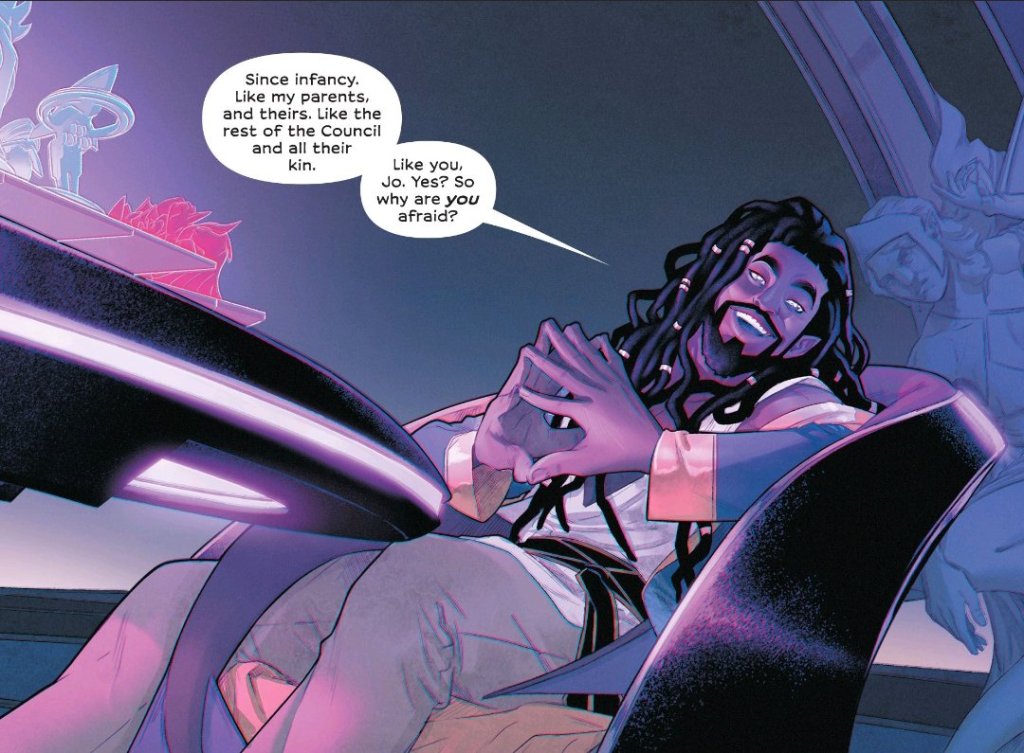
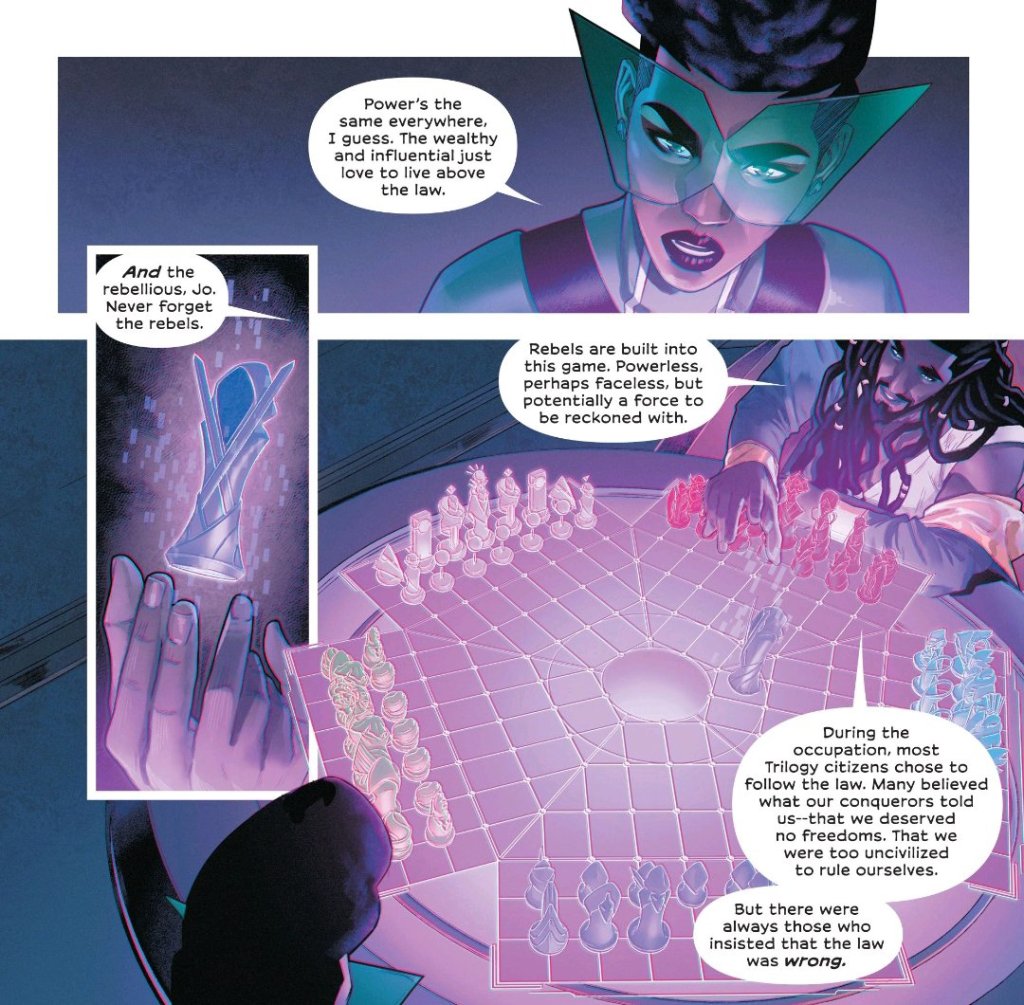
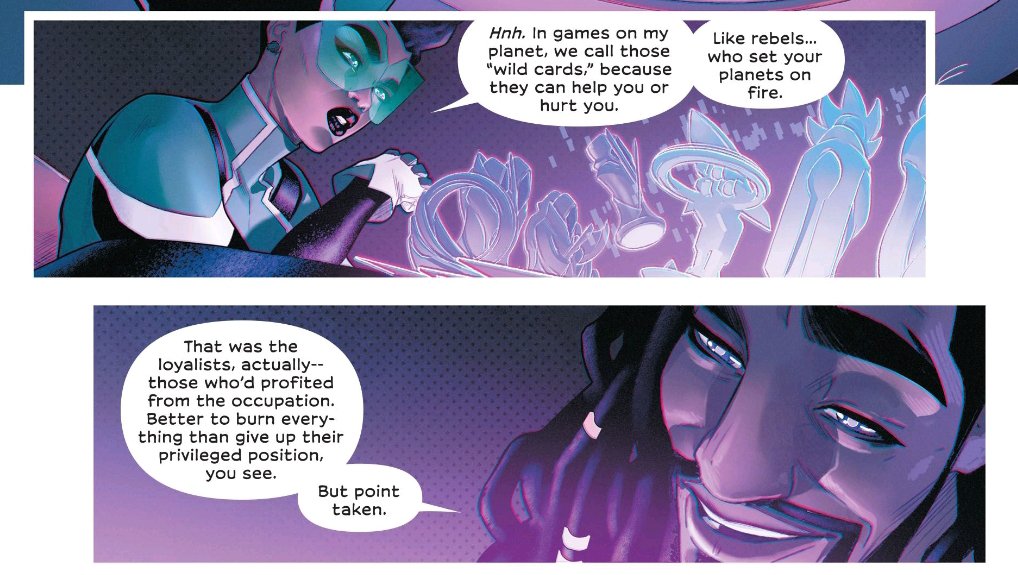


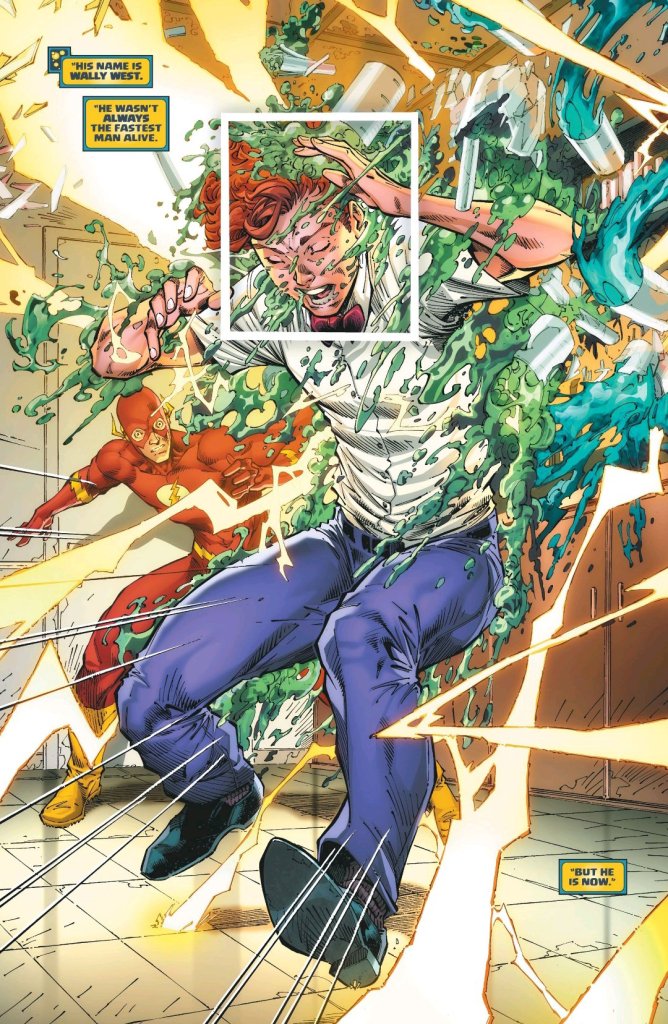

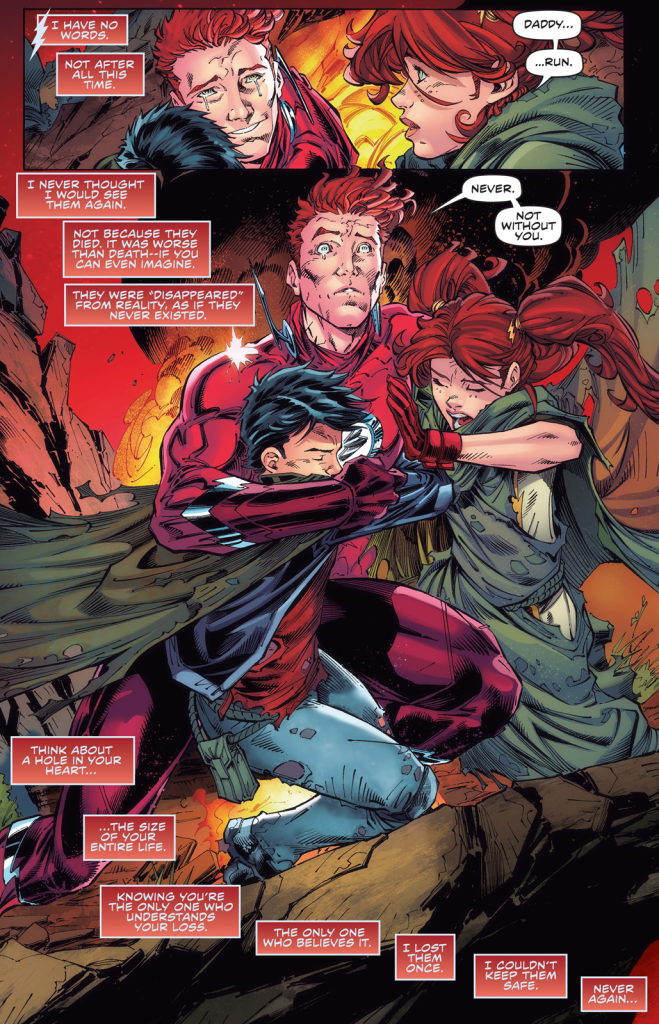
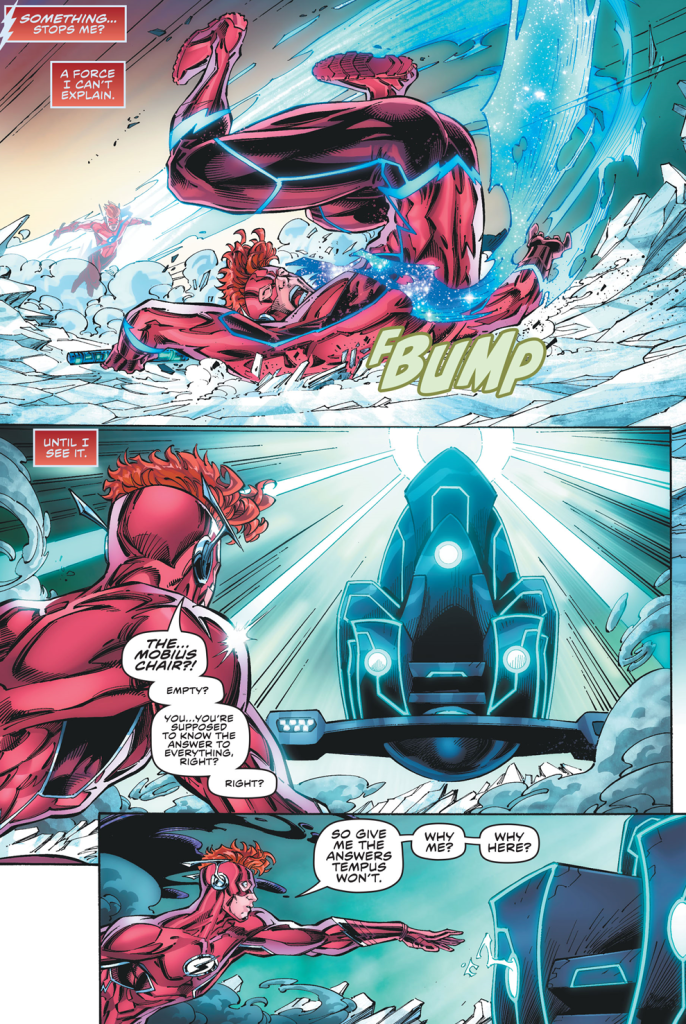
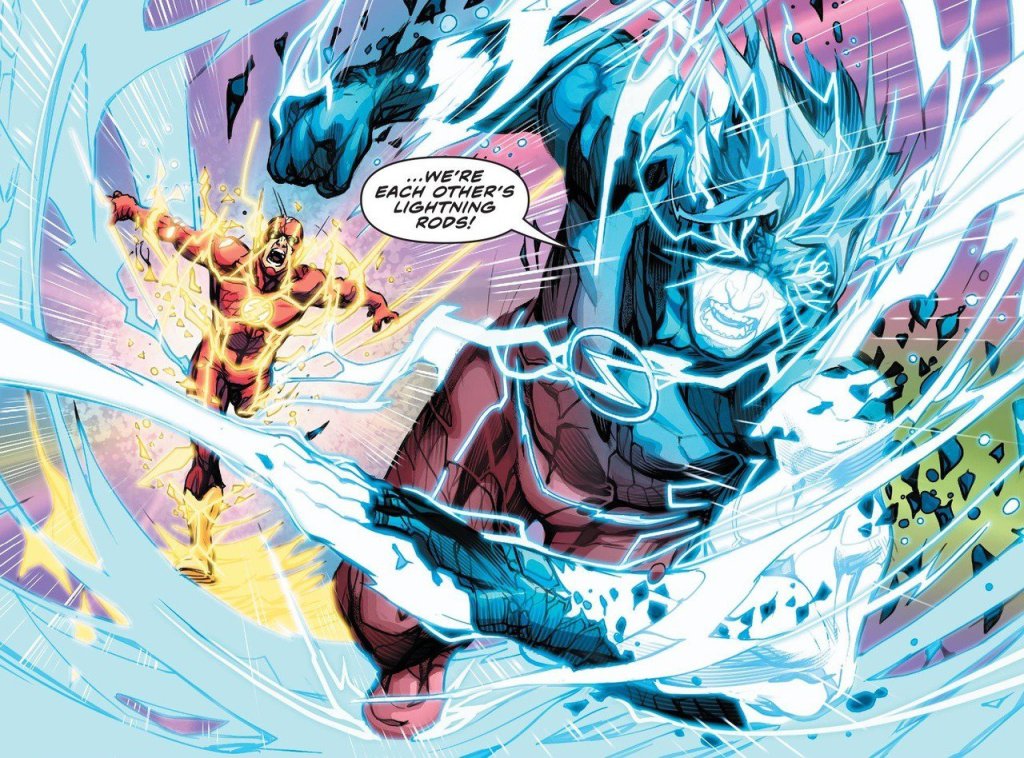


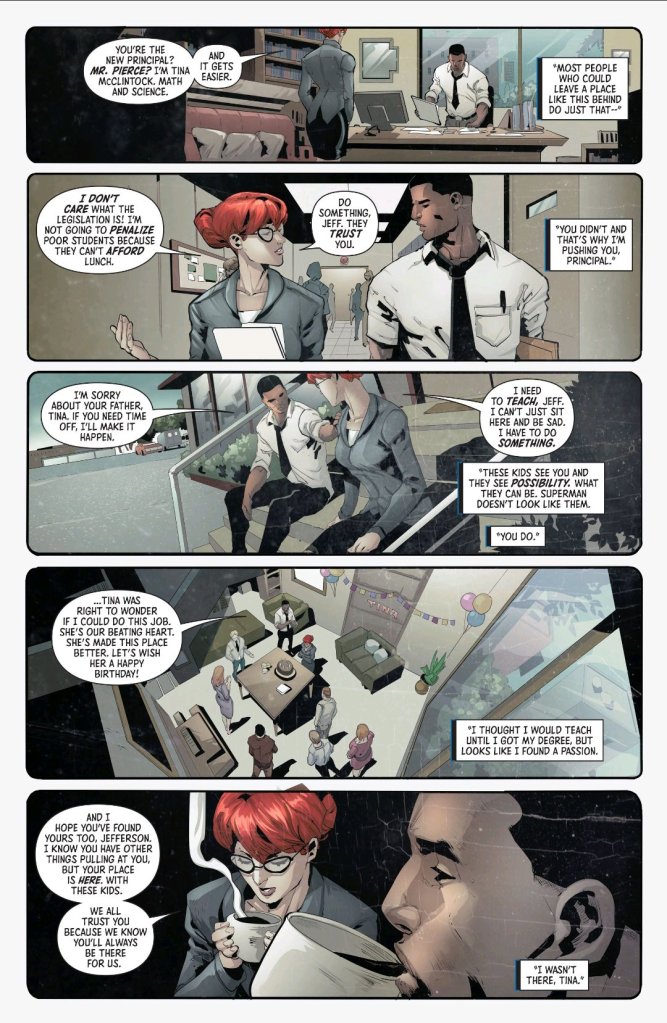

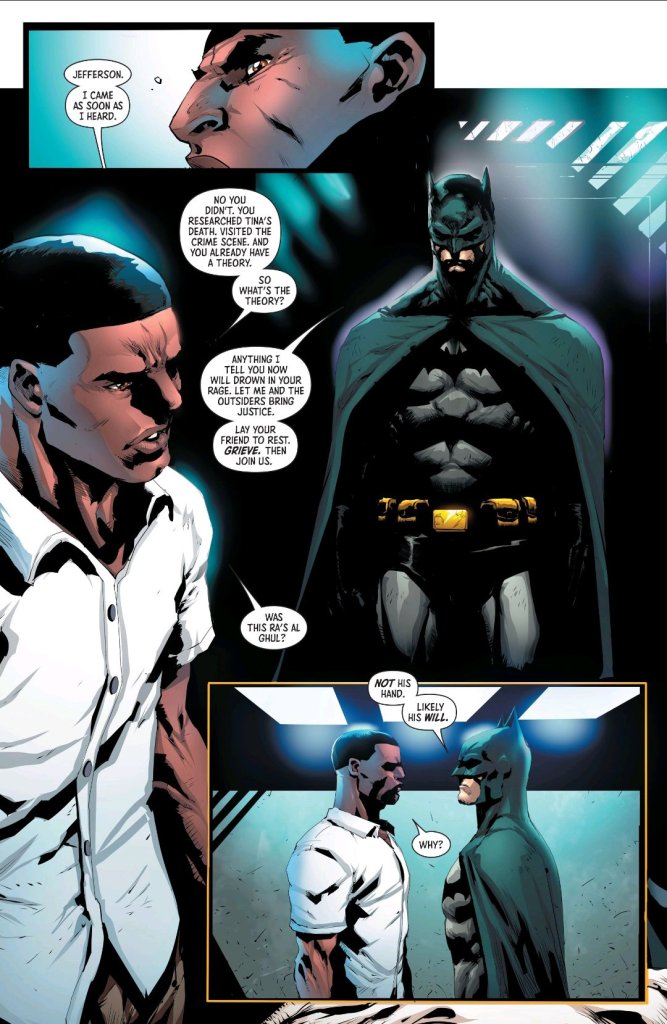
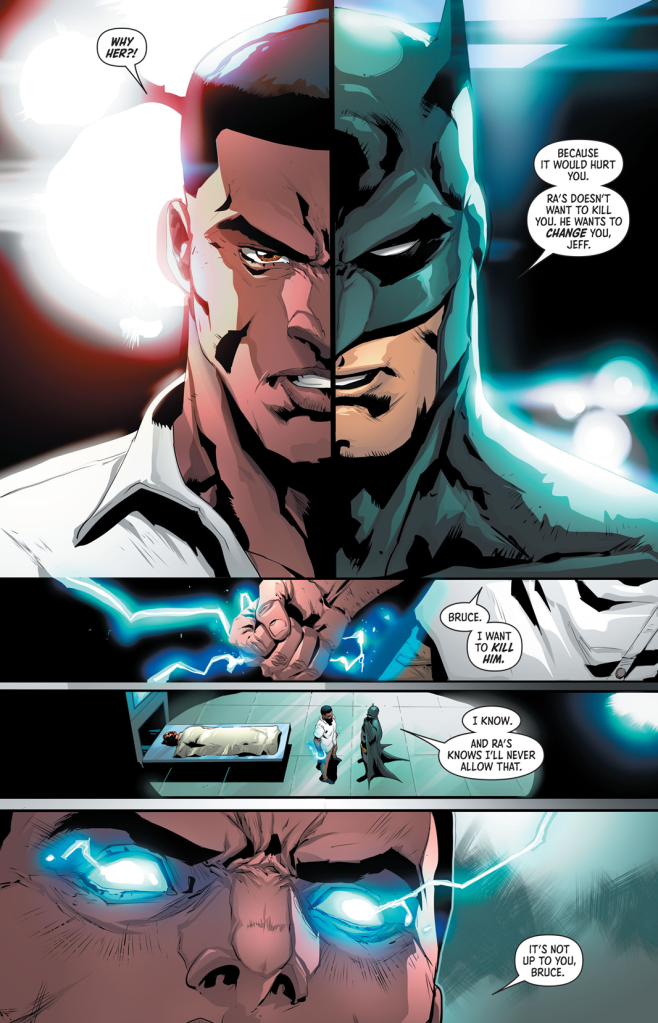


 Ty Talks Comics