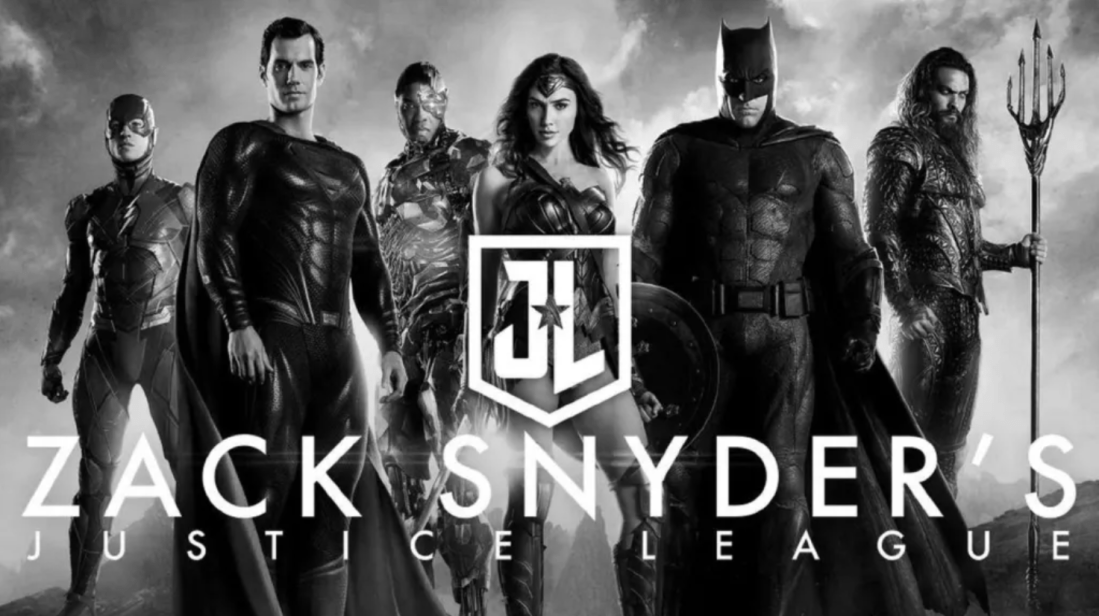
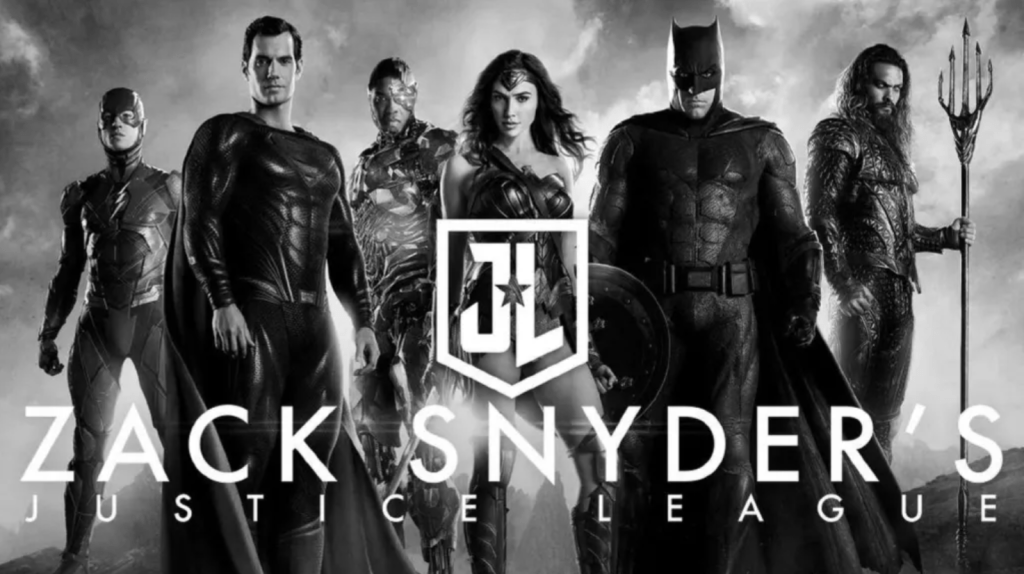
Ty Talks Comics Reviews: The Snyder Cut

What a strange position to be in.

Initially, when the groundswell of support for the Snyder Cut began, I found myself in full support of a filmmaker that I had been crapping on for his bad movies since the end of Batman V. Superman. I felt sympathy for the reasons that Zack had to leave the original Justice League project and even lightened up my criticism of the aforementioned BvS. Justice League under Joss Whedon turned out to be a mediocre mess of tonal dissonance and try-hard humor from a guy that, in retrospect, should never have been put in the driver seat after his actors’ criticism of him after Age of Ultron. I didn’t expect the Snyder Cut to actually exist, but the sliver of hope was there.

Then one after the other, the actors in the movie began to voice their support and tell of its “existence” and slowly, the sliver of hope became more real. The pressure was on Warner Brothers and then after years of speculation and cries from the fans, we got an announcement. It was vindication. Blog after blog, website after website said that it wasn’t real and that it would never happen. We would finally get Snyder’s original vision – and then he started tweeting and I remembered why I hated the man in the first place: He’s a giant, goddamn, edgelord.

Granted yes, Chris Terrio and David “She Hulk was a Giant Green Porn Star” Goyer, wrote the screenplay for BvS, Snyder still defended the murderous nature of Batman, the Martha moment and in general his love for the flawed Batman of The Dark Knight Returns and there’s a lot of bias coming from me going into this movie, but I tried my best to be as fair as I could and well, here we are.

The Good.
One of the biggest criticisms that came out of the original movie was how underdeveloped and forgettable Cyborg was. He had no arc to speak of clearly the director had no amount of care for the character at all. Thankfully the Snyder Cut vastly improved on Victor, not only as a character, but as an integral part of the team that had a lot to contribute. Watching him struggle with the pain of being mostly a robot and his own issues with his father before coming to terms with his new life and relationships was refreshing to see. Granted, Doom Patrol handled the arc a lot better, Zack Snyder did his best to show what his overall vision for Victor would have been and given how great of a character Cyborg is, it was much appreciated.

I love that Snyder actually made use of the awesome football scene that was a big part of the original movie’s marketing, but never made it into the final theatrical cut as it serves as some of the better character work as we’re able to see what a star football player Victor was. In many ways it reminded me of the animated Justice League War movie where his story played out in much a similar and more explosive way, with both of them acting as the eventual conduits to the defeat of the main villains through their understandings of the Mother Boxes.

Wonder Woman and the Amazons were filmed with an uncomfortable gaze of disrespect and oversexualization in the theatrical cut. Wonder Woman’s opening rescue scene deemphasized her heroics and the invasion of Themyscira portrayed the Amazons as being weak and ineffective when Steppenwolf set foot on the island and just wrecked them without regard. The Snyder Cut allowed all of these women to breathe, be leaders and warriors in every scene that they showed up in and I was much more hyped to see them on screen. If there was one thing that Snyder knew how to do, it was portray historical warriors as buff, badasses that didn’t flinch in the face of danger. The music during the scene was good, the camera shots were always well placed to get the most out of the Amazons and surprisingly the color wasn’t awful! They took the fight to Steppenwolf and Diana even made the final blow in the movie’s climax. 
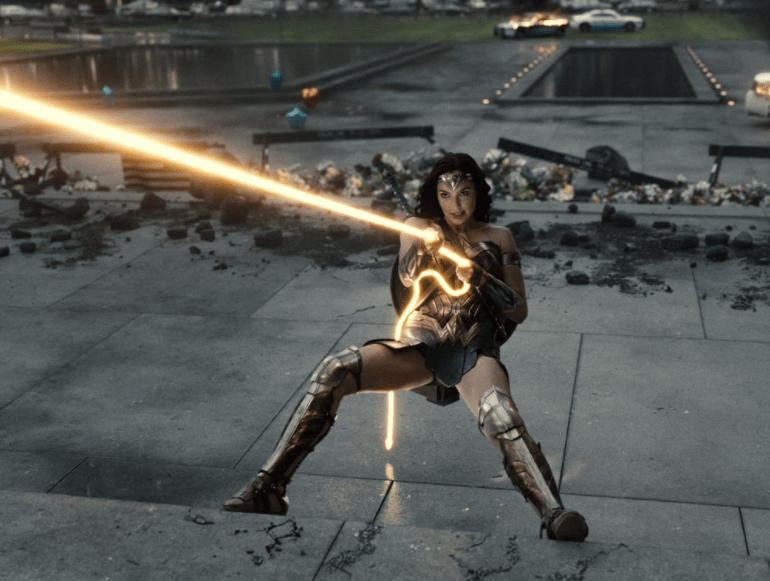
There’s not much I need to say about Superman’s resurrection scene that I haven’t said in the past review of this project. It remains one of the most epic and powerful scenes of Superman in a movie as he just systematically takes out each member of the League. It’s still fun and brutal and sort of sets the stage for how his mind would be susceptible to the Anti-Life Equation that would bring him to Darkseid’s flock if Snyder and Geoff Johns’ terrible sequel ideas ever came to fruition. I also liked the addition of the black suit, though of course he didn’t have a mullet, so this was really nothing more than fanservice.

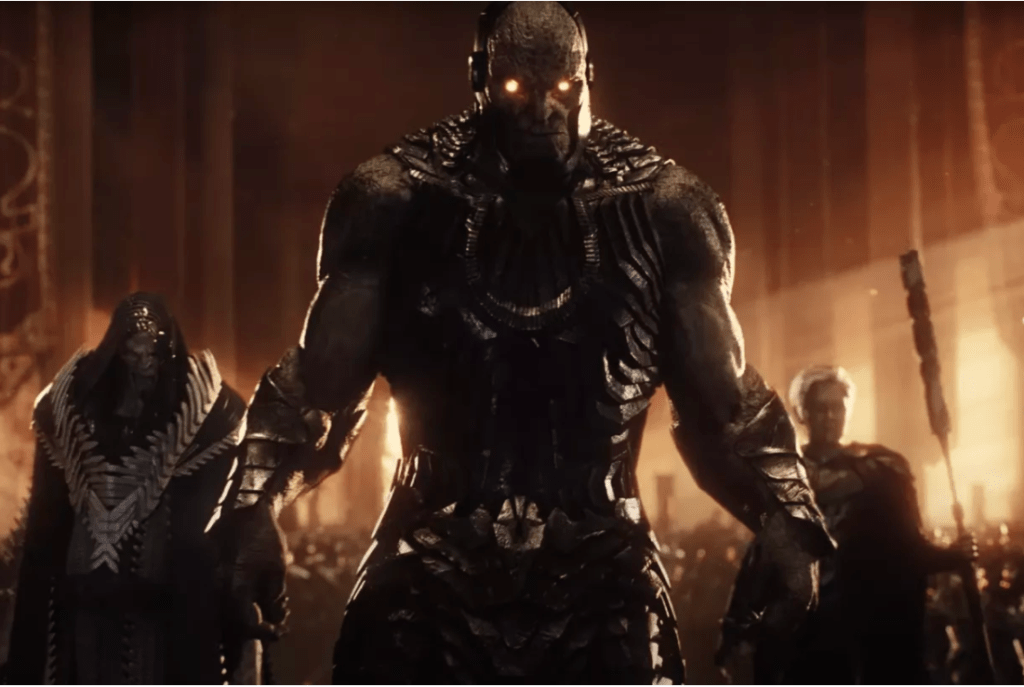
Finally, the reshot War for Earth was definitely one of the coolest and best scenes of the movie overall as, instead of Steppenwolf getting his ass kicked by the warriors of Atlantis, Themyscira and Humanity, it showed a younger Darkseid (or Uxas as he might have been known then) leading the invasion. This scene worked out well because it showed just how united the armies of Earth were, alongside a surprise Green Lantern while at the same time showing just how viscous and effective Darkseid himself was as a younger conqueror. The battle also looked really good from a filmmaking perspective as well since the CG blended well enough with the color so nothing looked too fake while also looking grand and bombastic. This scene was especially great as Darkseid was allowed to be defeated, giving viewers the idea that he wasn’t completely invulnerable and could be defeated by a powerful enough force.

The Bad.

Oh. There was so much. 

One of the biggest criticisms I have with Zack Snyder is that he takes his artistic expression to the nth degree and comes off as an edgelord looking to make all of his works dark and serious. His form of film directing values more style over substance, best exemplified with his version of Watchmen, which mostly stripped away Alan Moore’s criticism of fascism in superhero comics and Cold War era politics. His version placed value on how cool Rorschach was as hero that had a “code” once and then realized the world was too grim for it, as well as how COOL Moore and Dave Gibbon’s heroes were instead of the dark impact their existence had on the world. Granted, I do love his version of Watchmen because I’m capable of having nuanced opinions, but that doesn’t mean it shouldn’t be criticized. 

Zack Snyder’s Justice League is dripping with his style and while that style made this movie a lot more cohesive than the theatrical cut, it is still plagued with the same problems that the rest of his movies suffer from, which is artistic over indulgence, awful color grading, and terrible dialogue in some parts (oh we will get to the Knightmare, don’t worry).

First off, I think Sucker Punch is one of the worst movies I have ever seen. It was the film that awakened me to what Zack Snyder wants all of his projects to be like if he were given full creative control of things and it wound up being a confusing mess of interconnected music video moments and Justice League has most of that, but with a tighter focus. There is one scene in particular where a bunch of Icelandic women sing a song of lamentation as Aquaman is leaving their town after providing them with fish for the winter; for someone who proclaims their movie is supposed to be realistic, I don’t think that’s something ANYONE would do out of nowhere and not induce a cringe reaction.

Aside from that, a lot of the scenes that establish characters personalities in the beginning are, as previously stated, just music videos with water splashing, rain falling or something else happening in the background, all in slow motion while melancholic tunes play in the background. While I did manage to enjoy them for what they were, there were around four of these moments and soon wore out their welcome. Very easily these could have been shown as them committing heroic acts, but in Barry’s case (which is coming next), heroism is treated more as a joke than anything else.

Barry’s hot dog scene, second only to the Knightmare, infuriated me to no end. I love Ezra Miller with a passion. He’s a fantastic actor and, for the most part, steals the show in every movie he’s in! However, his Barry Allen is the most annoying, creepy and grating version of the character I have ever seen. He makes me question my tolerance of people with ADHD because he just never stops and his interpersonal skills are almost non-existent as while he’s in the middle of saving who I presume to be Iris West in slow motion, he just stares right into her eyes, almost brushes her skin, steals a hot dog and then proceeds to save her and get back to his job interview. It’s unsettling and that’s on top of his already bad humor during the rest of the movie.

As far as the color grading goes…yeah, it’s a much darker movie than it was before. There are so many scenes that either have their colors washed out or are simply far more shadowed than they need to be, giving the movie a much more bleak tone. One of the clearest examples was Wonder Woman’s first heroic rescue scene in which there was a light layer of blue over everything. I much preferred the colorful nature of the theatrical version given that Diana is one of the more hopeful heroes of the DCU. The color change seemed needless and seemed to want to fit more in line with the look that Snyder favors in his movies. I understand cohesive presentation, but one should also tailor scenes to each individual character and their respective personalities. 

That’s not the only instance of this, however, as Snyder somehow manages to get the editor to grade Batman’s trip to Iceland in search of Aquaman to be darker and that takes place in the snow, one of the most reflective and white surfaces possible. The contrast does work well in the end, but it almost has a stubbornness to it, like everything HAS to be darker to be cool. One of the things that I was looking forward to from the original trailers was the bluish tint of night during the final stand against Steppenwolf, but somehow even that gets made EVEN darker and my buddy Matt Dennis of the Fan of Everything Podcast (of course I had to plug him) explained that it might also be because of a Dolby Picture filter that they apply to their movies to give them more of a cinematic quality, but how hard is it to consider the audience that may not have larger TVs or the time to watch the film at night?

And finally, the dialogue of this movie is…something to behold. 

I honestly don’t believe the movie got its R-Rating from the violence within the movie itself because it is heavily tame in comparison to move other comic book properties like even the recent Invincible, but rather the R-Rating comes from its three (?) uses of “Fuck.” One when one of the Wonder Women terrorists just uses it to portray an air of “maturity,” another where Victor says “Fuck the world” as he laments his robotic transformation and finally when Batman says “I will fucking kill you,” to the Joker in the Knightmare scene. I love a good fuck every now and again, but either when they have meaning or are as gratuitous as a Share Size of “M and Ms” for one person. Breaking Bad had ONE fuck per season and they made use of it for full effect, The Boys has several fucks in each episode almost as a transition word at this point. The Snyder Cut has three and each of them just made me cringe and recoil with laughter.

From Flash asking Cyborg if Diana would go for a younger guy and Cyborg replying that because she’s 5000 years old, everyone’s a younger guy to Steppenwolf proclaiming that “the Great Darkness begins” there are a number of cheesy and bad lines, but most of them can reasonably be contained to the Knightmare itself. 

Not only do I hate Jared Leto, the fact that he’s a cult leader and possibly one of the worst Joker performers I have ever seen only makes me hate the final scene of the movie so much more. From his offering Batman a reach around to not so clever lines alluding to the fact that he murdered Dick Grayson in this universe, Jared Leto hams up his lines so much that it almost feels like he’s part pig. He wants to seem intimidating and crazy, but all that I can see is a cringe mall goth from the height of Marilyn Manson’s popularity. What makes matters even worse is that he even alludes to some of the plot that would have been part of Justice League 2 with Bruce and Lois being a couple after Clark died (remember those pregnancy tests in her drawer next to her Press Pass?)

This whole scene is clouded in a shit brown and Jared Leto is still the biggest piece of shit in it. If you look closely enough, you might be able to see two other turds in the form of Zack Snyder and Geoff Johns as their crap ideas just waft away in the billowing wind.

And there you have it. It has taken me a full week to collect my thoughts and put it to paper for this mediocre mess of a movie. Not everything was bad and it did have some quite enjoyable moments in it. Zack Snyder, Chris Terrio and David “I hate Green Characters, so why did I include Martian Manhunter in the Script” Goyer did manage to pull everything together back from the horrid state that Joss Whedon left it in. They are all talented in their fields and I applaud the crew of the movie for getting those additional shots, the long hours of editing and everything else, but fucking hell this movie was overhyped and underdelivered on both its cringe and possible goodness. Here’s to hoping Snyder and co. move on to better films after this and Johns continues to do well with Star Girl and comic projects…but after Doomsday Clock, who really knows?

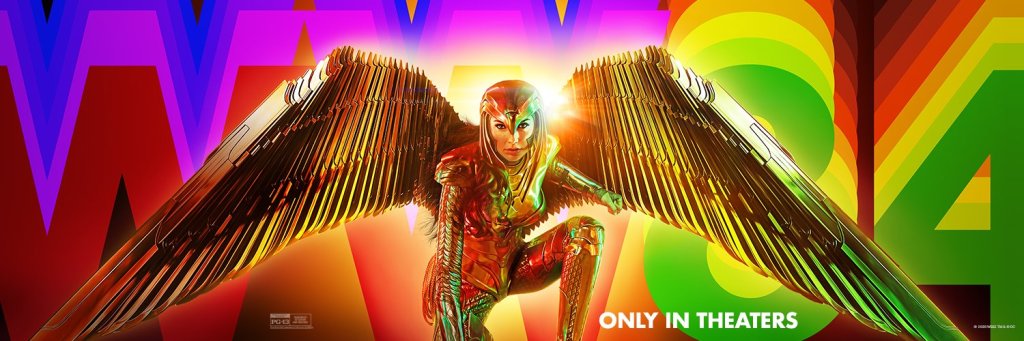
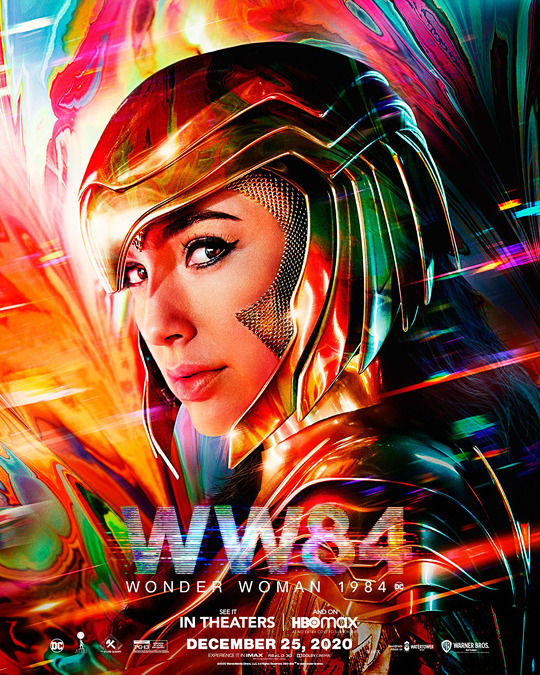
Ty Talks Comics Reviews: Wonder Woman: 1984

Directed by Patty Jenkins
Written by Patty Jenkins, Geoff Johns, and Dave Callaham
Starring Gal Gadot, Pedro Pascal, Kristen Wiig and Chris Pine

Introduction

When the first Wonder Woman came out way back in 2017, I was extremely elated to finally see one of my favorite female superheroes make it to the big screen after years and years of failed projects (especially the Adrianne Palicki show on NBC). When I finally did go see it, the movie blew me away and more than met my expectations up until the dreadful slog that was the third act. Overall, it was a fantastic movie that tripped up at the end and left me wanting more. So when this movie was announced, I had some slight fears that WW84 would face much of the same problems. 

Even through the pandemic, the delays and 80s fatigue, the movie finally made its way to theaters AND streaming and surprisingly did a great job at continuing DCs recent string of successful comic book movies. My girlfriend and I watched the movie through HBO Max, so that may color some of my opinions as we didn’t get the big screen experience, but hopefully it won’t be too much of a disconnect between the two methods.

The Plot

Wonder Woman: 1984 is, of course, the sequel to Wonder Woman, taking place in everyone’s favorite decade for the last five years; the 1980s! Sixty-six years after Steve Trevor sacrificed his life so that The Germans couldn’t have their deadly gas in World War I, Wonder Woman finds herself secretly fighting crime until a maniacal oil mogul, Maxwell Lord, finds himself with the ability to grant people their deepest desires in the form of wishes. Having accidentally wished Steve Trevor back, Wonder Woman and the love of her life must race against time to stop Lord from causing the collapse of humanity, but at what cost?
In stark contrast to Diana’s humble beginnings and finding her way through man’s world in the first movie, WW84 gives us a Wonder Woman that has lived in America for some time. She’s found her footing, a job she enjoys and occasionally saves the day and makes sure that no one knows that she’s still around from all the way back in 1918. She knows what it means to be a hero and has done her best to move on after Steve’s death, but still has some lessons to learn and I love that about this film.

While Diana’s main thread in the movie is learning how to let go of things and not take the easy route, her main antagonist in Maxwell Lord is just the opposite. His entire motivation in the movie is success by any means necessary in order to make his son proud of him and he takes every opportunity that he can and runs with it, whether he needs to schmooze or seduce, as long as his end goal is met, it doesn’t matter who he has to hurt to get to it. What’s even better about this is that he doesn’t DIRECTLY hurt anyone until the end, but that in itself is only because everything else just keeps escalating to a point where a single snowball leads to an avalanche that almost causes nuclear war.

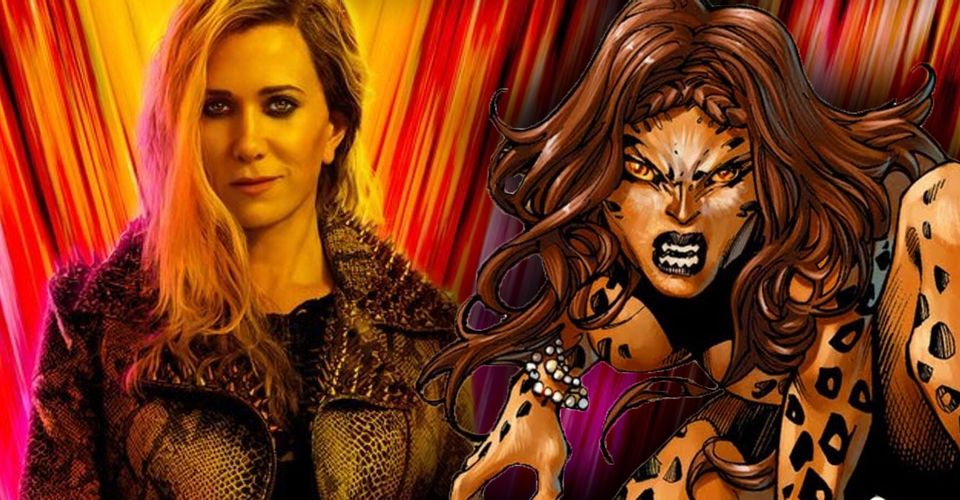
There’s also a subplot where Barbara Minerva, having also made a wish to become more sexy, confident and strong like Diana, morphs into the villainous Cheetah that probably should have gotten more screen time than she did. Her character arc follows a similar throughline as Electro,Tighten (from Megamind) and Syndrome in that her adoration for the hero of the story turns to hatred as she doesn’t feel appreciated nor does she want to give up the abilities that she’s gained and return to horrid existence she had before as a shy nerd.

While not as strong as the plot of the first movie it does bring on a lot more fun in the character with a few bits of campiness and humor in contrast to the mostly serious and heartfelt nature of the first movie. Even when Max Lord is in the hardest throes of his madness, there’s still a hammy nature that Pedro Pascal brings to his smiling performance that just infects you with how fun it must have been to work on this movie.

Many fans had wondered how Steve Trevor would return for this movie and I think that the way that they did it was inventive, fun and heartbreaking on many levels. Having his return be one of the first anchor points to drive the story was fantastic and the way it resolves makes you want to root for Wonder Woman more especially when you’re near the point of tears after.

Characters

The cast of this movie knocked it out of the park in almost every regard.

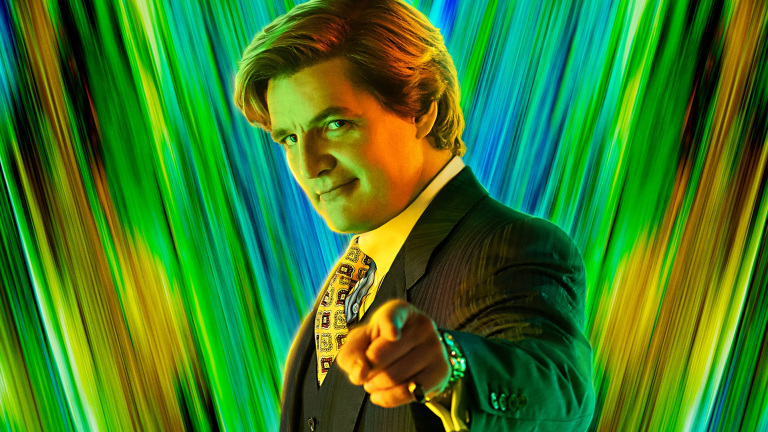
For all of the time that I’ve been reading comics, Maxwell Lord has always been this self-serious, anti-superhero telepath who only wants a world where humanity doesn’t have a need for capes, sort of like Amanda Waller, but maybe a bit more radical. Pedro Pascal’s Max Lord is a far cry from that and still finds a way to be compelling and charming as the character. He’s a shyster and it works on a level that I didn’t expect, so much so that I wish this version of the character were in the comics vs. the standard version that reappeared in Mariko Tamaki’s current WW run (even though it has been fun). Lacking in the sheer genius department, Pascal’s Lord relies on his guile to see him through most situations. He’s a fast talker, he has moxie and I feel like Jenkins, Johns and Callaham took their time while writing the screenplay to make him snappy and fun and not an overbearing bad guy.

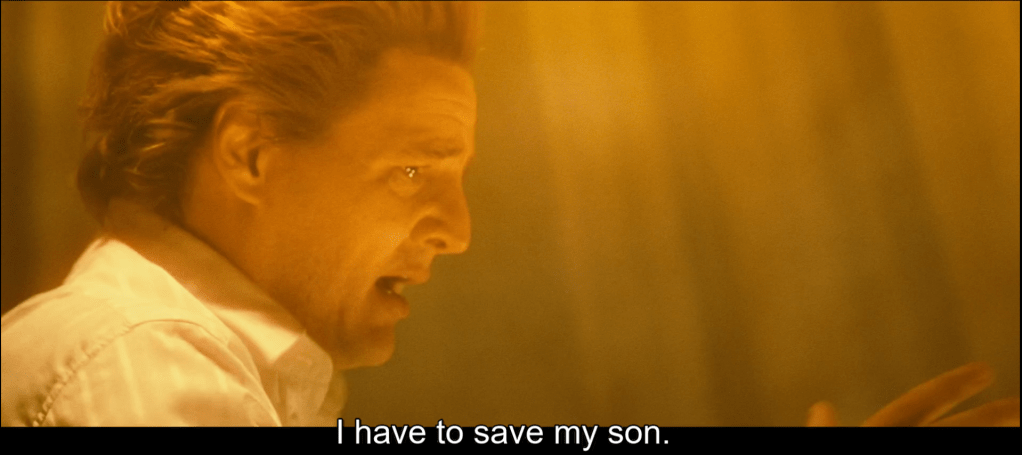
Even more so than that, he’s a loving father. One of the best things about this Max Lord is that everything he does is for his son as he doesn’t want to be the same kind of bad father that his own dad was and it comes off as very sweet, if a bit misguided, when the ball of madness start rolling. His lack of success in the oil industry has made him desperate for a break and he even turns to magic when literally nothing else works and it’s only his son that’s able to bring him back from the brink.

Gal Gadot herself also brings her DC best as she’s equal parts funny and dramatic, bringing some fantastic personality to the character, not saying that she didn’t in the first one, but it was much easier to believe that she was Wonder Woman this time around. The same thing can be said for the young Lilly Aspell, who played a younger Diana in the first movie and returns for the opening sequence of this sequel. She showed the same kind of drive to succeed that Diana would later show in the future, while also imparting some hard lessons in her childhood that made her become the hero she is.

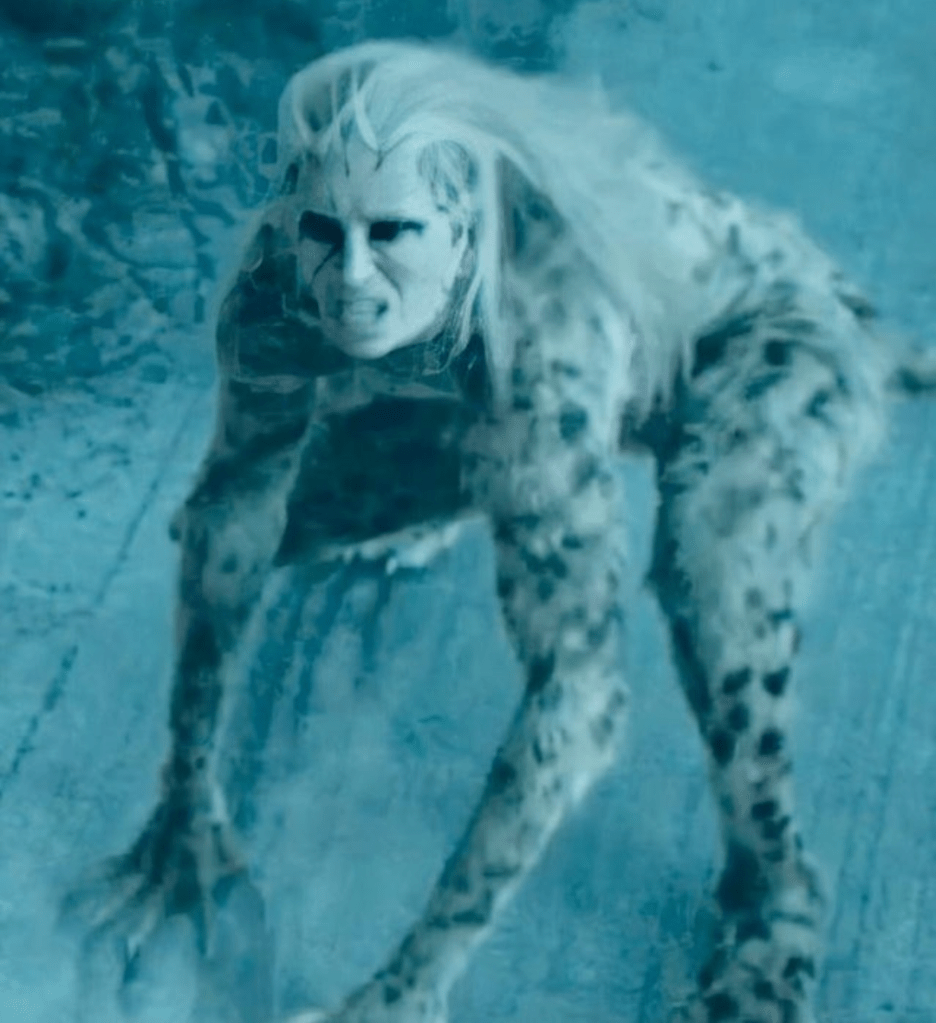
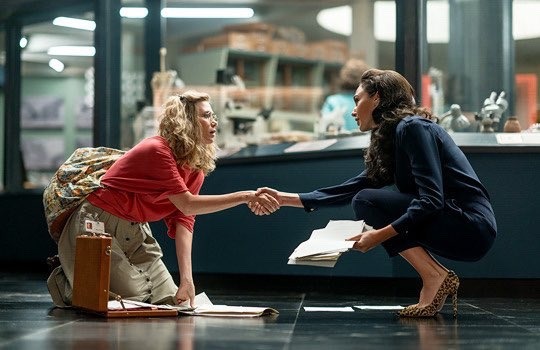
Cheetah has never been one of my favorite Wonder Woman villains. I chalk this up to her being one of DCs many characters with convoluted histories and mantle switches almost on par with Donna Troy or Hawkman. It wasn’t until DC Rebirth that Barbara Ann Minerva became an insanely compelling character in my opinion in what I consider one of the best Wonder Woman runs ever made. The same can’t quite be said for Kristen Wiig’s Barbara Ann Minerva. While she did the character very well, from the meek personality to the sexy, catlike turn, she never had enough screen time to really breathe life into the role. 

Hell, when she finally transformed into Cheetah, she was gone before anyone even noticed and gave some Cats flashbacks in the meantime with the CG effects. I feel like Wiig’s Cheetah needed a movie all to herself because so much of this one was taken up by Lord – depending on what the plot for Wonder Woman 3 will be, I would suggest she return as a puppet of Circe or Doctor Psycho, thus giving fans more emotional reason to be invested in her transformation since the way this movie ended left things a bit unfinished.

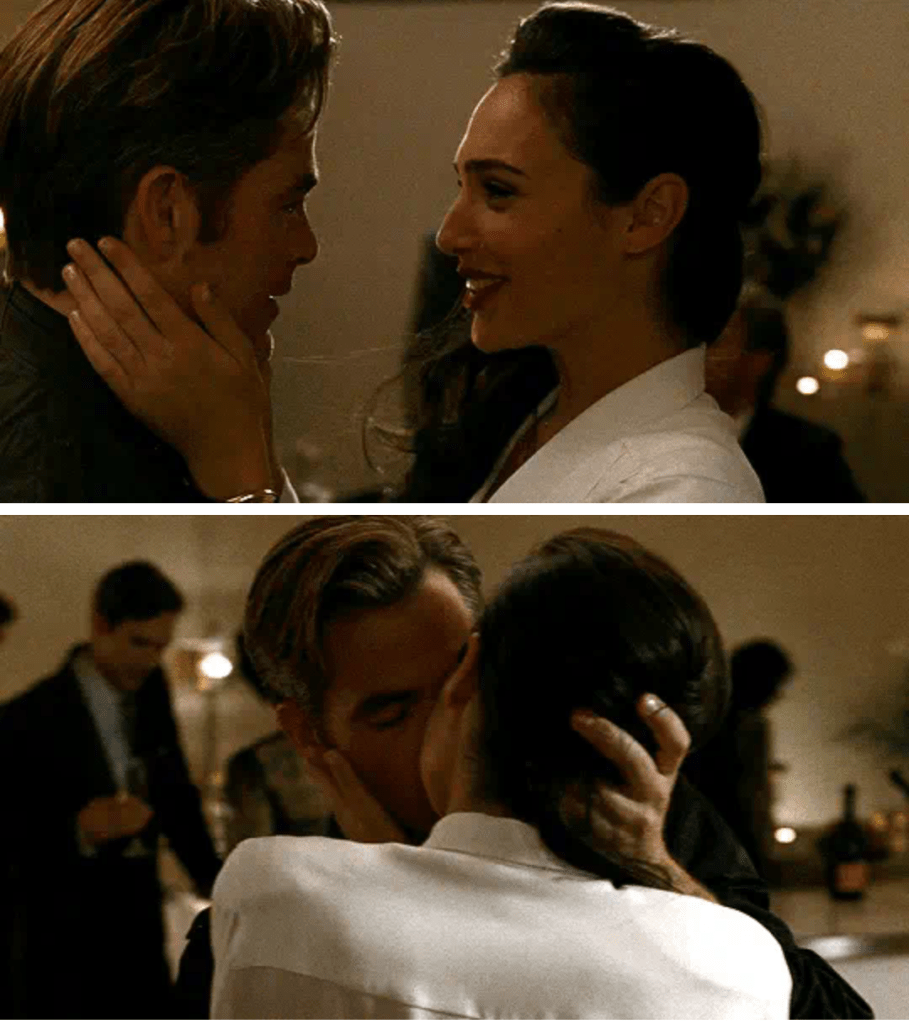
Steve Trevor was just a treasure. I don’t know that I’ve seen too many roles where Chris Pine has been able to flex some comedic chops, but the way that he portrayed Steve as being so fascinated with the 80s was unreasonably cute and adorable. His love for Diana also made him stand out as you never wanted him to leave her side, to get in serious danger again and it reminded me of why the first movie felt like such a joy to watch. Their chemistry together is amazing and he doesn’t come off as an incompetent goof, but as a capable guy that loves Diana with everything he has which makes the end of the movie all the more heartbreaking.

Themes

The 80s was a big time for consumerism in America. Brands, celebrities and media had their names slapped on everything from door mats to lunchboxes. Even your TV personalities were everywhere, just think of Letterman being in an issue of the Avengers! Wonder Woman 84 offers up something of a critique of Capitalism and the idea of winning by any means necessary, even if the way they go about it is made shallow by this being a superhero movie made by one of the biggest media conglomerates in Warner Brothers, owned by AT&T who, much like Maxwell Lord, don’t care who they have to fire, sell off or what projects they have to cancel to win the streaming war or get out of their immense debt.

DC Comics is full of corrupt businessmen and women. And despite what anyone says, Bruce Wayne is NOT one of them. When you have people like Veronica Cale or Simon Stagg (guess who has a minor role in this movie?), Wayne is a saint by comparison. Suffice to say, Lord’s actions in this movie are driven by the desire to be the number one oil man in the world to impress his boy. His lust for greed is so nearly insatiable that even in the face of worldwide nuclear war, he doesn’t want to give it up, very similarly to our world today. However, it is through the love of his own son that Lord is able to see the error of his ways, even if it is a far cry from a reality where people won’t even look at those lesser than them as worth a damn.

One thing that I praise this movie for is the opening sequence, something which Patty Jenkins herself has said that WB wanted her to cut from the movie. What made this succeed was that it showed that Diana was at one point willing to cheat to win and that she would never be a true hero that way. So when she has the opportunity to have something for herself, she has to make a decision that could lead to the destruction of humanity or begin the process of saving them all. One of the criticisms I read before writing this was that Wonder Woman would never have to think about the choice, but the difference is that comic Wonder Woman had 80 years to develop that heroism and movie Wonder Woman is still learning. She acts selflessly in the end and completes the arc that the movie set up for her.

Cinematography

I’m not the most qualified to talk about cinematography as I am about writing, but goddamn this movie is gorgeous and shot well.

If I did have any gripes about the first movie aside from the third act, it would have to be that it felt a little colorless. Sitting in line with the murky nature of WWI and producer Zack Snyder’s own predilection for washed out color schemes, there were quite a few scenes in the first film that felt a little dour. While this was definitely a creative choice as Themyscira itself was lush with greens and bright tones, man’s world was depressing and dark. WW84 does the exact opposite by placing more of the action in the daytime astride the many-hued looks of the time. 

Bright yellows show up from time to time in regards to characters expressing their greed in regards to Maxwell Lord and Cheetah respectively; in fact, one of the biggest moments in regards to Lord making big moves took place in Bialya where the greedy President of the country accidentally makes a wish that his ancestral lands were returned to him and Lord, in return, takes all of his guards and wealth.

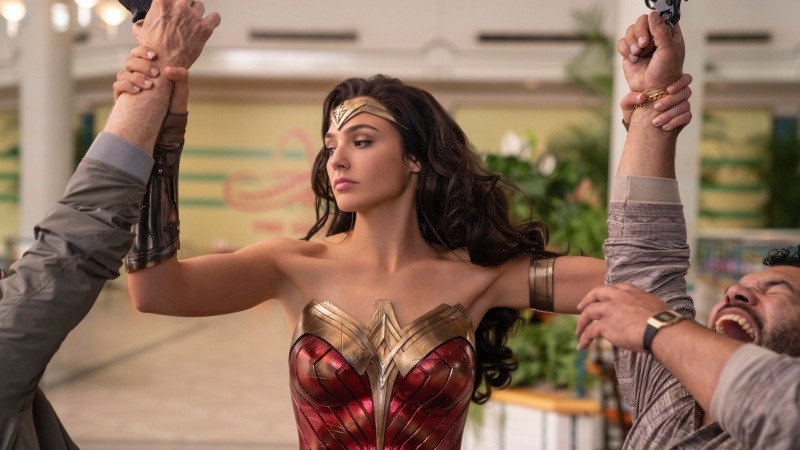
In contrast to that, Wonder Woman’s scenes themselves don’t stick to one particular hue, but allow for a more varied palette similar to Shazam. Her costume itself even seems a bit more saturated in its reds, blues and holds as she seems like an even happier and confident hero, which lends itself well to the tone of the movie itself, even when it’s later moments become standard Zack Snyder fare.

The action scenes are shot fantastically with a faster and frenetic pace in comparison to the slow and dramatic cadence of some of the scenes in the first movie. There are lots of sweeping camera movements as Diana swings and slides into action, jumps from vehicles and even uses her lasso to move from lightning bolt to lightning bolt in some of the BEST “learning to fly” scenes in a superhero movie I have ever seen. There were many moments where I was at the edge of my seat with just how dynamic the movements were.

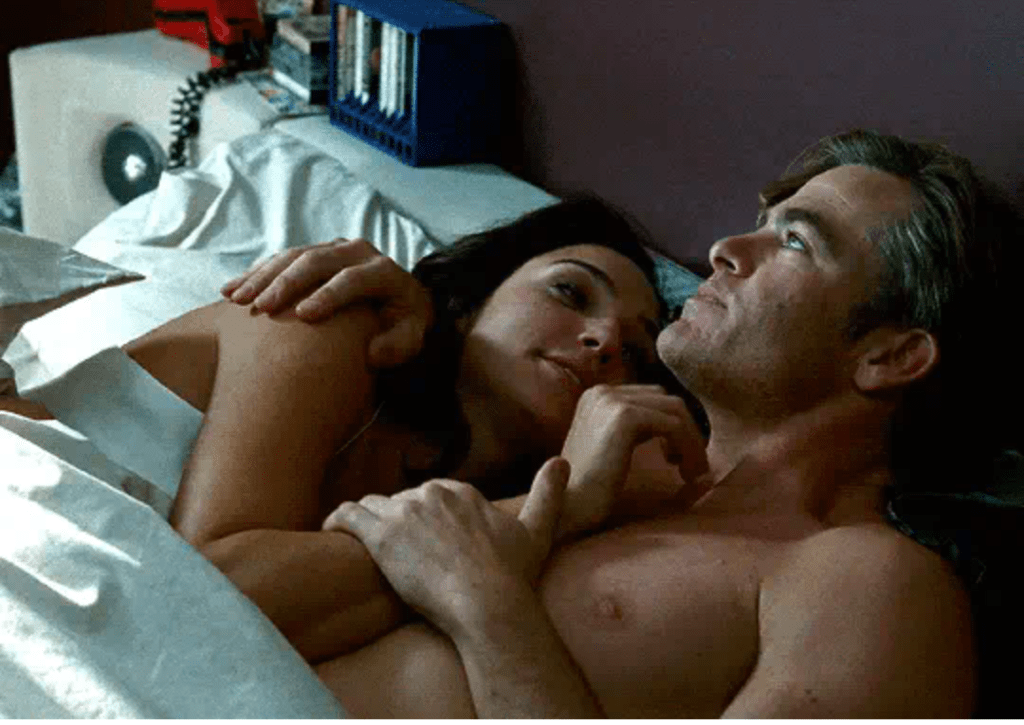
In terms of intimacy, WW84 did an awesome job of allowing the quieter moments to speak for themselves and the few romantic scenes that Diana got with Steve to fill the heart with joy. Whatever Patty Jenkins asked Gal Gadot to think about, she’s absolutely focused on it because when Diana looks at Steve, she seems lost in him. Like her love is there more than ever, but tinged with the fear of losing him again. And Steve himself looks like a kid in a candy store with the surprise at being alive again. They do excellently with Trevor’s astonishment given that he would almost certainly have been a kid or teenager in the 1890s and shows how he would have viewed the future had he lived to see it initially.

Questionable Things/Negatives

Granted, this entire review has been me fawning over the movie and I won’t deny that. The initial backlash took me aback, so maybe my expectations were lowered than what they could have been initially and somehow, this movie being more than above average sent me over to the “it’s a good movie side.” However, that does not mean that the movie is without its flaws and downsides – what live-action DC movie isn’t?

*SMALL/BIG SPOILERS AHEAD*

Starting off with the biggest possible thing, the sheer amount of calamity that befell the world due to the events of this movie would have to have been taught about in schools and been subject to discussion WELL AFTER their passing. World ending events are par for the course in superhero media of all sorts, but we’re talking about nuclear war, societal collapse, financial rises and crashes the likes of which the world will never see again, destruction of all sorts and, retroactively, nothing in the DC Universe makes sense. We can chalk this up to just brushing things under the rug, but there’s that and then there’s flat out ignoring things or writing oneself into a corner that future directors are going to have to course correct into later on.

This could lead to great future explanations like Batman’s turn to a murderer being because he wished his parents back to life only to have them taken away again; Krypton’s destruction being due to Martha and John Kent’s desire for a son and them not reversing their wish in time; Atlanna and Tom Curry wishing to have more time before the forces of Atlantis come after her; hell, it could be the reason Dr. Sivana is so smart in Shazam and the way that Barry Allen’s lightning bolt found him years later after wishing for a way to solve his mother’s murder. (Remember, just my ideas cause this movie answered NONE of that and Bruce was almost certainly a kid at this point)

One of the potentially weirder aspects was that there’s a strange question of consent in regards to Diana and Steve having sex because the method of Steve’s resurrection was the possession of the body of some random engineer located close to Diana in Washington DC. It’s…strange to say the very least, but if you can get over it, then things are all fine. 

There’s also the possible question of racism in regards to the President of Bialya being one of those world leaders who believes that the lands of his people belong only to them and wishing to have all foreigners kicked out and regaining the rights to his claimed land holdings. This wish causes a wall to spring up and trap his people within Bialya’s borders with no escape, incurring the wrath and hatred of his people. There’s also a moment where Wonder Woman swoops in to save some possibly Muslim children when Gal Gadot, a previous Isreali soldier with the Israeli Defense Force, voiced her support for Israeli soldiers in the conflict on the Gaza strip against Hamas. That one’s a bit of a heavy issue especially in regards to one review about a comic book movie, so make what you will with that.

Another potential plot hole that might spring its head would definitely have to be the likelihood that Wonder Woman was seen at any point during the movie and Batman would have known who she was a long time prior to Batman V. Superman. The amount of news coverage that there was in the movie, with her not doing anything to cover her tracks past the first mall robbery scene is BAFFLING to say the very least.

One aspect that I LOVED that I see other hating immensely was the fact that Wonder Woman learned to fly and had the ability to turn things invisible in this movie and never showed those abilities again afterwards. I loved the scene where Diana and Steve Trevor stole a WORKING JET from the SMITHSONIAN AIR MUSEUM with FUEL and WORKING PARTS and she used magic to give fans like me THE INVISIBLE JET. It was so stupid and dumb and non-sensical that my girlfriend and I just laughed at the implausibility and dumb-assery on display. It was AMAZING in every regard. Not to mention that I already talked about how much I enjoyed watching her finally figure out how to fly and testing out her poses.

As previously mentioned, Kristen Wiig’s Cheetah felt like something of a let down in this movie. For what could have been a very feminist villain, she came off as being very toothless when siding with the Lord, who had had a one night stand with her to get the thing that he wanted. If she had shown a little bit of fire after he pumped and dumped and made their relationship a little bit more tense in the, “I’ll kill you if you mess this up for me” kinda way, then she could have come off as a lot more threatening. And, I understand that the fight scene between her and Diana was set in the darkness to cover any flaws in the CGI, but the animation still looked a bit off in the Uncharted for PS3 kinda way. WB is a multibillion dollar company and, much like BvS, still didn’t want to put the money towards better VFX? Shameful.

And that still doesn’t even cover how limp the fight scene was and how we never saw Cheetah’s transformation into the “apex predator” that she wished to be. Her final climactic battle with Diana, where the princess wore the golden armor that we saw in promotional material everywhere, lasted all of maybe three minutes and consisted of Cheetah immediately destroying the armor, Diana using the Lasso of Truth to swing around and Cheetah being electrocuted to end the scene. 

Conclusion

For everything that Wonder Woman 1984 does wrong, it does about three or four things well enough to cover its flaws. Whether or not I have to amplify my worry when Wonder Woman 3 hits screens is yet to be known. This movie succeeds in my eyes with a heartfelt story and great funny/dramatic moments, but is let down with a weak secondary villain and a nothing story with insanely high stakes. It’s a mess, but I like messes when they’re fun.

Overall Score: 8.5/10

Best of Marvel: Week of March 25th, 2020

Best of this Week: Black Panther #22 (Legacy #194) – Ta-Nehisi Coates, Daniel Acuna, Ryan Bodenheim, Chris O’Halloran and Joe Sabino

Can T’Challa ever be redeemed?

Most people might not know, but I have something of a distaste for the King of Wakanda for various reasons over his long, illustrious, heroic career and, over time, it has all spun into a neverending flood of anti-T’Challa bias as time has gone on. From his time as part of the Illuminati to his failed relationship with Storm, I have hated this character and the fact that his misdeeds have gone mostly unpunished…until now.

The Black Panther has never been an apologetic hero and he shouldn’t have to be because he is a king and needs to be strong for his people. Though with his nation on Earth and in Outer Space under siege by the resurrected Erik Killmonger with a symbiote of the former Emperor N’Jadaka, T’Challa has trials to face before he’s able to command his people and see his defeat. His biggest question is, what is his name and will he be able to overcome his own transgressions and become the leader his people truly need?

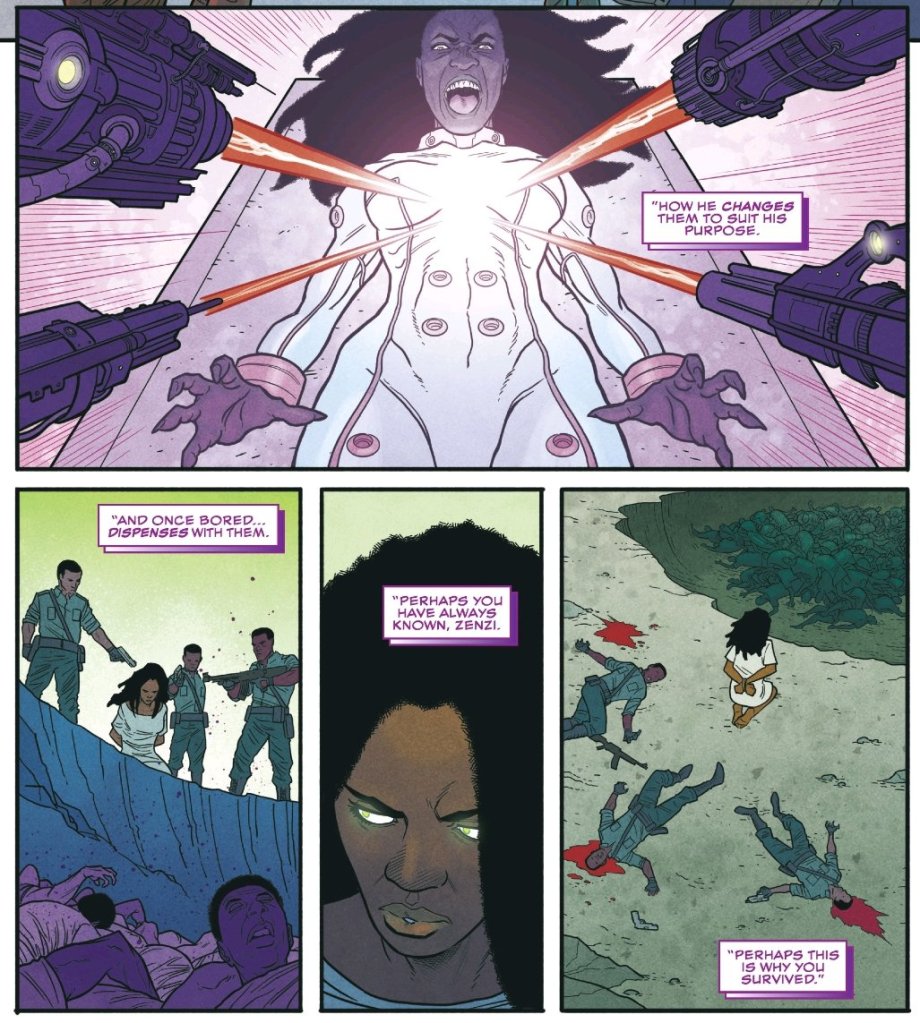
The main theme of Ta-Nehisi Coates’ Black Panther story is redemption. This issue begins with Zenzi, one of the first new villains introduced by Coates in his initial Black Panther series back in 2016, and gives us a little bit of her backstory with some history involving the original Killmonger. Through Ryan Bodenheim’s pencils, we see the simmering anger and power that she’s been capable of since her introduction and why she’s so eager to see the end of men like T’Challa who use their people and then discard them like Killmonger did for her, giving her superpowers and then trying to have her executed.

Bodenheim and Chris O’Halloran on colors gives this scene and her subsequent conversation with Bast in the body of a child a sense of weight as we now are able to understand why she’s on a mission to rid Wakanda of false rulers, Gods and Kings as Killmonger killed her entire village for his own ends and she likely feared T’Challa was doing the same to Wakanda. O’Halloran uses soft and hazy colors for the flashback, employing slight green and purple hues and switches it up to vibrant greens for Bast’s astral projection and Zenzi’s clothes as the Goddess convinces her to support Wakanda against Emperor N’Jadaka.

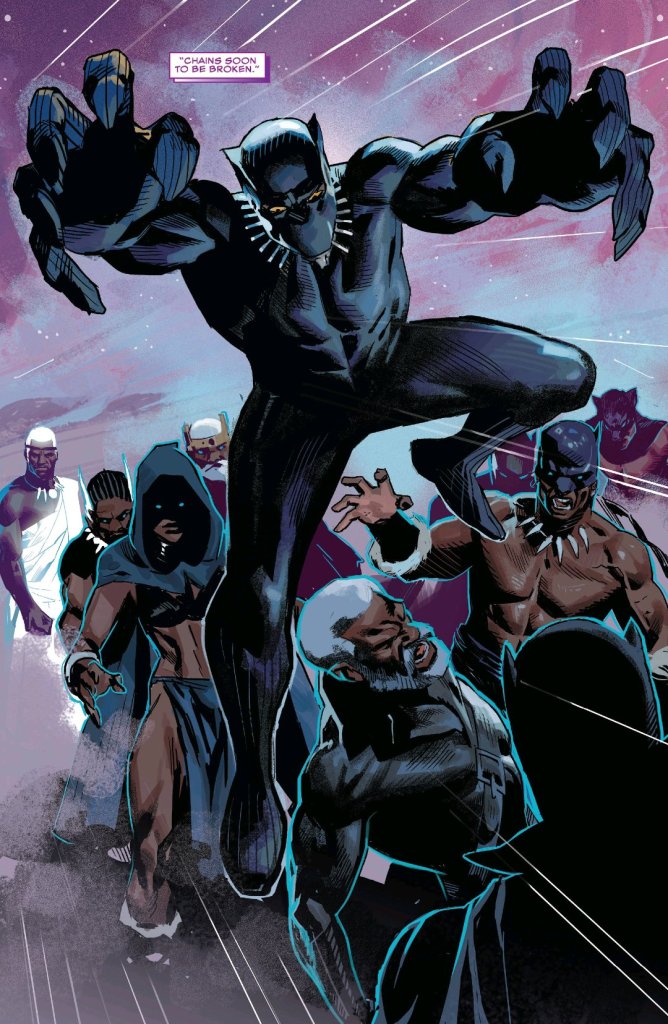
At the same time, T’Challa finds himself within the Djalia, the Plane of Wakandan Memory, facing off against his many ancestors to gain their help and fealty so that he may finally put this battle to rest. The main problem he faces, however, are both their numbers himself as a King. Daniel Acuna takes over the art for this portion of the issue and absolutely stuns throughout with impressively smooth linework and coloring which gives distinct borders to characters and their clothing and backgrounds while being absolutely beautiful at the same time. 

Joe Sabino’s lettering also shines here as he makes the distinction between T’Challa and the many other Black Panthers by giving him black letters and word bubbles while the rest have purple letters because of their nature as ethereal beings. Not only that, but his sound effects accentuate the panels perfectly as the “TWOK” from a headbutt is given a yellow hue while being transparent to show impact and a “THUD” from  T’Challa being swept at the feet is colored in a bright blue that accentuates the yellow background.

One of his female ancestors mocks his so-called “preparation” as he summons a white, luminescent spear to fight them all before she summons the Ebony Blade of the Black Knight (see Black Panther 22 – 23, 2005) and slashes him across the back, revealing his own recent past to him. This is meant to serve as a way to show how T’Challa is not as infallible as he makes himself out to be, considering how many times he’s been on the wrong side of history in regards to the world, his people, his lovers and his friends.

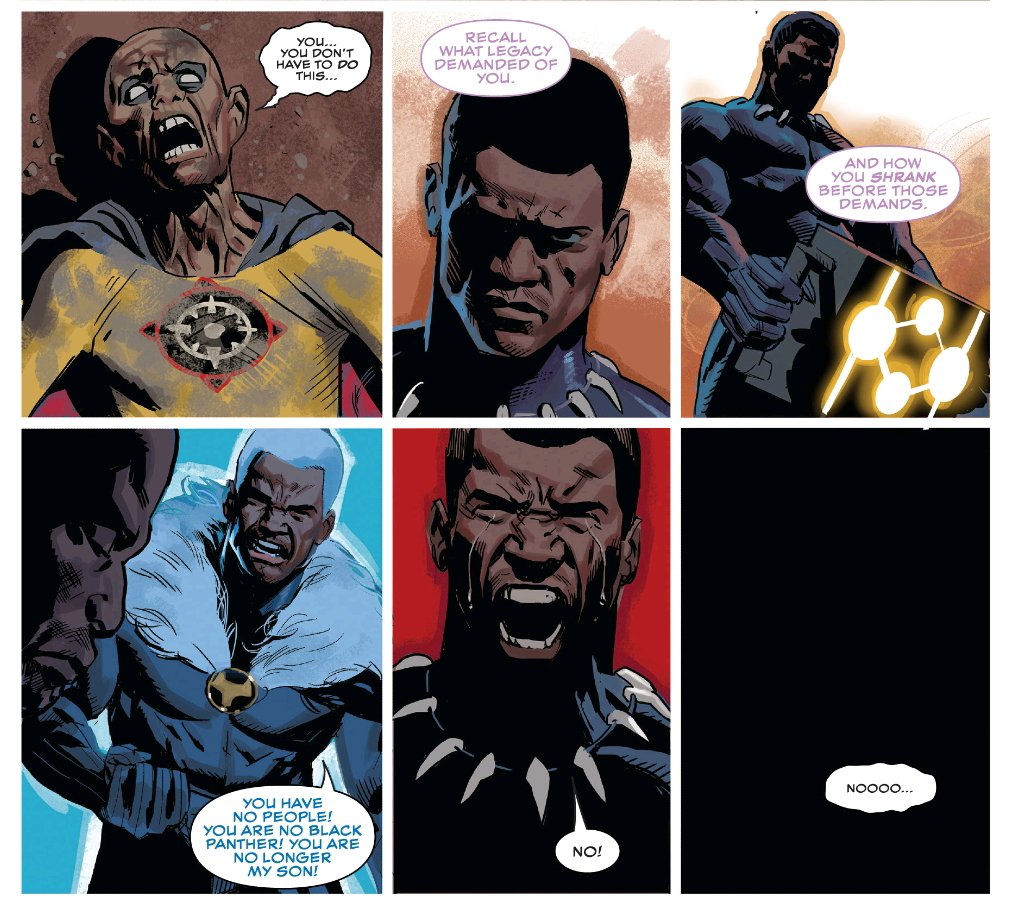
Coates has obviously done his research into Black Panther’s best and worst moments as the first flashback we get is from Jonathan Hickman’s New Avengers (#21, 2013) after the Illuminati defeated the heroes of another Earth to save their own, the caveat being that they would have to destroy the other Earth. This was one of the lowest moments for the hero as he couldn’t do what needed to be done and King Namor had to, knowing that sacrifices had to be made in order to save the Earth. He shrank away from his duties of protecting the Earth – of protecting Wakanda after The Black Order had attacked it merely ten issues prior.

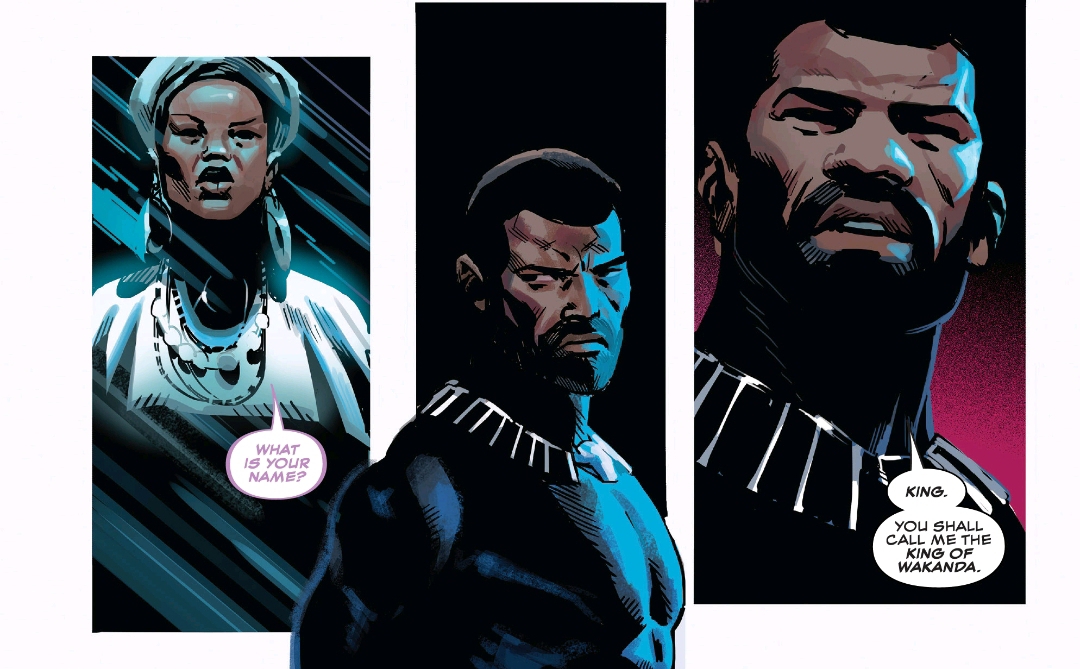
Daniel Acuna portrays T’Challas fear and reticence to commit such an atrocious act by having his face mostly shadowed and showing him cry as King T’Chaka lambasts him from the spirit world for his cowardice. Coates and Acuna then cut back to the hooded Panther and she asks what his ancestors should call the boy who scorned his legacy and T’Challa, still reeling from pain, says his own name before being slashed again.

Acuna begins the next flashback with a beautiful wide show of T’Challa looking upon a vibrant purple and almost 3D looking silhouette of the secret meeting location of the Illuminati before they wiped the memory of Steve Rogers. This was because they decided to destroy planets when the honorable soldier would not and T’Challa is framed in the background of these shots, just watching it happen. Coates makes it a point to stress that “No friendship [was] too precious to be spurned.” Then he is attacked by the Spirit of his grandfather, Azzuri.

Thematically, this makes sense as Azzuri and Steve Rogers first met when the Red Skull and Hydra Nazis tried to invade Wakanda for Vibranium and the two heroes had to fight them off, becoming friends and allies over the course of their battles together (see Marvel Knights’ Flag of our Fathers, 2010). Acuna gives the T’Challa/Azzuri fight a sense of speed by using a lot of blur lines as well as struggle squiggles as T’Challa is placed in a chokehold. As he breaks free, Azzuri disappears into a cloud of hazy, purple smoke.

We are then given a flashbak of what I consider to be his greatest failure, his broken vow and fight against Storm during the events of Avengers vs. X-Men where he stood against Mutantkind after the first mutant child was born post Scarlet Witch’s Decimation of them. The child, Hope Summers, was prophesied to be either the savior of mutants or the destroyer of everything and Black Panther cast his marriage aside during the conflict (AvX #5, 2012), though it was continued in Coates’ series years later.

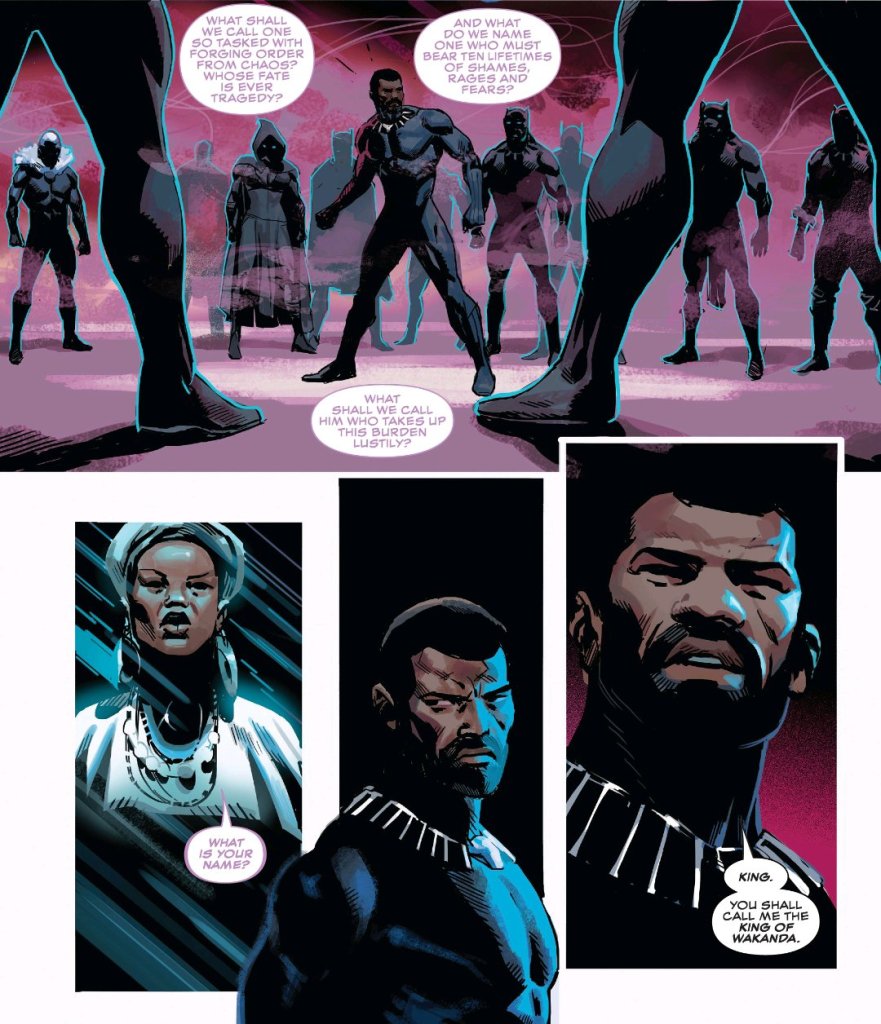
Of course, while ancestors are supposed to tear you down, it was his mother that proceeded to build him back up. The final flashback given is T’Challa’s birth mother, Nyami, showing T’Challa how King T’Chaka also grieved after his wife’s death, but because he was not just one man, but a nation, he had to move past it and that’s what this whole story has been about. T’Challa’s actions have all been about him and his decisions and not about Wakanda as a whole. He forgets that he is the crown and therefore the Nation itself.

Coates has become a master of longform storytelling as he’s managed to craft a saga of almost fifty issues of T’Challa taking responsibility for his crown and Coates has framed that excellently by the name he keeps giving when his ancestors ask him who he is: T’Challa. The wrong answer. Acuna show’s the various ancestors surrounding the man, waiting for him to give the correct answer as his mother encourages him and he stands for a moment before speaking. What should he be called?

King. King of Wakanda.

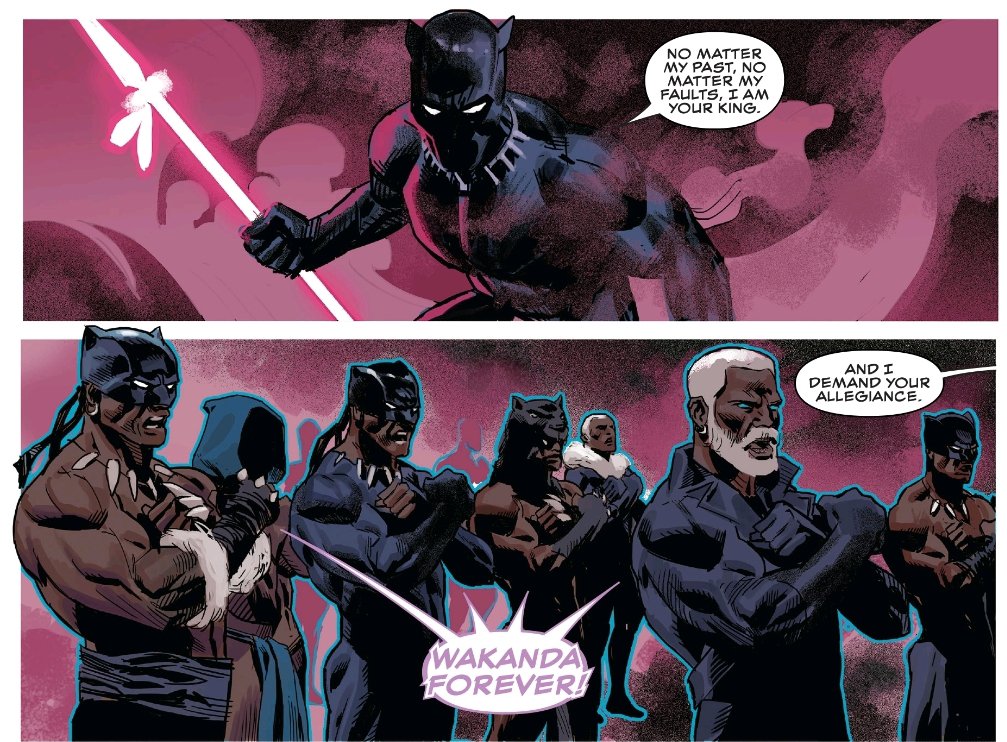
In that very instant, Acuna draws all of the ancestors giving King T’Challa the, now iconic, Wakanda salute as he demands their allegiance. He feels so strong, so complete as a character now that he accepts and acknowledges his many faults as part of who he is. He doesn’t need to apologize for them because they are a part of who he is as a man, but when he is a King, he must be better. He must protect his people and that is why he will be able to stop N’Jadaka in the coming battle, just like he stopped Killmonger all those years ago as well.

This issue of Black Panther was phenomenal and really shows how much Ta-Nehisi Coates has grown from his initial few books which were mostly full of world building. He’s shown that he can create an amazing and expansive story that utilizes not only T’Challa’s extensive history, but also that of the Marvel Universe at large to make this story seem grand and far reaching as something on this scale should. 

Ryan Bodenheim does have amazing skills as a penciller, but I found myself far more engaged with Daniel Acuna’s style throughout this issue as he manages to make the fight seem so ethereal while also focusing on some of my favorite moments of Marvel History – not to mention his colors are always so vibrant and loud, popping off the pages with the intensity that readers have come to expect from him.

I hope that the rest of this series continues this upward slope because this was fantastic and it gets a high recommend from me!

Best of Marvel: Week of March 18th, 2020

Best of this Week: Outlawed #1 – Eve L. Ewing, Kim Jacinto, Espen Grundetjern and Clayton Cowles

It all starts with one incident.

The original Civil War kicked off when the New Warriors team, trying to get footage for their terrible reality TV show, started a battle with some supervillains in hiding, one of which was Nitro. Nitro self destructed and wound up killing over 750 people in Stamford, Connecticut. This resulted in heroes choosing sides in the debate of whether or not to register their identities and receive training under SHIELD, effectively being handed a leash, or choosing to fight against the tyranny of having their lives exposed and powers exploited.

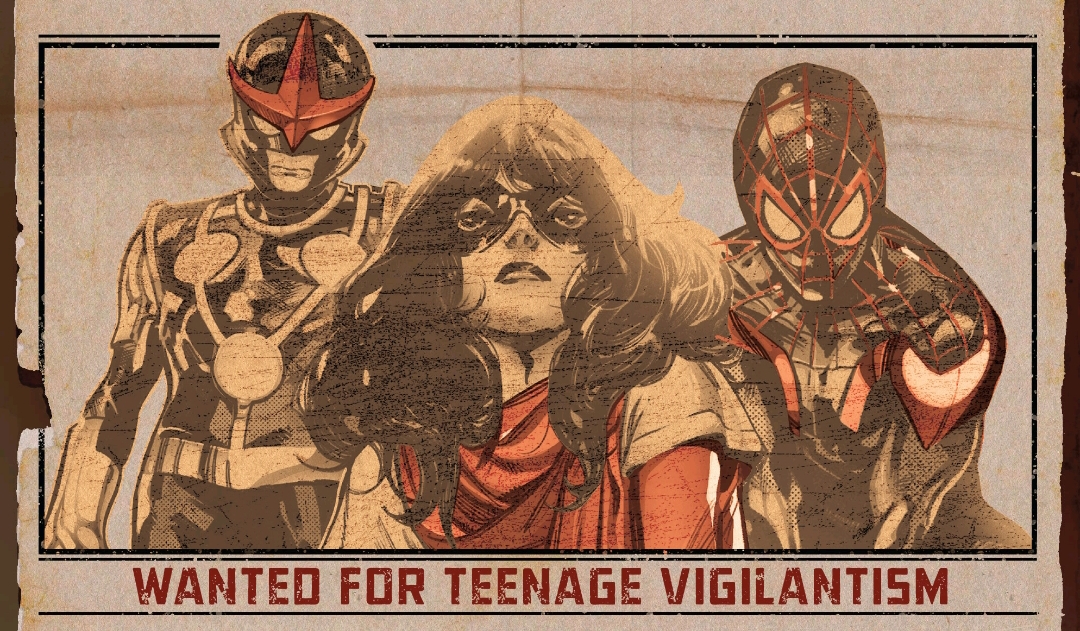
It’s been a little over 13 years since that story and a new crop of heroes has emerged in its wake. Outlawed #1 takes the basic concept of Civil War and lowers sheer tragedy while maintaining the stakes of hero groups like The Champions who are caught in the immediate crossfire of its inciting incident, most specifically, their leader: Kamala Khan.

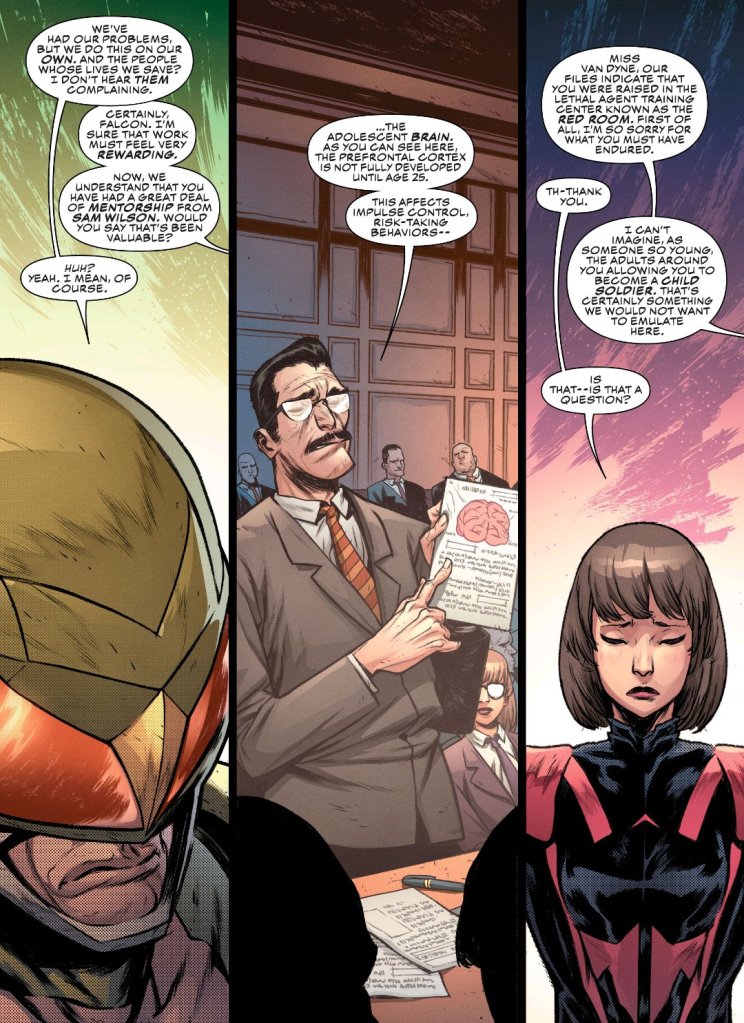
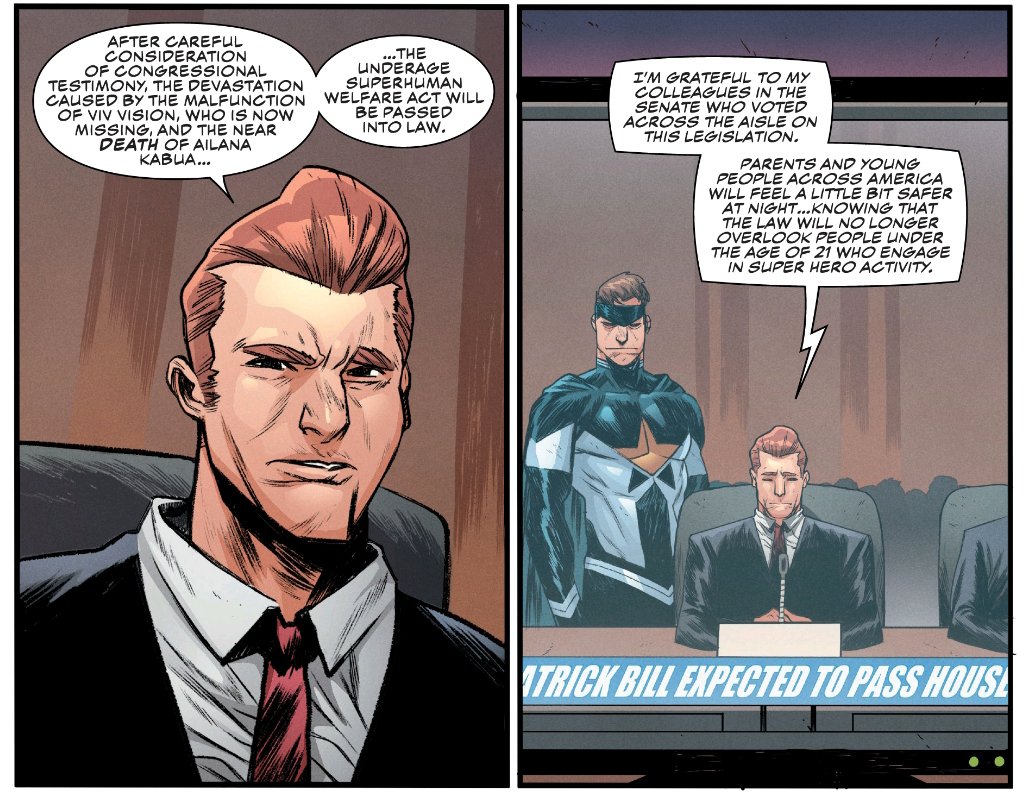
Eve L. Ewing starts the book in medias res with a Legislative hearing on a bill that would ban underage superheroism. Not only are the teens present, but we also get appearances from Avengers like Captain America, Captain Marvel and Vision, all of whom have big stakes in the fight. Captain America understands why they’re having the hearing, but counters that he was doing what the Champions were when he was their age, fighting for Freedom and he’s not wrong, but times have changed and there weren’t as many active superheroes as there are now.

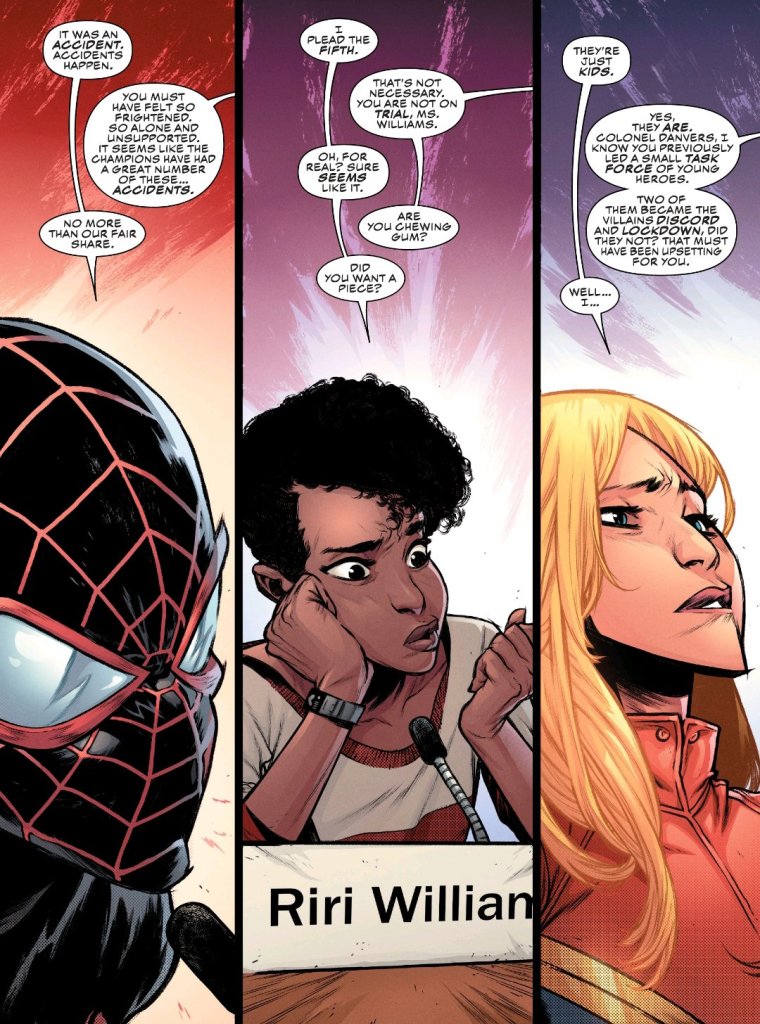
Captain Marvel is a damning case as she’s managed to avoid any repercussions for her actions during Civil War II for the last few years, but one of the senators brings up the fact that two heroes under her charge became supervillains, those being Kamala’s former friends; Discord and Lockdown. She stammers as she can’t counter that and Vision is initially silent, indicating that something happened to Viv Vision in whatever incident occurred. 

When Spider-Man, Riri Williams, Nadia Pym and Sam Alexander (Nova) are questioned, they are treated as though they are kids who needed adult support and supervision, almost like fragile things and not like heroes who have helped save the universe. Kim Jacinto and Espen Grundetjern characterize each hero through facial expressions and backgrounds that color their moods. Miles looks furious under his mask with a red background, Riri is nonplussed as she always is under a cool purple glow and Nadia is forlorn with hazy pink color.

Sam then goes on a tirade about how these same people don’t care about the problems that the Champions were created to solve like poverty, drug abuse and hunger and only make a stand when the kids try to protect their own and he makes a good point. When they were founded, the adult heroes were just fighting one another again and again, month after month and not caring about the citizens… but his concerns are simply pushed to the side by a well dressed man with a Supercuts hairstyle and fake concern.

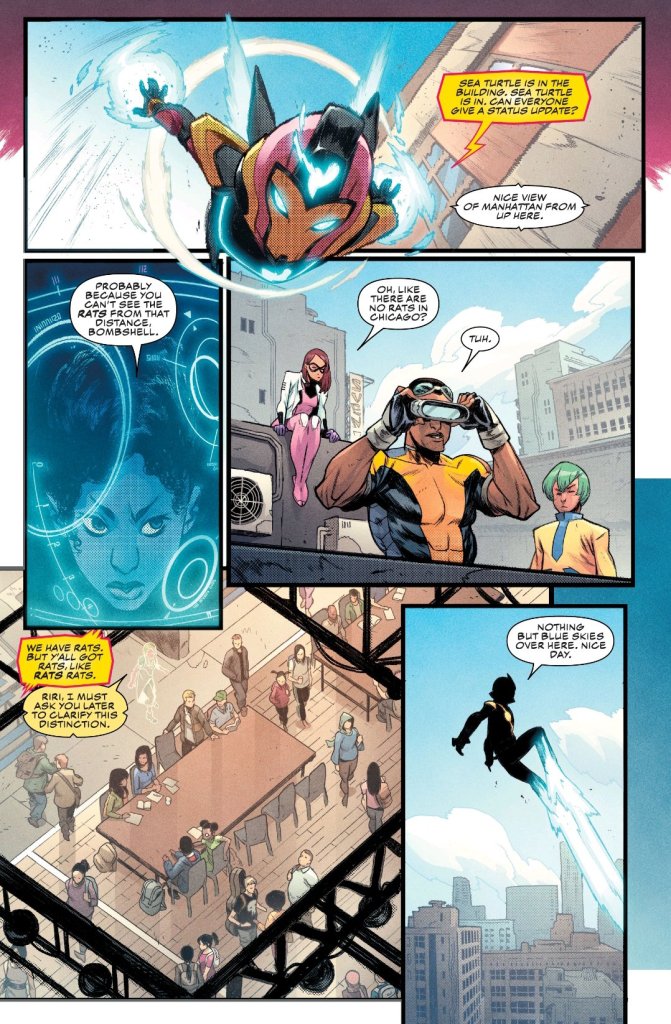
We then cut to the “Coles Academic High School” where Kamala, Miles and others are attending some sort of teen summit to watch over the plot device, Ailana Kabua, as she’s been receiving death threats for her speeches on environmentalism. She’s a very obvious nod to Malala Yousafzai, a young Pakistani advocate for female education, and Greta Thunberg, the young Swedish environmental activist that’s also begun to speak to the world. Both of these young women have courted controversy for speaking about what they believe in and have garnered undue hatred for it.  

The other Champions, consisting of Power Man (Victor Alvarez), Nadia Pym (The Wasp), Riri, Viv, Nova, Bombshell and Pinpoint, wait in the wings for anyone trying to assassinate or attack her. All things considered, this is a pretty stacked team. Ewing also does an amazing job of writing each character with their individual voices, much like she’s been able to make Riri Williams feel natural in her own solo series. They banter with each other like the teenagers/young adults that they are while Jacinto gives their stakeout a light hearted feel.

Things initially seem to be going well up until a DRAGON shows up out of nowhere to attack the summit. Jacinto, Grundetjern and Cowles give us an excellent splash page of the Dragon looking down at the Champions while breathing a small bit of fire. Jacinto frames the dragon as being far larger than the Champions, towering over the buildings around them with its wings taking up the sides of the page. Grundetjern colors the dragon with varying oranges, sometimes glowing and sometimes shadowed on its skin and Cowles accentuates it with a scratchy “GRAAAAAHHH” sound effect for its yell.

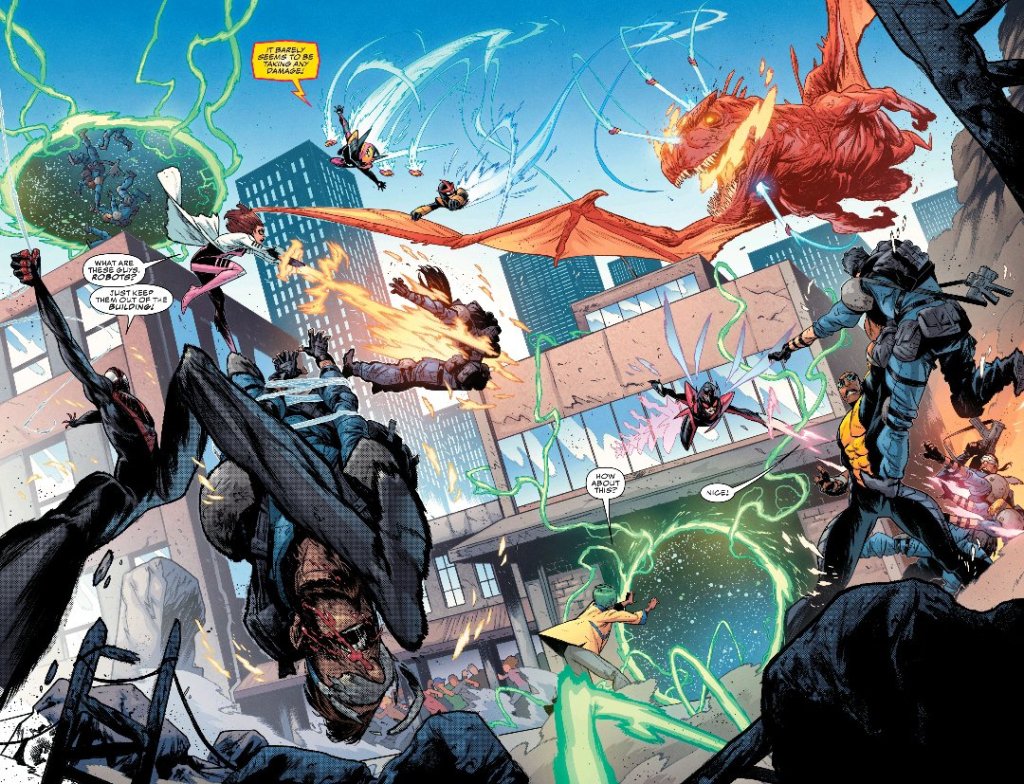
While some of them are dealing with that, Bombshell encounters the Roxxon Strike Team while Kamala and Ailana make their daring escape through the tunnels of the school. Jacinto and Grundetjern give us a double page spread of the absolute chaos with several Champions fighting off the dragon or the mercenaries. Admittedly, this scene is utterly chaotic but it does have something of a line to follow from the dragon flying through the air and its wing leading to Bombshell blasting a guy and Nadia with Power Man taking down another merc.

Grundetjern throws just about every color that they can in this scene, giving us vibrant greens for Pinpoint’s portals, nice and bright oranges for the dragon’s fire and Bombshell’s blasts as well as a more grayish black for Mile’s costume as he pretty much stomps a guy into mush

As much as the Champions maintain a sense of cordiality with each other, they’re still teenagers that struggle with working together from time to time and Ewing stresses that when Power Man forms a plan to use one of Pinpoint’s portals to punch the dragon with all of his built up Chi. Riri then comes up with her own plan to fly Power Man up to the dragon and then release him. They ask Ms. Marvel which option is better, but as she’s maintaining her cover with Ailana, she tells them to make the call.

In the middle of this indecisiveness, Viv swoops in and decides to air her frustration at not being able to defeat the dragon and decides that she’s going to phase through it. Jacinto draws a look of palpable anger on Viv’s face as she rushes past Riri with Grundetjern’s bright wave of green energy trails behind her as well as Cowles “SWOOOOSH” sound effect to capture the velocity of her flight.At the same time, Power Man, unaware of Viv’s rush of anger, goes through with his plan and punches through a portal.

This is where it all goes wrong.

Jacinto, Grundetjern and Cowles give readers a perfect sequence of panels with Power Man punching, Viv “ZOOMing” up to the dragon as Riri tells her to hold on and then the moment before it all goes bad. Pinpoint’s portal opens just behind Viv and she is overcharged with Power Man’s Chi in a blast of orange, green and yellow as her face is stretched in agony and her limbs contort before she overwhelms the dragon in two separate splash pages.

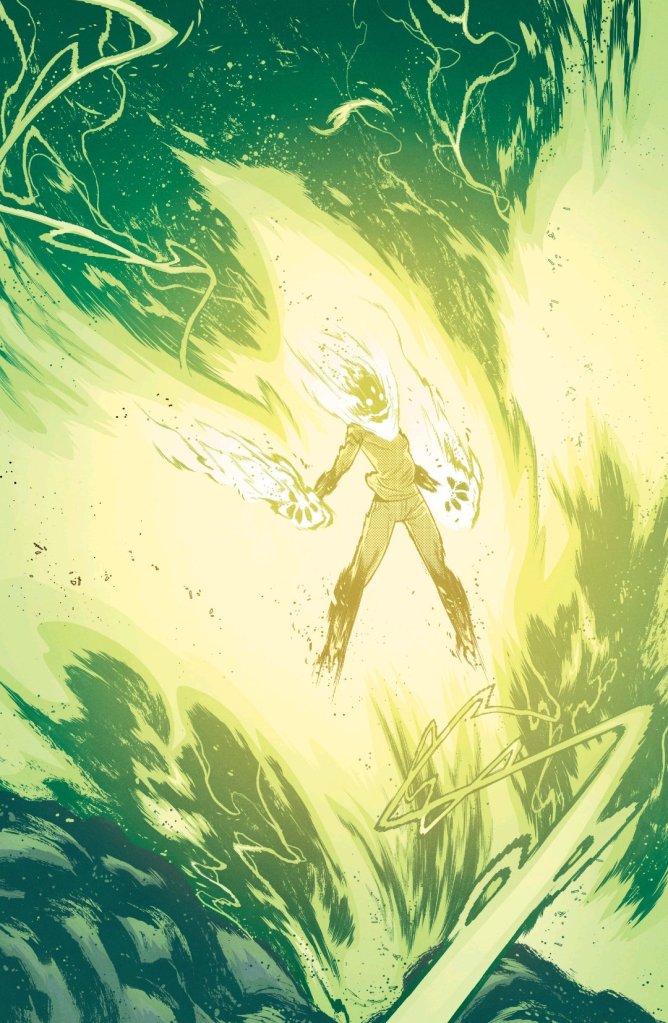
Both of these pages are intense as the first one sees Viv yelling pain before “taking control” and engulfing the dragon with a “FWOOOOSSHH” mirroring its firebreath. This page is filled with what appears to be green flame and a silhouette of Viv in the middle of it. The next splash page shows Viv alone in the pyro, looking like a horrific combination of the Phoenix Force and Dormammu. She has lost all control of herself and this is where Ewing, Jacinto and Grundetjern raise the stakes of the battle.

Viv’s newfound power spirals out of control and begins to collapse the school and the surrounding buildings and we cut to Kamala doing everything she can to protect Ailana from the collapsing ceiling around them before going back to the Champions scrambling to stop Viv. Ewing continues to show how well she can write Riri as she cries while making a plan with Nadia that possibly kills Viv and stops the dragon altogether.

The city is in shambles and this is one of the Champions lowest moments ever.

Cutting back to the present day, we see that the “Superhuman Welfare Act” passes and a new governmental watchdog group called CRADLE is sent to round up all of the teen superheroes and metahumans around America. The bill also seems to garner support from former teen heroes and New Warriors members Justice and Speedball. Justice had joined the pro-registration side during Civil War because he blamed himself for not being a guiding hand for the New Warriors that died at Stamford and Speedball had already suffered the consequences of surviving that same incident.

However, the one who may suffer the most is the girl who the act is nicknamed after, Kamala Khan as we see her in a hospital bed suffering from injuries while trying to save Ailana.

This first issue was explosive and gripping throughout. Initially I was worried that it wouldn’t be able to live up to its concept or just be a less cool Civil War, but the one thing that this book maintained because of Ewing, Jacinto, Grundetjern and Cowles was heart.

The Champions are heroes, but they’re also all teenagers that don’t have the experience that the adult heroes do and in typical American fashion, no one learns from the mistakes of the past. Victor already butted heads with Riri for his recklessness in the past, but now he’s given consequences for his actions. America remembers Stamford, but doesn’t seem to remember how the Civil War nearly tore the country apart and installed a tyrant in a high government position in the aftermath.

If anything, the Champions aren’t going to leave this incident the same people that they were before.

Best of DC: Week of March 4th, 2020

Best of this Week: Strange Adventures #1 – Tom King, Mitch Gerads, Evan “Doc” Shaner and Clayton Cowles

This is the Tom King I love.

The first book I read by Tom King was the awesome Grayson (2014) series post Forever Evil (2013) after Dick Grayson was “killed” by the Crime Syndicate. That book had a levity and coolness that no other book was really exhibiting at the time and King was kinda on my radar. Soon after, I’d heard that he was writing a solo Vision book and I was skeptical, but after a few issues I was sold and absorbed everything Tom King had written up to that point.

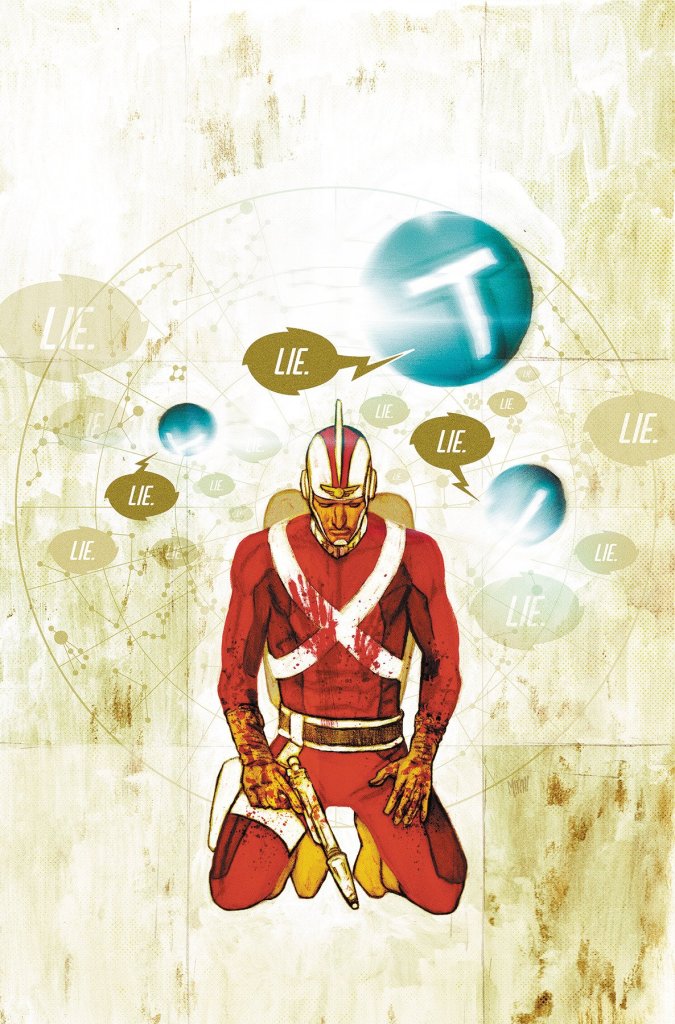
From Sheriff of Babylon to Mister Miracle, I was fully on board up until Batman got long in the tooth and Heroes in Crisis became a disaster. I have slung my fair share of mud, but Strange Adventures is an awesome return to form that blends the two amazing styles of Evan Shaner and King’s longtime collaborator Mitch Gerads. This book forms a tale of heroism and then overshadows it with horrific implications.

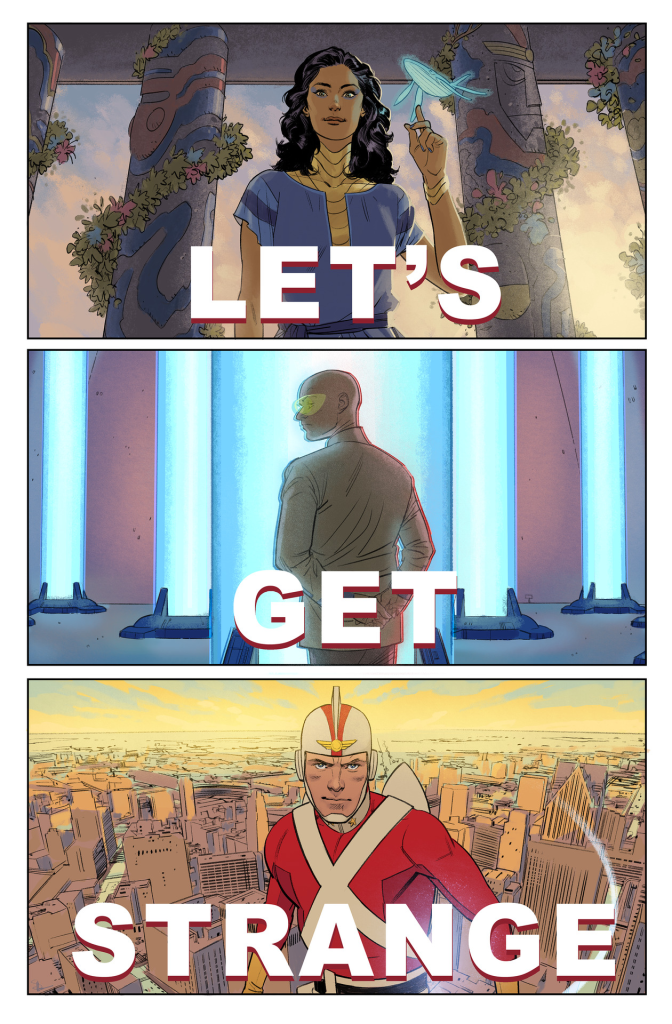
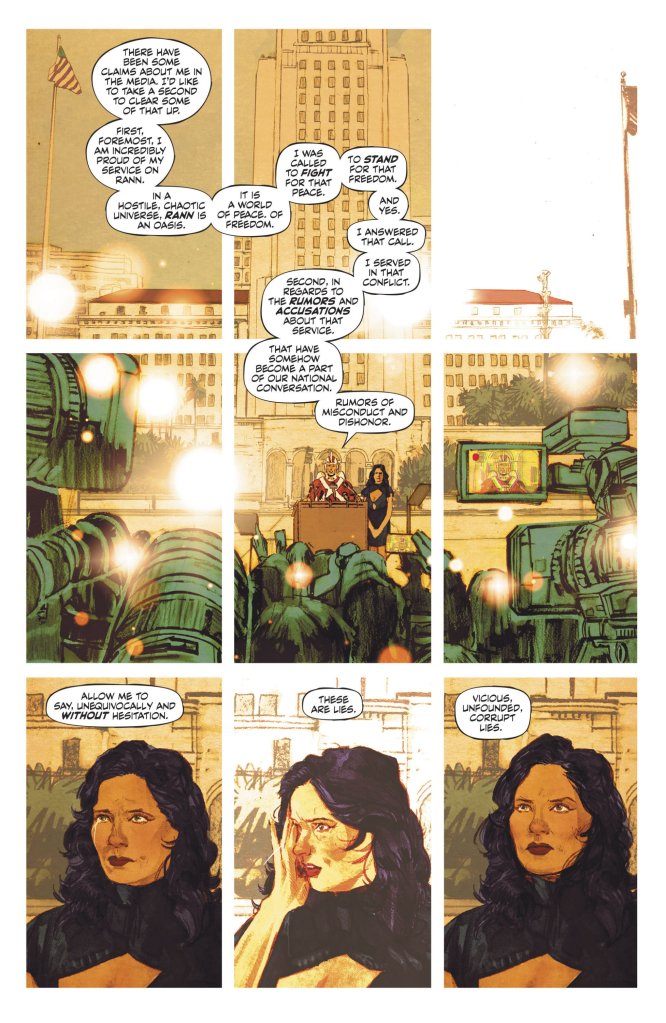
Adam Strange has always had something of a STRANGE presence within the DC Universe, mostly having stories in anthology books like Mystery in Space, miniseries or being part of various teams, he’s never quite been consistent. Adam Strange is a product of the sci-fi boom of the 50s and 60s, an archaeologist from the planet Earth whisked off to protect the spaceways and his beloved second home of Rann with his lover, Alanna. He’s always been kinda silly.

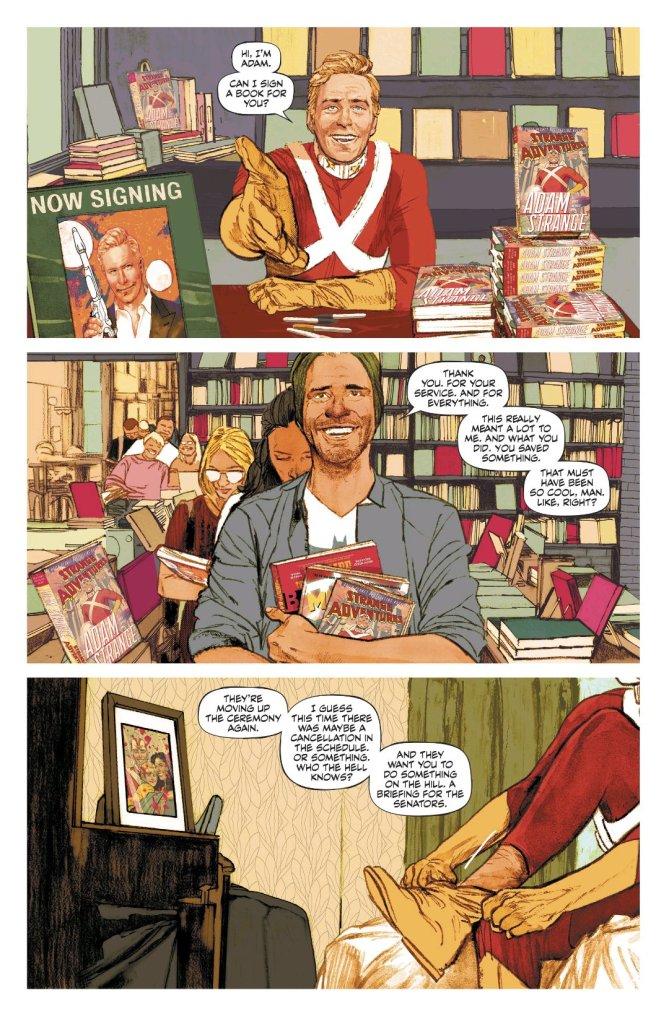
Tom King takes this silliness and turns Adam’s story on its head as we open to Strange doing a book signing of his memoir, Strange Adventures. At some point, he seems to have sold the story of whatever he did during some terrible war on Rann (that will definitely be expanded on later) and his name is on the lips of every American citizen, talk show host and politician as he and Alanna bask in their newfound fame.

In just the first few pages, Gerads and Shaner illustrate what kind of contrast we’ll be seeing throughout this series. During Gerads’ scenes, Adam is doing normal things, signing books, accepting awards, doing press and lying in bed (in more ways than one). King scripts the dialogue as being pretty casual in these scenes, the way that people talk when they’re alone or have a spotlight shone on them. Colors are striking, but the scenes aren’t dynamic, more somber with specific focuses.

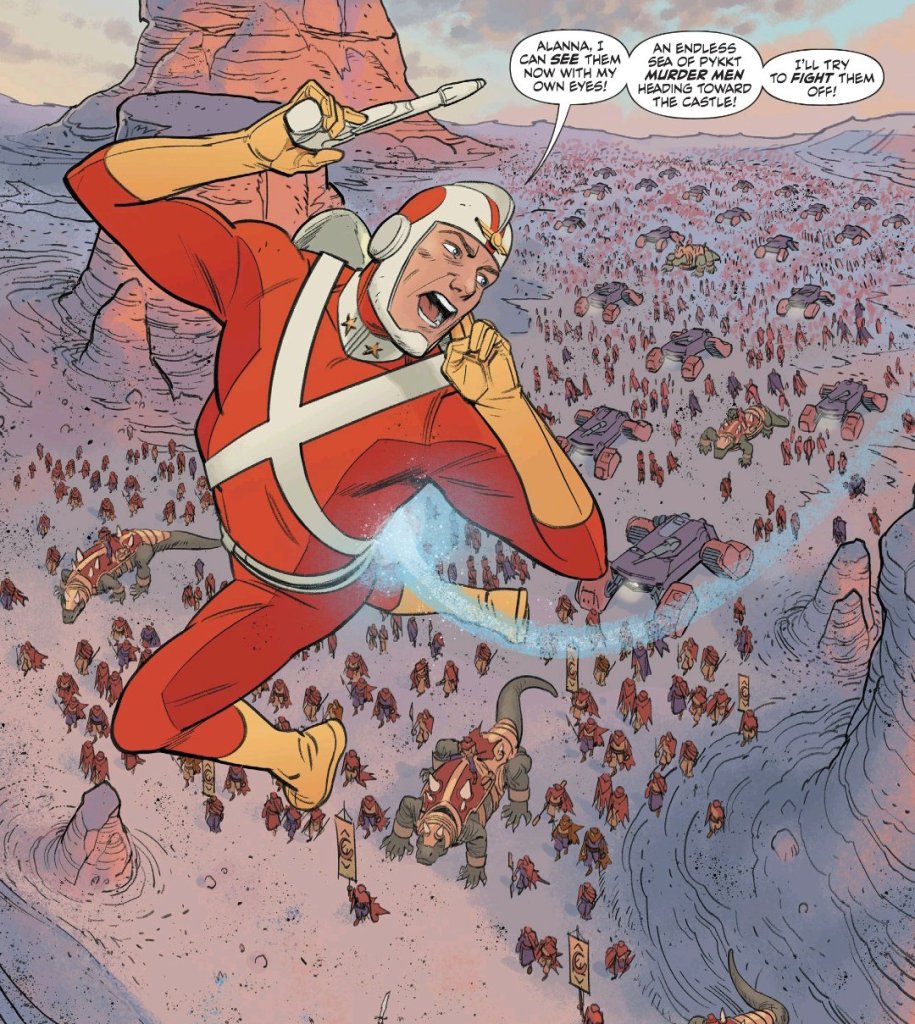
Shaner, on the other hand, get’s splash pages of Adam flying through the skies and facing down hordes of his enemies with heroic poses, laser gun fire and explosions. It looks like a high action, pulp comic or Saturday morning cartoon and the dialogue is comparably cheesy. These scenes are meant to paint Strange as the persevering hero as he has to face down insurmountable odds and get by by the skin of his teeth and his very handsome smile. Almost immediately, there’s a pit made in the stomach because it’s almost too unbelievable.

The closest real life comparison I’m willing to draw, before the next few issues come out, would have to be that of “American Sniper” Chris Kyle. A few years after leaving the Navy, Chris Kyle published the book which detailed his time during the Iraq War and a lot of the media painted him as a hero for his actions. The book sold gangbusters. He went on to the big talk shows, did the magazine interviews, he even got a great movie made by Clint Eastwood and Bradley Cooper, but it didn’t come without controversy

Tom King seems to be channeling a little bit of that for Adam Strange and it works to great effect as in one scene, a pair of talk show hosts laud Strange as a hero before their interview. Gerads gives the scene a television like static as if we’re looking at it all like the rest of America. In the background we can get excited too as Adam emerges from the crowd with his jetpack and makes a grand entrance.

However, not everything is smiles and praising as, after a fan carrying volumes of Sheriff of Babylon and Mister Miracle thanks Adam for his service, we see a panel of Adam taking off his boots in the foreground while the focus is on a bloody picture frame in the background. The picture depicts Adam, Alanna and their daughter Aleena, who is conspicuously absent from the present day scenes. The blood on the picture speaks volumes more than could be said in these initial pages.

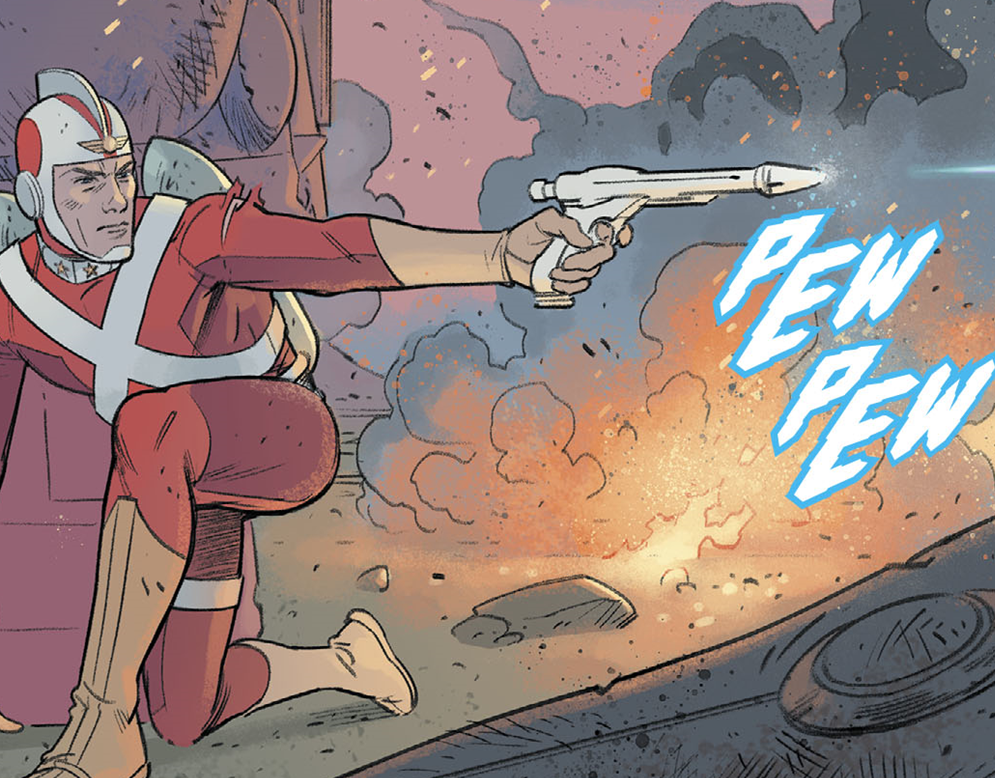
After another man screams at Strange, calling his depiction of events a lie, the pit in the stomach grows deeper as the first seeds of doubt are sown. Things are made even worse as we get a scene soon after with Shaner’s stellar art. The earlier scene made use of Cowles perfect letters with “BOOOOOOMs” and “PEW PEWs” to sell the sci-fi aspect of it and takes it to a higher level with even better balloons that placed comical emphasis on the more outworldly elements of Strange’s origins like Zeta Beam and Protector of Rann.

This comical heroism is emphasized as Adam screams about protecting his family while firing lasers at a mech created by Rann’s enemy, the Pykkts. Shaner draws Adam as being miniscule by comparison, but also nimble enough to dodge it’s blasts and taking it down with a few shots from his laser pistol. As he raises his hand in victory, one can’t help but wonder…was the event true? 

The same can be said when Shaner draws Adam zipping past a giant lizard creature, flossing his teeth as he goes in and out of his mouth like a real action hero. Adam Strange has always been capable, but this has an air of embellishment to it. Things get even worse for Adam as the man who screamed at him is found dead with what appears to be an exploded head due to laser gun fire. It’s an absolutely horrific scene that only Gerads could pull off.

We get a number of awesome pages of both Adam and Alanna doing damage control. The symbolism of Adam’s jetpack being a focus with a reflection of both Alanna and the picture is powerful as the implication seems to be that whatever happened to Aleena was somehow his fault, but Alanna still carries the scars of Rann, but doesn’t blame him. During a press conference, we see Alanna crying before wiping away her tears as Adam denies killing the man.

Where King scripted and overused the nine panel grid in Heroes in Crisis, he has Gerads use the format twice with powerful effect.

Something about Strange’s denial of war crimes on Rann feels off, much like how people called Chris Kyle a war criminal during the movie’s release, we get that same feeling here. There are almost always horrors in war and Strange has to have left out some of the worst details of things he’s done or seen, especially since this is a Tom King story and he doesn’t shy away from the morbid. 

As the pressure intensifies, Strange turns to Batman, the World’s Greatest Detective, as someone who can help clear his name. Adam is convinced that he didn’t commit the crime, nor anything else that he’s being accused of, but Batman refuses to accept the case. Batman cites their longtime friendship as a reason that he wouldn’t be able to stay impartial and that makes a lot of sense. You never want to show favoritism, especially when there’s a chance your buddy could be a murderer.

The book ends with another nine panel grid showing Adam flipping the bloody picture down, almost as if to avoid looking at his shame and guilt while he meets that man who’ll take his case. There will certainly be some “Fair Play” in his future.

This first issue of Strange Adventures was absolutely phenomenal. I think King does well with characters and stories like this. He did it with Mister Miracle and he did it with Kite Man in the pages of Batman. Adam Strange has always been that character who showed up in the background or the odd Hawkman story to show just how large the Universe was, but I’m glad he’s being given a focus like this. 

Of course, with Tom King, there’s always a worry that as the issues go on, things will start to go off the tracks, but I have hope. Even the worst issues of Mister Miracle or Omega Men were fantastic reads.

Evan Shaner and Mitch Gerads absolutely smashed it with their art. I love the idea of having two contrasting visions of one’s life with one bright and wondrous and the other real and dark. Separately, these two are phenomenal, together they are AMAZING. I would look forward to every issue of this series for their art alone, and with King’s scripts, this is just perfect.

This one gets a high recommend from me!

Best of Marvel: Week of March 4th, 2020

Best of this Week: Daredevil #19 (Legacy #631) – Chip Zdarsky, Marco Checchetto, Mattia Iacono and Clayton Cowles

Daredevil was dead.

After Daredevil miscalculated a baton throw which saw him accidentally kill a criminal, Matt Murdock has been on a path of redemption – hanging up his cowl as Daredevil to become something better, someone that Hell’s Kitchen could truly look to as a savior now that the legacy of Daredevil was tarnished by a horrible mistake. Matt looked to God and retired for a time, then Elektra sought to pick him up from his wallowing. With her help, he became something else, not quite Daredevil, but not Matt Murdock either.

But this grey area he operated in wasn’t working either, especially since Hell’s Kitchen was under new threats in The Owl and the insanely rich Stromwyn Twins that not even Kingpin could strike fear into. After convincing the enemy of vigilantes, Detective Cole North, to step up and stand against the tyranny of his corrupt police force, the pair seek to clean up Hell’s Kitchen, but they couldn’t anticipate the Inferno about to rain down on them.

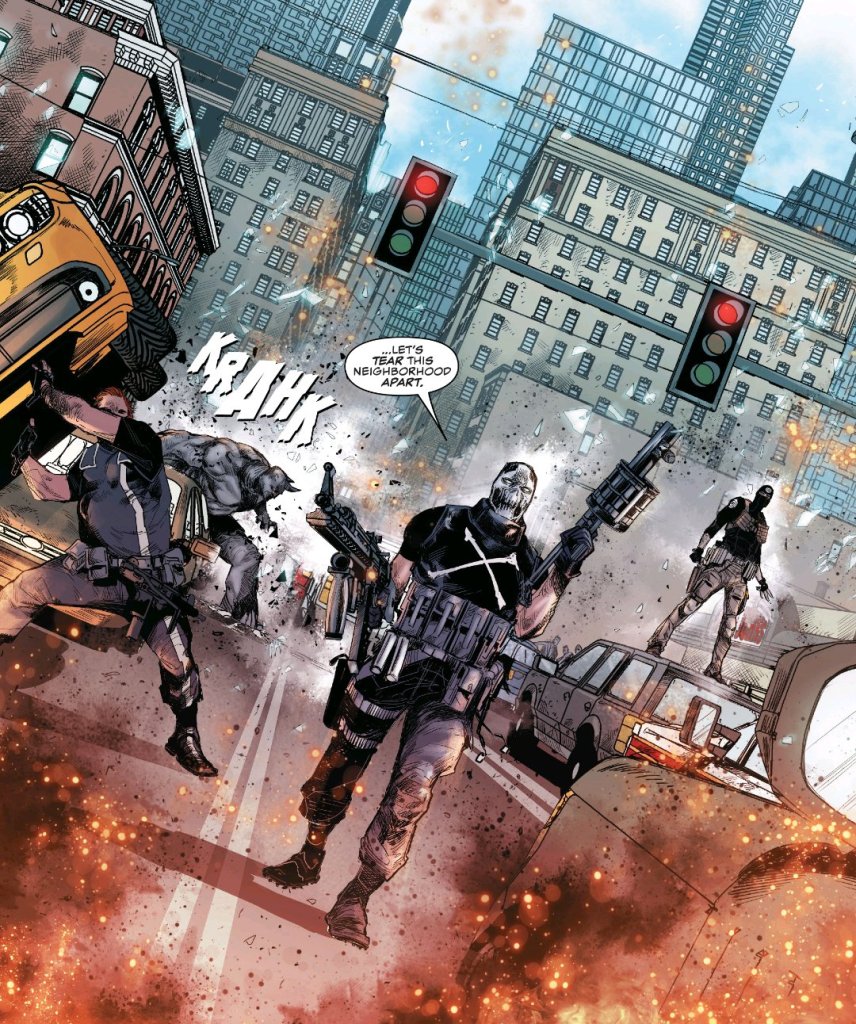
The issue begins with an opening salvo of villains, Crossbones, Bullseye, Bullet and Rhino “Alex O’Hirn,” tearing through the streets. Checchetto does an excellent job of emphasizing the carnage that these four are capable of with Bullet pushing a car over, Rhino causing debris to fly in the background simbly by stomping and Bullseye and Crossbones just looking generally terrifying with knives and a grenade launcher respectively. Iacono does an excellent job of showing the carnage through vibrant orange embers in the foreground that contrast the bright blue sky in the background.

Zdarsky does well in showing the scale of the carnage as various people from Hell’s Kitchen watch the destruction take place in their town. Hector, the hispanic Daredevil impersonator from several issues back, sees the explosions and digs out his costume to help and so too does Janet, one of the first to assume the identity of Daredevil post his disappearance. Both characters see the destruction of their home and step up to protect it. More on that as we go on.

Truly, no one is safe whenever Bullseye shows up to the party and Zdarsky and Checchetto, emphasize just that as a woman tries to save her child and Bullseyes shoots the man trying to save her from the carnage. When Bullet lambasts him for killing the innocent man, Bullseye claims that he was only trying to spook her because she was, “…going to throw a baby at [him].” I won’t lie and say that it didn’t make me laugh, but it came out of the blue and shows Zdarsky knows how to do Bullseye’s demented humor well, especially as Chechetto draws his terrifying grins.

In the midst of all of the carnage, Z-List villain, Stilt-Man, shows up and his appearance is one of the most devastating pages in the book as all of the art team comes together amazingly. One of the metallic stilts comes down in front of the car that North and Murdock are using to get into the Kitchen and the force of it is intense! Chcechetto makes excellent use of speed lines, glass shattering, car crumpling and Matt FLYING through the destroyed windshield to sell the impact.

Iacono colors the background with a dark red and black to emphasize how devastating this was as well as the dust from the concrete that was blown up by it. Clayton Cowles pulls it all together with amazing “KRNCH” and “KRSHH” sound effect lettering, made transparent to see everything and make readers feel like they were in the car with them. It hurts and I feel like my body is aching from it.

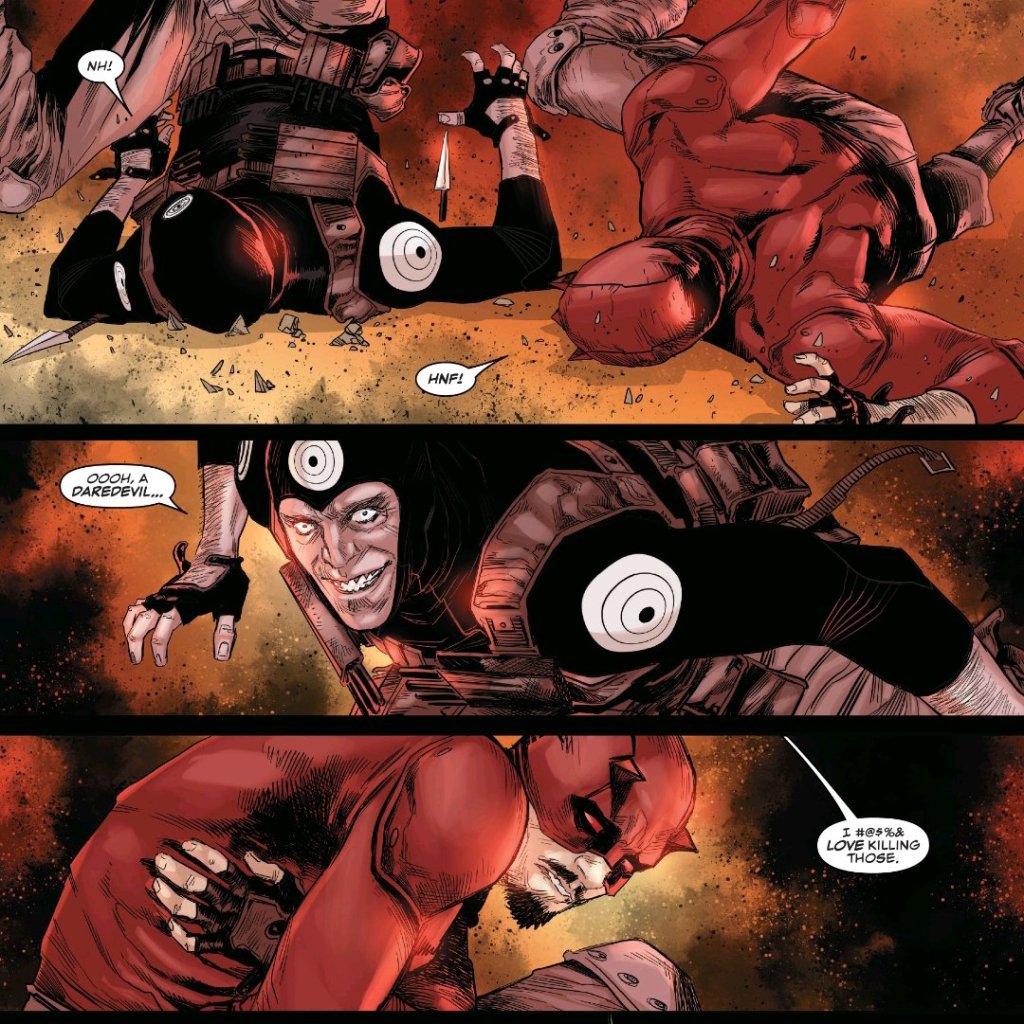
Crossbones shoots more grenades and sends the few cops ignoring the order to stay out of Hell’s Kitchen flying as only their silhouettes are shown in the ensuing explosion. Hector, however, decides to tango with Bullseye after tackling to keep him from shooting more people. The fight is painfully one-sided with Bullseye stabbing him in the gut with ease. It’s painful, it’s distressing because moment earlier, we saw the poor man helping his elderly father before things went south.

Other major players see the attack on the Kitchen with different eyes. The Owl sees this as an opportunity to rid himself of the non-dirty cops and get more business through the protection money they’ll pay to avoid this again. The Owl has always been a weird criminal mastermind, but Zdarksy has turned him into a madman bent on owning Hell’s Kitchen through the chaos and fire as he leaps and flies into the thick of it.

Elsewhere, Rhino is destroying his way through the city and makes it to the Church that Matt Murdock used to call his other home and gives the nun, Sister Elizabeth, ten minutes to clear the church before he bulldozes it. When Elizabeth was first introduced so many issues ago, I thought she was just another run-of-the-mill nun for Matt to heave his crisis of faith woes on, but Zdarsky gives us an exciting return through some excellent symbolism.

Chechetto does well with subtlety giving the smallest hint when Elizabeth lights a candle and then more light by themselves with Cowles small “fwot” effects dotting the page. Iacono obscures half of her face with dark blacks before it’s revealed to be Typhoid Mary with a demented smile. Mary was last seen in the (mostly awful) Typhoid Fever storyline in which the Mary personality was suppressed by the combined might of Iron Fist and the X-Men. At some point it seems as though Matt placed her there, but in the chaos things seem to crumble.

Of course, the most telling reaction is the look of utter dejection from Wilson Fisk, the former Kingpin. It’s not a look of anger, nor is he smiling, he looks defeated and in many ways, the state of things is his fault. Wilson Fisk became the Mayor of New York City and slowly washed his hands of all of his illicit activity, leaving things to the other families of New York. Under Fisk, the crime was at a reasonable level, but between the gang war of the Owl and the Libris family and the Stromwyn real estate scheme, things have become absolutely dire in his absence.

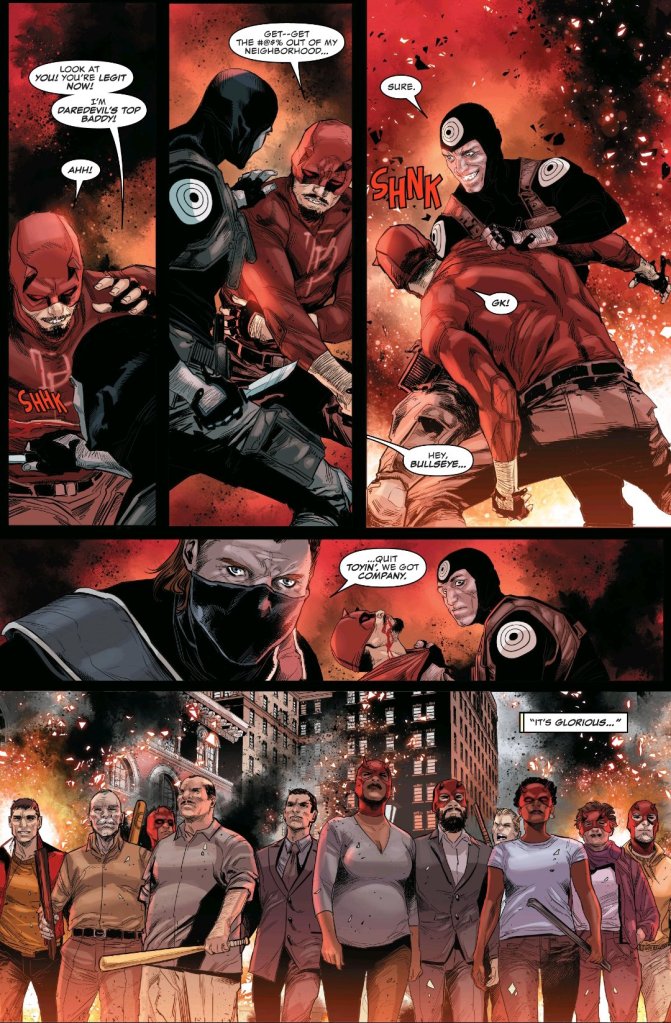
Bringing us back to Hector, soon after the stabbing, Chechetto delights readers with an amazing shot of the various citizens of Hell’s Kitchen with makeshift weapons and Daredevil masks. They tell the criminals to get out of their neighborhood, not hesitating to swing baseball bats at known terrorists and mercenaries like Crossbones. These are Daredevil’s people and just like him, they stand for what’s their and won’t see these thugs destroy it all. Even Detective North hits a devastating right to Bullet’s jaw.

Checchetto and Iacono come together with two excellent pages of Matt Murdock and the people around him. As Hector struggles to get to Matt, we see his own strength as the blood streams from him as the background is mostly black and red from the fires, but shows brighter oranges around the pair. His last words were, “I tried…” as the blood spurts out of his mouth while Matt holds him in his final moments. Murdock had saved Hector previously after the brave citizen stepped up, but didn’t make it in time this time.

All around him, Checchetto draws Matt visualizing the people of Hell’s Kitchen fighting back and saving people wearing his mask. Checchetto pulls in close to Mudock’s face as he removes the black bandana that he used as a mask and sheds a tear for Hector. He realizes that Daredevil is a symbol and it’s a symbol bigger than him because the people have taken it and made it theirs. Made it something to be proud of outside of him.

Matt Murdock’s greatest sins are Pride and selfishness. He carries the weight of the world on his shoulders and feels like no one else but him can do it. This entire series thus far has been about breaking him down using his guilt as a driving force for his actions. The black bandana took him back to his roots as Elektra and Detective North rebuilt him through his senses and sense of duty – his body and mind respectively.

It wasn’t until he saw what Daredevil truly stood for in the eyes of the people that he could retake his name and become the hero that they needed him to be and the final few pages are powerful.

Chip Zdarsky absolutely slams this amazing issue by building to an epic conclusion with the first of hopefully many stories that he has for the Hero of Hell’s Kitchen. Without a doubt, Marco Checchetto and Mattia Iacono make for the perfect art team with dynamic visuals and colors that almost make you want to cry. Clayton Cowles stuns with excellent speech bubble placement and AMAZING sound effects throughout. 

If I had a proper rating system, this book would be damn near PERFECT and I stand by that and this series as a whole.

Also, support me on Patreon: patreon.com/TyTalksComics

Best of Marvel: Week of February 26th, 2020

Best of this Week: Avengers #31 (Legacy #731) – Jason Aaron, Various Artists, Rachelle Rosenberg and Joe Caramagna 

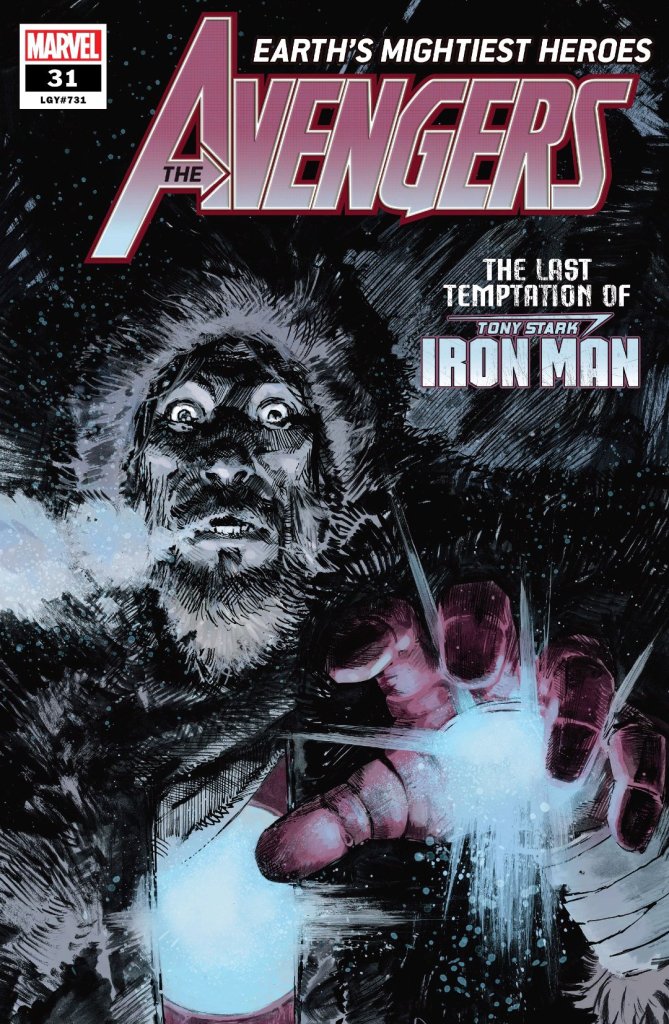
Tony Stark is Iron Man.

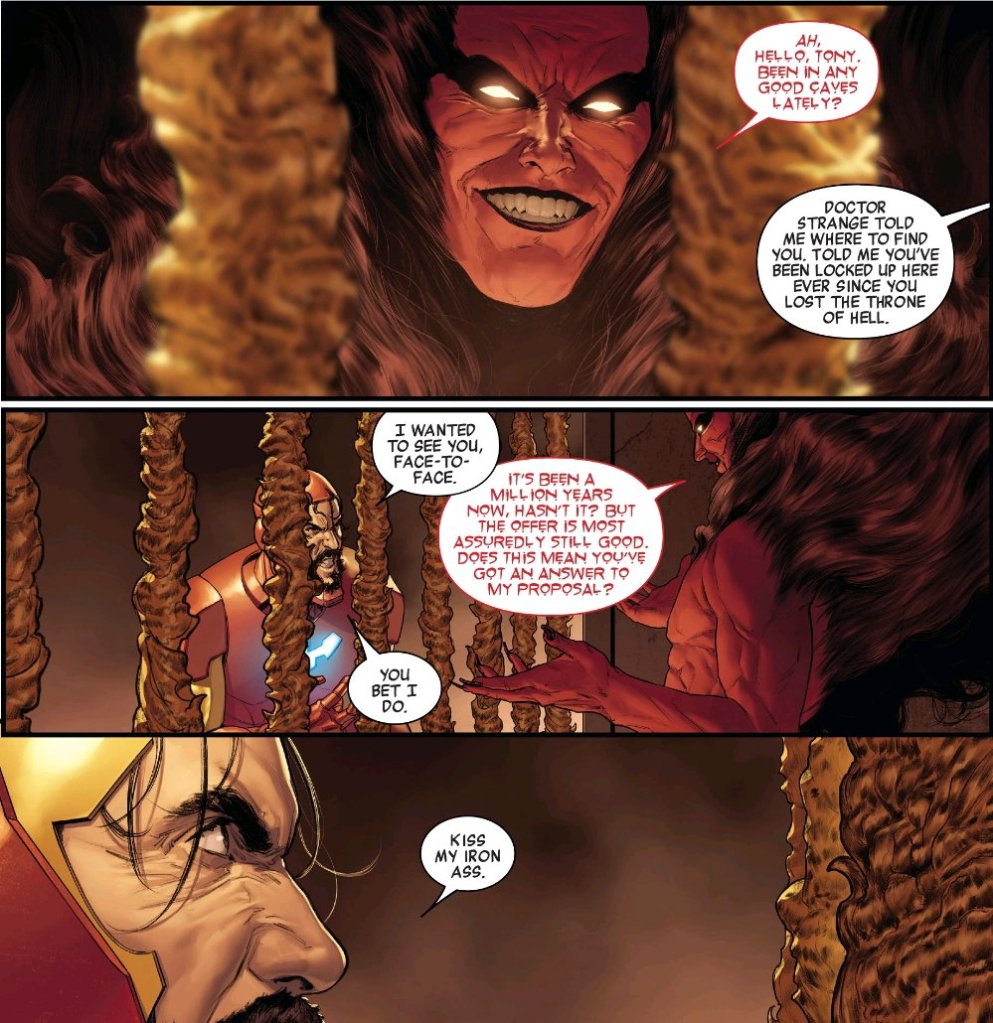
What makes him Iron Man isn’t just the suits, but the brilliant mind capable of forging them. Tony’s been flung a million years into the past and, lacking the proper equipment to either build a new suit or time machine, has to fend for himself until he finds a way back home or dies. Along the way, he staves off both his past and futures as madness and hopelessness begin to seep into his mind, but being the resilient bastard that he is, we all know that he can do it.

The issue begins with a flashback sequence to Tony using one of his first inventions, some X-Ray contacts, to spy on a seedy meeting that his adoptive father, Howard Stark, holds with some horrifying implications. Howard’s “goodness” in the Marvel Universe has flip flopped many a time throughout the years with the most recent being a swing towards good through Jonathan Hickman’s S.H.I.E.L.D., but this flashback peels back some layers on what Howard’s always been about. Through Geraldo Borges, we get a scene similar to Eyes Wide Shut and Rachelle Rosenberg contrasts the light that Tony thought his father was, with his immense darkness.

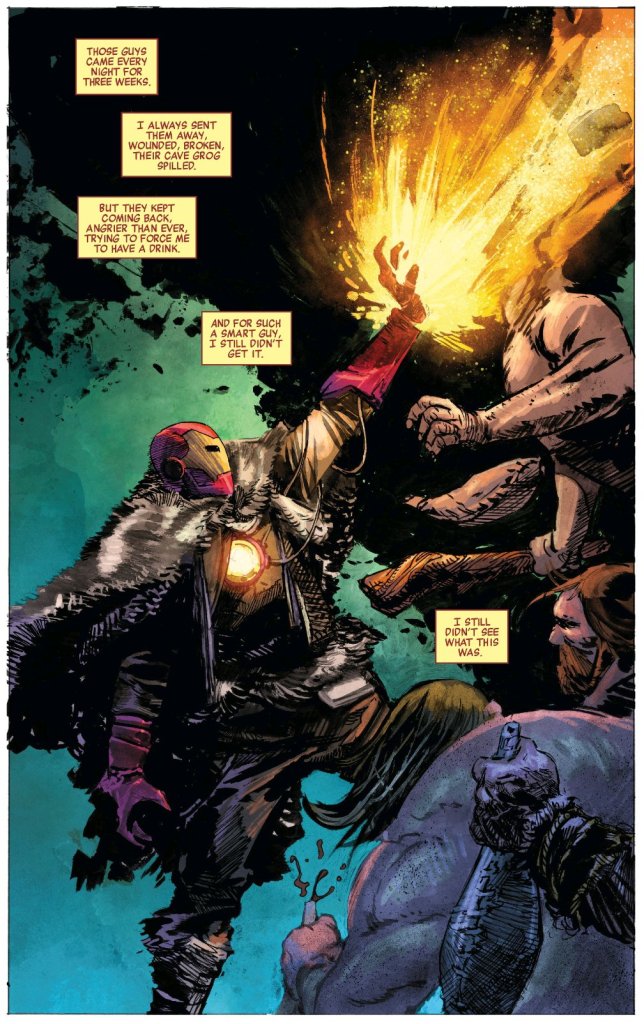
We then cut to the future…or the past rather, with Tony sitting in the same cave that he and T’Challa found the calcified remains of Tony’s armor a millennia later and he’s grown a sick beard and wears the pelts of various things he’s killed while trying to preserve his vibranium energy. Gerardo Zaffino takes over the art for this section and, per his amazing issues of Conan, continues to do an amazing job in portraying the wilderness as dark, cold and ravenous. There’s a black madness behind Tony’s eyes after being stuck for so long.

Soon after Aaron Zaffino, and Rosenberg show us just how Tony wound up in the predicament that he’s in with only half functioning armor. Zaffino shows The Ghost Rider, Starbrand, Odin and Phoenix of the era fighting the metal man from the future. It’s intense as he staves off the intense, orange fire from the Rider’s mammoth, takes a brutal shot on the chin from the Hulk-Brand, stops the buzzing blue lightning from Odin wielding Mjolnir and tries to reason with the Phoenix before she shoots him back to the ground. Her colors are striking with intense particle effects as she tells him to “Remember the face of the Devil.”

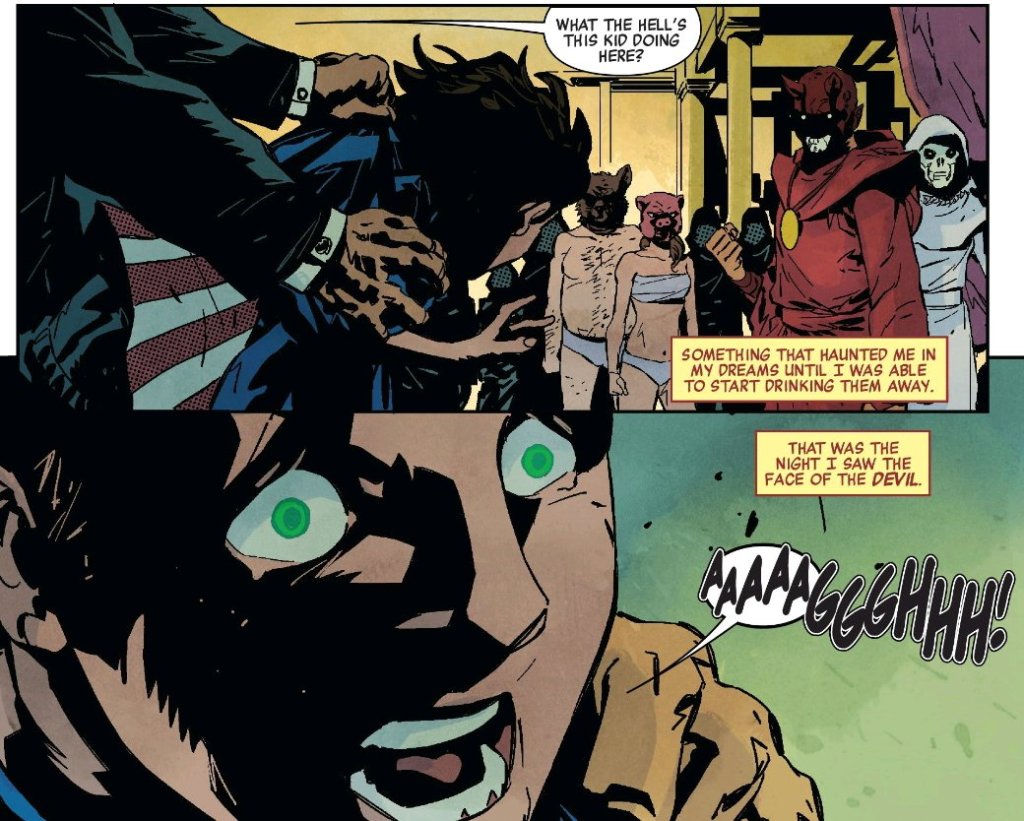
Throughout the issue, we get Tony’s narration of the whole situation and he’s so very hopeful in the beginning up until the offerings start coming in. It starts off with just one woman bringing him some cave grog and then more and more start pouring in. Aaron starts spreading the seeds of temptation as Tony bemoans the nights getting “lonelier and thirstier” and Zaffino shows these busty cave babes kneeling with their grog skins towards Tony. As time goes on, the men of the cave come with clubs and grogs in an attempt to force Tony to drink and Tony is forced to drive them away again and again.

He’s starting to lose things and get angry before a silver tongued snake appears in his helmet with Joe Caramagna giving him a voice through familiar red lettering and bubbles. The snake mentions Howard’s name, saying that his adoptive father paid some sort of price and Tony lifts his helmet, thinking to slam it down on the snake before realizing it’s just another temptation. It’s almost horrific and really sells just how much this time period and everything is getting to him.

At the same time, the Devil doesn’t like being denied, so it sends a monster after Tony, the Gorilla wielding the Power Stone from Avengers #13! It’s a short and one sided fight as Szymon Kudranski steps in and shows the Gorilla savagely beating Tony. Rosenberg’s purple background and debris signals us to the Power (wink wink) of the stone and the intensity of the splash page itself is immense as the Gorilla whips Tony around, smashing rocks and Tony’s bones while he’s powerless to do anything except yell and think. It’s not long before it leaves Iron Man for dead and allows him time to form a plan.

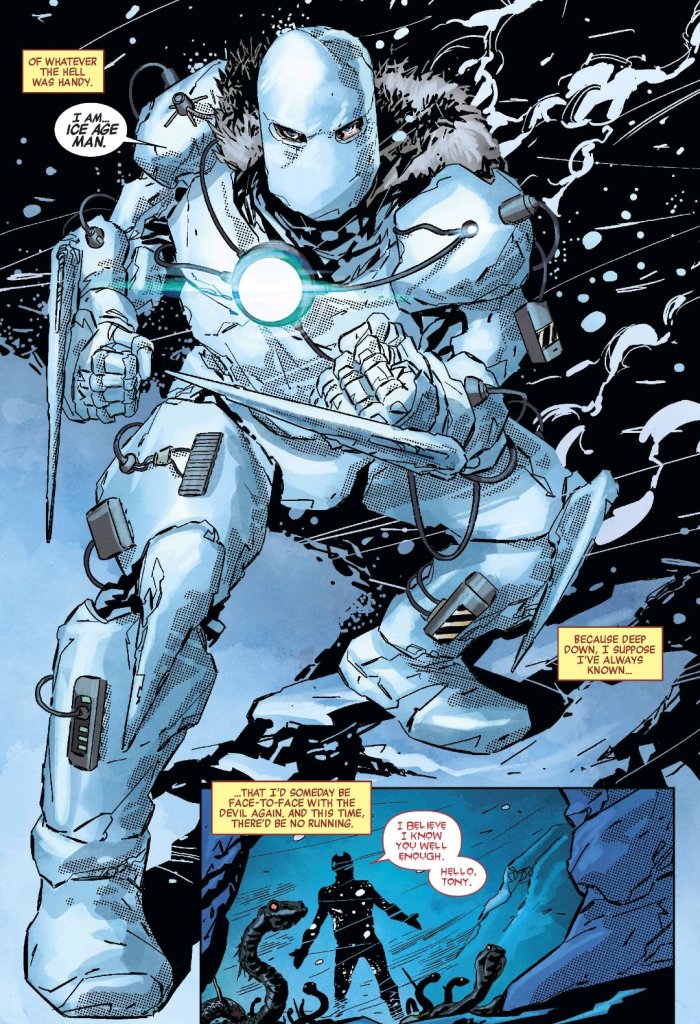
Tony does his best when he’s trying to not die, in his words, so the wheels of his mind begin turning as he sets traps outside of his cave as various snakes begin to appear outside and are skewered by his spikes. Oscar Bazaldua does an AMAZING job as he introduces us to his “Ice Age Man” design with Tony wearing a suit made out of hardened ice and powered by the last of his Vibranium energy. It’s very reminiscent of his Mk. I Armor and even has blades similar to Baraka from Mortal Kombat coming out of its forearms.

I love this design because it’s gaudy, retro and bulky all at once and made even better by the stark white, the fur on Tony’s neck and the stippling shading that I do love so much. Bazaldua even gives Tony the classic pose as he confronts the Devil at his door. It turns out that the figure is… *gasp* Howard Stark in the red cloak from Tony’s initial flashback. Tony knew that the man behind the Devil Mask was his father in that cult meeting because of the X-Ray contacts and had been scared since.

Aaron portrays him as an evil bastard that wants to have Tony cast away his future and rule the world as Father and son, only for Tony to send a spike through his head, “killing him.” Unfortunately for him, the body rises and reveals himself to be MEPHISTO and he absolutely launches himself at Tony and uppercuts the hell out of him. Robert Gill takes over the art here and shows parts of Tony’s being smashed off before Mephisto hammer fists Iron Man in the chest. It’s fast and intense to a point where the speed lines are almost nauseating.

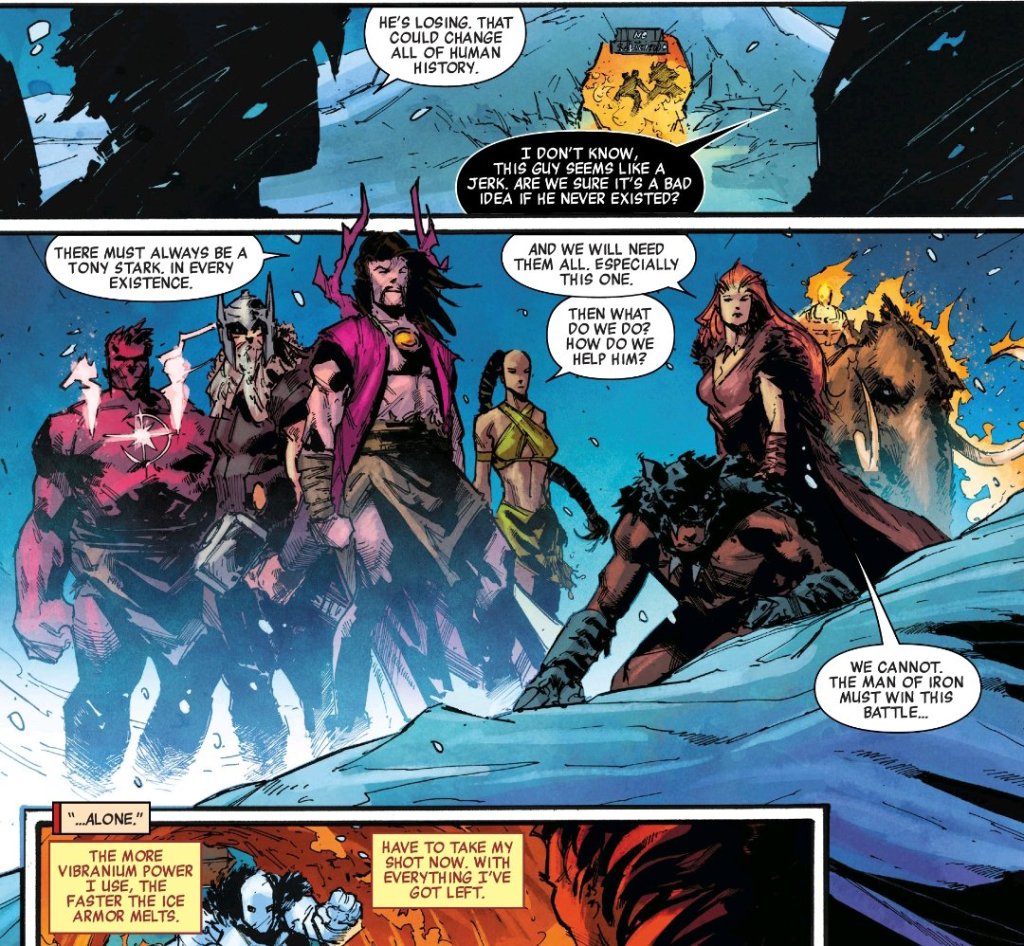
The Avengers One Million look on at the fight and ponder if Tony’s strong enough to hold out against Mephisto alone. It’s a tough fight because Tony’s running out of energy, his suit is melting and the Devil has far more power than he can handle, so he makes one final hail mary upon seeing that Mephisto has the Time Stone. As he denies the offers Mephisto makes, one last time, and blasts the stone full of his last reserves of energy.

It’s a beautiful set of shots with Gill giving Tony a dynamic pose as the armor cracks off of him, shattering into pieces as he expels a beautiful beam of blue and white light thanks to Rachelle Rosenberg.Tony’s unkempt hair flies out and looks amazing as it flows out of the cracked half of the helmet and the wires dangle back. Mephisto lets the energy hit the stone and looks on with his evil grin and blasts Tony back with Time energy.

Throughout the book, Joe Caramagna has been providing excellent lettering and placement, filling the empty space and hinting at the villain throughout. He does this to great effect when Tony is flung back to his normal future, but has to witness other possible futures. Caramagna spaces each of the thought bubbles, grouping them based on the image in the background and spacing them out as to draw attention to Tony words and the corresponding panel of horror.

The question is, what was this experience meant to teach? 

In many ways, it could be seen as a way to strengthen him against the coming threats that Mephisto has coming and that’s doubly true since Arno Stark has resurrected his father in the pages of Iron Man 2020 and he could be used against Tony again. On the other hand, as Mephisto says in the final pages by Mattia de Iulis, he’s sown fear and doubt in the heart of Tony. Tony does some pretty dumb things when he’s afraid and wh’s to say that this won’t create a new ripple among the Avengers becaue of it?

Overall, I enjoyed this issue! While not all of the artists were to my liking, the story made up for the pages that I wasn’t enamored with. I really enjoyed seeing how Tony would find a way out of the mess and I do enjoy when Mephisto is being used well. Jason Aaron is doing his best to pace out the story and weave pieces into place for the Mephisto Event that we’ve been waiting for since it was revealed that he was the Avenger’s true threat.

The various artists did well, of course there were a few that I didn’t enjoy as much as others, but everyone has their tastes. Rachelle Rosenberg stunned with her amazing colors on every page and Joe Caramagna made it all possible through his lettering. This book was cohesive and a lot of fun throughout, but the price and the fact that this was more of an annual kinda story drags it down just a bit. 

For the most part, however, it’s a high recommend.

Best of DC: Week of February 19th, 2020

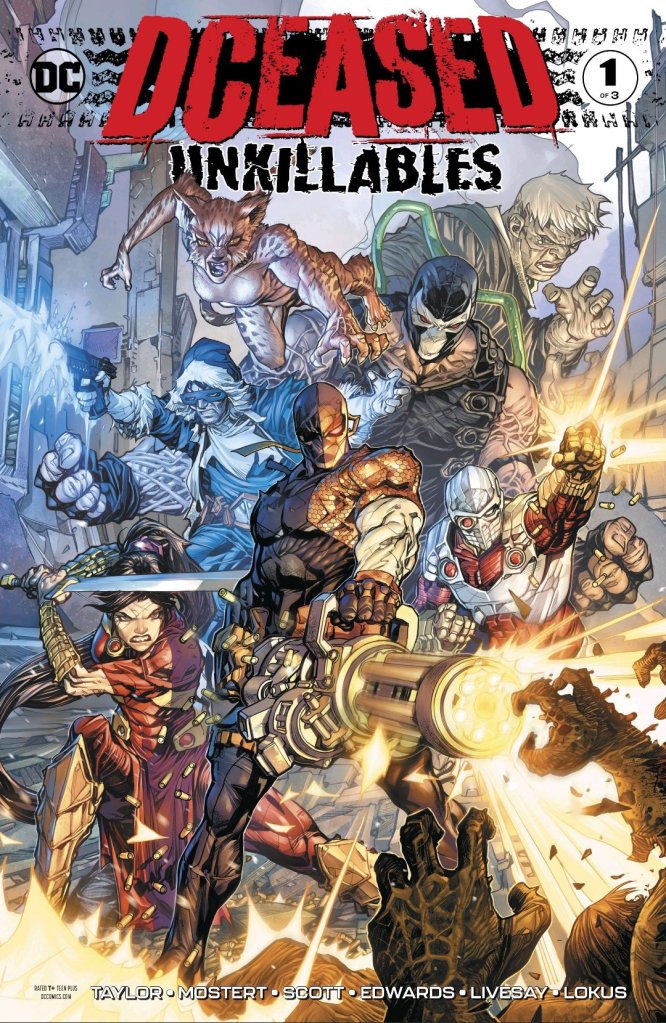
Best of this Week: DCeased: Unkillables #1 – Tom Taylor, Karl Mostert, Trevor Scott, Neil Edwards, John Livesay, Rex Lokus and Saida Temofonte

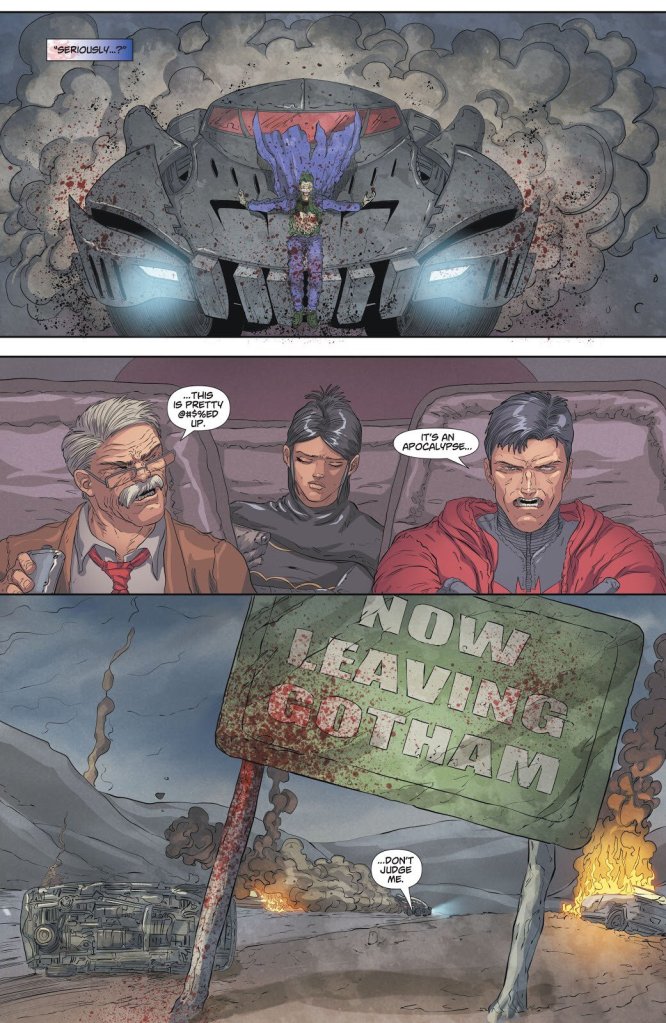
Ahhh shit, here we go again. DCeased was awesome.

In much the same way that the original Marvel Zombies filled my heart with dread, DCeased absolutely blew my mind with the short six issues that it took place in. It was equal parts violent and heartbreaking as the heroes of Earth had to figure out a way to either stop the Anti-Life virus or die trying. We had a good spin off with the single issue, A Good Day to Die and now we have Unkillables, another spin off focusing on some of the more violent heroes and villains while the events of the main series unfold elsewhere.

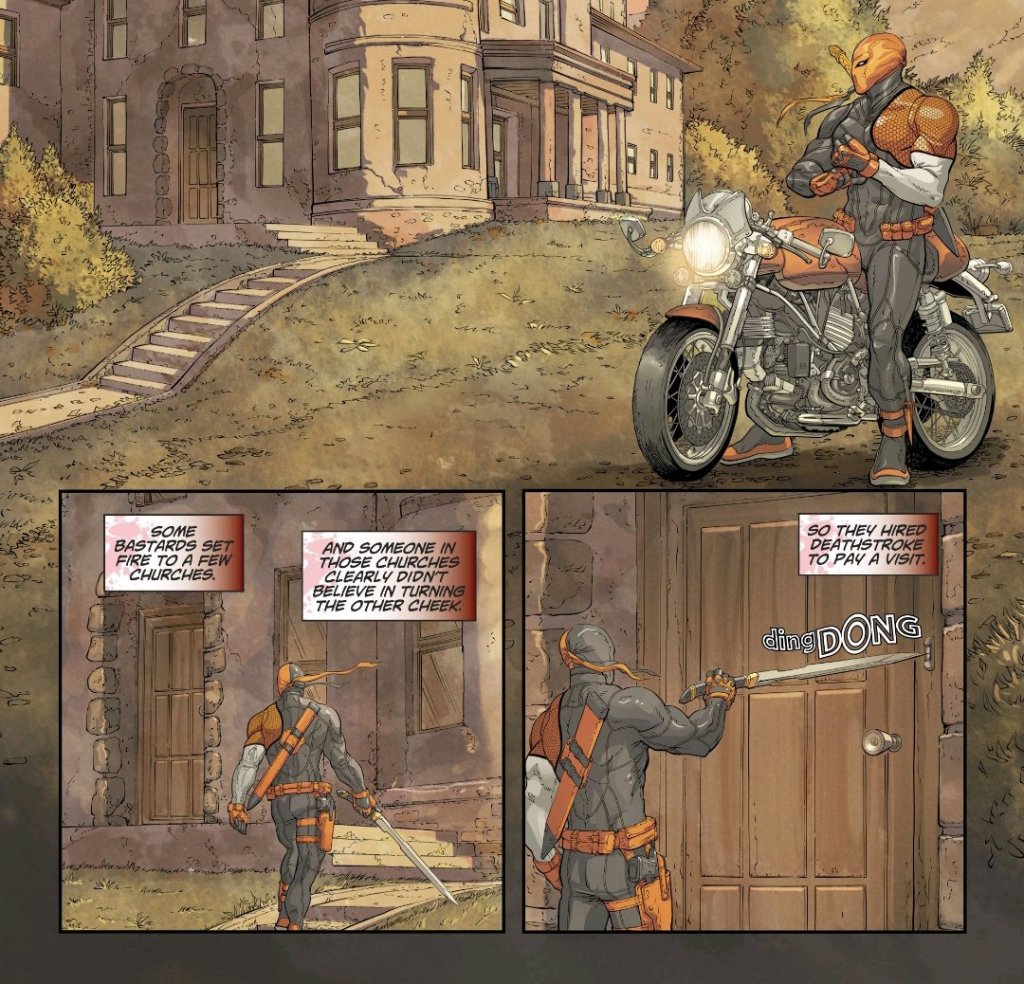
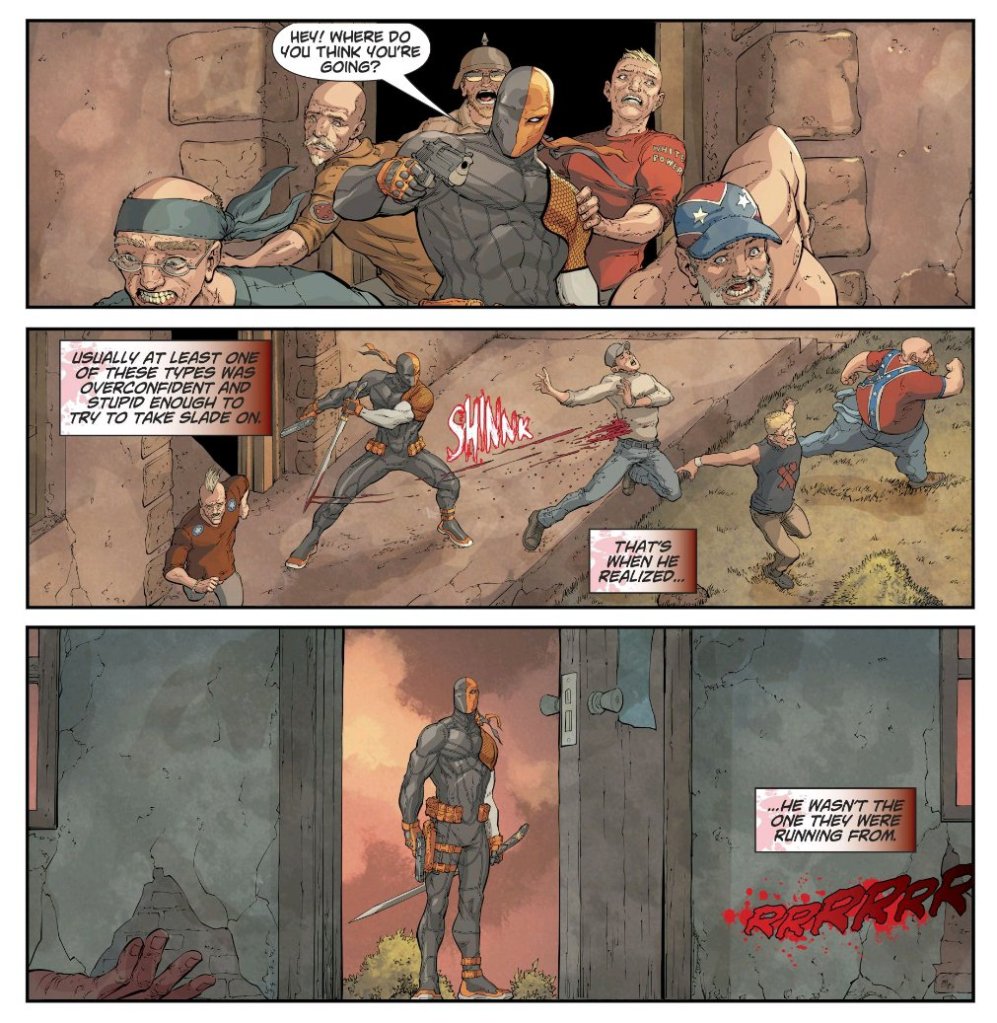
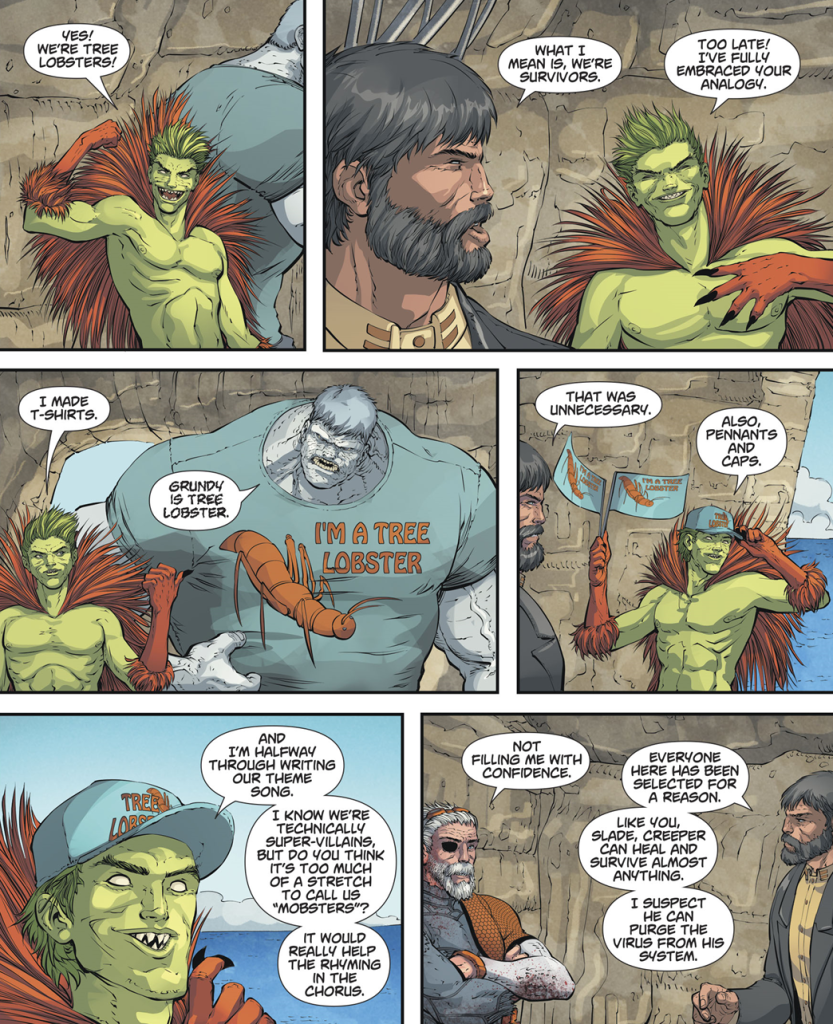
The book begins on the first day of the Anti-Life virus being released as Deathstroke finds himself on a job in Kentucky. Throughout the original story, I did kinda wonder what people like him or the other assassins were up to, given that we saw a select number of other dead supervillains throughout like Giganta and Clayface. As Tom Taylor and Karl Mostert unfold the story we see that Slade Wilson was killing some infected Neo-Nazis before an attempt to renegotiate his price ends with him infected too.

Mostert and Taylor set this opening up in a very comedic way with the white supremacits running from something in the local church as Deathstroke looks on, puzzled as to why they’re running before taking a few out before heading inside. Mostert, Rex Lokus and I think Trevor Scott then give us an awesome single page of Slade facing down a horde of zombies with only his gun and a bloody sword. He looks like a badass and, in the following panels, proves it by killing them with ease.

Mostert doesn’t shy away from Slade’s brutal violence and shows how fluidly he can kill with dynamic poses as he shoots and slices multiple enemies at once. This accentuated by the excellently colored spurts of blood from the zombies and the gory detail of blood on the walls. There’s even a really good panel of one of the zombies being cut in half with Scott inking the silhouette as their blood and insides drip down. Even better is when Slade gets infected and violently rips his mask off before coming back to his senses while choking a guy.

Tom Taylor introduces a unique aspect here as Deathstroke returns to normal on the second day of the virus being introduced. As we learn later, it’s due to Slade’s unique super soldier DNA that allows him to fight off the infection, effectively being immune to a point. I can definitely see this being a double edged sword for him as the infection seems to last for a day before being purged from his system. This makes him unique amongst both the heroes and villains of Earth as maybe a potential savior.

 I’d also like to praise Saida Teofonte for her amazing lettering as well. She does an amazing job, not only with word balloons, but with captions that have a bloody background and the typefaces she uses for sound effects. For the most part, they fit the gruesomeness of the story with intense and bloody BANGs to eerie RRRRRRs, signaling the incoming zombies. Deathstroke’s scream as he claws his own face is intense, scratchy and blood curling until we get an AMAZING title page with names filling the empty space.

As things progress, we cut to Jason Todd in the Batcave. The silence is eerie as we get one small “spsh” sound as Jason steps through the blood trail of Bruce, Tim and Dick. Unfortunately, this seems to take place shortly after the events of DCeased #2 when an infected Dick and Tim attack and infect Batman, leaving Alfred to kill them all. Jason, like most readers, is shocked because he thought Bruce would have found a way to survive and then he’s met by Ace the Bathound. After letting Ace see that he’s not infected, Jason proceeds to make graves for his brothers and father before speeding off in the Batmobile to find the rest of his family with Ace.

These scenes are powerful as Jason, normally the black sheep of the family, has to deal with the fact that he’s one of few left. Why wasn’t Bruce prepared? Why was he the one left and not Dick or Tim? Damian’s still alive in Metropolis, but effectively, Jason is all alone. Mostert and I believe Neil Edwards show Jason’s love for his family as he carves out wooden headstones and buries them in the cave. Without a word of dialogue, this speaks volumes about Jason’s love for his family.

Elsewhere in Gotham, Ravager, Rose Wilson with a missing eye, unlike her main continuity counterpart, is curled up in her apartment in fear. The zombies are pounding on her door when Slade radios in and tells her it’s time to escape. Rose has the ability to see into the future in short bursts and sees that everytime she goes for the door, Zombies come through and kill her. Deathstroke, however, has a plan. As a side note, it’s great to see Rose in gear similar to what she wore in Geoff Johns’ “Teen Titans” while also complementing Deathstroke’s current armor.

Unfortunately for Deathstroke, as he keeps his eyes to the sky, he sees the terror that is an infected Man-Bat flying at him with a terrifying SCReeeee as he crashes through the window and smashes the plane on the roof Rose runs to her dad and, believing him to be infected, plunges her sword through his chest and he screams “Ow.” This scene is pure comedy made even better by the dramatic rain and fire in the background. Soon after, Mirror Master, Evan McCulloch, shows up offering them help.

I don’t know what the reason is for using the Scottish version of the character, but it doesn’t really matter as the representation of the Mirror Dimension is still cool as hell. While wearing special glasses that block signals, they walk through the dimension and Mostert draws an epic depiction of it with all of the violence, gore and death through the many mirrors while the characters look miniscule compared to the vastness of it all. The Mirror Dimension has always been terrifying and McCulloch could do a lot to solve the problem, but it makes sense that he doesn’t. Cause it’s terrifying.

After many pages, we arrive at the rest of the stars (fodder) of the series in Vandal Savage, Solomon Grundy, The Creeper, Cheetah, Lady Shiva, Bane, Deadshot and Captain Cold. I do have a bit of a continuity issue as Cold was shown to have been one of the Infected during the events of “A Good Place to Die,” but alternatively this series could explain how he got there or, much like that story, it’s off base with what’s happening in the main pages. But some of these additions are pretty interesting to say the very least.

Savage is near immortal, but has been shown to have been killed before. There’s a high chance that using Deathstroke, he’ll find a way to cure and rule over the people of the Earth after the heroes leave. Grundy is already dead, so can he get infected? The Creeper is much like Deathstroke in that he can heal from anything, so it makes sense that he’s managed to survive. Cheetah is strong and fast, but I don’t rate her chances high and the rest, while immensely skilled, are still just human. This is a ragtag group, but they’re not averse to getting the job done by any means.

The rest of the issue focuses on Jason Todd and his fight to rescue the remaining members of the Batfamily. Mostert, Lokus and John Livesay give readers an awesome assault on the Gotham PD with Cassandra Cain as Black Bat, James Gordon and Harvey Bullock fighting back against the zombies. Cass awesomely kicks and knees zombies in the background while Harvey and Jim shoot them. I LOVED Cass as Batgirl/Black Bat and it was awesome to see the return of the iconic costume and a character that I like so much.

Of course,Temofonte thrills with the lettering here again. She sells the panic in both Jim and Bullock as they fight off the horde as well as the frankness of Bullock as he has to break it to Jim that Blck Bat is the only one coming. The static-y bubbles that she uses on Bullock when he gets infected is also amazing and saddening, but gets even worse when Cass has to “CRCK” his neck to kill him. Soon after, Jason plows through the GCPD in the Batmobile with a “CRNNNCH” that shrinks around the vehicle.

Jason rescues Cass and Jim after shooting the remaining zombies in the head and plans to get the hell out of dodge. Jim, still holding out on the idea of hope, tells Jason that Barbara is still out there somewhere, but Jason, knowing that it’s no longer the time to keep secrets, reveals his and Cass’ identities and shows Jim that Barb is dead. He then takes the haggard detective to her last known location and Mostert and Lokus sell the utter despair of the scene.

Infected versions of Barb, Stephanie Brown, Batwoman and Catwoman were killed by Poison Ivy and Harley Quinn in Issue #3 of DCeased (if I remember right). This scene of James finding his daughter is depressingly grey and his facial expressions show us just how painful this is for him. He’s lost just about everything and cries in his grief. Jason, however, finds the dead body of the Joker and ties him to the front of the Batmobile before they all make their escape to Bludhaven.

This first issue of a three part miniseries already has me as excited as the original story did. I love each of the characters being used, the callbacks to past history and the way that everyone is being written. Each of these violent characters sees that there’s no need to hold back anymore as the regular rules are tossed out of the window. Everyone now has different amounts of pain and grief to deal with while others have different hopes of power or a cure. Ultimately, I don’t think things will end ultra well given the events of the main series, but I have no doubts that this will stand on its own.

Tom Taylor continues to be excellent when writing the despair and tragedies of DCeased and lifting up lesser characters, like The Creeper. His scripting and dialogue are a joy to read and I really feel like he’s got a grasp on everyone. Karl Mostert brings their all to this book with awesome panels and scenes that make readers want to wince, but look again to see the utter brutality of what they’re witnessing. His art is stellar. The various inkers definitely bring it to life alongside Lokus’ vibrant colors and Temofonte’s amazing letters.

I’m already gleefully anticipating the next issue and it more than justifies the $5.99 price, high recommend!

Best of Marvel: Week of February 19th, 2020

Best of this Week: Fantastic Four #19 (Legacy #664) – Dan Slott, Sean Izaakse, Marcio Menyz, Erick Arciniega and Joe Caramagna

It all began with one fateful foray into space.

Reed Richards, a gifted scientist from Empire State University, his brilliant wife, Susan Storm, her hot headed younger brother, Johnny Storm and expert pilot Ben Grimm board the Marvel-1 in an attempt to explore space. Unfortunately for them, their ship is hit with a wave of Cosmic Rays, sending them crashing back to the Earth and giving them all special powers. For decades, we all thought that everything was Reed’s fault for not having strong enough shields, blessing and cursing his family with powers, but we learn here that that is not the case.

Throughout the last five issues, The Fantastic Four have been fighting against the people of Spyre; A planet of normal people, enhanced people and monsters that have feared the prophecy of the “Four-Told,” beings that would destroy Spyre and their way of life. After Reed exposes their leader, The Overseer, for being the one that released the cosmic rays on the Four, Ben climbs his tower and beats the everloving crap out of him and destroys the tower in the process.

Realizing that the Overseer stands defeated and the eye that watched them is no more, every citizen turns on the FF, proclaiming that the prophecy did happen as the Overseer lay in the rubble. This issue picks up in the immediate aftermath (after a preview of the coming story in the first few pages involving Mole Man and Wyatt Wingfoot). Sue places a barrier over the FF as the citizens, heroes and monsters pelt her forcefield with fists and rock. Previously, the citizens were divided by their classes, but now they’ve united against Reed and the Four.

One of the more interesting subplots that Dan Slott had been weaving is the burgeoning relationship between supposed “soulmates” in Johnny Storm and a Spyrian hero named Sky, a darker skinned girl with wings that may actually be in love with another hero by the name of Citadel. This is one of the few times that Johnny shows an actual longstanding interest in a woman, especially since their connection was made shortly after the Fours first failed mission unbeknownst to him.

Slott had been building this up and getting readers invested in their struggle of love and it’s good to see Johnny loving someone like he did with Medusa or Crystal of the Inhumans.This is further tested as Sky is torn between the traditions of her people and her disdain for the FF after their actions. Of course, she’s not the only one who is irate as the Overseer picks himself back up and calls Reed out for a one-on-one brawl.

Reed’s never been the best fighter in the world, but he’s always had ways to use his powers to his advantage and can still hold himself pretty well. Sean Izaakse portrays that pretty well with a few expertly drawn pages of battle as Reed uses his stretchy abilities to dodge energy beams, punch Overseer from afar and uses his arm as a slingshot to fling boulders at the villain. Izaakse and Erick Arciniega work in perfect tandem to make these scenes exciting with bright colors and dynamic angles.

Things get even crazier as Overseer fights back with his own arsenal of suit abilities. Izaakse draws amazing looking rings for sonic blasts that Arciniega colors with a beautiful yellow. Then switches it up for crackling blue lightning and finally ends things with Kirby-esque bubbles of energy that go from a dark orange to a dastardly purple to match Overseer’s beautiful armor. This fight is absolutely gorgeous to look at even as the panels are mostly medium sized, widescreen rectangles.

Throughout their fight, the two have an exchange that boils down to hubris vs. personal responsibility and both make pretty good points. Reed had always blamed himself for what had happened to his friends and family, thinking that his miscalculations are what put them all in anger and that weight is lifted off of his shoulders with rage at finally punching the cause. Overseer, feared for the lives of his people from the potential threat from beyond by a man that never asked what the greater galaxy wanted. Reed always does things like this and Overseer’s only course of action was to curtail it before things got bad.

As always, Reed does what he does best, uses his brain to talk Overseer down, knowing that he too hasn’t fully mastered the use of Cosmic Rays and suggests that they could accomplish more together than against each other (opposite his conversation with Charles Xavier – see X-Men + Fantastic Four). Reed proposes that the two make a trade of sorts and offers the people of Spyre a chance similar to what Ben has in “The Almost Cure,” something we’ve seen used recently when Ben and Alicia Masters went on their honeymoon and would have allowed him to turn human for a day until he fought the Hulk and landed in a coma.

The Monster Men take umbrage with the idea because Ben had preached appreciating who one is on the inside when he rallied them to fight Overseer, but when one of the Heroes of the Spyre asks if it will work on him too, almost everyone seems to want in on the change. Of course there are others who see the FF’s gift as what will truly destroy their people, showing that some people just can’t be pleased. As their time on Spyre draw to a close, Reed and Johnny bond together like they did when this arc started as Johnny muses on what his life would have been without his powers.

It’s a touching scene and Dan Slott has always been great at things like these. From his time on Spider-Man and She Hulk, he’s shown that he has skill in giving readers heartfelt moments, especially given that we almost hardly ever see the pair together. This is accentuated by Izaakse drawing Johnny with a smile on his face as he flies through the skies with an almost old school look colored by Arciniega with lush oranges and intense reds.

Just as the FF are about to depart, Overseer tells them that only ones soulmate can remove the soul bindings on their arms. After a few pages of searching for Sky, she shows up to Johnny. I think the implication is that she went on some soul searching away from Johnny and when he offers to remove her Soul Binding, she refuses and tells Johnny he can keep his too as she’s joining them on the trip to Earth.

Suffice to say, this is as shocking to The FF as one might expect as they add yet another hero to the ranks, but she likely won’t be on the main team, but more as a supporting role until Marvel decides to give her a miniseries and then sends her back to the Spyre. She’s certainly a welcome addition and it’ll be fun to see what kind of shenanigans she and Johnny will get into as he’s naturally flirtatious and she wants to keep to the traditions of her people. It’s difficult to say that she’s fully in love with Johnny still as she flirts with Citadel before they disembark.

Overall, this was a really fun issue and concludes a story that had a surprising amount of heart and depth. Generally, I like the idea of Cosmic Happenstance and did love the mysterious nature of how the FF got their powers. I might have preferred that things be kept random chance, but honestly, I wasn’t put off by this equally ridiculous explanation either. At the same time, Dan Slott also alleviates some of the guilt from Reed’s shoulders which could be a double edged sword for him in the future if his ego grows too large.

Sean Izaakse and Erick Arciniega also do an amazing job on the art (I can’t leave out Marcio Menyz, but I didn’t really care for the Wingfoot stuff). The pair smash it with the visual storytelling through fantastic facial expressions, body language and utopian setting. One thing that took me time to notice was that all of the people of Spyre were black. It’s a small, but nice touch that makes them stand out amongst the other races that we see throughout the galaxy.

Depending on how the next issue goes, I may stick with the series, but I’ve never been a big fan of Mole Man stories, so I may drop off until the next arc, but this one was absolutely worth the time, a high recommend!

Best of Marvel: Week of February 5th, 2020

Best of this Week: Miles Morales: Spider-Man #15 (Legacy #255) – Saladin Ahmed, Javier Garrón, David Curiel and Cory Petit 

I had a really difficult time choosing between this and X-Men/Fantastic Four #1.

Both stories were great this week and I was tempted to choose the latter because up to this point, I hadn’t really been enjoying this Spider-Man run very much. Of course, here we are though. There was just something about how this issue pulled everything together that made me appreciate the story that Saladin Ahmed set out to tell and how Miles is finally growing into the hero that fans always knew he was. Everything just felt so right amidst this roller coaster of an “Ultimatum” arc.  Even in the face of tremendous adversity Miles overcomes.

Throughout this series, Ahmed has been sprinkling small bits of an arc to readers with Miles constantly being late for class, tired and even being placed on academic probation by his Principal, Mr. Dutcher. Of course it’s easy to paint Dutcher as potentially a racist due to how much he’s had it in for Miles throughout the story, almost to very ludicrous points in his attempts to kick Miles out of the school. Things seek to finally take a turn when we find out that Dutcher found the notebook that Miles had been writing in with all of his Spider-Man adventure thoughts.

Garrón makes sure to draw Dutcher with the worst, “I’ve got your ass now” looks I’ve ever seen with one hand placed in his underarm while he taunts Miles with his journal. Curiel colors things ominously with light shadows going over most of his face as he prepares to ream Miles, but suddenly Brooklyn Visions, Miles’ school, is attacked by a horde of new Green Goblins. Garrón makes them look threatening as hell as they terrorize the student body and the teachers with destroyed cars and fire in the background.

Without hesitation, Miles tries to swoop in and save them, but the Goblins find him and Dutcher, rounding them up with the rest of the hostages. The leader Goblin demands that the school hand over Spider-Man while threatening the staff. Garrón and Curiel sell this by portraying the Goblin as a towering beast with one green foot planted on the head of one of the teachers, his grey toenails curling over him. They’re certainly not as intimidating as the Main Green Goblin of the Ultimate Universe, but their numbers and power do cast as at least mildly formidable foes, at least for this issue.

One of the black teachers steps up and offers to remain the only hostage if they let the kids and other teachers go. I really like this character as I think he’s the one that assigned the journal project and he’s been acting as something of a mentor to Miles throughout. He really cares about his students and colleagues even though he’s terrified and he’s the first of many to inspire courage in this issue.

Just as the Goblin is about to absolutely RIP the teacher’s head off, Dutcher steps up and says that his colleague doesn’t know where Spider-Man is and says that he does. Everyone remembers that moment in the first Sam Raimi Spider-Man movie where J. Jonah Jameson risks his life for Peter so that he can escape – well, after giving a telling look to Miles, Dutcher claims that he himself Spider-Man before getting smacked into a wall. This is an amazing turning point for the character as we’ve only seen him be annoying and antagonistic to Miles the entire time that we’ve known him. With one small act of courage, he kinda reverses it all when he could have just given into his worse thoughts.

Garrón and Curiel frame this scene excellently with one shot of Miles looking at Dutcher, with a light shining on his face, almost wondering what the right decision is. He may not like Miles too much, but he couldn’t forgive himself if he gave the boy up. We get another shot over Dutcher’s shoulder, shadows covering the other side of his face and Miles looking at him, afraid that he could have his identity exposed and die right there. With no dialogue these two panels say more than any word balloons could.

Ganke, Miles’ best friend, decides to launch another distraction for Miles to suit up and our hero swings in with an amazing splash page by Garrón and Curiel. The students cheer, the Goblins grit their teeth in anger and Miles takes a dynamic pose as his webs make an excellent line for the our eyes to follow from Miles arms, his heroic symbol and his gymnast legs getting ready to kick the crap out of evil. The black and red suit stands out amongst the mostly greens and browns of the page, putting the focus mainly on him.

For the most part, the rest of the issue is Garrón and Curiel showcasing Spider-Man’s Goblin Slaying skill while they try to take him down. He crashes through the wall of the school and Garrón emphasizes the weight and speed of the fight with debris and skid marks as Miles knocks two of the Goblins out, making them revert to human form. There’s also a really good shot of the leader Goblin chucking dumbbells and gymnast posts at Spider-Man.

Curiel does an amazing job of coloring the action as things move from the brown of the basketball court, to the blues of the indoor pool in which Garrón draws an amazing few panels of them fighting in the water. As per Curiel’s coloring style the water is fluid and beautiful and then gets excellent lighting as Spider-Man Venom Blasts the Goblin in the middle of it all. 

Cory Petit deserves heaps of credit for giving this entire book life with his incredible lettering and even more so this fight sequence. His transparent CRASHes and ZZZZZTs sell both the intensity of Miles and the Goblin going through walls and the power of Spider-Man’s Venom Blasts respectively. I’d be remiss if I didn’t mention the SPLASH as the Goblin falls into the pool or the transparent SLOSH that curves down the villain’s arm as he tries to punch at Miles in the water. 

The fight reaches its conclusion after Miles repeatedly kicks the Goblin in the face and finishes with an uppercut (Shoryuken!) over a red, pop-art background that could only have been made better with a POW sound effect. The Goblin, knowing he’s been defeated, jumps away and leaves Spider-Man until their next confrontation. Later on Miles and Mr. Dutcher resume their conversation from earlier and it is a far more tense situation, especially after all of the damage that occured to the school.

Surrounded by Curiel’s dim oranges from the fires raging in the background, Miles tries to explain all the things that he says in his Journal, but Mr. Dutcher calmly hands his student his journal back. Dutcher tells Miles that he “should report students engaging in dangerous activities to the administration,” but all that he read was a “fictional story.” For a moment, Dutcher gives Miles a look like he sees the fear on the young man’s face, but he rationalizes that if Miles hadn’t done what he did, there’s no telling if any of them would be alive.

Mr. Dutcher proves himself to be a trustworthy person because of the bravery that Miles showed him. Miles has saved Brooklyn, if not the whole of the world, many a time and he’s actually one of the more well liked Spider-People. Miles serves as an inspiration to the rest of Brooklyn Visions and the borough as a whole, but there’s also the downside of his presence. Somehow the Goblins were able to find out what school Spider-Man attended and that puts everyone in grave danger, so the question is… what will Miles do now? He did save the day and got taken off of academic probation, but the school is mostly in ruin. Much like Peter’s best victories, this one is pyrrhic.

Saladin Ahmed really knocked it out of the park with this issue. He does a really good job at scripting Miles and his supporting cast, making each of them seem courageous and sympathetic. Javier Garron and David Curiel’s art and colors have been some of the best parts of this run and they continue to stun with amazing visuals, making sure readers get really invested in the art and the story it tells along with the script.

I do also wonder if this story will play into the upcoming “Outlawed” event which sees teenaged superheroes getting banned from active operation after something terrible happens to Spider-Man friend, Kamala Khan aka. Ms. Marvel. The destruction of Brooklyn Visions could act as more fuel to the fire following this issue and it would be interesting to see how this could possibly contribute to that event. Maybe we’ll even see Miles unmask to the world? (Nah, it’s probably gonna be her, but who knows?) But I am excited at the very least for the rest of Ahmed’s run if the issues continue being this awesome.