Best of DC: Week of March 25th, 2020

Best of this Week: Batman: Curse of the White Knight Book Eight – Sean Murphy, Matt Hollingsworth and AndWorld Design
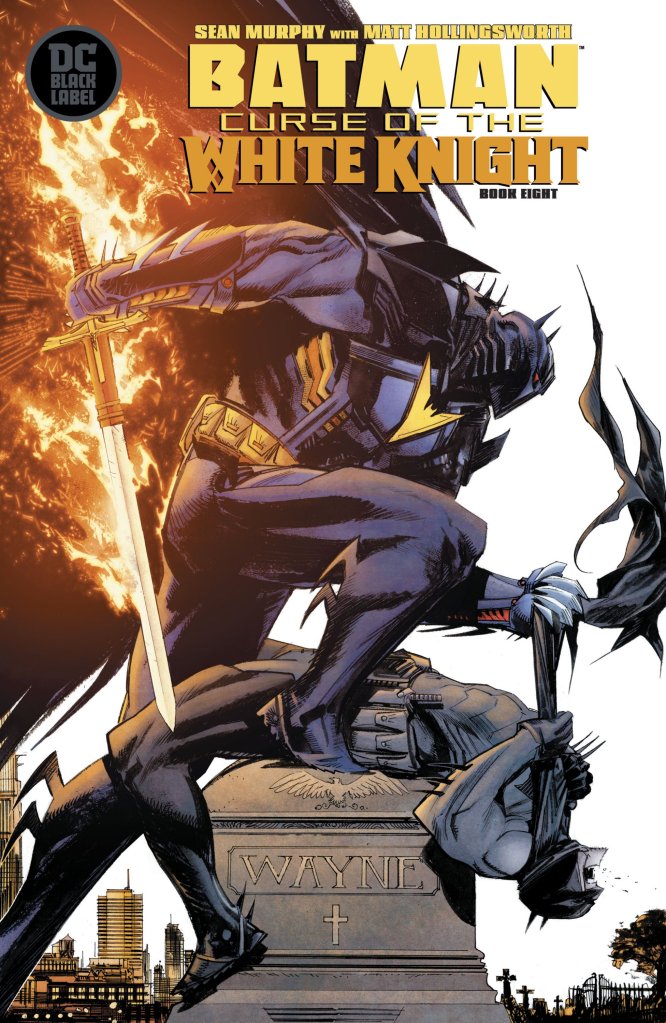
And here we are at the end of the road.

The original Batman: White Knight gave us a tale of a hero who refused to see the error of his ways – a man that would lie to his friends and destroy his treasured city as long as villains received the justice that they deserved, but he never saw that he was becoming one of them. Enter Jack Napier, the former Joker, cured of the madness that led him down the path of costumed villainy for a time. He became a symbol for the change that Batman refused by offering to rebuild the broken down parts of Gotham and stopping Batman once and for all.

Unfortunately for Napier, he couldn’t keep the Joker at bay long enough to see his dream Gotham come to fruition, but he did manage to inspire, not only the people of Gotham and its police force, but Batman himself. Of course, not everything could remain peaceful. Soon after all of that happened, Azrael and the Order of St. Dumas cropped up to cause trouble and save Gotham from its false protector: Batman. Azrael serves as the logical conclusion to what Batman’s war on crime could have been.

After several issues of cat and mouse, Batman is finally on the trail of Azrael with the Gotham Terrorism Oppression Unit (GTO) at his side. Initially, Sean Murphy makes the chase look like a team effort with Dick Grayson leading the charge, but Matt Hollingsworth gives slight hints at Batman’s state of mind with an orange glow around the Batmobile before getting close enough to remote shut off the rest of their cars. AndWorld Design excellently captures the slowing down of the cars with their lettering going from high energy “VvvvvvvVvvvvvs” to slow, sputtering “Pkk, Pkk” sounds as the wheels begin to stop.

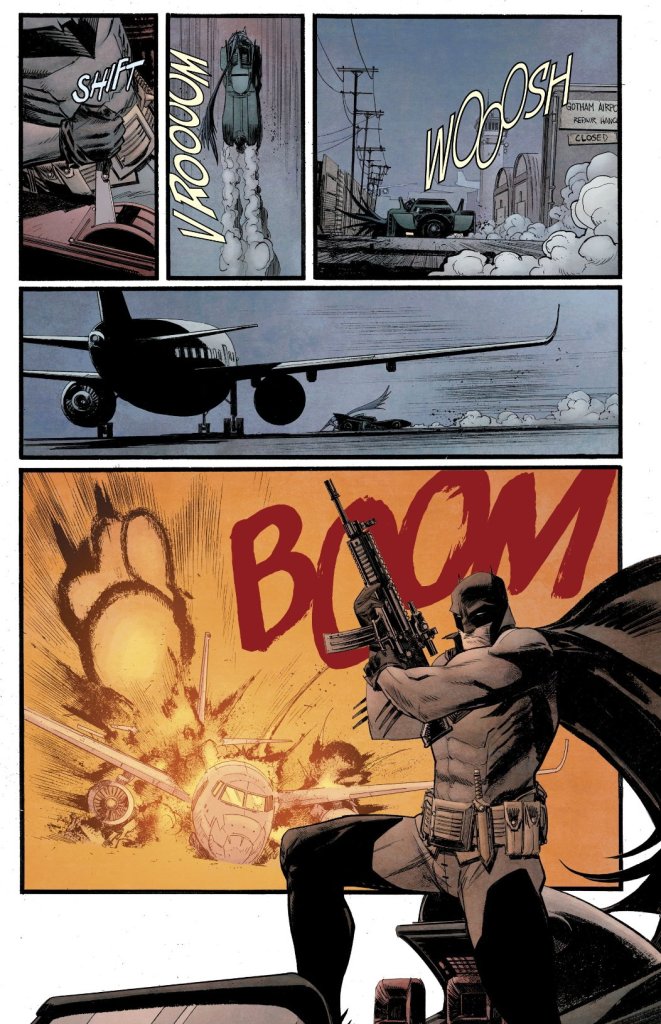
Dick, being the one closest to Bruce, had a conversation with him in the last issue and anticipated that he might have done something like this and tells the rest of them that it was because he didn’t want them to stop him from killing Azrael. Batman then zooms off to chase Azrael on his own, catching the villains foot with the cars grappling hook and hilariously swinging him around while drifting the car before reeling him in and reversing the car into a plane – all the way at the Gotham Airport. 

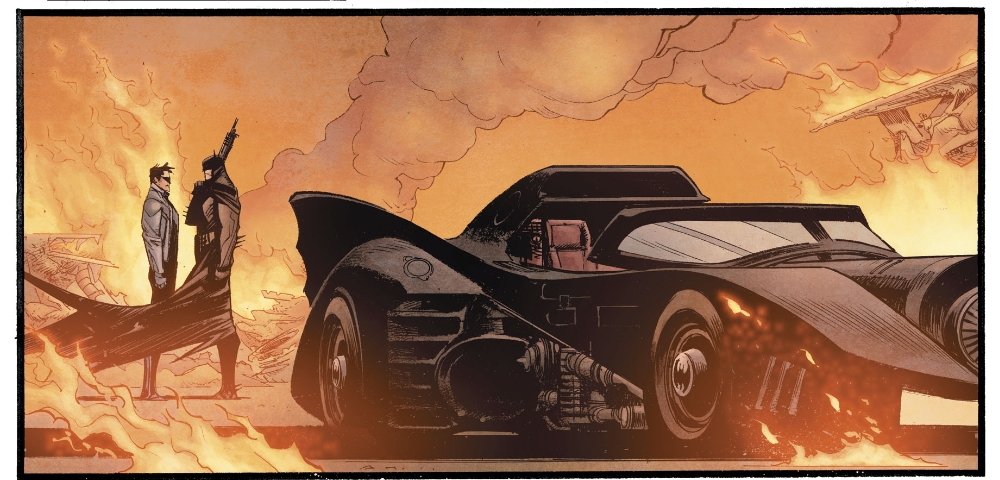
Sean Murphy is known to be a big car guy and he showcases the 1989 Batmobile with beautiful side shots, powerful flames blasting out of the exhaust right into Azrael’s face and even a single panel of Batman using a six gear shift to reverse. All of this badass car action results in a massive and fiery explosion. The big panel is beautifully shot with the plane being small in the background, the huge, orange pyro coming out of it, a big “BOOM” lettering in red to accentuate the power and Batman wielding some kind of assault rifle.
Of course, this is a betrayal of everything Batman is about and Azrael even acknowledges Bruce’s “No Killing” rule as the bullets bounce off of his armor before easily gaining the upper hand on this desperate Batman. Azrael then holds him by the collar of his cape and thoroughly dresses down Batman’s mindset for this entire fight, comparing the struggles of Bruce’s war on crime and futile search for peace as being the same as his own. 

Murphy and Hollingsworth draw the scene with a palpable sense of intensity as the fire rages around them while they stand on the debris of the plane and the Batmobile. The shot is pulled out, allowing for AndWorld to utilize the empty space for Azrael’s monologue while the hot oranges paint everything around them. As Batman fears his own end, Murphy draws him with terror in his eyes and a defiant gritting of his teeth as he tells Azrael to “go to hell,” for saying that they are one in the same and threatening to flood the city before Dick’s car barrels into the villain and causes another explosion. 

Initially, I questioned why Murphy decided to invert the timelines of Jason and Dick as Robins, but this book understandably gives good reason. One of the things that Dick had been dealing with over the course of both of these stories is his conflict with Batman over what the proper course of action should be when it comes to Gotham. He’s been Bruce’s biggest critic when he was destroying Gotham and didn’t want to be another casualty like Jason was, so he joined the GTO to stop Batman.

Murphy draws on this when Dick confronts Batman on his recklessness and Batman recognizes that everything he’s done, including adopting Dick and dragging him into this never ending battle all played a part in ruining his life as well as the lives of everyone close to him. Jason’s dark cloud has always hovered over Dick, but with tears in his eyes, he tells Bruce that he still believes in him and that he needs to end this fight as Batman, not as Azrael. Hollingsworth lowers the intensity of the orange backgrounds to make the scene more somber before Batman rushes off to do things the right way.

With the Rapiers of Edmond Wayne by his side, Murphy and Hollingsworth give readers an excellent double page spread of the Batmobile VROOOMing down the streets while various panels of Bruce’s interactions with Alfred, Victor Fries and Jim Gordon remind use that there’s a good man under that cape and cowl, a man that yearns for justice and peace in Gotham City.

Knowing that Azrael plans to flood the city, Batman tells the GTO to shore up defenses and get everyone off the streets as he goes to finish the fight at the Gotham Reservoir and pops out of the Batmobile in an AMAZINGLY heroic pose with double rapiers sans cape, beckoning Azrael to take him in a sword fight. Murphy leans into Batman’s Zorro roots as he chooses to fight with honor, calling out Azrael’s faith, knowing that his sword’s Arabic name is God’s Will and that it is all that a God fearing man like Azrael should need and they duel valiantly.
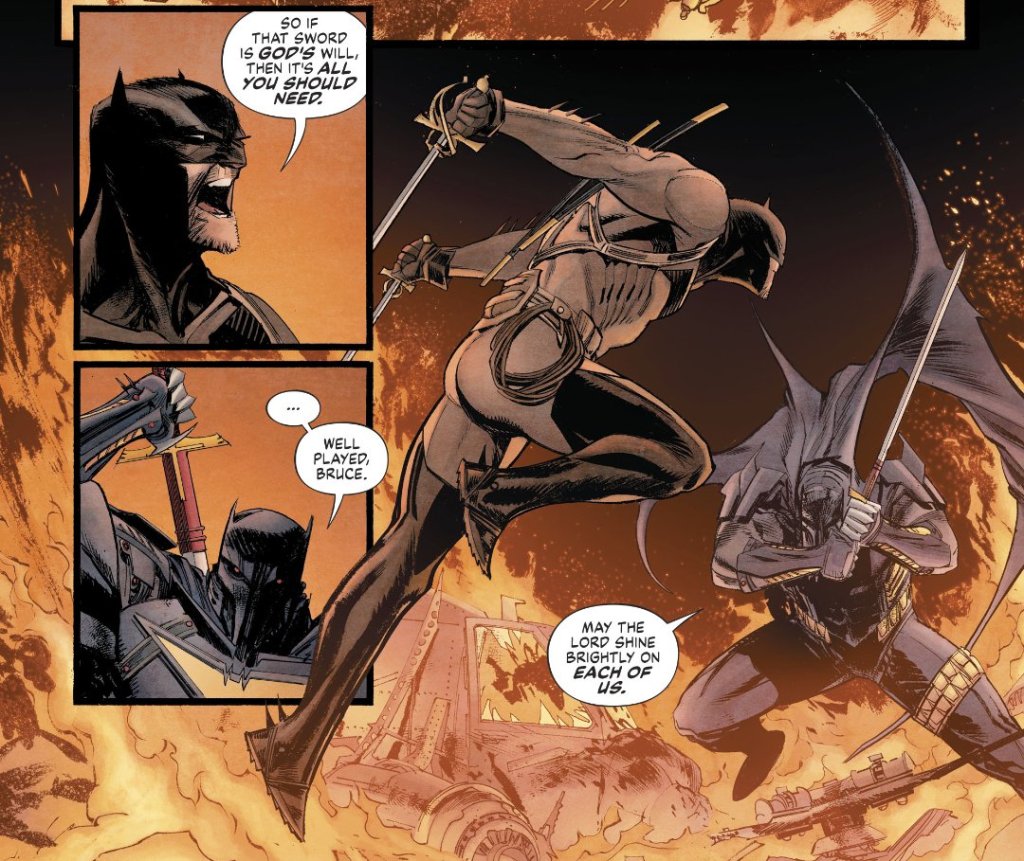
Murphy, Hollingsworth and AndWorld Design give readers an amazing scene of Batman disarming Azrael rather than trying to kill him, removing one of his gauntlets with a deft flick, giving it a “HRRN” sound, removing his cape to get a rapier between his armor with a “WOOSH,” indicating the speed and flow of his movements. Bruce even goes so far as to let Azrael knock the rapiers from his hands so that he could knock the helmet off of his head by trapping it between the “CLINKing” panels of the Batmobile as they close before taking the villains sword.

Azrael, knowing that he’s going to lose and trying to throw Bruce off of his game for a moral victory, starts insulting Thomas and Martha’s deaths, calling them leeches of Gotham’s wealth. This causes Bruce, in a rage, to “HACK” across Azrael’s neck, slitting his throat. Murphy makes it look so sudden, Hollingsworth ratchets up the intensity of the flames in the background and emphasizes Azrael’s blood as it pours out onto the ground, proclaiming that Bruce “eliminated the last Wayne.”

Murphy and hollingsworth treat readers to a beautiful panel of Bruce looking at his beloved city, shadowed in the night sky with orange glows coming from the streets while Azrael bleed out on the boat, Batman quickly decides to suture his throat and use his blood to keep it flowing into Azrael while proclaiming that being the protector of Gotham has always been about more than being a Wayne or a Bakkar. It’s bigger than blood and that’s why Jason Blood gave Edmond’s Journal to Bruce, because Batman was always Gotham’s true hope.

The series then starts winding down with Bruce saying his goodbyes to Dick and Barbara and the rest of the GTO with varying levels of banter. Even Harleen has a moment where we think she’s going to drive Bruce away as he allows himself to be arrested for his vigilantism, but he convinces her that she’s done all that she needs to and that she saved his soul when he was at one of his lowest moments just like he did for her after leaving The Joker. It’s sad and sobering, especially as these scenes are given a blue hue and these characters have a mutual love and respect for each other.

Murphy also drops in some political commentary at the end where the City of Gotham argues over Bruce giving away all of his fortune to the City and whether or not it goes far enough or veers too far into socialism. While this particular White Knight story has been focused on the heroism side of Batman, I might have liked more of this commentary throughout the book, much like it was focused on in the original series. Though, who’s to say that that’s not where Murphy is going as this book ends on something of a cliffhanger with a SURPRISING reveal.
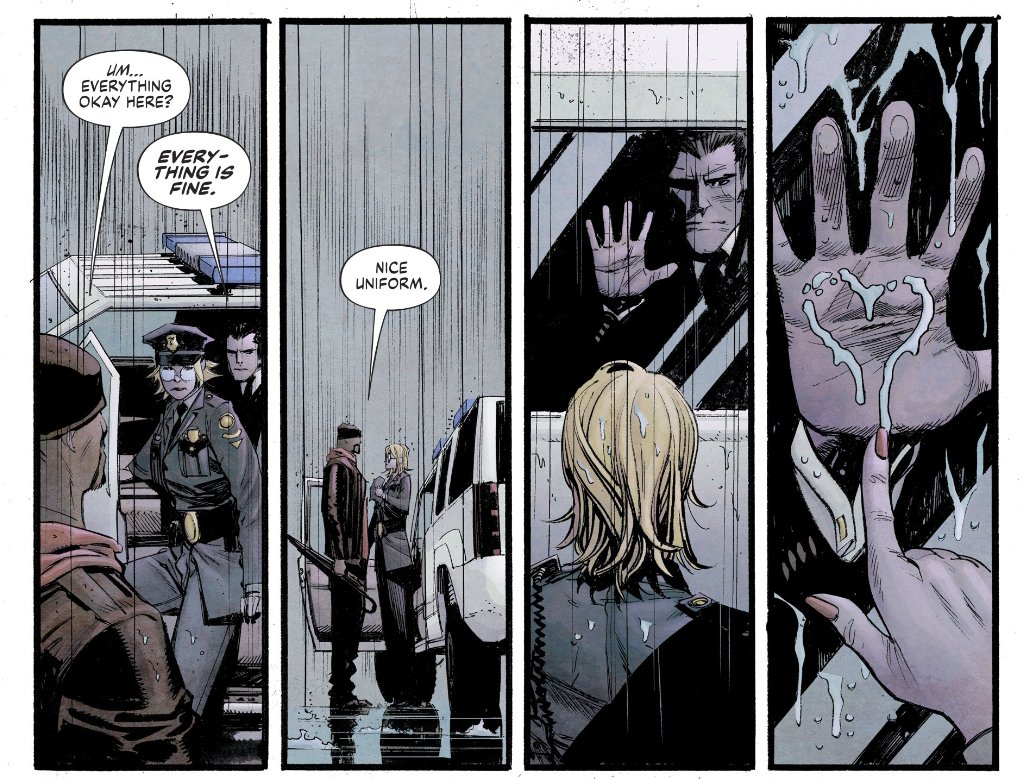
For the end of such a phenomenal book, I can gladly say that this was absolutely worth it. From the compelling story, to the amazing art, coloring and lettering, almost everything about this was perfect in every way. I really enjoyed seeing Batman’s journey from angry vigilante to true savior of Gotham and the dichotomy between him and Azrael as an angry war veteran. Knowing that Sean Gordon Murphy has been given free reign to start his own White Knight Imprint, I’m ultra excited for what the future holds!
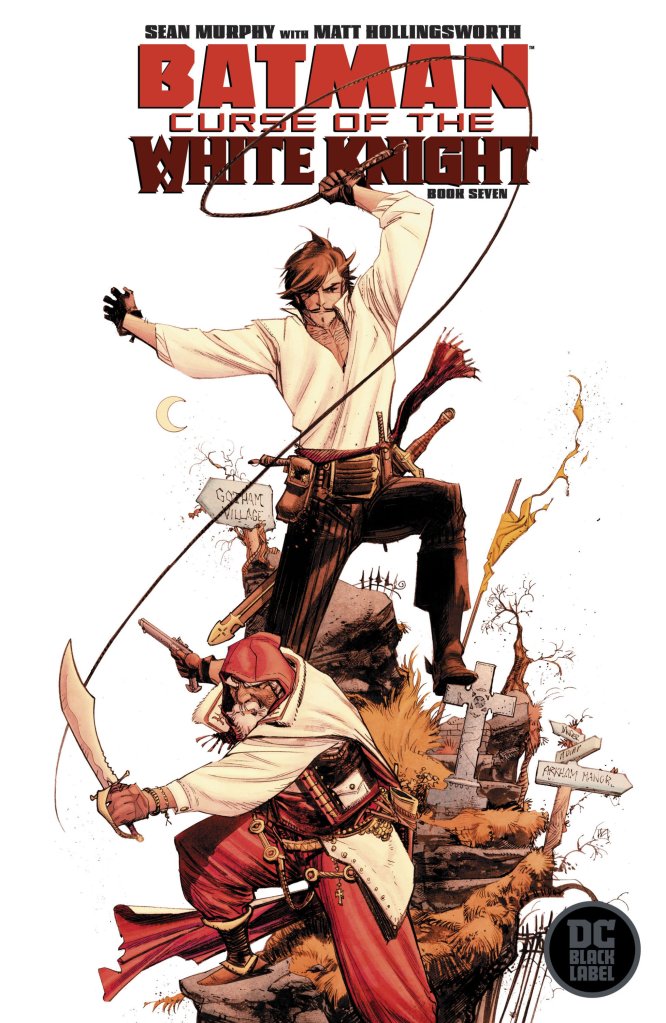
Best of DC: Week of February 26th, 2020

Best of this Week: Batman: Curse of the White Knight Book Seven – Sean Murphy, Matt Hollingsworth and AndWorld Design

Batman is Dead.

The last issue of Curse of the White Knight gave us the last in the story of Edmond Wayne and revealed that the man that Bruce thought was his ancestor, turned out to have been the family to Jean-Paul Valley instead. Bakkar of the Order of St. Dumas killed Edmond after betraying and stealing Gotham from under him, thus assuming the name of Wayne and forming the city to his vision. With this newfound information, Batman has found himself a man with a lineage of thievery, especially after finding out that Gotham’s Elite have been funding their crime through Wayne Enterprises.

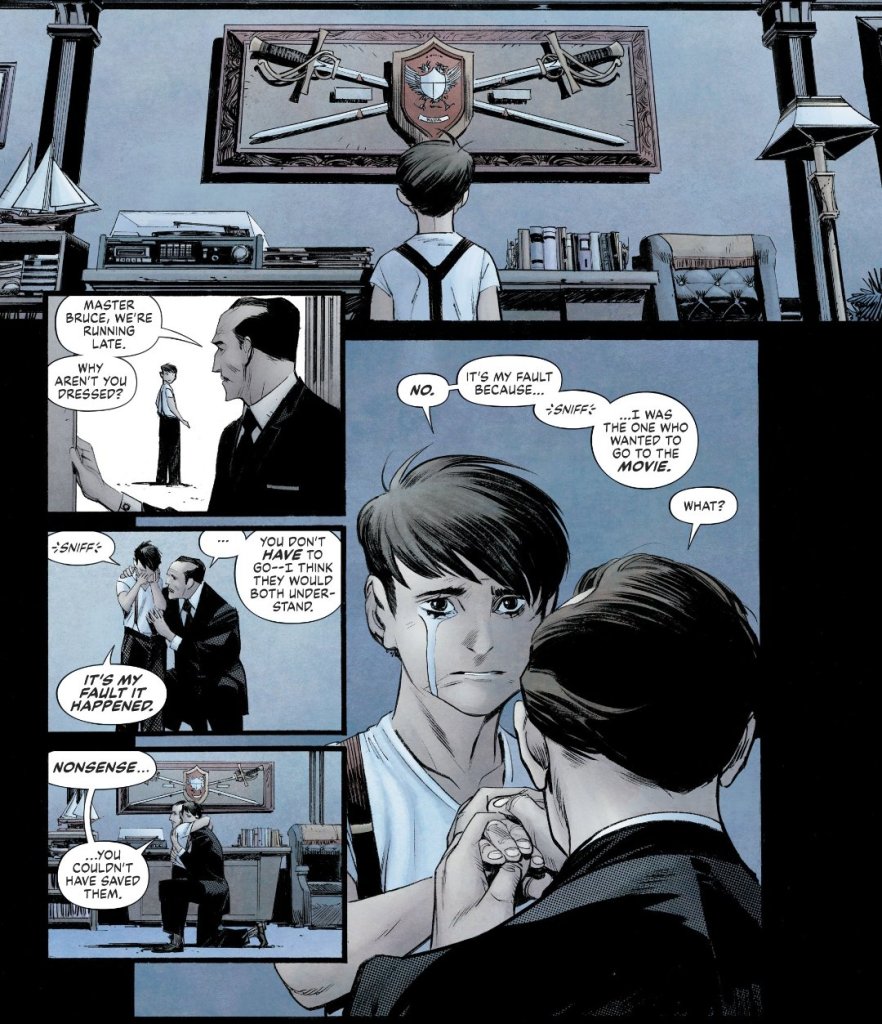
This issue begins with a somber flashback to a moment before the funeral of the Waynes. Bruce cries and blames himself for their deaths because he wanted to see The Mask of Zorro. He had always wanted to use the rapiers that his father kept on display and figured if he learned to use them from the movie, then he would be able to impress his father enough. Alfred, always so caring, tells him that if he’s able to go to the funeral, then he can hold a rapier. He then vows to teach young Bruce how to use it for the next danger he may face.

Matt Hollingsworth colors this flashback in a cool blue hue, emphasizing both the sadness and the hopefulness of the moment. Murphy portrays Alfred as being caring and shows that even with the tears, Bruce shows his ability to rise up and become the hero that people need. Though the rapier is far too large for his kid body, Bruce holds it firm in hopes of protecting Gotham in the future.

As we cut back to the modern day, Bruce faith in himself and his dreams of becoming Gotham’s knight are shaken. He was never a Wayne by blood and he sees himself as part of Gotham’s cuse. Many would be right to see him as such given Gotham’s crime initially started off as petty stuff and eventually escalated into battles with The Joker, Two-Face and others with Gotham being caught in the crossfire every time. He didn’t even know that his company was being used by criminals because of his singular focus on fighting crime.

Murphy draws Batman as being tired and ashamed of himself for only just now understanding Jack Napier’s vision and why Batman is just as bad for Gotham as The Joker was. His expressions are melancholic, Murphy makes excellent use of shadow to try to hide some of his shame and body language to make him look like an old man that’s been sitting on a lawn chair for eighty hard years. Harleen Quinzel acts as his voice of reason during his pity party and actually shows concern for him.

Hareen has been a central character in this world since the very first issue of the original White Knight and that doesn’t change here though her own personal arc is over. The last issue saw her do her best to bring Jack Napier out of Joker’s mind for one last time for information and to save her children. In the end, she had to shoot Joker in the head to let Jack rest and rid herself of the monster that had been plaguing her for years. She still finds herself at Batman’s side as one of his most trusted friends.

Bruce still has one thing that he can do to make sure that Jean-Paul doesn’t get away with his crimes and Harley convinces him that Gotham will forgive his transgressions like they did for the former Joker in Napier. At the same time, Azrael is still out there and Murphy and Hollingsworth give readers an AMAZING shot of the villain in his updated Knightfall costume. He grabs onto the nds of his cape s he soars backwards into his hideout. The lights of the city contrast with his blacks, yellows and blues to just give us a pretty damn good shot of how powerful he feels in the suit.

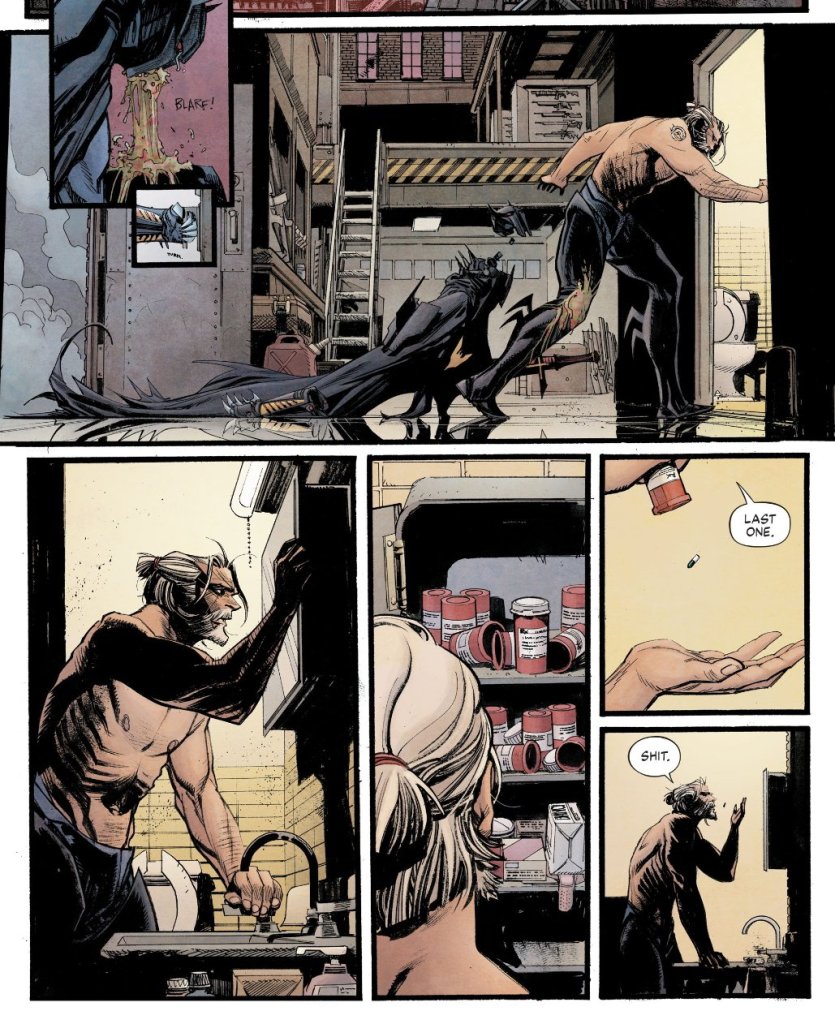
This is contrasted by the next few set of panels where he’s puking out of his mask after escaping from the GTO (Gotham Task Oppression Unit). This version of Azrael has been diagnosed with terminal cancer and as such needs medicine to live and suppress the symptoms. With little dialogue and some telling panels, we see that Azrael has empty bottle after empty bottle of pills in his cabinet. He’s starting to look a bit more gaunt than the first time we saw him. He’s withering away slowly and only has one more pill to spar for his coming battle with Batman.

I love the details that Murphy and Hollingworth add here. There’s blood in his vomit and it maintains after he pukes on his leg. His ribs are starting to show and we’ve seen just how jacked he was in the issues prior. His hair doesn’t appear as long as it did, even pulled into a bun/ponytail and there’s just something so final about the “shit” he gives after finding out that he only has one more pill left. In that singular moment, his mistakes come back to haunt him after killing his, admittedly, treacherous employer.

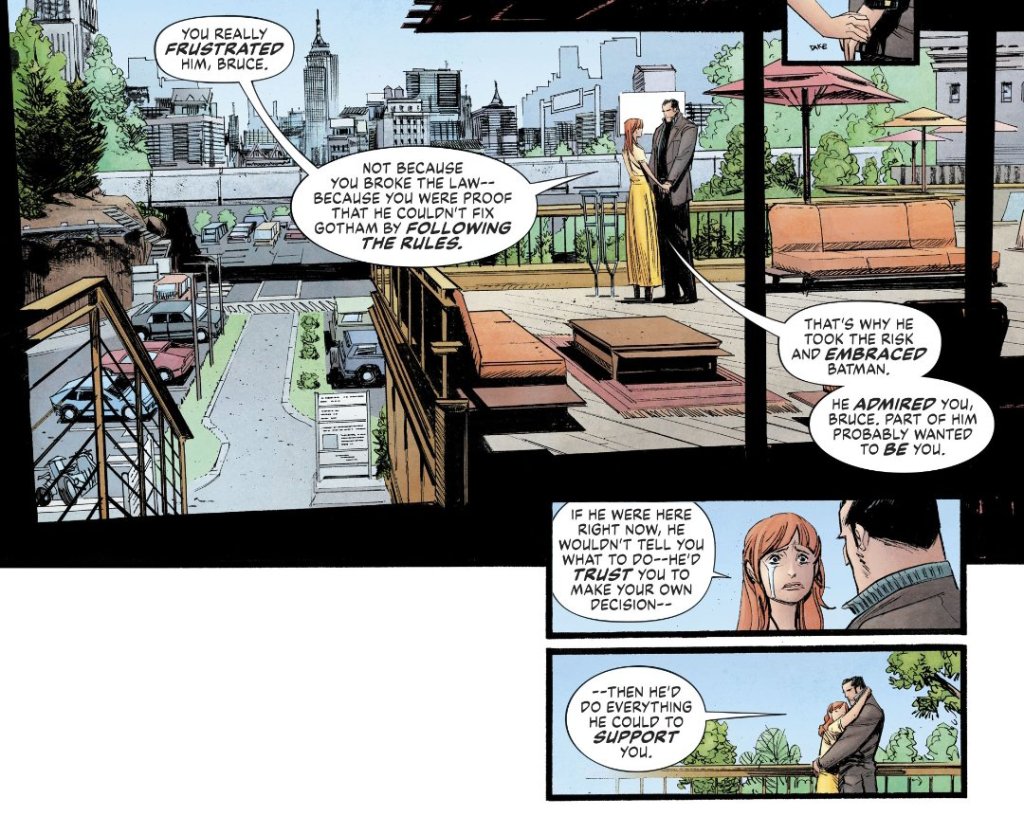
Soon after, Bruce makes amends to Barbara Gordon after inadvertently causing the accident that almost saw her completely lose use of her legs and effectively getting her dad killed. Barbara has always been resilient and we all feared that that issue #5 would be yet another Killing Joke, but here she is, using crutches to try walking again. The scene takes place during the bright Gotham day and this signals a brighter future for their relationship.

Bruce had always gone to Jim Gordon for advice on what route he should take, but without him, Bruce is missing one of his moral compasses. Barbara is the next best person because she has always been smarter than her father and Bruce has a ton of guilt to get off of his chest and Barbara handles everything like the mature adult that she is. She doesn’t blame Bruce for what happened, even though she said horrid things in anger, but can anyone blame her? She cries at the mention of her father and embraces Bruce, encouraging whatever his decision may be.

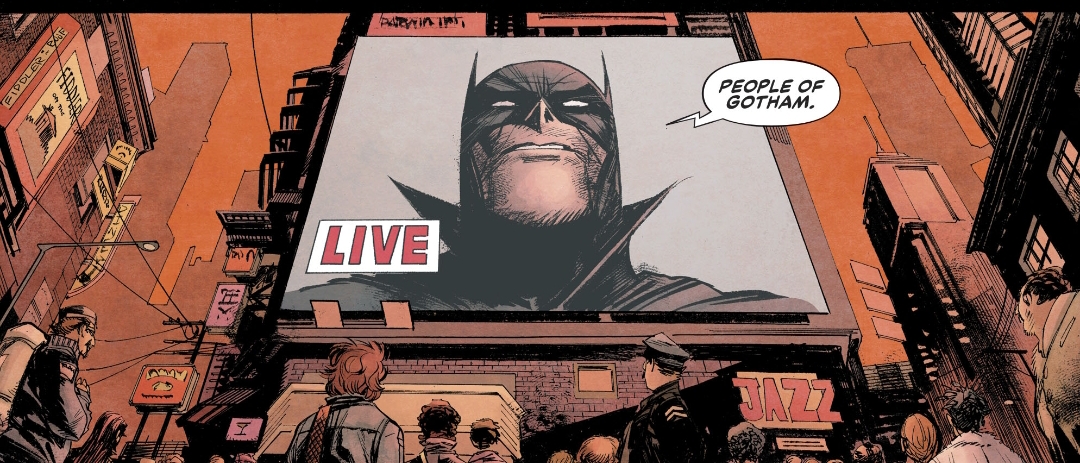
Of course, with this being the penultimate issue in this particular storyline, it only makes sense that we see a grand revelation come out of it. Murphy and Hollingsworth set the stage with Hollingsworth coloring the afternoon skies of Gotham with an orange-red kind of hue. We see various shots of different places in Gotham from public libraries to the streets themselves as Batman appears on the giant monitor of Gotham Square. Everything feels hot and sort of uncomfortable.

Bruce gives his appreciation and thanks to the people of Gotham for allowing him to serve as their protector and we continue to get these various shots of people. There’s auto mechanics watching the broadcast in their shop, people in a bar and kids watching on a cell phone with their dog. Murphy uses this to illustrate that Gotham is far larger than we think it is and that there are many people that Batman has saved from every corner of his beloved city, but he hasn’t done enough yet. So what’s the final step?

Batman reveals himself to be Bruce Wayne and dismantles WayneCorp.

Bruce finally becomes the knight that Gotham needs by giving back to the people. By destroying his company, he gives back to the people of Gotham by giving all of his money to nonprofits, schools, homeless shelters etc. It’s everything that Batman detractors have been saying Bruce should have done for ages. In doing so, he offers Gotham a better future than he could have as Batman, but he only asks them to stay off the streets of Gotham for one night while he takes care of the Azrael business. Murphy shows Bruce holding his cowl one last time, standing tall by his heroic decision.

Back at the GCPD, he gets lambasted by Commissioner Montoya for going off and doing his own thing again, but counters by saying that he trusts in the people of Gotham and they all formulate their battle plans. It’ll be his last time taking the reigns before he turns himself in as well, so he might as well make sure that everything goes according to plan.

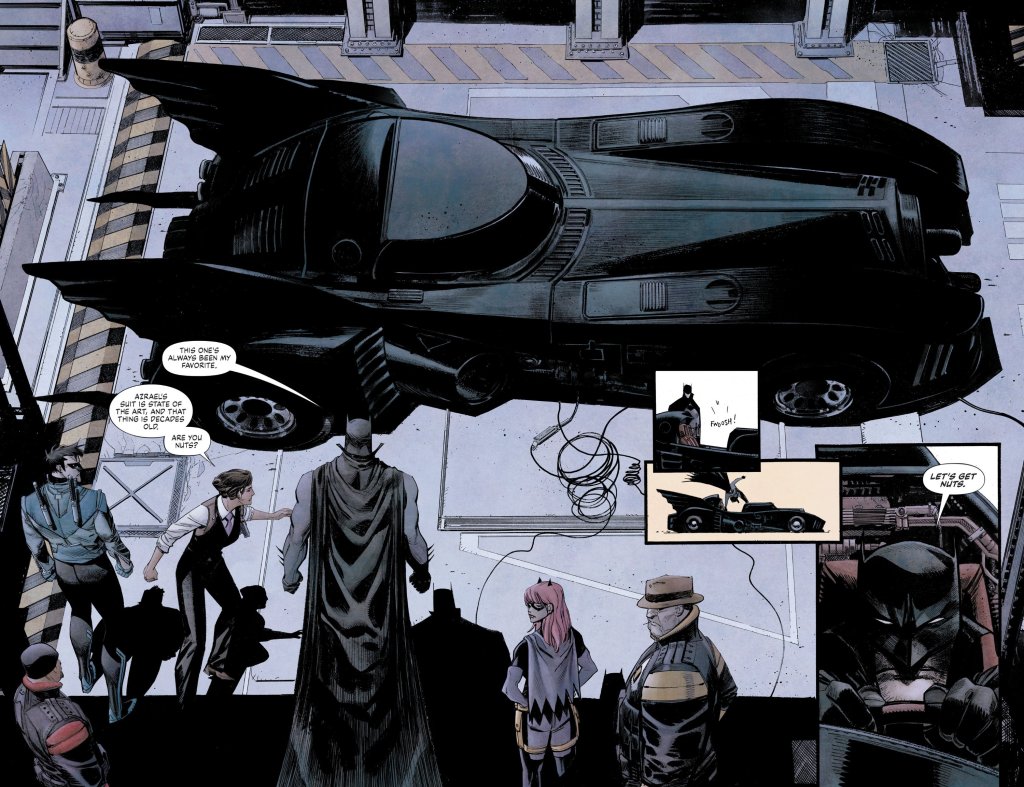
As Montoya tells Batman that Azrael destroyed most of the other Batmobiles in his assault on bruce in Book Four (I think), she reveals that one survived and I see that Sean Murphy is a Batfan after my own heart. The Batmobile that survives is the badass one from the Animated Series, what this book is supposed to be the “sequel” to. It’s sleek and well designed thanks to Murphy’s own love of cars. From the presentation, readers can tell that this is one of the pages he took serious time with as the Batmobile is given so much respect.

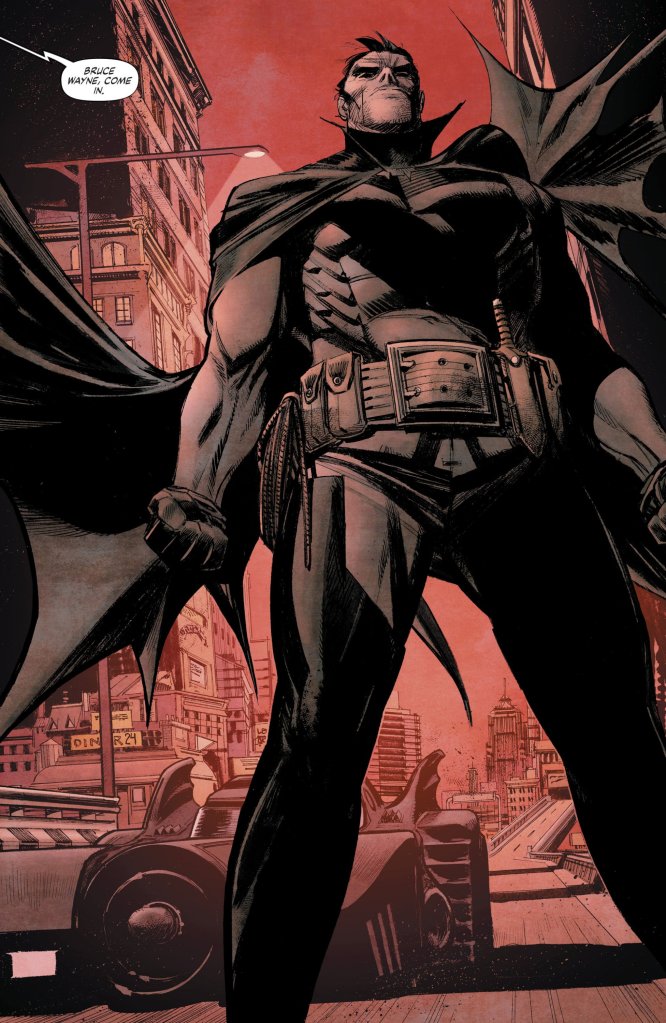
After a short conversation with Dick about what Bruce is going to do when he catches Azrael, Batman drives away, leaving his sidekicks concerned about his state of mind and we get one last splash page of Batman standing in the middle of Gotham Square without his cowl and the sky is a blood red. The Batmobile looks sexy in the background and this was all just so amazing.

Sean Murphy is a comic book treasure. His art and his writing truly made this an experience and a Batman story worth standing the test of time. It had the action, the drama, the stylish sequences and several twists and turns that make a story great. He’s made Batman his own in a grungy style much like how Scott Snyder and Greg Capullo have in a heavy metal manner. Murphy’s Gotham is a masterpiece in crustpunk with social problems that Batman’s always had in the periphery of his character and every issue has been better than the last.

Matt Hollingsworth brings it to life with his perfect colors; Whether they’re making use of the blues of Gotham’s clear skies or the light purples of the night sky, Hollingworth makes Gotham look distinct no matter the time of day. Scenes are given hues to match the tone of the pages whether they’re full of intense anger or incredible sadness, Matt Hollingsworth sets the mood no matter what.

I really enjoyed this series, but I can’t wait for the next and final issue of it just to see that confrontation between Batman and Azrael. It’s been a long time coming and the fallout from Bruce’s decision as well… it’ll be too much, but yeah High recommend!

Best of DC: Week of March 4th, 2020

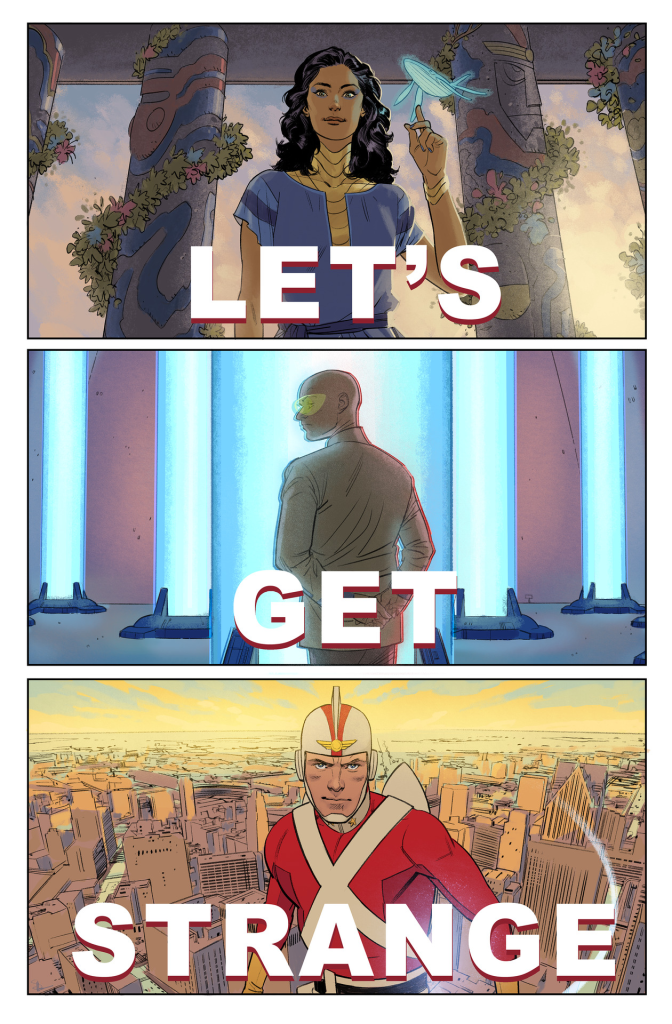
Best of this Week: Strange Adventures #1 – Tom King, Mitch Gerads, Evan “Doc” Shaner and Clayton Cowles

This is the Tom King I love.

The first book I read by Tom King was the awesome Grayson (2014) series post Forever Evil (2013) after Dick Grayson was “killed” by the Crime Syndicate. That book had a levity and coolness that no other book was really exhibiting at the time and King was kinda on my radar. Soon after, I’d heard that he was writing a solo Vision book and I was skeptical, but after a few issues I was sold and absorbed everything Tom King had written up to that point.

From Sheriff of Babylon to Mister Miracle, I was fully on board up until Batman got long in the tooth and Heroes in Crisis became a disaster. I have slung my fair share of mud, but Strange Adventures is an awesome return to form that blends the two amazing styles of Evan Shaner and King’s longtime collaborator Mitch Gerads. This book forms a tale of heroism and then overshadows it with horrific implications.

Adam Strange has always had something of a STRANGE presence within the DC Universe, mostly having stories in anthology books like Mystery in Space, miniseries or being part of various teams, he’s never quite been consistent. Adam Strange is a product of the sci-fi boom of the 50s and 60s, an archaeologist from the planet Earth whisked off to protect the spaceways and his beloved second home of Rann with his lover, Alanna. He’s always been kinda silly.

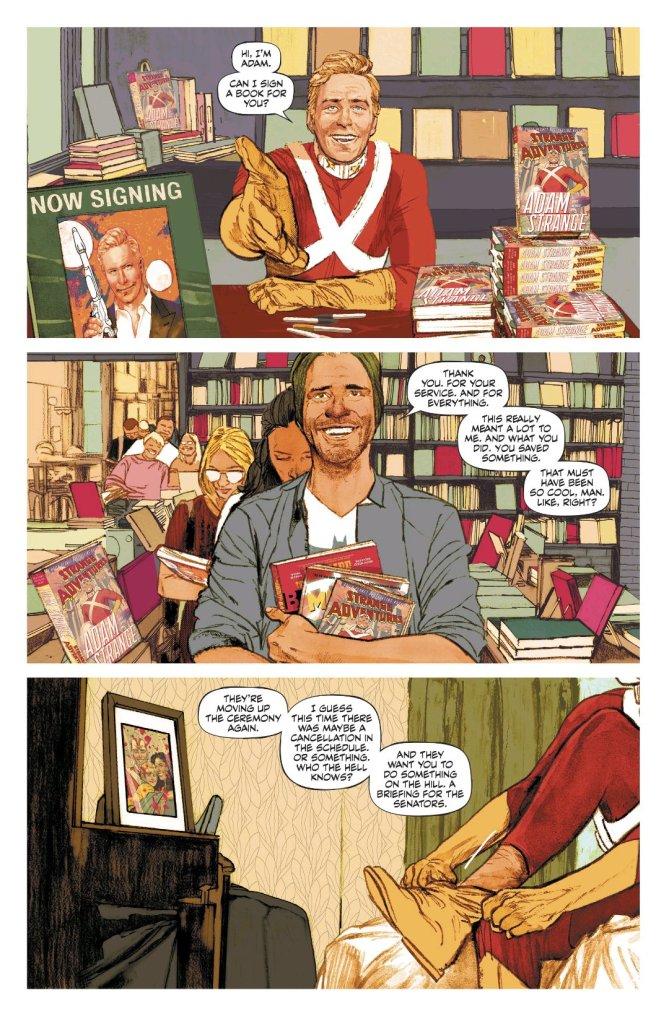
Tom King takes this silliness and turns Adam’s story on its head as we open to Strange doing a book signing of his memoir, Strange Adventures. At some point, he seems to have sold the story of whatever he did during some terrible war on Rann (that will definitely be expanded on later) and his name is on the lips of every American citizen, talk show host and politician as he and Alanna bask in their newfound fame.

In just the first few pages, Gerads and Shaner illustrate what kind of contrast we’ll be seeing throughout this series. During Gerads’ scenes, Adam is doing normal things, signing books, accepting awards, doing press and lying in bed (in more ways than one). King scripts the dialogue as being pretty casual in these scenes, the way that people talk when they’re alone or have a spotlight shone on them. Colors are striking, but the scenes aren’t dynamic, more somber with specific focuses.

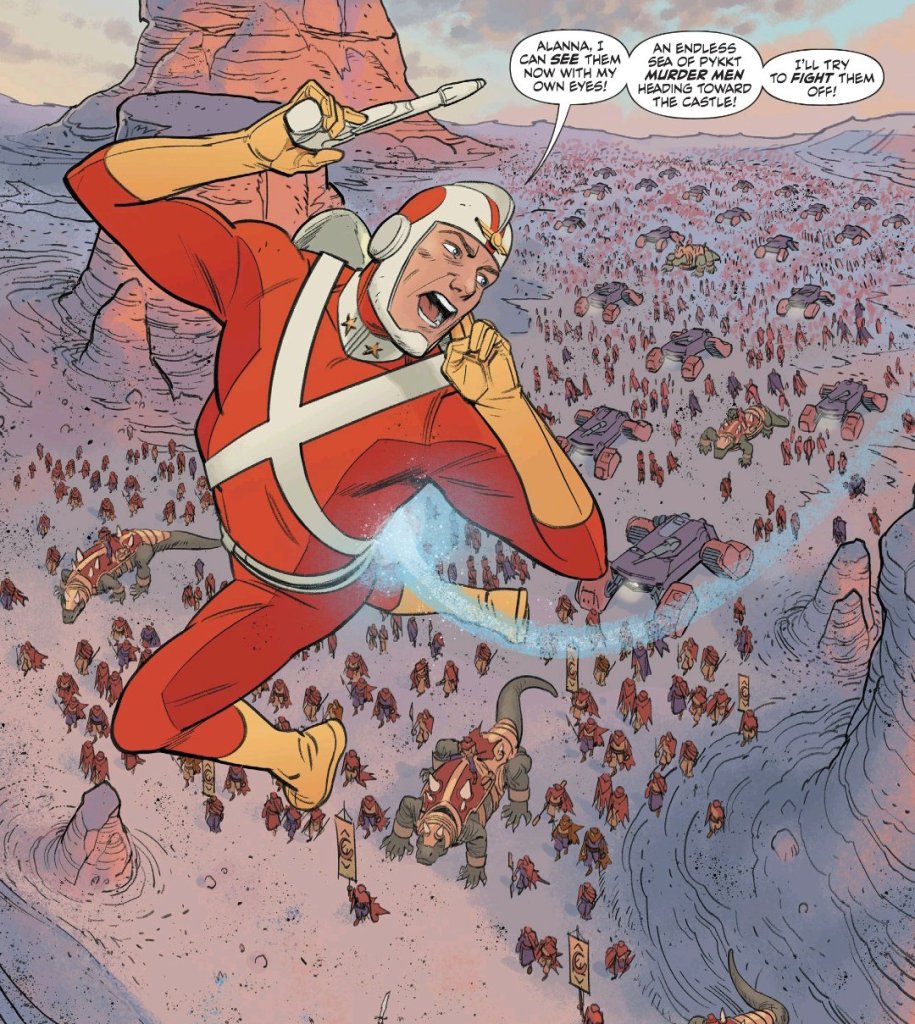
Shaner, on the other hand, get’s splash pages of Adam flying through the skies and facing down hordes of his enemies with heroic poses, laser gun fire and explosions. It looks like a high action, pulp comic or Saturday morning cartoon and the dialogue is comparably cheesy. These scenes are meant to paint Strange as the persevering hero as he has to face down insurmountable odds and get by by the skin of his teeth and his very handsome smile. Almost immediately, there’s a pit made in the stomach because it’s almost too unbelievable.

The closest real life comparison I’m willing to draw, before the next few issues come out, would have to be that of “American Sniper” Chris Kyle. A few years after leaving the Navy, Chris Kyle published the book which detailed his time during the Iraq War and a lot of the media painted him as a hero for his actions. The book sold gangbusters. He went on to the big talk shows, did the magazine interviews, he even got a great movie made by Clint Eastwood and Bradley Cooper, but it didn’t come without controversy

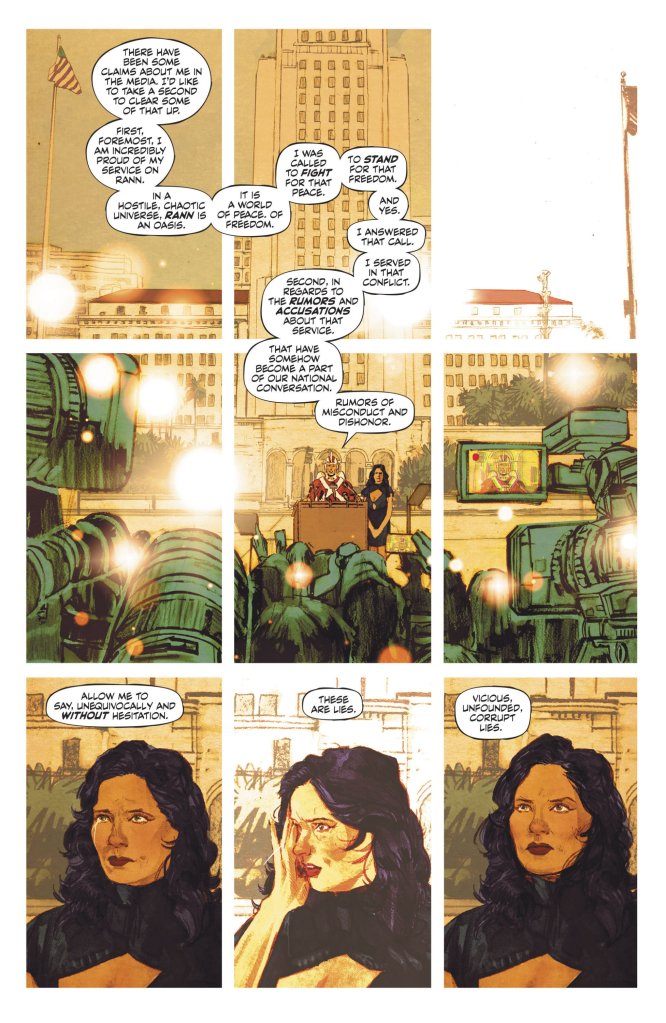
Tom King seems to be channeling a little bit of that for Adam Strange and it works to great effect as in one scene, a pair of talk show hosts laud Strange as a hero before their interview. Gerads gives the scene a television like static as if we’re looking at it all like the rest of America. In the background we can get excited too as Adam emerges from the crowd with his jetpack and makes a grand entrance.

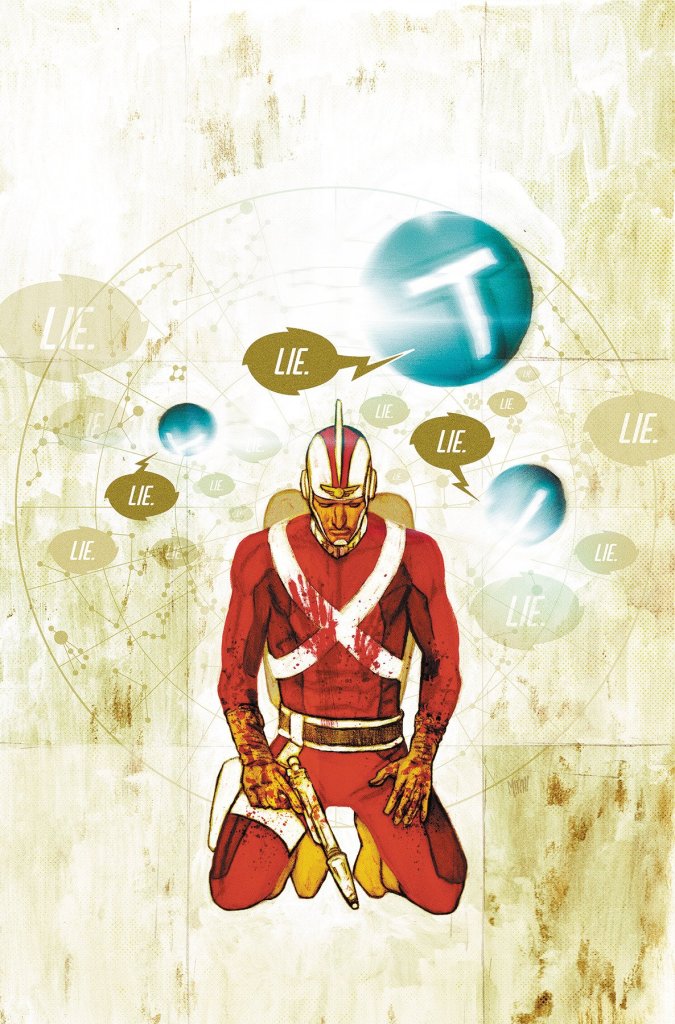
However, not everything is smiles and praising as, after a fan carrying volumes of Sheriff of Babylon and Mister Miracle thanks Adam for his service, we see a panel of Adam taking off his boots in the foreground while the focus is on a bloody picture frame in the background. The picture depicts Adam, Alanna and their daughter Aleena, who is conspicuously absent from the present day scenes. The blood on the picture speaks volumes more than could be said in these initial pages.

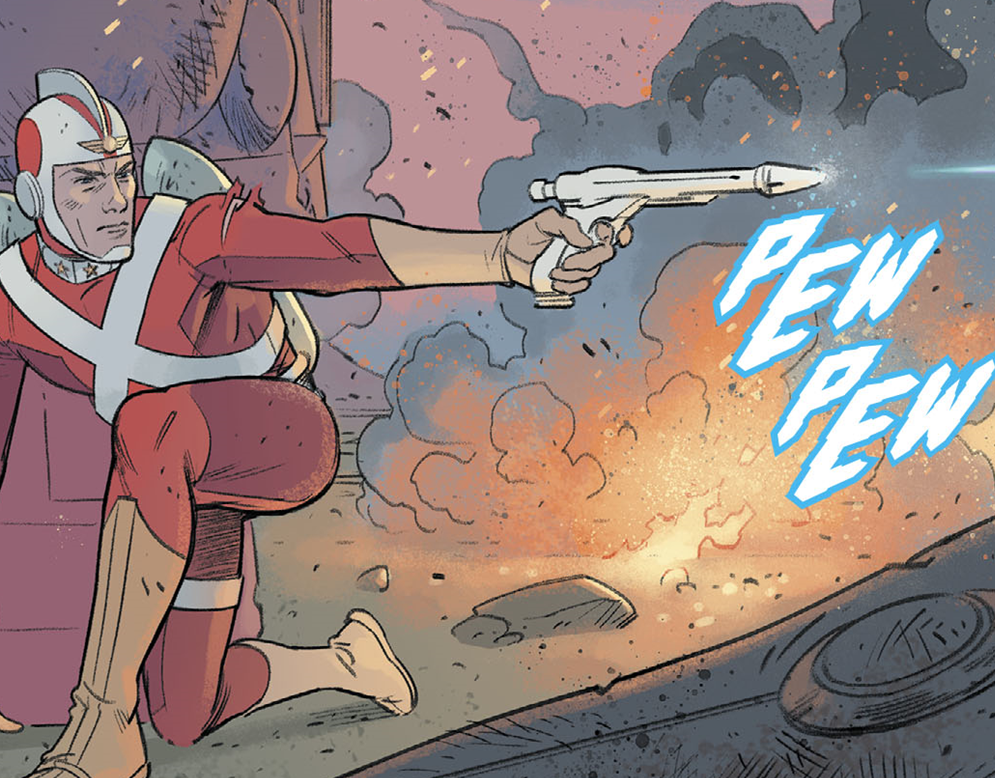
After another man screams at Strange, calling his depiction of events a lie, the pit in the stomach grows deeper as the first seeds of doubt are sown. Things are made even worse as we get a scene soon after with Shaner’s stellar art. The earlier scene made use of Cowles perfect letters with “BOOOOOOMs” and “PEW PEWs” to sell the sci-fi aspect of it and takes it to a higher level with even better balloons that placed comical emphasis on the more outworldly elements of Strange’s origins like Zeta Beam and Protector of Rann.

This comical heroism is emphasized as Adam screams about protecting his family while firing lasers at a mech created by Rann’s enemy, the Pykkts. Shaner draws Adam as being miniscule by comparison, but also nimble enough to dodge it’s blasts and taking it down with a few shots from his laser pistol. As he raises his hand in victory, one can’t help but wonder…was the event true? 

The same can be said when Shaner draws Adam zipping past a giant lizard creature, flossing his teeth as he goes in and out of his mouth like a real action hero. Adam Strange has always been capable, but this has an air of embellishment to it. Things get even worse for Adam as the man who screamed at him is found dead with what appears to be an exploded head due to laser gun fire. It’s an absolutely horrific scene that only Gerads could pull off.

We get a number of awesome pages of both Adam and Alanna doing damage control. The symbolism of Adam’s jetpack being a focus with a reflection of both Alanna and the picture is powerful as the implication seems to be that whatever happened to Aleena was somehow his fault, but Alanna still carries the scars of Rann, but doesn’t blame him. During a press conference, we see Alanna crying before wiping away her tears as Adam denies killing the man.

Where King scripted and overused the nine panel grid in Heroes in Crisis, he has Gerads use the format twice with powerful effect.

Something about Strange’s denial of war crimes on Rann feels off, much like how people called Chris Kyle a war criminal during the movie’s release, we get that same feeling here. There are almost always horrors in war and Strange has to have left out some of the worst details of things he’s done or seen, especially since this is a Tom King story and he doesn’t shy away from the morbid. 

As the pressure intensifies, Strange turns to Batman, the World’s Greatest Detective, as someone who can help clear his name. Adam is convinced that he didn’t commit the crime, nor anything else that he’s being accused of, but Batman refuses to accept the case. Batman cites their longtime friendship as a reason that he wouldn’t be able to stay impartial and that makes a lot of sense. You never want to show favoritism, especially when there’s a chance your buddy could be a murderer.

The book ends with another nine panel grid showing Adam flipping the bloody picture down, almost as if to avoid looking at his shame and guilt while he meets that man who’ll take his case. There will certainly be some “Fair Play” in his future.

This first issue of Strange Adventures was absolutely phenomenal. I think King does well with characters and stories like this. He did it with Mister Miracle and he did it with Kite Man in the pages of Batman. Adam Strange has always been that character who showed up in the background or the odd Hawkman story to show just how large the Universe was, but I’m glad he’s being given a focus like this. 

Of course, with Tom King, there’s always a worry that as the issues go on, things will start to go off the tracks, but I have hope. Even the worst issues of Mister Miracle or Omega Men were fantastic reads.

Evan Shaner and Mitch Gerads absolutely smashed it with their art. I love the idea of having two contrasting visions of one’s life with one bright and wondrous and the other real and dark. Separately, these two are phenomenal, together they are AMAZING. I would look forward to every issue of this series for their art alone, and with King’s scripts, this is just perfect.

This one gets a high recommend from me!

Best of DC: Week of February 5th, 2020

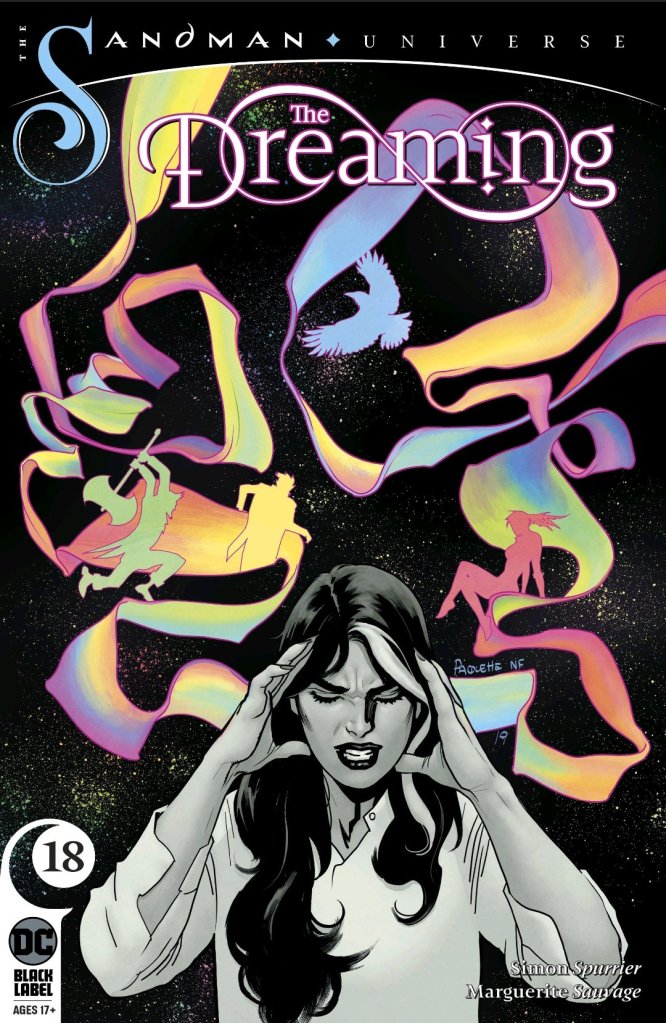
Best of this Week: The Dreaming #18 – Simon Spurrier, Marguerite Sauvage and Simon Bowland

Okay, hear me out – The Dreaming has been really good since the beginning and while not on the same level as Sandman itself, Si Spurrier has done a fantastic job of contributing to this world of the fantastic and absurd with his own brand of whimsy and abject horror. I haven’t found the time to cover any of the issue because, well, there’s always been something just a bit better on the same weeks that this series released and though the normal artist, Bilquis Evely, wasn’t on the art this month, Marguerite Sauvage stepped up and provided her always stunning style.

A short-ish recap for the uninitiated, The Dreaming is a realm where all of humanity’s minds go when they sleep. It was ruled by Dream of the Endless, a being of immense power over and creator of the realm before he was succeeded by a young man named Daniel Hall. Daniel becomes Dream for a time and even appeared in Scott Snyder and Greg Cappullo’s Dark Nights: Metal, but at some point, he left the Dreaming entirely. This caused things to spin out of control until the realm lands in the hands of Wan, a moth like boy with a dark side.

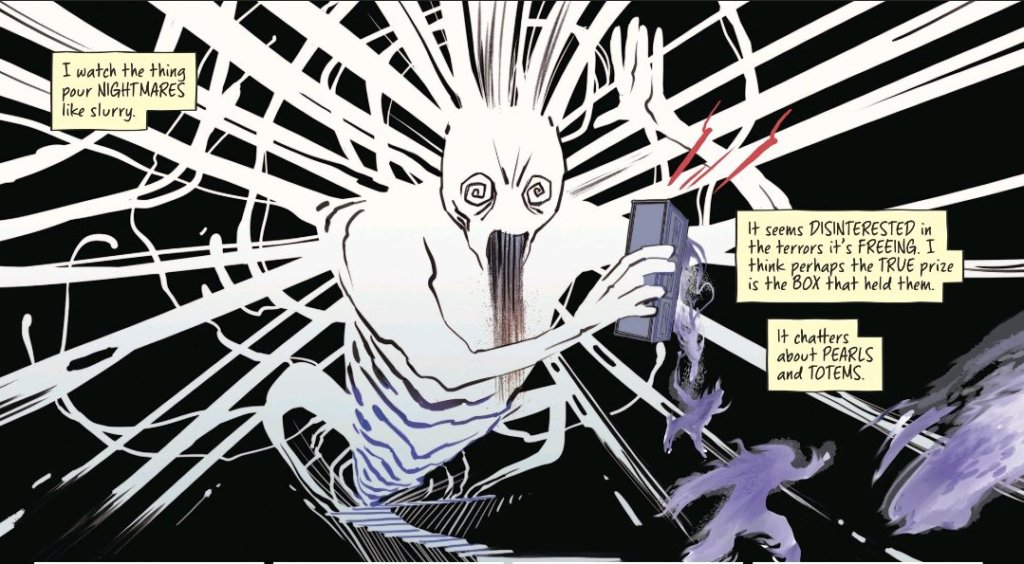
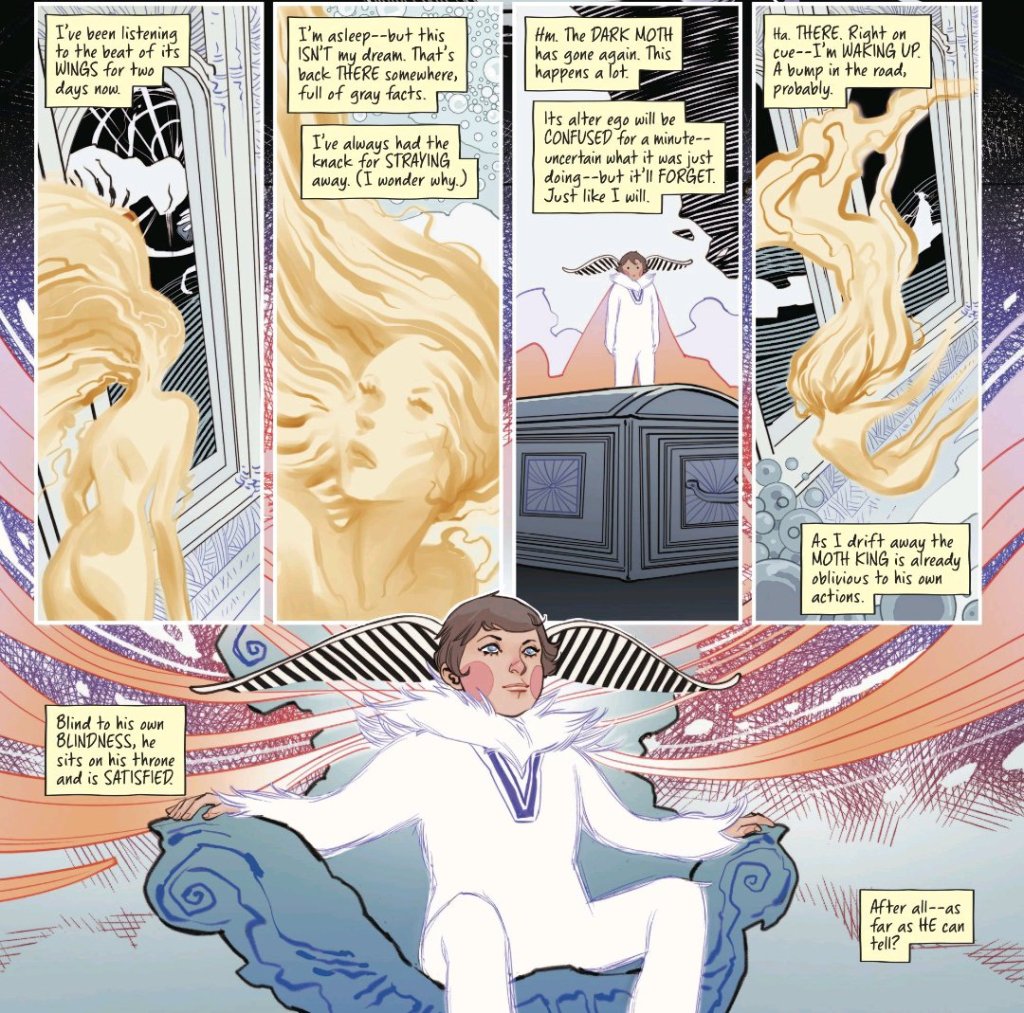
The book begins with a dream apparition of Rose Walker, a central character of the Sandman series, looking upon Wan’s Eldritch side as it releases nightmares into The Dreaming. She muses that she’s been watching him for some time now, acknowledging that when he returns to his cute moth form they both forget what had just occurred. Wan appears satisfied, thinking his rule over the Dreaming is making the world better as he’s been dispatching “blanks” into people’s dreams to make their whimsical dreams more logical instead. This has a profound effect on the world as it seems as though joy and color are lost.

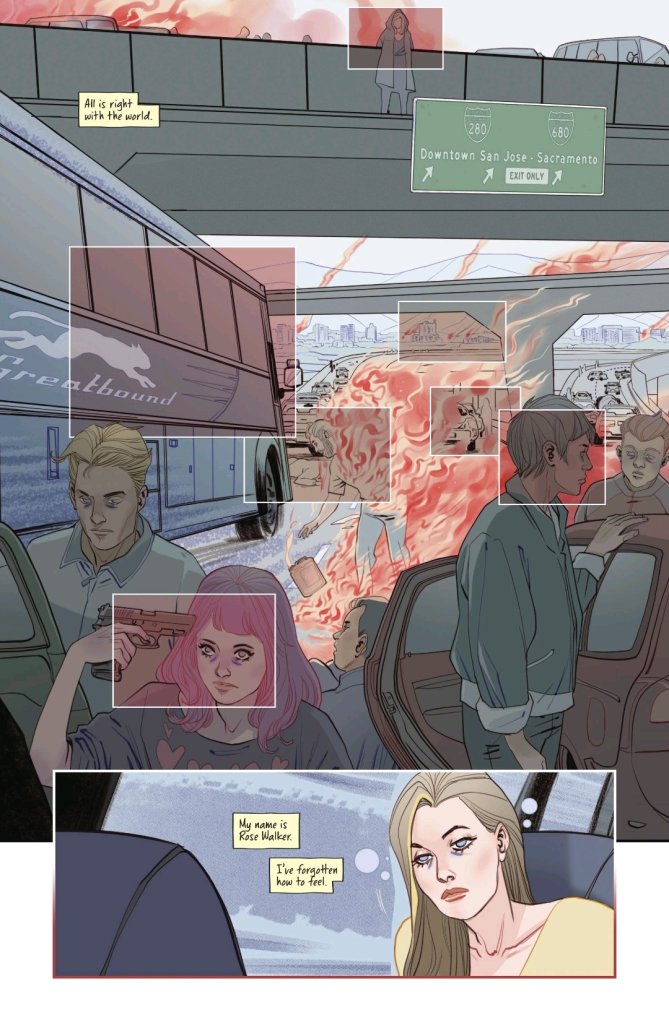
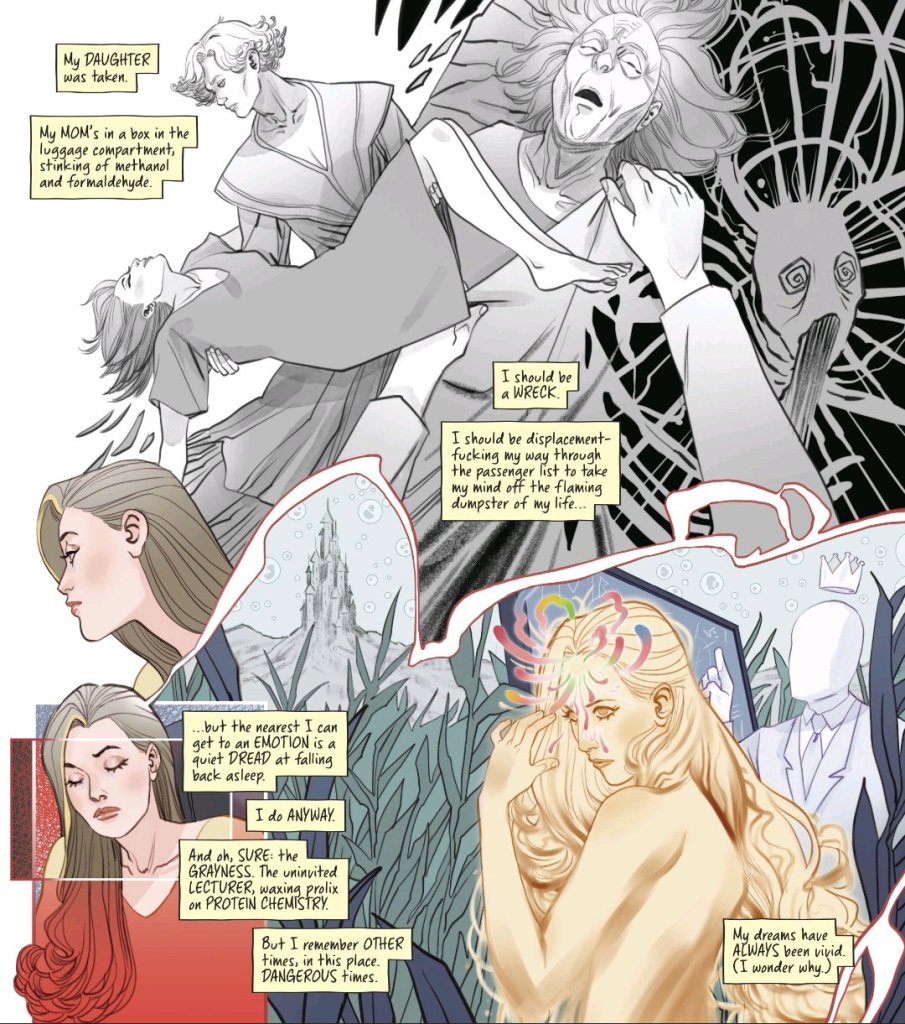
Sauvage stuns with her depiction of this joyless world as people just walk around with utter lethargy and casually kill themselves. It’s absolutely disturbing to watch as a woman prepares to drop herself from an overpass, seeing another calmly hold a gun to the side of her head and a man self immolating in the background. What makes all of this especially great, however, is Sauvage’s use of soft colors to almost make the despair and horror feel unimportant. Rose walker is the only one that stands out because of her bright yellow dress and normal looking skin.

Her internal monologue allows her to see that something’s amiss and that she should be a wreck after losing her mother and daughter over the course of her personal story, but she lacks sufficient motivation to pursue any action aside from sleeping, but then she recalls how vivid her dreams always were and Sauvage portrays this excellently as an unseen figure lights a cigarette for her and she drifts into a white space filled with beautiful wisps of smoke and color. In the dream, she hears something about a Vortex that will likely play a big role later in the series.

We then cut to Dora as she watches the transferred consciousness of Cain kill the man who initially caused Dora to fear her own existence, Keter. Dora is a Night Hag that had haunted Keter in his younger years, causing him to want to figure out the secrets of the Dreaming and ultimately how to destroy it. It’s implied (or plainly stated, I forget) that he created Wan and set him upon the Dreaming in Daniel’s absence. Unfortunately for Dora, with Keter’s death there is no one able to remember her story and she starts to fade away.

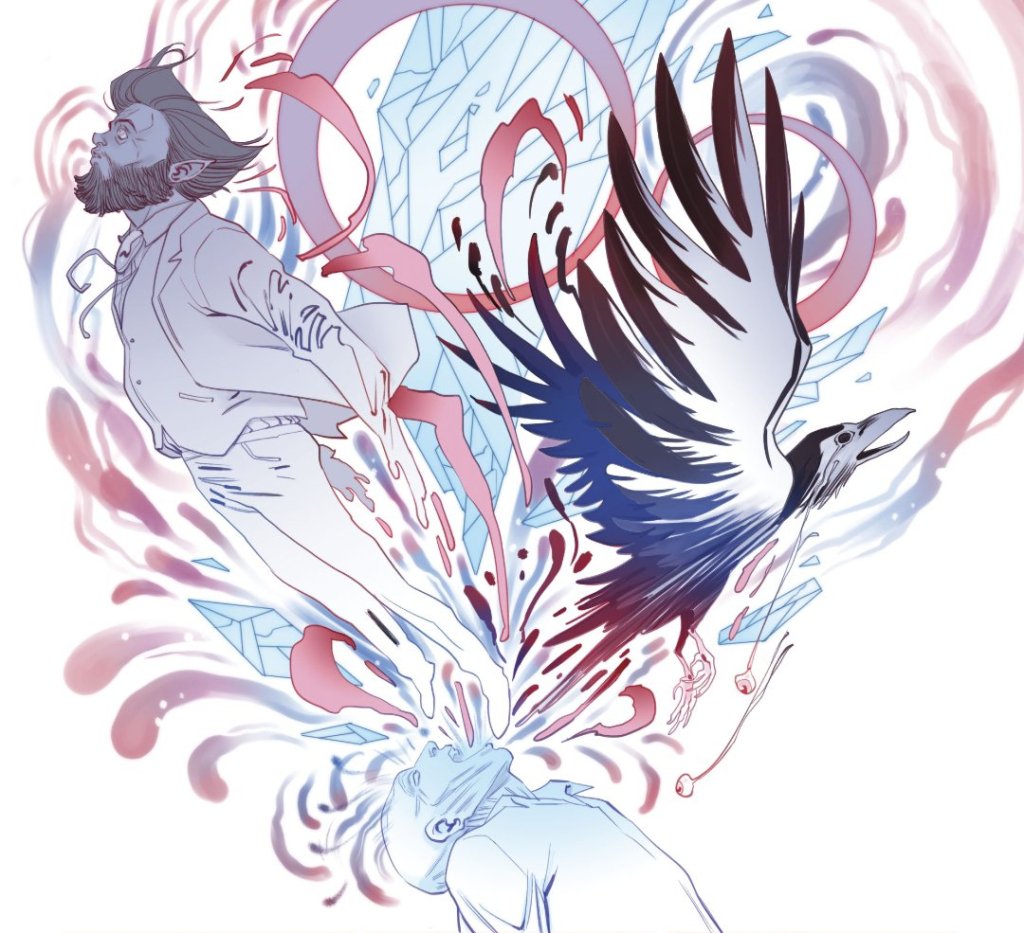
In contrast to the previous pages, Sauvage colors this scene with a deep, but not oppressive red as the facility responds to its creators impending death, giving things a sense of panic as Dora then looks puzzlingly at her translucent hands. Soon after, Keter’s body starts to convulse and a murky plume of light purple and pink pours from his mouth – the background and Keter’s body are white, with his outline and the monitor version of Cain being the only line art for this panel. Abel and Matthew (and others) then burst forth from Keter’s mouth as he finally dies.

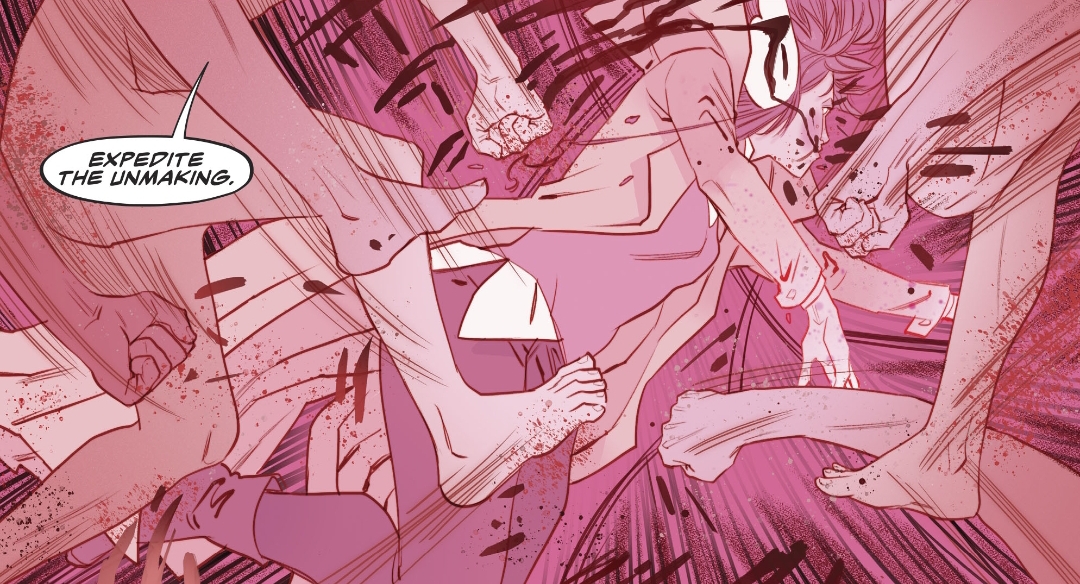
Matthew is one of the Ravens of the Dreaming and he acts as the eyes for the ruler of the Kingdom as they survey the dreams of men. Abel acts as something of an accountant of some kind, but he has been keenly aware of Wan’s other side and chose to escape the Dreaming with Matthew, but The Dark Moth sent blanks to follow them and one of those blanks just so happened to be Ziggy, Dora’s former blank companion. When Ziggy disregards his former identity, his other blanks begin to savagely beat Dora in a flood of oppressive pink colors.

Spurrier tells two tales that Sauvage portrays in nine striking and dynamic triangular panels. On the downward facing panels, Cain lambasts Abel for having the audacity to kill him, but Abel counters with the fact that Cain has killed him hundreds of thousands of times over the millenia they’ve been together. Cain looks on with rage and it only gets worse as he realizes that Abel is mostly right to call him a coward. At the same time, we continue to watch as the blanks continue to assault Dora. These panels are most uncomforting as she pleads for Ziggy to help.

Sauvage does an amazing job of showing Dora’s distress is pained and betrayed facial expressions as she bleeds and cries while a flurry of fists and feet meet her. She continues to fade and is soon dragged away by the other blanks before cut back to Rose Walker and her continued feeling of disillusionment before Spurrier reveals that the unseen figure that lit her cigarette might be the hand of her Grandmother, another being with a strong connection to the Dreaming. She manages to convince Rose to take the bus and find the color of the world again.

One subtle thing that I liked about this issue and the way Spurrier has been writing this series thus far, is the implication that things started to go horrendously wrong when Abel killed Cain and stopped stuttering as a result. Cain was always one of the smartest residents of the Dreaming and would have figured out Wan’s scheme even if Wan himself wasn’t aware of his other half, but Abel was far too nice to think about it like his brother. When Abel is finally reunited with his brother, he begins to stutter a lot more again, symbolizing a return to how things were.

In trying to convince his brother to return to the Dreaming, Abel does he one thing he needed to do make things right with Cain, he recreates his brothers murder by stabbing himself in the neck with a fork while Cain says that he will, but because he WANTS to, not because Abel asked (Cain is a tsundere confirmed).

While absolutely brutal and horrific, it’s touching at the same time because Abel does this out of love and sacrifice knowing that the world is doomed without his brother at his side. At the same time, this inspires Ziggy who goes against his order and tells the other blanks to stop the process of killing Dora because she made Ziggy who he was…

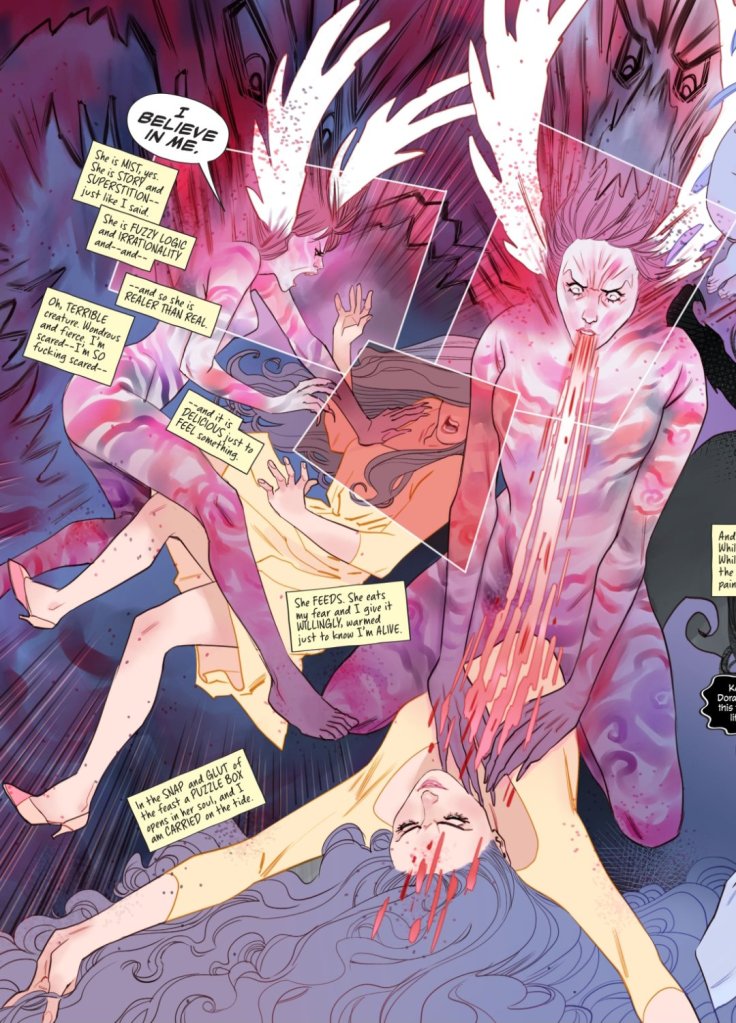
Unfortunately, his newfound sentience comes late as Dora is probably seconds from death and True Death by fading. Then suddenly a bus CRASHES through the walls and Rose emerges, feeling the dream energy drifting away from Dora. Sauvage draws their interaction together beautifully as Rose inches closer and closer to Dora, trying to feel something before whispering in her ear and bringing the Night Hag back to life.

The soft colors spring to life as Dora mounts Rose and begins to drain her fear, her ear wings turn a bright white and varied pink watercolors dance across her body as she reaffirms her belief in herself and Rose is in ecstasy of feeling again. We then learn something crucial about Dora and how all of this might have been by the original Dream’s design. At the end, not only is Dora restored, but the keeper of the Dream Library is as well.

The Dreaming is a weird story, but it always has been. One thing that I have loved about this story so far is that it doesn’t completely require you to have read all of Sandman to understand it, but it enriches the experience if you have. These characters are fully three dimensional with their own motivations, fears and thoughts that Si Spurrier has captured so well. I’m glad that he took on this story because it’s equal parts beautiful and dark like the Sandman Universe should be.

This is also in no small part thanks to how Marguerite Sauvage chose to draw, color and ink these beautiful scenes, characters and environments. Everywhere from the human world to the land of the dreaming was distinct and interesting because of backgrounds, color choice and intensity – even the use of white space was striking and amazing to look at.

I think the series is supposed to end at Issue 20, but it already feels too soon, like we need more. Of course there are the other Sandman books out like House of Secrets, Books of Magic, Lucifer and Hellblazer, but everything related to the Dreaming will always have a special place in my heart and I can absolutely say that I have enjoyed this ride thoroughly thus far. High recommend!

Best of DC: Week of November 20th, 2019

Best of this Week: The Question: The Deaths of Vic Sage #1 – Jeff Lemire, Denys Cowan, Bill Sienkiewicz, Chris Sotomayor and Willie Schubert

The Question is one of the best Objectivist heroes.

By extension, that also includes Rorschach since he’s a pastiche of good old Vic Sage himself and it’s easy to see why people gravitate towards them so much. The idea of Objectivism is… iffy to say the least, but being rational, utilizing one’s free will and choosing to act in one’s own self interest can be seen as good qualities, especially in the ways that Vic and Rorschach operate. They have good, unwavering moral compasses and do their best to persuade others to their reality.

But their strengths are also their greatest weaknesses.

When Steve Ditko created The Question back in the 60s, he was all into Ayn Rand’s philosophy and that carried over heavily into Vic Sage’s characterization which saw him use almost any means necessary to keep Hub City’s chaos at bay, even going so far as to let criminals live or die on their own merits if Sage left them in precarious situations (Once leaving a man in a sewer drain and calling the cops to either find him or his body.). He was not a good person, but he was what the city needed to survive, much like Rorschach who chose to die rather than live in Ozymandias’ world built on a lie.

This book continues to build off of that characterization while mixing in elements from Dennis O’Neil and Denys Cowan’s 1980s run with the character and brings in his cast of characters and modernizes Hub City’s issues, hopefully to the delight of those wanting to see a return of everyone’s favorite conspiracy theorist/detective/agent of justice. Honestly, it’s a damn good job.

The book begins with The Question savagely breaking up a prostitution ring operating out of the city. He smashes faces into walls, elbows a big guy in the face and when he runs out of people to hit, he turns to the Councilman of Hub City who just so happens to be one of the patrons of the seedy motel. In fear, the Councilman pleads with The Question to not kill him and he responds by pulling out a phone and recording as much as he can, he then elbows the Councilman in the head and steals his ring, hoping that it might help him with other cases. One of the prostitutes thanks The Question for his help, but he rebuffs her and essentially says that she has no future, but the innocent little girl does.

In just one scene we learn everything we need to know about this iteration of Vic Sage; while he’s not a murderer, it is implied that he may have killed before, but he also knows that getting evidence and ruining someone’s life with their evil deed is just as effective as a bullet. Though he saved the lives of the prostitute and the child with her, he insults her by calling her a whore, but insists that the little girl be given to the soon to arrive police. It’s another Randian idea that he doesn’t feel sorry for those that have “ruined” their lives in his eyes and he even notes this when he speaks about how Hub City itself is rotten and dying.

Soon after the bust, Vic Sage appears on his news channel and grills Myra Fermin, a character from the O’Neil and Cowan run, on the activities of her brother – incumbent Mayor Wesley Fermin. This is a bit of a change from the O’Neil run as Wesley was Myra’s husband in that series, but Lemire seems to be doing this in an effort to showcase some kind of family loyalty between the two. Sage accuses Wesley of being the man behind Hub City’s wave of crime, linking him to video evidence from an “anonymous source” of the Councilman in the brothel and this catches Myra off guard.

He then continues by saying that the Councilman’s arrest wasn’t mentioned in the police report, obviously showing that they’re corrupt as all hell and when the cameras are cut off, she lambasts him for ambushing her with his accusations and he says that she lacks spine and that the longer she chooses to ignore things, the more complicit she becomes. When the family lawyer comes to take her away from Sage’s “slanderous accusations” and threatens a lawsuit. Vic asks Myra what happened to her that she has to hide behind a lawyer and she replies by saying she grew up, labeling Vic’s objectivism as childish.

In some ways it’s easy to agree with her that the world isn’t necessarily black and white, but at the same time, it’s because of that that Vic’s able to operate in the way that he does. Of course, this doesn’t necessarily mean that either of them are right as Hub City is still suffering and neither of their actions seem to have changed much in that regard. It’s a sad reality that only Vic is able to see since it’s so plain in his face, but when his only solutions are to beat people up and occasionally have evidence that can easily be dismissed by bought off judges, it’s clear that cynicism would win out in the end.

Denys Cowan really does remind me of why the early Question series was so memorable as his style his only improved from the old days. His signature style of hatch shading, Sienkiewicz’s inks and Sotomayor’s colors really set the noir tone of the story. Though it takes place in the modern day, it looks like a 90s book set back in the 50s or 60s and I love that about this. Cowan manages to pull so much emotion out of a character whose most distinct feature is the fact that his mask has none. Vic Sage is angry, he’s tired of this shit and has been for a little while.

Sotomayor does an amazing job contrasting Sage’s double identities with The Question wearing his normal dark blue suit and orange undershirt and Vic Sage wearing a bright brown suit. This symbolizes the dual natures of the man himself, with one operating in the dark and other in the light. This is brought up when Vic goes to speak to his former Chemistry teacher, Tot. Tot is one of the few people that knows Vic is The Question and as they discuss Hub City’s need for Vic Sage more than The Question right now.

Cowan’s art is absolutely beautiful in these scenes. As I will continually state, everything feels very noir-inspired, grimy and dak. Chris Sotomayor is able to beautifully use all of his colors to illustrate the gravity of the situation and show how easily Vic is able to move between his two personas. Using the compound that affixes the featureless mask to his face, a puff of smoke is created and that allows for Sotomayor to transition the blue into brown and vice versa through the scene. It’s amazing to look at when combined with Sienkiewicz dark inks. What’s even better is that the smoke almost forms a question mark in some thematic fun.

Vic says that The Question can do things that Vic Sage can’t and it’s debatable as to whether or not that’s always going to be a good thing. Throughout this scene they also discuss the ring that Vic took from the Councilman and how he seems to have some sort of odd memory or attraction to the symbol on it. While we’re left in the dark initially, I have some speculation as to what it could possibly be and how it may tie in to another incarnation of The Question or if it’s just something completely new and interesting. Sage is convinced that Fermin is involved with it somehow and the conspiracy begins as he notes that Fermin’s lawyer had a similar ring.

When Vic gets back to his office, he starts obsessively drawing the symbol almost from memory and then he questions how he can Google search it…then he does just that, commenting on how the internet has taken the fun out of detective work. It’s a funny crack, especially as he finds information that he absolutely needed and starts building a board for every piece he has, focusing on an old society that used to call Hub City home.

One of the best bits of the book have to be The Questions inner monologue throughout each page. He details, moment by moment, his actions and the actions of two other occurrences at the same time. It feels very Ditko-esque with just a little bit of Rorschach omnipresence thrown in there for good measure, though Sage mentions how he was actually oblivious to the other two events. Likely meaning that he’s writing a journal of the important things shortly after everything’s gone down.

As he enters the former home of the Hub City Elder Society, Myra accidentally walks in on her brother in the middle of putting the screws to the Councilman and in another part of the city a white police officer shoots an unarmed black man. We don’t get to see much more of the other events as the book then mostly spirals into a nightmare for Vic.

Cowan’s art takes a dark turn as The Question walks through the dark tunnel, discovering the symbol on the wall and starting to see horrific visions. Eventually, he stumbles upon the bodies of the Elder Society and a dark hole in the middle of the cave. Cowan and Sienkiewicz turn this into a horror show as the skeletons are strewn across the cave and The Questions visibly hit with fear, wondering if he should let his identity slip away and let the darkness tell him his real name. 

Sienkiewicz earns his money through his dark inks in these pages and the few panels he’s given to illustrate nightmares on the level that he did with The New Mutants. The lines are scratchy, dark, sometimes incomprehensible and I absolutely loved them. At one point we get a close up on The Question’s blank face as done by Coan and the following panel is one of those nightmares – a jagged, green face begging “Charlie Victor Szasz” for help. The panel that follows sees The Question jolt back, his body language being the only thing that betrays his blank face as we can clearly see how afraid he is.

He runs out of the tunnel monologuing about how fear pushes one aa from the truth and how he only knew fear, especially after having found a blank face mask similar to his own in the cave, only… it was far older than he. Tot calls him soon after and tells him that he’s been trying to reach him for three hours, much to Vic’s surprise. The city is in chaos after the shooting death of David Fuller, the black man mentioned earlier, and there are riots in the streets. Vic’s talk show would have been airing during the time The Question was in the tunnel and the City NEEDED his commentary, but whatever’s going on with the Elder Society and the mask demanded his attention more.

It’s astounding just how bad Hub City was able to get in a few short hours as Cowan portrays the riot as deafening and violent with Vic standing on one side of the street with no violence and the other side being a madhouse with car windows being smashed, bricks being thrown and molotovs flying in the background. At the same time, Myra wasn’t supposed to see what her brother was doing and unfortunately, she picked the wrong time to attain a moral high ground to things. Wesley has her detained in the room to decide which side she’s on, especially knowing that she’s turned a blind eye to her activities in the past.

Vic goes to visit his friend Richard Dragon, the man who taught him how to fight. While he drives, he listens to Wesley Fermin’s statement on the shooting and Fermin tries to deflect any blame from the Officer in question even though there is clear video evidence, he calls it “supposed video evidence.” He comments on the Officer’s history on the HCPD and says it’s too early to lay blame on anyone, claiming that the officer had just cause to “defend” himself. The riots only get more heated.

Vic and Dragon’s prior history is acknowledged, even Vic’s time as a man of Zen is brought up before we learn that he dismissed the “new-age bullshit” in favor of just hitting people. Dragon pours him a cup of tea and Vic tries to seek answers about things he’s seeing, calling them more than visions – memories maybe. Vic notes that all of this has an occult “mumbo-jumbo” feel to it and says he doesn’t believe in superstitious nonsense to which Dragon replies that he must feel the same way about metempsychosis. Before Sage is able to question him about what that means, he feels the effects of whatever drug Dragon put in his drink and he’s sent into a colorful rainbow of a dreamscape, waking up in the past without his face.

I love the fact that Denys Cowan returned to a character that he really helped popularize back when he was first being showcased at DC Comics and Bill Sienkiewicz does an amazing job with the inks in this issue, really helping set the grimy tone. Chris Sotomayor knocked it out of the park with his coloring to give this book life. Of course, the book wouldn’t have been nearly as good if not for Willie Schubert’s expert lettering as well.

This book was an amazingly fun and dark read that really returned The Question back to… at least his 80s roots while still acknowledging the characters past and potentially some of the unexplored parts of his New 52 self. Jeff Lemire does a good job of reintroducing Vic Sage as a nightly news host as well as his supporting cast from Tot to Myra and Richard Dragon. He’s still a good detective and conspiracy theorist, only this time, he’s going to have to go to places that he normally wouldn’t.

As it tends to happen, I’m sure that Book Two will be the absolute best issue of the series and will give us some insight over the many times The Question has lived or died and that’s a mystery that I’m sure Vic Sage would love to solve and find a rational answer for. I honestly also hope that we get some clarity on the other reboots and retcons that he’s endured over time as that seems to be one of the main themes of the book. Vic Sage isn’t enough, so the Question is the other half, but if the Question is no one, then who is he?

Best of DC: Week of October 23rd, 2019

Best of this Week: Batman: Curse of the White Knight #4 – Sean Murphy, Matt Hollingsworth and AndWorld Design

A Darkness has fallen over Gotham. 

Jim Gordon has always been one of the most trustworthy police officers in the cesspool known as Gotham City. Under his tenure as Commissioner, he cleaned up Gotham PD as much as he possibly could, brought up great officers like Harvey Bullock and Renee Montoya and even formed a long lasting partnership with Gotham’s protector, Batman. His role gained him allies and enemies alike and he put his life on the line every day he out a badge on.

Unfortunately for him, his number came in the last issue when Azrael impaled him with his sword, leaving him for dead in an alley for Batman and the Gotham PD to see. This issue follows what happens immediately after.

Gordon is rushed to the hospital and the doctors do their very best to keep him alive. The shots are tense and heartbreaking as we get no dialogue except for the words of the flashback that occurs simultaneously. Barbara is frantic, pushing through Renee and Harvey Bullock. We don’t hear what she’s saying, but her pain is palpable. She doesn’t have the cool calmness she maintained as Batgirl, she’s just a girl terrified of losing her father.

As the doctors use their defibrillators, Gordon flat lines and Barbara doesn’t even acknowledge Batman as she runs into the night, tears in her eyes. Interspersed between the operation are panels showing a flashback between Barbara and Jim. It acts a bit of foreshadowing as Jim tells Barbara to fight back and hit harder after she tells him that a boy bullied her at school. These two scenes play out in perfect opposition to each other.

Murphy is really good at Panel to Panel storytelling and conveys the happiness and absolute destruction with little dialogue, body language and facial expressions. He wants you to feel the despair that Barbara feels. Pulling in close to Gordon’s short breaths as she bangs on the window in the background as he kisses her little forehead in the next panel, it’s almost too much.

Hollingsworth colors the operation scenes with cool colors, making everything seem sterile aside from the blood on Gordon’s chest. It’s bleak and lacks the warmness of the muted pink/purple hue of the flashback. Murphy also does his best to depict how much Jim meant to Barbara by showing her childhood innocence and happiness opposite the fear that she faces as an adult. Barbara is absolutely devastated by what happens to her father and later on, it will drive to her make a reckless decision that will change her life forever.

Tensions are high when the Gotham Terrorism Oppression (GTO) unit meets in the aftermath of Gordon’s death. Barbara blames Batman and calls him a coward for operating in the shadows while her father stood at the forefront. Dick Grayson wants to console her, but Renee tells him to stay focused and when he tries to question her authority, she snaps that Jim put her in charge before his death.

Bruce leaves in the middle of the GTO’s planning, frustrating Renee as she gets a taste of what Gordon dealt with for years. He goes to visit Leslie Thompkins who’s taking care of Harleen Quinzel after she’s given birth to twins. They converse and Leslie reveals to Bruce that she and Alfred had known about the journal of Edmond Wayne.

What’s interesting about this section is the manner in which they retrieved it. Shortly after Bruce had put on the cowl, Alfred and Leslie found a letter addressed to Bruce and Batman, telling them to go to the oldest part of Gotham. The scene is drawn and colored in a style reminiscent of what I think of when I hear Victorian Era England. There’s a lot of smoke, greys, muted colors and vibrant yellows from lamps and fire. The building they enter is very old timey and they meet someone surprising upon their arrival.

While his name is never stated, I believe the Librarian of the New Order of St. Dumas to be Jason Blood. He maintains Blood’s red hair with a white streak and his brazenness when speaking to Alfred and Leslie and his lack of care when Alfred  levels a rapier to his throat is characteristic of a man that has lived for centuries and the knowledge he has attained up that point. He tells Alfred to give the journal to Bruce when he thinks the boy is read and then he just suddenly disappears. Alfred and Leslie have been guarding the secret ever since.

While all of this is going on, Barbara tries to find anything she can about the man who killed her father. Dick tries to talk to her, flipping their roles from the first White Knight series. Dick was angry the entirety of that series, blaming Bruce for the destruction of Gotham City, but now Barbara sees what he was talking about back then. Murphy makes the decision to not have Barbara don her mask, but still wear the ears, signaling that she can no longer hide behind her mask while Dick still wears his.

Page from Batman: White Knight #6

She’s rapidly removing herself from the world of capes and cowls, saying it’s not working, while Dick reminds her that she chose this life, same as him. She gets a hit on the vehicle Azrael used and sets off after him. She removes the bat ears, heads to the armory, grabs a gun and almost takes a tumbler before Harvey Bullock meets her there. Their relationship doesn’t need too many words as both of them want revenge, not justice. 

It’s wonderful to see because there’s no pretense between them. Harvey wasn’t exactly the best policeman before he was under Gordon, but he eventually learned to respect his higher up. He became a better officer and person because of Jim, he’d obviously be in the same mindset as Barbara, knowing that there’s only one way for this to end. As they race off in the Tumbler, the background is colored in a beautiful shade of light brown, insisting that the fight is on and blood is boiling.

Dick informs Batman that Barbara and a tumbler are missing, so Batman tracks it and catches up to her and Harvey just as they’ve ambushed Azrael and his crew. Barbara levels a gun to Azrael’s head and cries tears of anger as she goes to pull the trigger. Batman wraps a grapple around the muzzle of the gun and rips it away before Azrael’s brain is scattered all over the street. The distraction of Batman’s arrival allows the rest of Azrael’s crew to get their bearings as they begin to shoot at the Bat and Harvey. Azrael lunges at Barbara. 

With fire spreading all around them, the next few pages are coated with an intense orange and the action is impactful. Harvey screams at Batman to shoot Azrael as he overpowers Barbara. Bruce stands there, not knowing what to do and drops the gun, going for his grapple again. His inaction, however, allows Azrael to knee Barbara in the spine, breaking it with an unsettling “CRACK” sound effect.

Batman retaliates in anger, pleading with Azrael to leave the rest of them out of the fight. Azrael responds by saying that God must have spared Bruce for this moment, for this fight and begins to turn the tables on Batman. He manages to cut the cowl off of Batman before one of his crew pulls him away from the fight, saying that they need to leave as one of their men is lost and they escape. In the aftermath, Batman walks out of the fire with Barbara, his facial expression giving it away that he knows he has utterly failed.

One of the best characteristics of this version of Batman is his inability to recognize or change his ways following his failures. He failed to see how his increasingly dangerous battles with the Joker were destroying Gotham City, he failed to see that his protegés were slowly losing their trust and faith in him and only got worse over time. He tries his best to change throughout this series, but he’s always stopped by his own mind. 

It was heavily implied that his aversion to firearms is what caused this timeline’s original Robin, Jason Todd, to be killed and now it’s cost Barbara her mobility. Batman doesn’t often face adversity this much, so it’s great to see him continually broken down by the circumstances that absolutely could have been prevented. On the flip side, maybe this is exactly what he needed to actually solve the problem of Azrael. Not by killing him, but by using his motivation and willingness to change as a driving force to defeating the Knight and the remainder of his order.

He can’t flinch in the face of danger, not anymore.

Best of DC: Week of September 25th, 2019

Best of this Week: Harleen #1 – Stjepan Šejić and Gabriela Downie

Hindsight is 20/20.

Looking back through the history of Harley Quinn, you’d be a fool to think that she hasn’t taken a strong look back at her life before she became the psychotic Clown Princess of Crime at The Joker’s side. We’ve seen the story told many a time in movies, comics and cartoons, but there’s just something so inviting about the way Šejić presented this absolutely tragic origin story, at least for the first issue. As Harleen describes it, “it felt like one of those cheesy romance novels.”

Harleen separates itself from the other Harley Quinn origin stories by taking that cheesy romance and turning it into a long form car wreck centered entirely around Dr. Quinzel’s point of view and her early interactions with The Joker and the other criminals of Arkham Asylum. If I had to level a complaint at the book, it would have to be that, at least initially, everything is quite flowery and light. To counteract that point, it makes sense for the story to be told in this manner to show the often manipulative nature of abusive relationships like Harley Quinn’s and how ultimately, they don’t end well.

The book opens with Harleen in a dream sequence taking place in a distorted Gotham City. The style here is very reminiscent of Šejić’s work on Death Vigil with dark cityscapes, many shining lights and gothic imagery throughout. Dr. Quinzel walks down a winding road, expecting the same nightmare that she’s had many times before, but there’s something different about this particular dream. Instead of being eaten by an unknown monster, she’s met with the arrival of a bat monster and a pale man with green hair that’s being attacked by him and she chooses to intervene, smiling back at the pale man as he smiles at her. With the narration of this book, it’s easy to assume that this dream sequence takes place a little while after her relationship with the Joker is fully formed as she even acknowledges that smiling back was the biggest mistake of her life.

We get a beautiful page of Joker and Harley dancing and looking happy with each other as Harley’s future transformation occurs in the panels behind them. As beautiful as these shots are, the way that Šejić draws these panels, looking like glass shattering in the background is very telling of what we’re to expect in these future issues. Things transition to a little bit before Harleen meets Joker for the first time as she interviews a veteran who tells her about his “one bad day.” He describes how he and one of his Battle Buddies had each other’s backs until the other guy got his throat slit by a woman in a local bar during their deployment. The veteran describes how he just snapped in that moment and we have something that will be called back to in later pages.

A few years later, Doctor Quinzel presents her interview and findings to a Scientific Symposium in Gotham and it appears to be going badly. She shows her research notes and tells the crowd that the veteran then shot up a hospital full of injured kids and that her research, if implemented, would help decrease the recidivism rate of crime in Gotham by identifying what exactly made them go bad in the first place. She starts to flub her words and get nervous as some in the crowd check their watches, look disinterested or just leave altogether.

Harleen and her friend Shondra go to get drinks and talk about how the good doctor thought she nuked her presentation, they leave separately and it’s almost as if fate was just waiting to kick down the door when an explosion rings out and Harleen faces down the barrel of The Joker’s gun.

This moment is when I fell in love with this book. In a beautiful double page spread, Harleen looks on in abject horror as The Joker aims his gun directly in her face with a wide, toothy grin. The most disturbing part of this is how he’s framed as still being a sexy bad boy. He’s tall, slim with medium length hair and gives off a sickening charm. He’s very distinctly a Sějić Joker and his art style lends well to that. 

In an instant, however, he sets the entire tone for how their relationship will be in the future – threatening her life, but pulling back after seeing her face full of cold fear. In the background we see her life flash before her eyes. From her childhood of uncertain career choices, to her adulthood of being attracted to people that she’s not supposed to be, like one of her professors and eventually her current job as a criminal psychologist.

Through this we see exactly what kind of roller coaster her life had been and how, from an early age she just wanted to help people. It’s the very definition of “the road to hell is paved with good intentions” which is one of the central themes of this story.

Joker let’s her go after savoring her fear before he is stopped by the Batman. This action sequence is fairly standard Batman faire, but from Harleen’s point of view it becomes something more. She is absolutely terrified, not just because she almost died, but because she’s found herself interested and immersed in the Joker and Batman’s struggle. Everything in her mind is telling her to run away, but as Batman catches an escaping Joker and pummels the tar out of him, she follows and can’t look away.

She hears the others in the crowd and feels that there’s something wrong. The panels are arranged into a deranged smile of blood as Batman holds Joker by his collar and the sounds of his punches are replaced with the rabid howls of bloodthirst. She feels a bit of sympathy and the agony of post trauma nightmares over the next few days. After coming in to work soon after, one of her bitchy coworkers asks who she slept with to “get it,” and she soon finds out that her research has been funded by the Wayne Foundation as she is met by Lucius Fox. 

During their conversation we see more of her own pre-crisis personality come forth. Finding her nervous, insecure and initially unsure as to why she was called into her bosses office in the first place gives us perfect insight as to how the Joker will be able to manipulate her in the manner that he does. She not dumb or naive by any means, but she appears to lack a serious emotional strength. Sejic is good at writing characters like these as seen in his work on Sunstone and Switch and it gives her a good flaw in her personality.

Fox tells her that she’ll soon be transferred to Arkham Asylum to talk to the worst that Gotham has to offer and this last third of the book is rife with on the nose symbolism. As soon as she arrives at Arkham, the shadow behind her morphs from Harleen Quinzel into the form of Harley Quinn and the shadow of Arkham’s ominous gate sign becomes the perspective of someone on the inside looking out.

Within her first few days, she meets people that will be very close to her in the future such as Pamela Isley and Killer Croc to real headcases like Victor Zsasz and The Riddler. She’s also met with the disrespect of having her name mispronounced numerous times by the Arkham staff, outright dismissal of her theories by Dr. Hugo Strange and pushback from Gotham District Attorney, Harvey Dent.

Harvey in particular is most interesting because of his firmness in his ideals. He doesn’t believe there’s any rehabilitation for the residents of Arkham and that they should be sent to Blackgate Penitentiary instead. Harleen is steadfast in her beliefs that there’s more to each of these patients than simple violence and crime. Harvey notes that Arkham has a breakout rate so high that it might as well install a revolving door.

Throughout their argument, half of Harvey’s face is covered in shadow, specifically the half that would later become the deranged side of Dent’s future alter ego, Two Face. This is intriguing because in many ways this meeting feels like a shakedown, a foreshadowing of the man that he would soon become. In one instance he remarks of the beauty of Gotham City and in the next he just flat out tells her what he wants, almost threateningly while rolling his coin over his fingers. His moralizing is betrayed by his furrowed brow and eyes of fury over the sheer thought of Gotham having criminals like Zsasz freed because lawyers blame his mental illness for his horrid actions. 

Harleen, infuriated that Dent would ask her to end her research and refuse the Wayne grant so smugly, found herself driven to conduct the one interview that she had been avoiding after going through the likes of Mad Hatter, Killer Croc and The Riddler. The night before her meeting with Harvey, Harleen had gone through all of the Joker’s interview tapes. One thing that stood out to her was Joker’s propensity to retell his “troubled” past in a variety of different ways, Šejić’s own take on the Multiple Choice origin story of the Clown. She felt mildly annoyed by how underwhelming they all were until she found a tape of Joker being arrested and him speaking the way that he did the night that they first met, saying that Gotham is full of civilized monsters and all they needed was a push to send them over the edge.

Just like the veteran in the beginning.

Harley needed a full nights rest to get the courage to interview The Joker and tried a multitude of methods from horse tranquilizers, to a chiropractor, to just simple drinking, but it was Dent that gave her what she needed to go. When Joker and Harleen meet face to face again, he doesn’t recognize her until a sudden SLAM on the glass brings back her look of shock and terror, allowing the Joker to remember her. 

With their pleasantries exchanged, he asks her to refer to him as Jay and we jump into the inferno.

Stjepan Šejić is an amazing artist and writer with a knack for writing fun and silly characters. He can also delve into dak territories and themes when he needs to and while this issue is more comedic and funny, it does hide some very dark bits of story underneath. The best way to describe it would have to be…a calm before the storm. Everything in Harleen’s life is at a perfect place. She’s got the dream job that she’s wanted for her research, she’s found very interesting subjects and one in particular that might be the break that she’s been looking for. But we all know what’s on the horizon for her.

The problem I can see people having with this is the common, “this story is going to glorify the abusive relationship between Joker and Harley!” I don’t see it turning out that way. I think it’s very clear to Dr. Quinzel and the reader that The Joker is wearing a mask. His charm is an ugly façade worn to hide the monster underneath, but she just can’t turn away, especially since he’s been the subject of her dark dreams for a while.

I think that the next issue will show just how the cupcake stage of their relationship with the dark underpinnings slowly transforms her from a reasonable psychologist into a sympathetic beauty that’s found her beast. Šejić only showed us a small part of his writing and art powers and since the second issues of these Black Label books tend to be the best issues, I have no doubt that the next Harleen will be amazing. High recommend

Best of DC: Week of August 28th, 2019

Best of this Week: Batman: Curse of the White Knight #2 – Sean Murphy, Matt Hollingsworth and AndWorld Design

Sean Murphy smashes it yet again.

In the original White Knight story, Joker somehow managed to acquire pills that returned him to a state of normalcy. Under the name of Jack Napier, he sought to expose Batman for the threat to Gotham that he was slowly becoming after his continuing and escalating efforts to capture the maniacal Joker and the various, horrible beatings that he gave the villain. Napier vowed to clean the streets of Gotham and just before he returned back to his Joker state, he was able to see Commissioner Gordon and Batman come to terms with the harsh truths of Batman’s activities. Batman is set free and strove to be better for Gotham and Gordon began to run for mayor.

But things weren’t meant to last.

The Joker returned to his villainous state and instead of being an obsessed madman bent on getting Batman to acknowledge him, he wants to tear down every good thing that was left in Napier’s wake; The Napier Initiative, The GTO and especially Batman. With his goals in mind, he uncover the ancient history of Gotham and sets forth a task for a former Soldier dying of cancer and gifts this man with a Holy Sword of Fire from the Order of St. Dumas.

This issue builds upon these ideas as Joker and Ruth, a representative of The Elites of Gotham, set out to either corral Bruce or destroy him. Ruth tries to appeal to any sense of family honor and wealth that Batman has and tells him that she knows who he is. She warns that if he were to reveal his identity and go through with the Napier Initiative then Wayne Enterprises stock would free fall, thousands of employees would lose their jobs, Dick and Barbara would be arrested along with Bruce for their actions and no one would win.

Bruce, steadfast as ever, vows that they will be exposed and Gotham will be made safe again. What’s great and terrible about this is that Batman thinks he doing what’s best for Gotham, but much like in the past he’s not thinking of the greater consequences of his actions and who will be hurt in the long run. It seems as though the Wayne’s act in a cyclical manner, feeling as though Gotham is theirs to control and decide what to do with if the beginning pages of this book are anything to go by.

Soon after, Gordon makes his first speech about throwing his hat into the mayoral race. Unfortunately he’s interrupted by The Joker who reveals Batgirl’s identity to the crowd of a few hundred as he’s taken down by Gordon. The first of many dominoes fo fall as this reveal shatters his newly fixed relationship with Batman. Barb’s life is absolutely ruined by this, though we’re not given any immediate fallout. Elsewhere Ruth activates her Plan B, Azrael.

Jean-Paul Valley sees his mission of wresting control of Gotham from Bruce Wayne as his last act in the will of God before Cancer takes him. To him, this is a Holy Quest as the Wayne’s stole Gotham from the Order of St. Dumas, so not only has he taken up the sword, but the crimson armor of Azrael and he will destroy Batman. 

Sean Murphy’s Azrael design is a work of art. It mixes the feel of a ninja/priest badass with the tactical armaments of the modern day. I love just how perfect the reds of the costume are with their golden accents and accessories. Azrael looks Godly and threatening to no end. Murphy’s stylish art makes even a still shot of the man look like something he’s the biggest threat that Batman could ever face. 

In all honesty, he is. After he’s activated he goes after batman in the worst way. In the best pages of the book, Azrael takes over the Batcave controls and turns them on Batman. Murphy puts Batman through the ringer, dodging Batmobile gunfire, a falling Batwing and a spreading fire in the cave. Hollingsworth coats these pages in a reddish orange as Murphy’s art moves in a fluid manner with Batman using all of his skills to avoid death. In one fantastic double page spread, he retakes control of the Batmobile and whips it on two wheels to avoid the falling Dinosaur before escaping.

As Wayne Manor is set ablaze, Azrael and his crew drive away through the darkness.

This book was phenomenal from front to back. Thematically, it was on point with how the past can come back to haunt you as there are many parallels between the Wayne’s past and the future. Bruce’s ancestor, Edmond Wayne, betrays the man who saved him when he asks for half of Gotham as payment. Azrael sees this past act as something that needs to be rectified. Alternatively, Bruce is also repeating his own mistakes that ultimately lead to more destruction.

Sean Murphy has always been an amazing artist, but he turned it up to 11 here with amazing visuals, fantastic hatch shading (my favorite kind), dynamic action and set pieces that make me anticipate the next issue even more. Matt Hollingsworth absolutely compliments Murphy’s style with colors that make the book feel fantastical, grimy and dark.

Curse of the White Knight is already shaping up to be a worthy successor to an already amazing story and if it keeps up this amazing pace, it may even outclass the original!

Best of DC: Week of August 21st, 2019

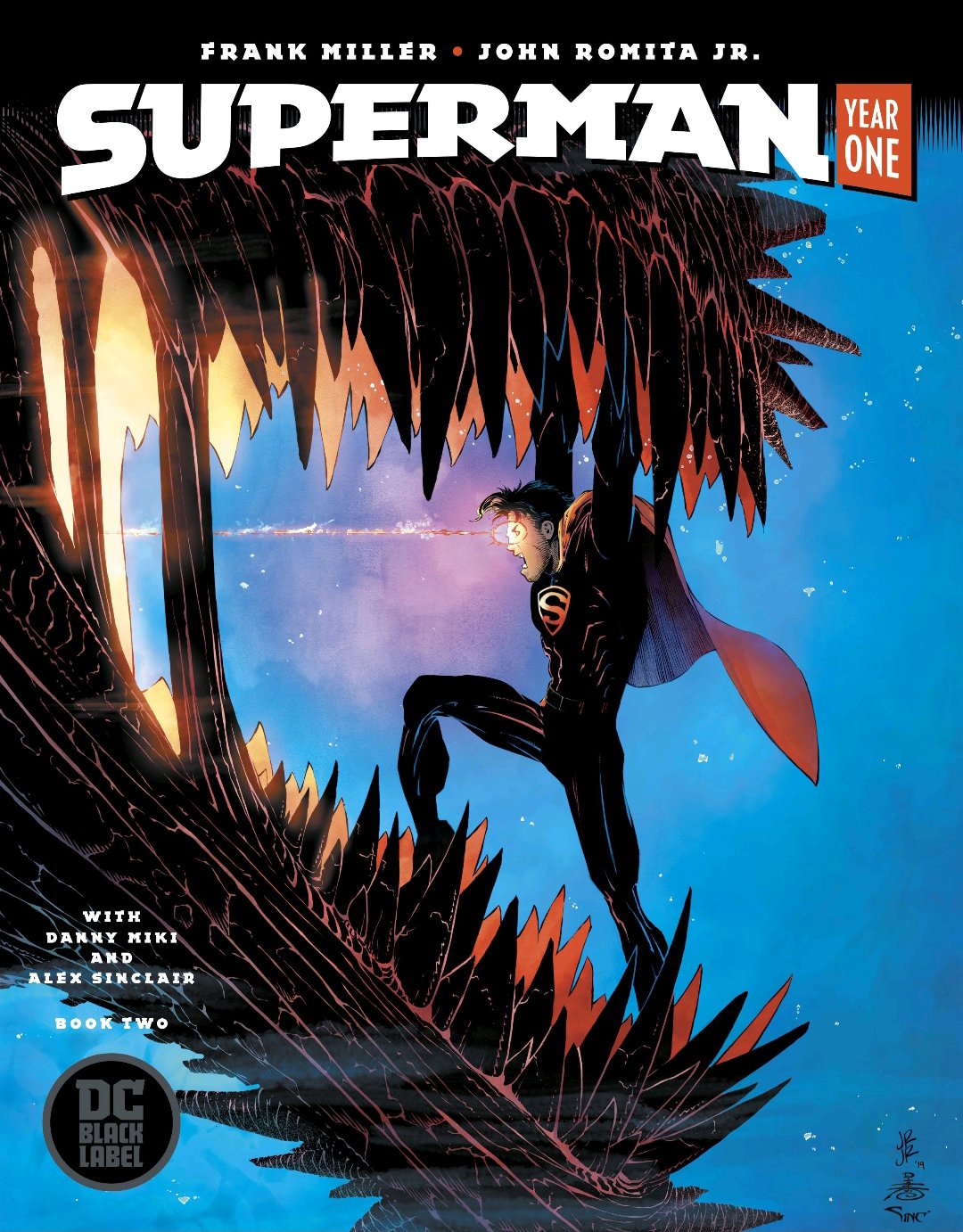
Best of this Week: Superman: Year One – Book Two – Frank Miller, John Romita Jr., Danny Miki, Alex Sinclair and John Workman

Superman has always stood for Truth, Justice and the American Way. 

This has never been more true (arguably) than right here in Superman: Year One, where Clark Kent becomes a US Navy Sailor. I briefly touched upon it at the end of the last issue, but this one really resonated with me in a way that no comic has in a little while. Other books have made me feel feelings of fear, disgust and elation beyond compare, but this one makes me feel the bittersweet memories of my own experience.

I remembered my first haircut, carrying my seabag across the base, marching and all of the PT (physical training) that I had to endure for those grueling two months. Clark isn’t fazed by any of it. It takes a few clippers to cut his dense hair. He breezes through the PT, noting how hard it is for everyone else to do and when he has to qualify for using a pistol, he hits the mark dead center every single shot. There were a few superstars like Clark when I was in boot camp and seeing that written and excellently drawn by John Romita Jr., made me feel something of a kinship to one of my favorite heroes.

You can see the struggle in his shipmates faces as they sweat and heave with Clark monologuing in his mind that he can hear their lungs about to burst or their legs about to give out. That shit was me. Every single PT test leaving me winded, marching at a double time… I hated every second of it. But through all of it, I felt proud. I wanted to get through, to push myself harder than I ever could. 

Clark doesn’t feel that. How could he? He’s an alien from another planet with abilities beyond compare and he could do anything he set his mind to. But what does he choose to instead? He answers the call of duty, he chooses to serve his country and his fellow man. It’s ridiculous, but at the same time absolutely commendable and inspiring. If I were to level criticism at the first two acts of this book, however, it would definitely be the lack of real feeling of camaraderie that Sailors feel together in Boot Camp. Never once do we see Clark interact with his shipmates in any meaningful way, aside from his Captain later on. The feeling of pride is there, but the friendships and relationships that come with it does leave a little bit of the story feeling hollow in favor of a less than great, but still good subplot later.

Another problem I have is… I don’t know how accurate print media and comics are allowed to be with military rank and titles, but Kurtzberg is supposed to be a Captain, but wears the insignia of a Petty Officer Second Class and Chief Petty Officer at two separate points. It’s a mildly irritating and nitpicky thing, but what can you do?

Of course, Clark’s path diverges greatly from my own. A little bit before the pistol qualification section, he gains the attention of a Captain Kurtzberg and after his perfect scores, he’s allowed to try out his skills further with an assault rifle, which he also excels at. Kurtzberg recommends him for more advanced training and soon after, he trains to become a Navy SEAL. I don’t have a singular clue as to what the SEAL lifestyle is like, but training he’s made to endure is even worse, though you wouldn’t know it from how he reacts to it all.

It’s here at SEAL training that the first seeds of the subplot, later becoming the hook of Act Three are sewn. Clark begins to hear the calling of the sea. It’s something that some deployed Sailors still feel to this day, the Siren Song or Mermaid Call that drives most men mad with how beautiful their voices are. Kurtzberg calls Clark out during one evening of PT and makes him to push ups on the shore of the beach after Clark tells him that the Captain should see how pretty “they” are. Unable to sleep during the night, Clark sneaks out of his barracks to watch the beings on the coast when Kurtzber appears next to him, warning him to not tell anyone about what they’ve seen as Kurzberg too knows of their beauty and the world of wonders that they live in. 

If you’ve been reading Superman stories for a long period of time, things may start to click as what or who may be calling Clark. After our hero accidentally starts a bar fight while trying to defend the honor of a woman, he’s punished by having to use his toothbrush to clean the head (bathroom) and garbage cans. After finishing his chores way into the night, he makes a dummy in his rack (bed) and sets off to explore the sea, taking to the water like a fish since he doesn’t actually need oxygen. 

He follows the sounds of the voices calling and finally see them, Mermaids, laughing at this strange human. One in particular catches his eye, Lori Lemaris, one of Superman’s original love interests from the late 1950s. He follows her as she laughs, until her voice turns to tears, seeing a submarine having crashed into their city. In one of his first of many acts of heroism, Clark lifts the sub off of the city, saves the people and helps them rebuild just before Morning Colors. Lori begs him to stay, to become her husband and King, but he tells her that the people up there need him, but that he will be back. As always, Clark is torn between two worlds, but his first thought is always to honor his commitments because he’s such a good guy.

Romita Jrs art shines best in these few pages for me. Lori is absolutely beautiful, playful and the visuals of the underside of the ocean are stunning. Everything’s a beautiful hue of blue except for the vegetation and Lori, who’s colored with yellow and purple clothing. Clark looks amazingly strong and happily curious as he saves the people of Atlantis. Romita Jrs. lines are amazingly crisp and he makes great use of only a few hatch lines to shade things. Everything is thoroughly enjoyable to look at, even the way that everything flows under the water is awesome.

Clark manages to return back to the barracks just in time as Kurtzberg watches on, knowing where Clark’s been and thinking to himself that the young SEAL better keep those memories clean and pure because he’s witnessed something amazing. He swam with the angels. There’s a three page long training montage where Clark shows just how efficient he can be in combat, embarrassing one of his shipmates so hard that he’s pulled aside and given his first assignment.

Things take a dark turn as Clark and his team are made to infiltrate a ship that’s been hijacked by pirates. During the training, as Clark thought to himself just how easy it would be to kill, he started to get a pit in his stomach. Things weren’t sitting right, especially as Kurtzberg egged him on by saying, “That there is how to kill a man good!” This stuck with Clark as he did his bet to avoid killing any of the hijackers. He saw how monstrously they murdered the crew of the ship and he felt himself getting more angry, but he still couldn’t bring himself to take a life. 

Things reach a head as the team reaches the control deck and Clark still refuses to kill any of the enemies. Kurtzberg lambasts Clark and orders to give him some corpses, until one of the hijackers pulls out a grenade. Everyone starts to panic as the mission goes FUBAR, but Clark utilizes his strength to stop the grenade, subtly, making it seem like it was a dud. 

While he ended up saving the lives of his fellowsailors, his reckless actions reward him with an honorable discharge. Kurtzberg advocates for him, but ultimately Clark has to pack his sea bag and say goodbye to his friends. Before he departs, he has something of a heart to heart with Kurtzberg. The Captain tells him to hone his skills, that he could do amazing things with his gifts and Clark salutes him, walking into the ocean to find his destiny.

The way this scene is framed, with the lighting indicating an early morning, makes everything seem like the future is absolutely bright for Clark. Having Kurtzberg abandon his badass attitude of authority and strength to give Clark advice while shaking his hand like a man is an amazing and heartfelt sight. For the first time, Clark doesn’t have to try to lower his strength, it just comes naturally.

All of this is bittersweet. Clark Kent wanted something different than his life in Smallville. He knew that he would have to hide his abilities if he stayed, he knew that he could do so much more for the world. He chose to serve his country, one of the best things a Patriot can do, but his heart was too good for it. His skill and power raised him to a position that did not align with his own moral code. Clark would never kill, but no good deed goes unpunished.

The third and final act of this book comes with Clark returning to Atlantis, seeking out his new love, Lori. She reacts happily once she sees him again, calling him the love of her life and saying that he should meet her family. Then they… frolic in their special hiding place until the next day. She tells him to wear his best as he is to finally meet her father, Lord Poseidon. He emerges from the shadows in his iconic red and blue with fish swimming all around him and the flora lighting up in his presence. 

Poseidon isn’t amused, seeing Clark as a little standing frog and proceeds to put Clark through impossible tasks to win his daughters hand. Clark begins to find the true scope of his powers as he concentrates and releases his heat vision on one of the enemies. It’s a stellar display of power and control as Clark monologues that this fire inside of him was his and his alone. Alex Sinclair did an amazing job of portraying the ability and powerful it is with intense and vibrant reds.

Poseidon pulls out every stop that he can to try and crush Superman. He sends his best warriors, but Clark doesn’t even acknowledge them trying to crush him. Stone automatons fall to his might. A giant squid swallows him whole and vomits him back up, unfettered by the stomach acid. Becoming increasingly enraged, Poseidon summons the Kraken and uses the fabled beast to try and crush Superman to death. 

As the tentacle lifts and Lori cries, thinking her one true love has died, Clark stands right back up with a smile. Lori jumps for joy, the people are stunned and in a silent rage, Poseidon calls off the Kraken and plots revenge on the frog that he couldn’t crush.

Throughout this entire act, Poseidon monologues to himself about the bug that wouldn’t be crushed or burned or destroyed in any way. Clark just smiled, snickered and mocked Poseidon the entire time. There was no malice in his smirk, just the boyish exuberance of love and youth. Poseidon though Clark wanted his crown, but really he just wanted Lori, a place to finally be himself and a peace of mind that he’s never truly had.

Superman: Year One has been amazing thus far. While it’s only a few peoples take on what would happen if Superman joined the military, I feel like it’s a great and accurate one in line with who Superman would be as a man. Given the lessons that he’d learned from Pa Kent, how could we expect him to be ready to kill at any moment? Instead, we see his compassion for humanity shine through as he’s even willing to preserve the lives of absolute monsters. 

John Romita Jr. captures the apathy of an effortless Clark in his early career, the wonder when hears the beautiful call of love from the sea and the conflict of a man caught between duty and morality. To say that this is some of his best art in years would be an understatement when it concerns this entire story. While the last issue focused heavily on the vast normality of the midwestern United States, this issue feels more tight and focused on the inner turmoil of Superman. The locales feel more linear, allowing us to explore more of Clark’s own inner thought processes. He is surrounded by other strong men, but he is in a league of his own until he meets Lori.

Superman: Year One is a great journey of self-discovery. Other Superman stories have tried similar themes with varying degrees of success. Superman: Earth One went in the hard direction of Superman being an apathetic douche that knows he’s a God and lowers himself to the level of men until someone bigger makes him want to protect the citizens of Earth. Superman: American Alien grounded Superman near as much as this book does, but what makes them different is the journey Clark takes to find himself.

This book warmed my heart something fierce with it’s incredible storytelling and art. With issue two being this good, I can only hope that the next one will be nearly as amazing. Given that the preview of the next one shows Superman holding up the Daily Planet globe, we are absolutely going to be in for a treat. 

Highest of recommends.

Best of DC: Week of July 31st, 2019

Best of this Week: Batman: Last Knight on Earth #2 – Scott Snyder, Greg Capullo, Jonathan Glapion, FCO Plascencia and Tom Napolitano

The last case Batman will ever solve, might just be his most terrifying.

Beginning with Batman confronting an older Joe Chill in the past over the dead child in Crime Alley that looks eerily similar to Bruce. Our hero kind of surprises and disarms him by removing all of the weapons he’s hidden around his apartment. Chill seems to have been expecting him, preparing what he calls an “end of an era feast” for Bruce, implying he knows his identity. To make matters even more interesting, he insinuates that he didn’t even kill the Waynes for Marth pearls and makes it seem like there was an even larger plan afoot than anyone realized.

Cutting back to the Nightmare future, Batman and Joker’s Head are taken by surprise as a Speed Force Storm tears through the desert. Never let it be said that Greg Capullo hasn’t been improving his skills at body horror because the tornado is terrifying. Consisting of the constantly shifting, twisting and stretched bodies of Barry Allen, Bart Allen, Jay Garrick and possibly others, the faces scream and cry for Bruce to help them. It’s a shocking and unsettling sight as one can almost hear the deafening cries of atom splitting agony that they’re going through. The deep red of the storm doesn’t help as it just makes things FAR more threatening than they need to be. Bruce and Joker sit in a cave for safety while Bruce laments that there is absolutely nothing that he can do to save them.

The pair continue on, hang gliding through the air, crossing over a base named Fort Waller. Joker tells Batman that originally it was the last bastion of hope, where Mr. Terrific, Dr. Sivana, Ivo and others could combine their knowledge with the powers of the new avatars of the Green and Red to repel those incensed by Luthor. Batman asks him what happens and Joker’s narration ends as they watch the battle. Unknown Soldiers fighting abominations of the Red in a hellish battle of blood and fire until a Swamp Thing appears from the crimson dust of their fight, no longer appearing to have any faculties or emotion other than: KILL.

The tone shifts as they reach an area known as the Plains of Solitude, seeming a mass of crystalline structures similar to Superman’s secret base. The cool blues of this area offer something of a safety in a book that has otherwise been overbearingly tense since it began. It doesn’t help that Joker’s been doing variations of “can I be Robin, are we there yet, and knock knock jokes the entire time. Bruce snaps that he could never be Robin because Robin was a good guy and who in this world was still like that? Pods shaped like Superman’s baby rocket start landing close to Bruce and Joker before the pair are saved by… Superman?

Or so we think, this “very talkative” (end sarcasm) Superman leads the pair to a farmhouse in the middle of the plains where a surprisingly alive and potentially insane Lex Luthor greets them. Batman, furious at the state of this world demands to know what happened, what did Luthor do? Luthor answers that he had a debate with Superman. What makes this so interesting is that, Luthor says that he knows that he should have lost. The stakes were such that, the loser would be impaled by spike of Kryptonite and Luthor, having almost crapped himself a speech mostly using platitudes from others in his own words, didn’t hold a candle to Ka-El… but in the end, Superman ends up skewered and the world goes to hell with him.

It begs the question of, what happened? Did all of the people just side with Luthor on impulse? Did something happen to sway them or was someone else manipulating things? Everything is speculation. Things are cut short, however as Bane and Scarecrow show up to punish Luthor and bring Batman to their new God, Omega. Bane appears to be absolutely rotting with venom as his veins are green and his skin is pale. Scarecrow looks absolutely scraggly with long, gnarled fingers with syringes at the end of his fingers. Scarecrow has poisoned the Superman clone and forces him to try and break the Bat.

Suddenly, as Superman lifts Batman above his head, a sword pierces his chest as it’s revealed that Wonder Woman has returned to save the Caped Crusader. The two are told to run away by Luthor, to save the world as he opens a portal for them and is summarily torn apart by other infected Superman Clones. 

We see the full extent of the utter destruction Luthor’s actions have caused as they land on the cloak of The Spectre. Wonder Woman tells Batman that the fighting eventually spilled over and destroyed both Heaven and Hell. It only makes sense, doesn’t it? The forces of magic are very powerful in the DC Universe. How much trouble would it take for a Mordru or Neron to tangle with Doctor Fate or Zatanna, culminating in the ruination of the afterlife, damning everyone to a non-existence at the end of everything?

They enter the cloak and take a ride down the River Styx. Diana tells Bruce that the voices of the dead will be calling out to him for sending them there. Capullo stuns with a double page spread of many of DCs biggest heroes, showing Batman the sheer weight of what his as-of-yet unknown role in Luthor’s scheme was. There are far too many to name, but I will say that I appreciate Capullo putting Kyle Rayner among those in the front. His deaths in many alt-stories will always irk me, but I do like seeing him recognized and put higher than Hal Jordan or even John Stewart.

Things take an even darker turn as Alfred shows up among the dead and Batman almost climbs out of the little boat, knowing that he just saw Alfred not too long ago and he and Wonder Woman make it to the real Gotham City with a cliffhanger and a surprising reveal at the end.

Last Knight on Earth pulls no punches when it comes to depicting a desolate world where Doom wins. I want to say that it’s almost dour to the point of being almost being hopeless and that’s exactly what I love. I adore how much is being packed into this story, how many references to the greater DC universe we’re getting. Capullo’s art is probably the best it has been in years and the quality of the writing is right on part with Dark Knights: Metal. It’s a righteous trip as Batman lugs the annoying head of the Joker around like a planet hopping adventure. It’s really fun and very dark.