Best of DC: Week of February 26th, 2020

Best of this Week: Batman: Curse of the White Knight Book Seven – Sean Murphy, Matt Hollingsworth and AndWorld Design
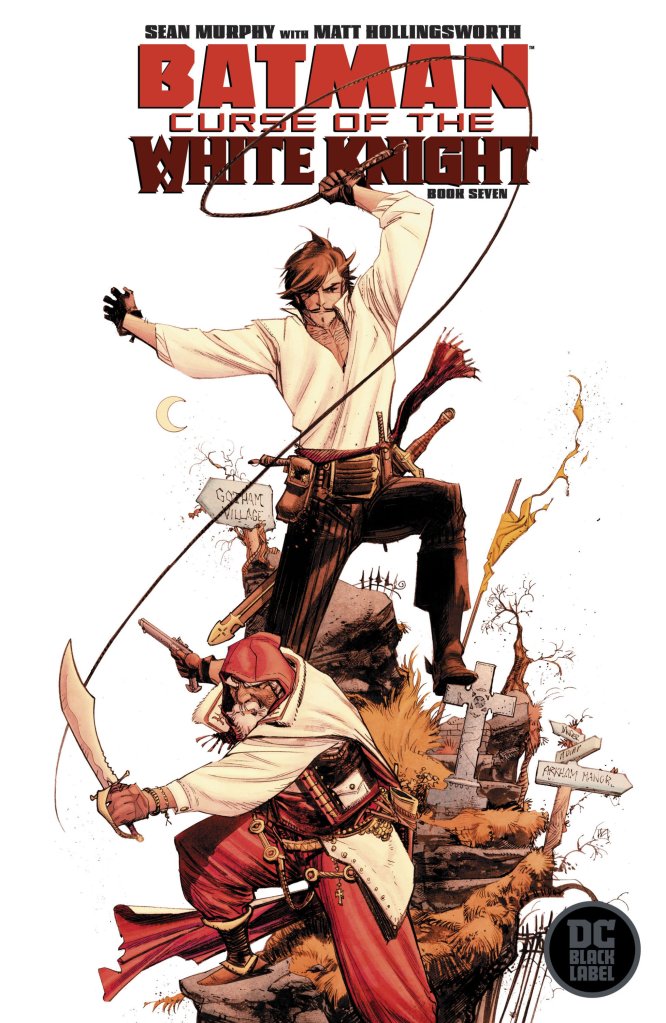
Batman is Dead.

The last issue of Curse of the White Knight gave us the last in the story of Edmond Wayne and revealed that the man that Bruce thought was his ancestor, turned out to have been the family to Jean-Paul Valley instead. Bakkar of the Order of St. Dumas killed Edmond after betraying and stealing Gotham from under him, thus assuming the name of Wayne and forming the city to his vision. With this newfound information, Batman has found himself a man with a lineage of thievery, especially after finding out that Gotham’s Elite have been funding their crime through Wayne Enterprises.

This issue begins with a somber flashback to a moment before the funeral of the Waynes. Bruce cries and blames himself for their deaths because he wanted to see The Mask of Zorro. He had always wanted to use the rapiers that his father kept on display and figured if he learned to use them from the movie, then he would be able to impress his father enough. Alfred, always so caring, tells him that if he’s able to go to the funeral, then he can hold a rapier. He then vows to teach young Bruce how to use it for the next danger he may face.
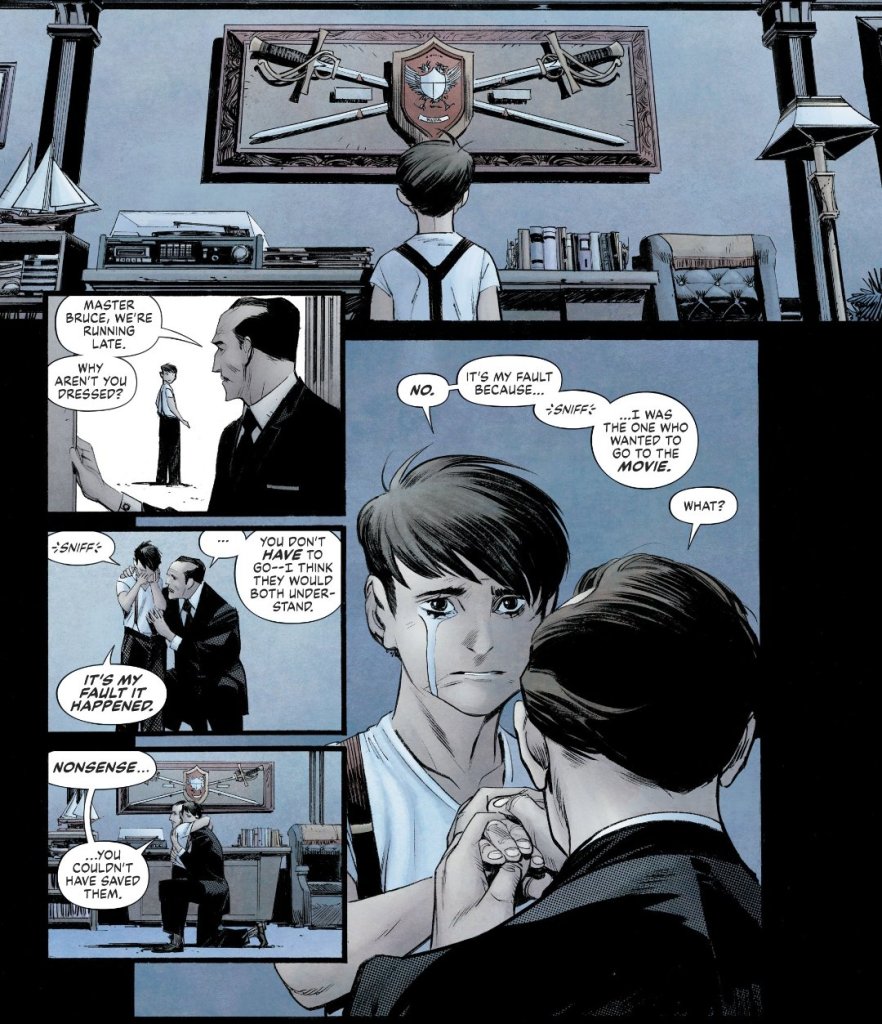
Matt Hollingsworth colors this flashback in a cool blue hue, emphasizing both the sadness and the hopefulness of the moment. Murphy portrays Alfred as being caring and shows that even with the tears, Bruce shows his ability to rise up and become the hero that people need. Though the rapier is far too large for his kid body, Bruce holds it firm in hopes of protecting Gotham in the future.

As we cut back to the modern day, Bruce faith in himself and his dreams of becoming Gotham’s knight are shaken. He was never a Wayne by blood and he sees himself as part of Gotham’s cuse. Many would be right to see him as such given Gotham’s crime initially started off as petty stuff and eventually escalated into battles with The Joker, Two-Face and others with Gotham being caught in the crossfire every time. He didn’t even know that his company was being used by criminals because of his singular focus on fighting crime.

Murphy draws Batman as being tired and ashamed of himself for only just now understanding Jack Napier’s vision and why Batman is just as bad for Gotham as The Joker was. His expressions are melancholic, Murphy makes excellent use of shadow to try to hide some of his shame and body language to make him look like an old man that’s been sitting on a lawn chair for eighty hard years. Harleen Quinzel acts as his voice of reason during his pity party and actually shows concern for him.

Hareen has been a central character in this world since the very first issue of the original White Knight and that doesn’t change here though her own personal arc is over. The last issue saw her do her best to bring Jack Napier out of Joker’s mind for one last time for information and to save her children. In the end, she had to shoot Joker in the head to let Jack rest and rid herself of the monster that had been plaguing her for years. She still finds herself at Batman’s side as one of his most trusted friends.

Bruce still has one thing that he can do to make sure that Jean-Paul doesn’t get away with his crimes and Harley convinces him that Gotham will forgive his transgressions like they did for the former Joker in Napier. At the same time, Azrael is still out there and Murphy and Hollingsworth give readers an AMAZING shot of the villain in his updated Knightfall costume. He grabs onto the nds of his cape s he soars backwards into his hideout. The lights of the city contrast with his blacks, yellows and blues to just give us a pretty damn good shot of how powerful he feels in the suit.

This is contrasted by the next few set of panels where he’s puking out of his mask after escaping from the GTO (Gotham Task Oppression Unit). This version of Azrael has been diagnosed with terminal cancer and as such needs medicine to live and suppress the symptoms. With little dialogue and some telling panels, we see that Azrael has empty bottle after empty bottle of pills in his cabinet. He’s starting to look a bit more gaunt than the first time we saw him. He’s withering away slowly and only has one more pill to spar for his coming battle with Batman.
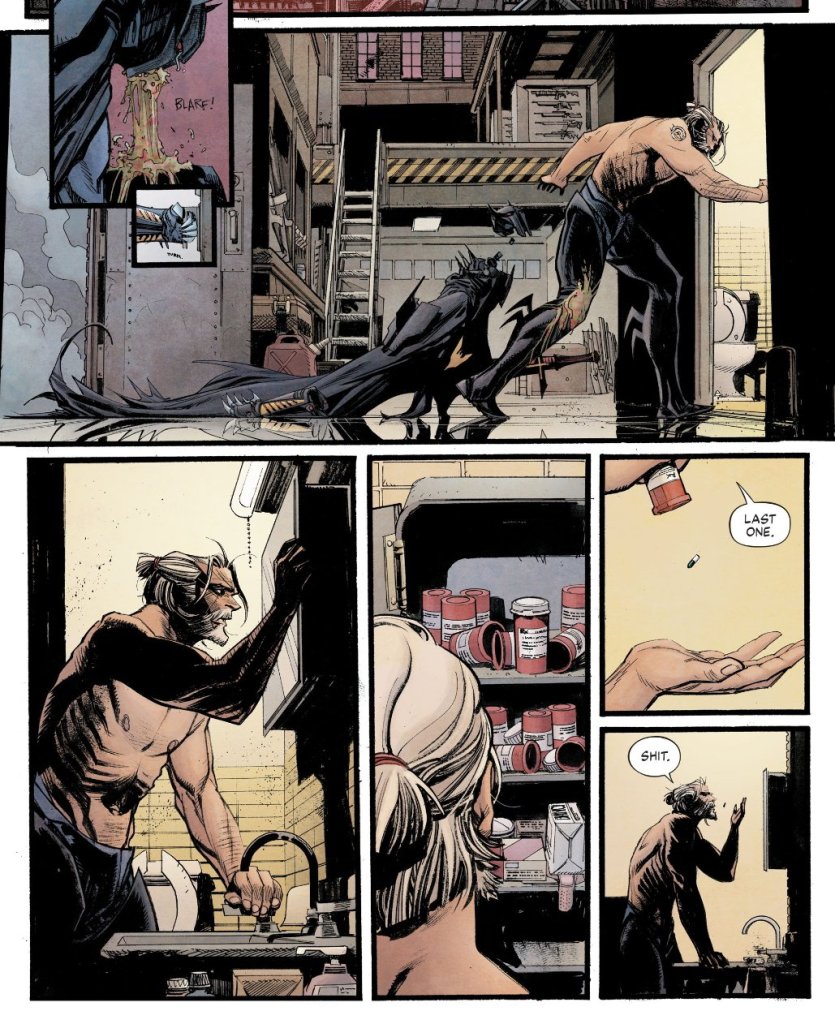
I love the details that Murphy and Hollingworth add here. There’s blood in his vomit and it maintains after he pukes on his leg. His ribs are starting to show and we’ve seen just how jacked he was in the issues prior. His hair doesn’t appear as long as it did, even pulled into a bun/ponytail and there’s just something so final about the “shit” he gives after finding out that he only has one more pill left. In that singular moment, his mistakes come back to haunt him after killing his, admittedly, treacherous employer.

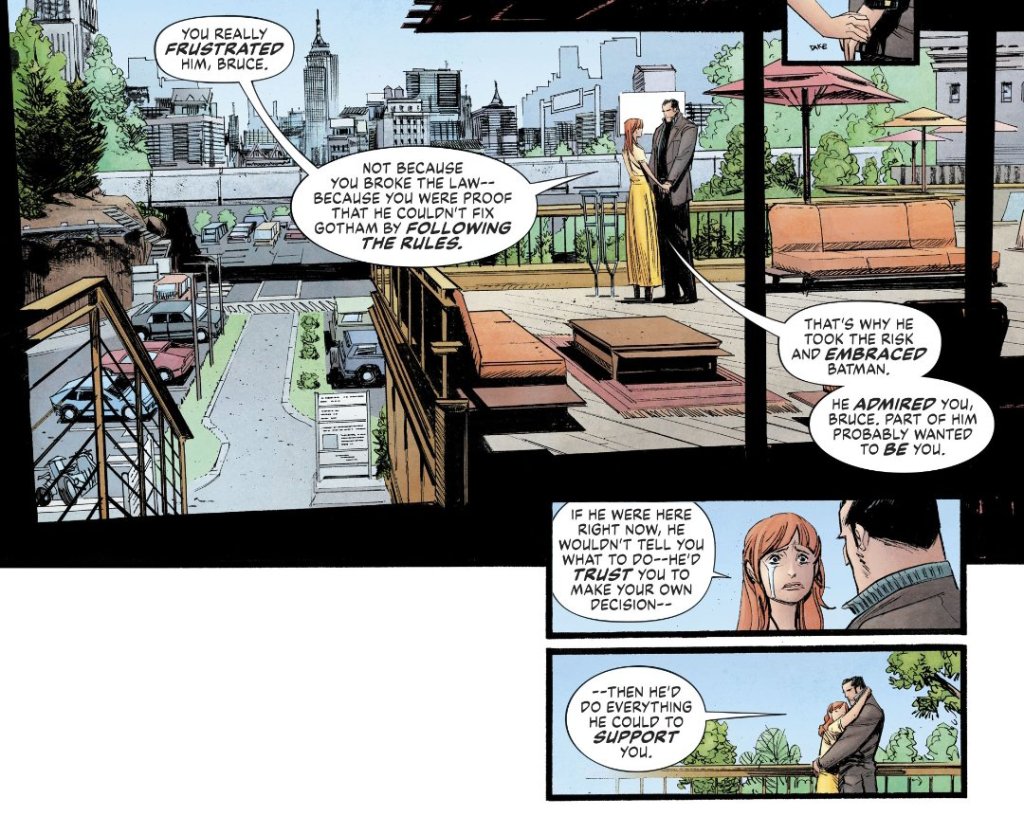
Soon after, Bruce makes amends to Barbara Gordon after inadvertently causing the accident that almost saw her completely lose use of her legs and effectively getting her dad killed. Barbara has always been resilient and we all feared that that issue #5 would be yet another Killing Joke, but here she is, using crutches to try walking again. The scene takes place during the bright Gotham day and this signals a brighter future for their relationship.

Bruce had always gone to Jim Gordon for advice on what route he should take, but without him, Bruce is missing one of his moral compasses. Barbara is the next best person because she has always been smarter than her father and Bruce has a ton of guilt to get off of his chest and Barbara handles everything like the mature adult that she is. She doesn’t blame Bruce for what happened, even though she said horrid things in anger, but can anyone blame her? She cries at the mention of her father and embraces Bruce, encouraging whatever his decision may be.
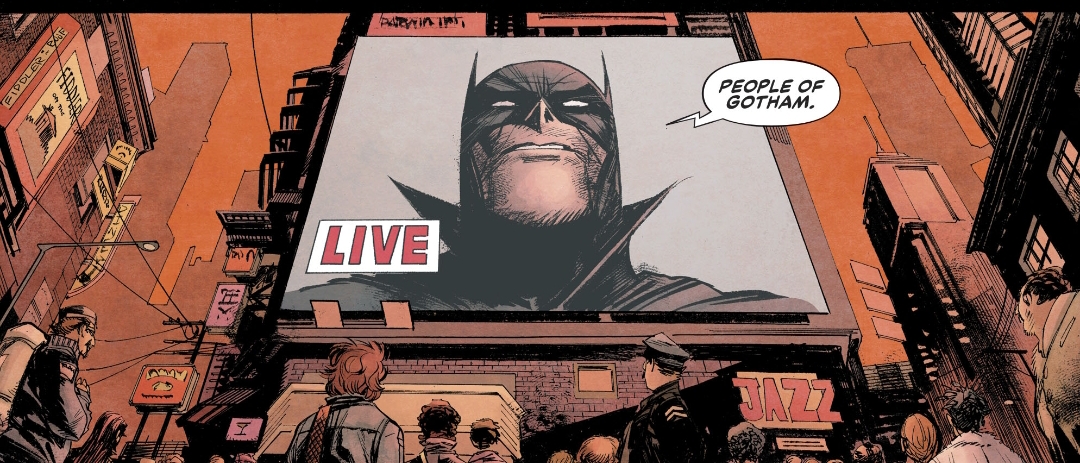
Of course, with this being the penultimate issue in this particular storyline, it only makes sense that we see a grand revelation come out of it. Murphy and Hollingsworth set the stage with Hollingsworth coloring the afternoon skies of Gotham with an orange-red kind of hue. We see various shots of different places in Gotham from public libraries to the streets themselves as Batman appears on the giant monitor of Gotham Square. Everything feels hot and sort of uncomfortable.

Bruce gives his appreciation and thanks to the people of Gotham for allowing him to serve as their protector and we continue to get these various shots of people. There’s auto mechanics watching the broadcast in their shop, people in a bar and kids watching on a cell phone with their dog. Murphy uses this to illustrate that Gotham is far larger than we think it is and that there are many people that Batman has saved from every corner of his beloved city, but he hasn’t done enough yet. So what’s the final step?

Batman reveals himself to be Bruce Wayne and dismantles WayneCorp.

Bruce finally becomes the knight that Gotham needs by giving back to the people. By destroying his company, he gives back to the people of Gotham by giving all of his money to nonprofits, schools, homeless shelters etc. It’s everything that Batman detractors have been saying Bruce should have done for ages. In doing so, he offers Gotham a better future than he could have as Batman, but he only asks them to stay off the streets of Gotham for one night while he takes care of the Azrael business. Murphy shows Bruce holding his cowl one last time, standing tall by his heroic decision.

Back at the GCPD, he gets lambasted by Commissioner Montoya for going off and doing his own thing again, but counters by saying that he trusts in the people of Gotham and they all formulate their battle plans. It’ll be his last time taking the reigns before he turns himself in as well, so he might as well make sure that everything goes according to plan.

As Montoya tells Batman that Azrael destroyed most of the other Batmobiles in his assault on bruce in Book Four (I think), she reveals that one survived and I see that Sean Murphy is a Batfan after my own heart. The Batmobile that survives is the badass one from the Animated Series, what this book is supposed to be the “sequel” to. It’s sleek and well designed thanks to Murphy’s own love of cars. From the presentation, readers can tell that this is one of the pages he took serious time with as the Batmobile is given so much respect.
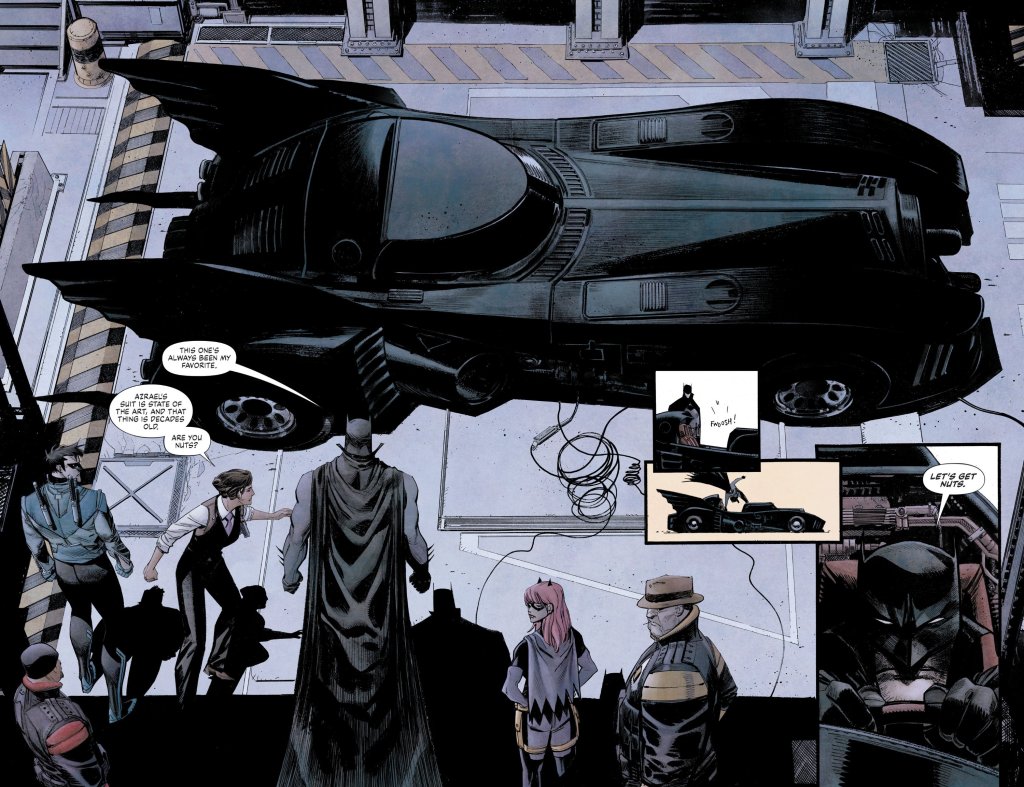
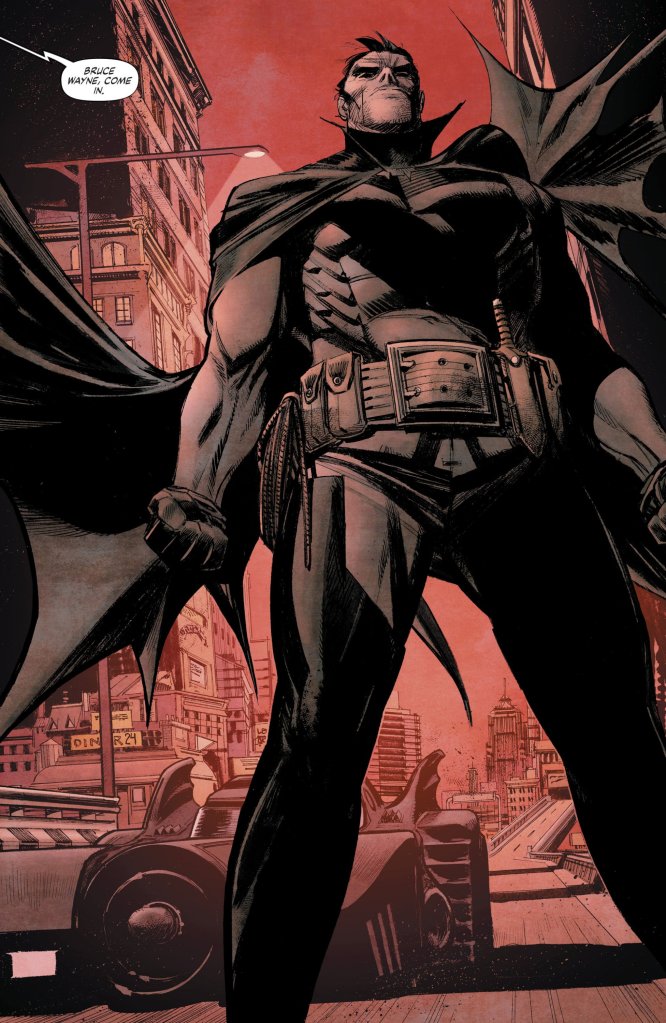
After a short conversation with Dick about what Bruce is going to do when he catches Azrael, Batman drives away, leaving his sidekicks concerned about his state of mind and we get one last splash page of Batman standing in the middle of Gotham Square without his cowl and the sky is a blood red. The Batmobile looks sexy in the background and this was all just so amazing.

Sean Murphy is a comic book treasure. His art and his writing truly made this an experience and a Batman story worth standing the test of time. It had the action, the drama, the stylish sequences and several twists and turns that make a story great. He’s made Batman his own in a grungy style much like how Scott Snyder and Greg Capullo have in a heavy metal manner. Murphy’s Gotham is a masterpiece in crustpunk with social problems that Batman’s always had in the periphery of his character and every issue has been better than the last.

Matt Hollingsworth brings it to life with his perfect colors; Whether they’re making use of the blues of Gotham’s clear skies or the light purples of the night sky, Hollingworth makes Gotham look distinct no matter the time of day. Scenes are given hues to match the tone of the pages whether they’re full of intense anger or incredible sadness, Matt Hollingsworth sets the mood no matter what.
I really enjoyed this series, but I can’t wait for the next and final issue of it just to see that confrontation between Batman and Azrael. It’s been a long time coming and the fallout from Bruce’s decision as well… it’ll be too much, but yeah High recommend!

Best of DC: Week of September 25th, 2019

Best of this Week: Harleen #1 – Stjepan Šejić and Gabriela Downie

Hindsight is 20/20.

Looking back through the history of Harley Quinn, you’d be a fool to think that she hasn’t taken a strong look back at her life before she became the psychotic Clown Princess of Crime at The Joker’s side. We’ve seen the story told many a time in movies, comics and cartoons, but there’s just something so inviting about the way Šejić presented this absolutely tragic origin story, at least for the first issue. As Harleen describes it, “it felt like one of those cheesy romance novels.”

Harleen separates itself from the other Harley Quinn origin stories by taking that cheesy romance and turning it into a long form car wreck centered entirely around Dr. Quinzel’s point of view and her early interactions with The Joker and the other criminals of Arkham Asylum. If I had to level a complaint at the book, it would have to be that, at least initially, everything is quite flowery and light. To counteract that point, it makes sense for the story to be told in this manner to show the often manipulative nature of abusive relationships like Harley Quinn’s and how ultimately, they don’t end well.

The book opens with Harleen in a dream sequence taking place in a distorted Gotham City. The style here is very reminiscent of Šejić’s work on Death Vigil with dark cityscapes, many shining lights and gothic imagery throughout. Dr. Quinzel walks down a winding road, expecting the same nightmare that she’s had many times before, but there’s something different about this particular dream. Instead of being eaten by an unknown monster, she’s met with the arrival of a bat monster and a pale man with green hair that’s being attacked by him and she chooses to intervene, smiling back at the pale man as he smiles at her. With the narration of this book, it’s easy to assume that this dream sequence takes place a little while after her relationship with the Joker is fully formed as she even acknowledges that smiling back was the biggest mistake of her life.

We get a beautiful page of Joker and Harley dancing and looking happy with each other as Harley’s future transformation occurs in the panels behind them. As beautiful as these shots are, the way that Šejić draws these panels, looking like glass shattering in the background is very telling of what we’re to expect in these future issues. Things transition to a little bit before Harleen meets Joker for the first time as she interviews a veteran who tells her about his “one bad day.” He describes how he and one of his Battle Buddies had each other’s backs until the other guy got his throat slit by a woman in a local bar during their deployment. The veteran describes how he just snapped in that moment and we have something that will be called back to in later pages.

A few years later, Doctor Quinzel presents her interview and findings to a Scientific Symposium in Gotham and it appears to be going badly. She shows her research notes and tells the crowd that the veteran then shot up a hospital full of injured kids and that her research, if implemented, would help decrease the recidivism rate of crime in Gotham by identifying what exactly made them go bad in the first place. She starts to flub her words and get nervous as some in the crowd check their watches, look disinterested or just leave altogether.

Harleen and her friend Shondra go to get drinks and talk about how the good doctor thought she nuked her presentation, they leave separately and it’s almost as if fate was just waiting to kick down the door when an explosion rings out and Harleen faces down the barrel of The Joker’s gun.

This moment is when I fell in love with this book. In a beautiful double page spread, Harleen looks on in abject horror as The Joker aims his gun directly in her face with a wide, toothy grin. The most disturbing part of this is how he’s framed as still being a sexy bad boy. He’s tall, slim with medium length hair and gives off a sickening charm. He’s very distinctly a Sějić Joker and his art style lends well to that. 

In an instant, however, he sets the entire tone for how their relationship will be in the future – threatening her life, but pulling back after seeing her face full of cold fear. In the background we see her life flash before her eyes. From her childhood of uncertain career choices, to her adulthood of being attracted to people that she’s not supposed to be, like one of her professors and eventually her current job as a criminal psychologist.

Through this we see exactly what kind of roller coaster her life had been and how, from an early age she just wanted to help people. It’s the very definition of “the road to hell is paved with good intentions” which is one of the central themes of this story.

Joker let’s her go after savoring her fear before he is stopped by the Batman. This action sequence is fairly standard Batman faire, but from Harleen’s point of view it becomes something more. She is absolutely terrified, not just because she almost died, but because she’s found herself interested and immersed in the Joker and Batman’s struggle. Everything in her mind is telling her to run away, but as Batman catches an escaping Joker and pummels the tar out of him, she follows and can’t look away.

She hears the others in the crowd and feels that there’s something wrong. The panels are arranged into a deranged smile of blood as Batman holds Joker by his collar and the sounds of his punches are replaced with the rabid howls of bloodthirst. She feels a bit of sympathy and the agony of post trauma nightmares over the next few days. After coming in to work soon after, one of her bitchy coworkers asks who she slept with to “get it,” and she soon finds out that her research has been funded by the Wayne Foundation as she is met by Lucius Fox. 

During their conversation we see more of her own pre-crisis personality come forth. Finding her nervous, insecure and initially unsure as to why she was called into her bosses office in the first place gives us perfect insight as to how the Joker will be able to manipulate her in the manner that he does. She not dumb or naive by any means, but she appears to lack a serious emotional strength. Sejic is good at writing characters like these as seen in his work on Sunstone and Switch and it gives her a good flaw in her personality.

Fox tells her that she’ll soon be transferred to Arkham Asylum to talk to the worst that Gotham has to offer and this last third of the book is rife with on the nose symbolism. As soon as she arrives at Arkham, the shadow behind her morphs from Harleen Quinzel into the form of Harley Quinn and the shadow of Arkham’s ominous gate sign becomes the perspective of someone on the inside looking out.

Within her first few days, she meets people that will be very close to her in the future such as Pamela Isley and Killer Croc to real headcases like Victor Zsasz and The Riddler. She’s also met with the disrespect of having her name mispronounced numerous times by the Arkham staff, outright dismissal of her theories by Dr. Hugo Strange and pushback from Gotham District Attorney, Harvey Dent.

Harvey in particular is most interesting because of his firmness in his ideals. He doesn’t believe there’s any rehabilitation for the residents of Arkham and that they should be sent to Blackgate Penitentiary instead. Harleen is steadfast in her beliefs that there’s more to each of these patients than simple violence and crime. Harvey notes that Arkham has a breakout rate so high that it might as well install a revolving door.

Throughout their argument, half of Harvey’s face is covered in shadow, specifically the half that would later become the deranged side of Dent’s future alter ego, Two Face. This is intriguing because in many ways this meeting feels like a shakedown, a foreshadowing of the man that he would soon become. In one instance he remarks of the beauty of Gotham City and in the next he just flat out tells her what he wants, almost threateningly while rolling his coin over his fingers. His moralizing is betrayed by his furrowed brow and eyes of fury over the sheer thought of Gotham having criminals like Zsasz freed because lawyers blame his mental illness for his horrid actions. 

Harleen, infuriated that Dent would ask her to end her research and refuse the Wayne grant so smugly, found herself driven to conduct the one interview that she had been avoiding after going through the likes of Mad Hatter, Killer Croc and The Riddler. The night before her meeting with Harvey, Harleen had gone through all of the Joker’s interview tapes. One thing that stood out to her was Joker’s propensity to retell his “troubled” past in a variety of different ways, Šejić’s own take on the Multiple Choice origin story of the Clown. She felt mildly annoyed by how underwhelming they all were until she found a tape of Joker being arrested and him speaking the way that he did the night that they first met, saying that Gotham is full of civilized monsters and all they needed was a push to send them over the edge.

Just like the veteran in the beginning.

Harley needed a full nights rest to get the courage to interview The Joker and tried a multitude of methods from horse tranquilizers, to a chiropractor, to just simple drinking, but it was Dent that gave her what she needed to go. When Joker and Harleen meet face to face again, he doesn’t recognize her until a sudden SLAM on the glass brings back her look of shock and terror, allowing the Joker to remember her. 

With their pleasantries exchanged, he asks her to refer to him as Jay and we jump into the inferno.

Stjepan Šejić is an amazing artist and writer with a knack for writing fun and silly characters. He can also delve into dak territories and themes when he needs to and while this issue is more comedic and funny, it does hide some very dark bits of story underneath. The best way to describe it would have to be…a calm before the storm. Everything in Harleen’s life is at a perfect place. She’s got the dream job that she’s wanted for her research, she’s found very interesting subjects and one in particular that might be the break that she’s been looking for. But we all know what’s on the horizon for her.

The problem I can see people having with this is the common, “this story is going to glorify the abusive relationship between Joker and Harley!” I don’t see it turning out that way. I think it’s very clear to Dr. Quinzel and the reader that The Joker is wearing a mask. His charm is an ugly façade worn to hide the monster underneath, but she just can’t turn away, especially since he’s been the subject of her dark dreams for a while.

I think that the next issue will show just how the cupcake stage of their relationship with the dark underpinnings slowly transforms her from a reasonable psychologist into a sympathetic beauty that’s found her beast. Šejić only showed us a small part of his writing and art powers and since the second issues of these Black Label books tend to be the best issues, I have no doubt that the next Harleen will be amazing. High recommend