
Best of this Week: The Dreaming #18 – Simon Spurrier, Marguerite Sauvage and Simon Bowland
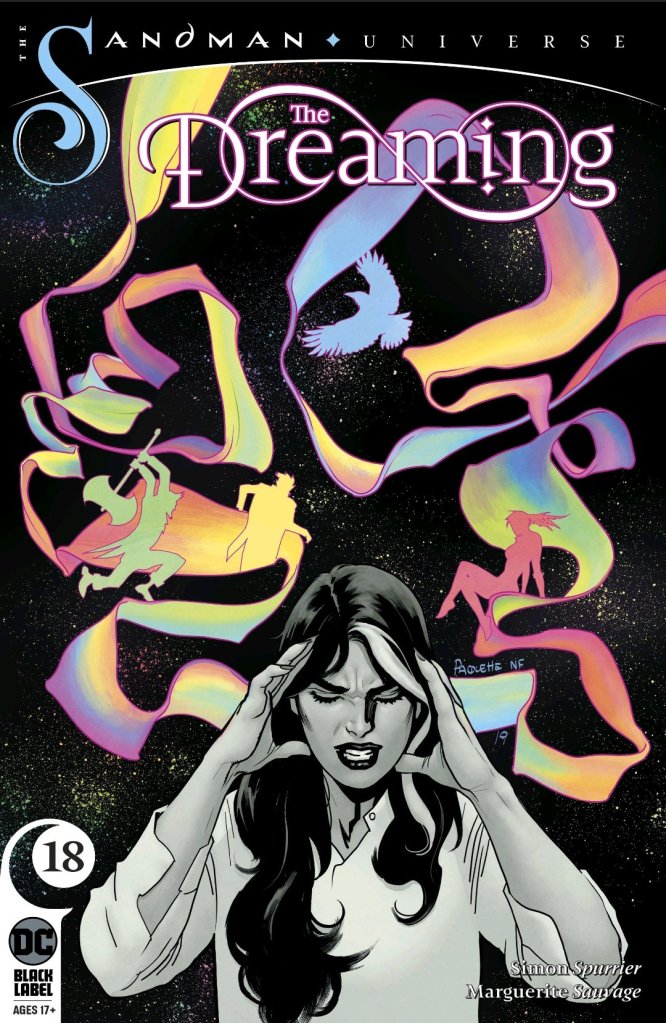
Okay, hear me out – The Dreaming has been really good since the beginning and while not on the same level as Sandman itself, Si Spurrier has done a fantastic job of contributing to this world of the fantastic and absurd with his own brand of whimsy and abject horror. I haven’t found the time to cover any of the issue because, well, there’s always been something just a bit better on the same weeks that this series released and though the normal artist, Bilquis Evely, wasn’t on the art this month, Marguerite Sauvage stepped up and provided her always stunning style.
A short-ish recap for the uninitiated, The Dreaming is a realm where all of humanity’s minds go when they sleep. It was ruled by Dream of the Endless, a being of immense power over and creator of the realm before he was succeeded by a young man named Daniel Hall. Daniel becomes Dream for a time and even appeared in Scott Snyder and Greg Cappullo’s Dark Nights: Metal, but at some point, he left the Dreaming entirely. This caused things to spin out of control until the realm lands in the hands of Wan, a moth like boy with a dark side.
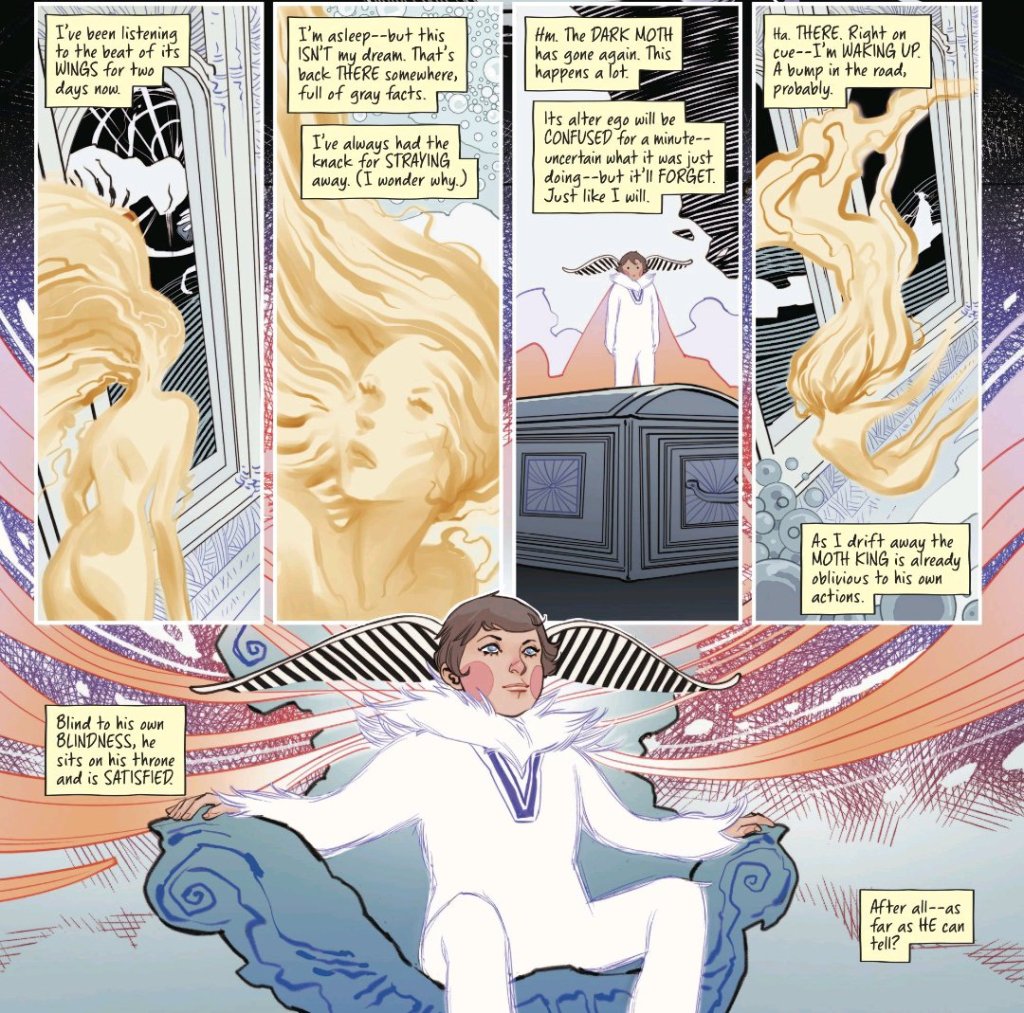
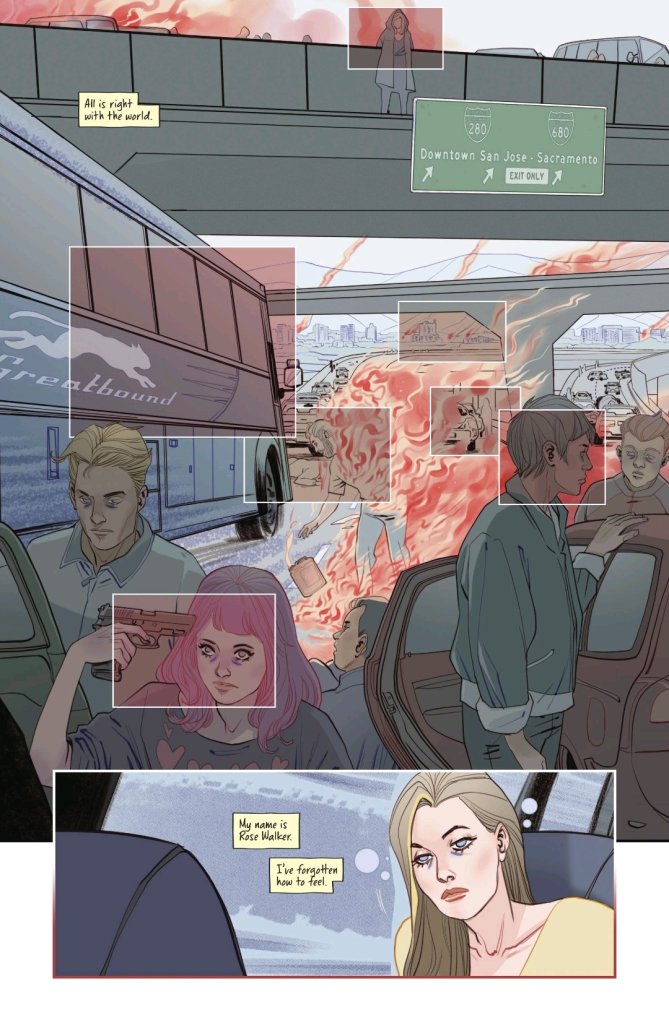
The book begins with a dream apparition of Rose Walker, a central character of the Sandman series, looking upon Wan’s Eldritch side as it releases nightmares into The Dreaming. She muses that she’s been watching him for some time now, acknowledging that when he returns to his cute moth form they both forget what had just occurred. Wan appears satisfied, thinking his rule over the Dreaming is making the world better as he’s been dispatching “blanks” into people’s dreams to make their whimsical dreams more logical instead. This has a profound effect on the world as it seems as though joy and color are lost.
Sauvage stuns with her depiction of this joyless world as people just walk around with utter lethargy and casually kill themselves. It’s absolutely disturbing to watch as a woman prepares to drop herself from an overpass, seeing another calmly hold a gun to the side of her head and a man self immolating in the background. What makes all of this especially great, however, is Sauvage’s use of soft colors to almost make the despair and horror feel unimportant. Rose walker is the only one that stands out because of her bright yellow dress and normal looking skin.
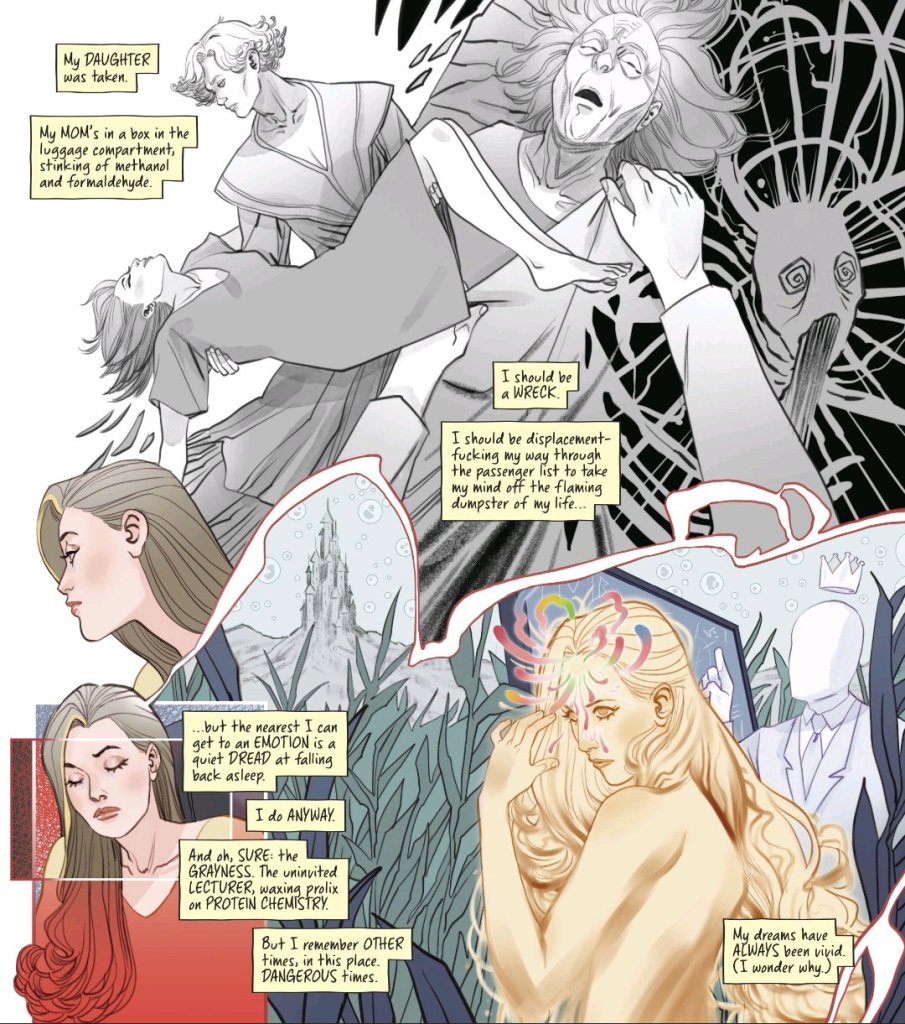
Her internal monologue allows her to see that something’s amiss and that she should be a wreck after losing her mother and daughter over the course of her personal story, but she lacks sufficient motivation to pursue any action aside from sleeping, but then she recalls how vivid her dreams always were and Sauvage portrays this excellently as an unseen figure lights a cigarette for her and she drifts into a white space filled with beautiful wisps of smoke and color. In the dream, she hears something about a Vortex that will likely play a big role later in the series.
We then cut to Dora as she watches the transferred consciousness of Cain kill the man who initially caused Dora to fear her own existence, Keter. Dora is a Night Hag that had haunted Keter in his younger years, causing him to want to figure out the secrets of the Dreaming and ultimately how to destroy it. It’s implied (or plainly stated, I forget) that he created Wan and set him upon the Dreaming in Daniel’s absence. Unfortunately for Dora, with Keter’s death there is no one able to remember her story and she starts to fade away.
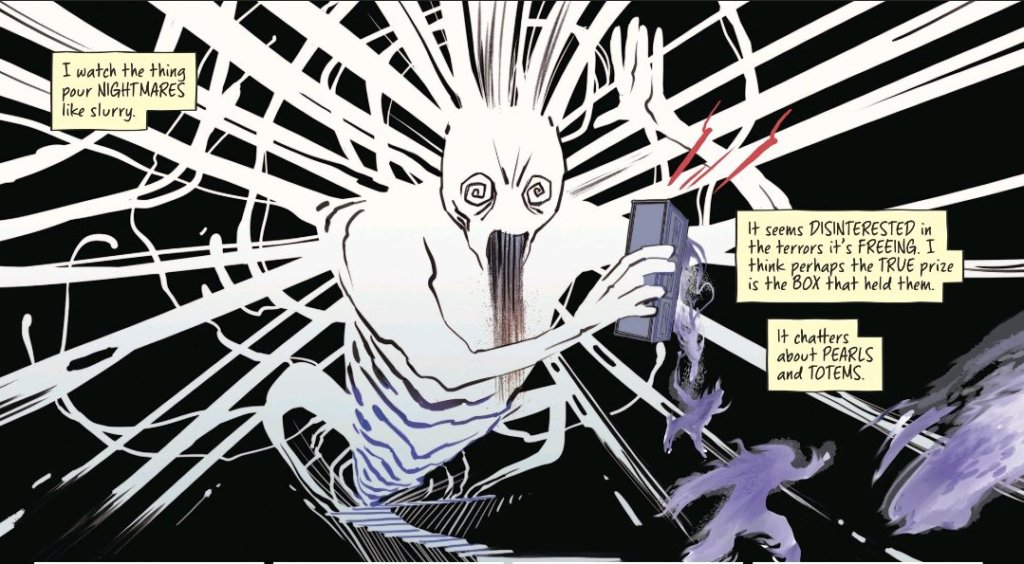
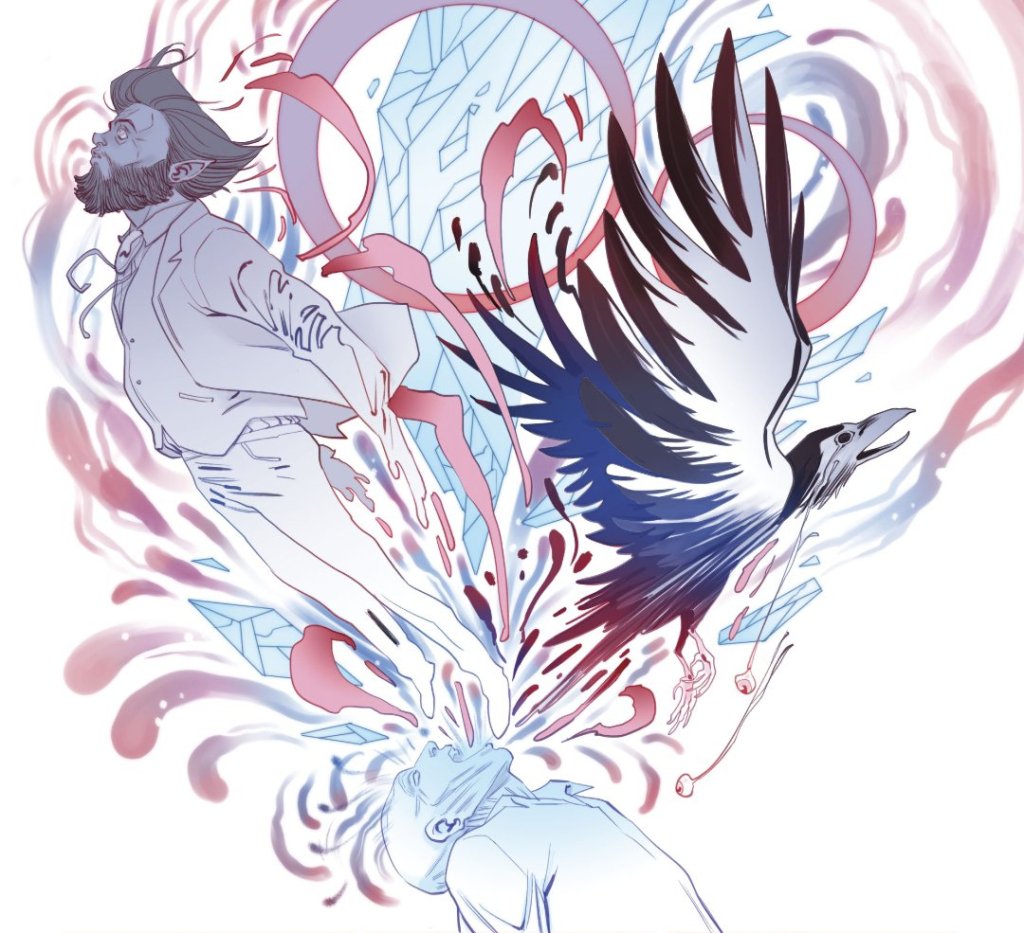
In contrast to the previous pages, Sauvage colors this scene with a deep, but not oppressive red as the facility responds to its creators impending death, giving things a sense of panic as Dora then looks puzzlingly at her translucent hands. Soon after, Keter’s body starts to convulse and a murky plume of light purple and pink pours from his mouth – the background and Keter’s body are white, with his outline and the monitor version of Cain being the only line art for this panel. Abel and Matthew (and others) then burst forth from Keter’s mouth as he finally dies.
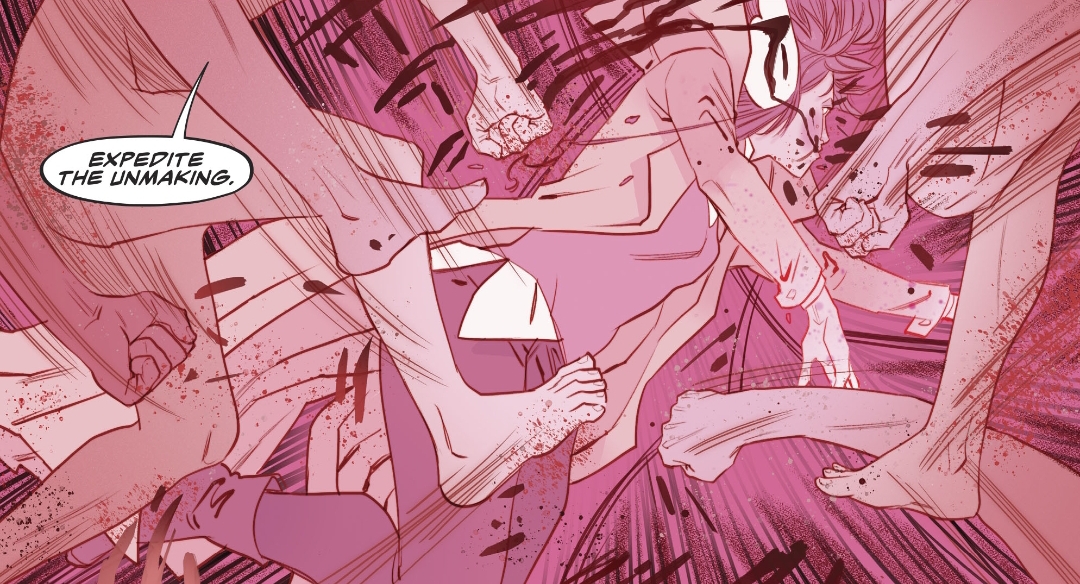
Matthew is one of the Ravens of the Dreaming and he acts as the eyes for the ruler of the Kingdom as they survey the dreams of men. Abel acts as something of an accountant of some kind, but he has been keenly aware of Wan’s other side and chose to escape the Dreaming with Matthew, but The Dark Moth sent blanks to follow them and one of those blanks just so happened to be Ziggy, Dora’s former blank companion. When Ziggy disregards his former identity, his other blanks begin to savagely beat Dora in a flood of oppressive pink colors.
Spurrier tells two tales that Sauvage portrays in nine striking and dynamic triangular panels. On the downward facing panels, Cain lambasts Abel for having the audacity to kill him, but Abel counters with the fact that Cain has killed him hundreds of thousands of times over the millenia they’ve been together. Cain looks on with rage and it only gets worse as he realizes that Abel is mostly right to call him a coward. At the same time, we continue to watch as the blanks continue to assault Dora. These panels are most uncomforting as she pleads for Ziggy to help.
Sauvage does an amazing job of showing Dora’s distress is pained and betrayed facial expressions as she bleeds and cries while a flurry of fists and feet meet her. She continues to fade and is soon dragged away by the other blanks before cut back to Rose Walker and her continued feeling of disillusionment before Spurrier reveals that the unseen figure that lit her cigarette might be the hand of her Grandmother, another being with a strong connection to the Dreaming. She manages to convince Rose to take the bus and find the color of the world again.
One subtle thing that I liked about this issue and the way Spurrier has been writing this series thus far, is the implication that things started to go horrendously wrong when Abel killed Cain and stopped stuttering as a result. Cain was always one of the smartest residents of the Dreaming and would have figured out Wan’s scheme even if Wan himself wasn’t aware of his other half, but Abel was far too nice to think about it like his brother. When Abel is finally reunited with his brother, he begins to stutter a lot more again, symbolizing a return to how things were.
In trying to convince his brother to return to the Dreaming, Abel does he one thing he needed to do make things right with Cain, he recreates his brothers murder by stabbing himself in the neck with a fork while Cain says that he will, but because he WANTS to, not because Abel asked (Cain is a tsundere confirmed).
While absolutely brutal and horrific, it’s touching at the same time because Abel does this out of love and sacrifice knowing that the world is doomed without his brother at his side. At the same time, this inspires Ziggy who goes against his order and tells the other blanks to stop the process of killing Dora because she made Ziggy who he was…
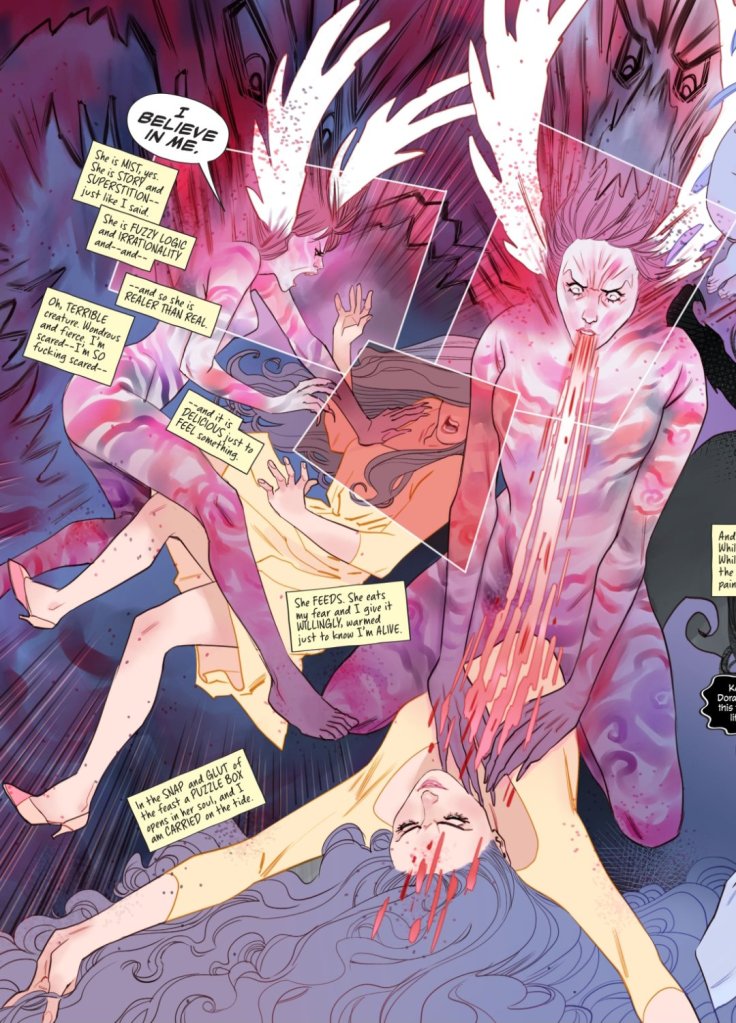
Unfortunately, his newfound sentience comes late as Dora is probably seconds from death and True Death by fading. Then suddenly a bus CRASHES through the walls and Rose emerges, feeling the dream energy drifting away from Dora. Sauvage draws their interaction together beautifully as Rose inches closer and closer to Dora, trying to feel something before whispering in her ear and bringing the Night Hag back to life.
The soft colors spring to life as Dora mounts Rose and begins to drain her fear, her ear wings turn a bright white and varied pink watercolors dance across her body as she reaffirms her belief in herself and Rose is in ecstasy of feeling again. We then learn something crucial about Dora and how all of this might have been by the original Dream’s design. At the end, not only is Dora restored, but the keeper of the Dream Library is as well.
The Dreaming is a weird story, but it always has been. One thing that I have loved about this story so far is that it doesn’t completely require you to have read all of Sandman to understand it, but it enriches the experience if you have. These characters are fully three dimensional with their own motivations, fears and thoughts that Si Spurrier has captured so well. I’m glad that he took on this story because it’s equal parts beautiful and dark like the Sandman Universe should be.
This is also in no small part thanks to how Marguerite Sauvage chose to draw, color and ink these beautiful scenes, characters and environments. Everywhere from the human world to the land of the dreaming was distinct and interesting because of backgrounds, color choice and intensity – even the use of white space was striking and amazing to look at.
I think the series is supposed to end at Issue 20, but it already feels too soon, like we need more. Of course there are the other Sandman books out like House of Secrets, Books of Magic, Lucifer and Hellblazer, but everything related to the Dreaming will always have a special place in my heart and I can absolutely say that I have enjoyed this ride thoroughly thus far. High recommend!

 Ty Talks Comics